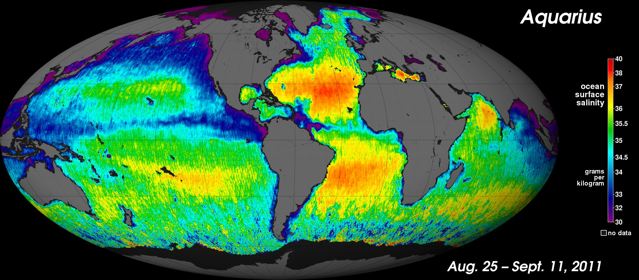
 The first global map of the salinity of Earth’s ocean surface produced by NASA’s new Aquarius observatory: red/yellow=high salinity; blue/purple=low salinity; black=no data. The Aquarius/SAC-D observatory is a collaboration between NASA and CONAE, the Argentine space agency Credit: NASA/GSFC/JPL-Caltech.The Aquarius Mission, launched in June, is making its first space observations of ocean saltiness—a key component of Earth’s climate linked to the freshwater cycle and its influence on ocean circulation. The first map (above) is a composite of the first two and a half weeks of data since Aquarius became operational on August 25 and reveals well-known salinity features: higher salinity in the subtropics; higher average salinity in the Atlantic compared to Pacific and Indian Oceans; lower salinity in rainy belts near the equator and in the North Pacific. One obvious feature: the strong differential between the arid and salty Arabian Sea to the west of the Indian subcontinent and the fresher Bay of Bengal to the east, dominated by freshwater outflow from the monsoon-fed Ganges River. An important detail: the unexpectedly large area of low-salinity water around the outflow of the Amazon River. Aquarius is already providing higher-then-expected quality data this early in the mission and should soon greatly increase our understanding of the connections between global rainfall, ocean currents, and climate.