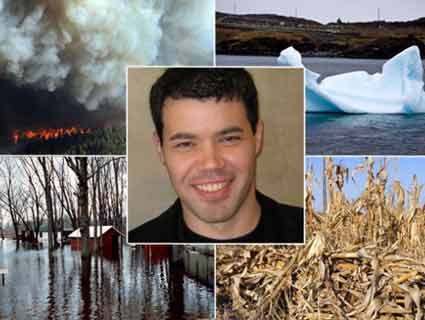
Weather forecasts predict that Snowstorm Nemo will be highly unusual in its intensity—the worst blizzard the Northeast has seen in ages. Already, thousands of flights have been canceled and people are scrambling to stock up on emergency supplies. So it might seem like now would be the perfect opportunity for the media to sound the alarm about the connection between climate change and extreme weather. But a new study finds that exactly the opposite is true: When it gets cold out, some prominent newspaper opinion writers start hammering out their next attempt to debunk global warming.
Despite overwhelming scientific consensus about the long-term phenomenon, newspaper op-ed pages are most likely to opine about how climate change isn’t real when seasonal temperatures dip. According to a new study published in Climatic Science, annual and seasonal deviations from mean temperatures can explain attitudes (both positive and negative) expressed in 2,166 opinion pieces between 1990 and 2009 in five major newspapers, the New York Times, Washington Post, Wall Street Journal, USA Today, and Houston Chronicle. (It also demonstrated that national public opinion polls aligned with temperature anomalies.)
During heat waves or temperature spikes, the percentage of newspaper columns that agreed with climate change rose. But when winters were rough or temperatures fell, the percentage of disagreement ratcheted up. Lead author and University of British Columbia climate scientist Simon Donner told Mother Jones it was difficult to explain such correlations, but he and his co-author took a stab at it, this way, in the paper:
Furthermore, editors may be more likely to write about climate change or to accept a submission on the subject during or after and [sic] anomalously warm season. Therefore, the relationship between climate variability and the opinion data may arise not solely from people viewing weather or climate anomalies as proof or disproof of climate change, but from the anomalies serving as a reminder of the issue of climate change and as “hooks” for opinion articles.
The problem with writing opinion articles supporting climate change exclusively during heat waves or slamming it during cooler seasons is that it fails to consider that the phenomenon is really “a long-term average,” Donner says. “If next decade is warmer than this decade, it doesn’t mean every day in next decade is warmer than every day in this decade. There’s still going to be variability in the system.”
If the public and newspapers are going to trust that climate change is real, even when it’s cold outside, scientists and educators also have to step up and be more vocal. “We’ve got to talk about climate change not just when there’s a good ‘hook’ to talking about it, but even you know, on unusually cold days in the summer,” Donner adds.