
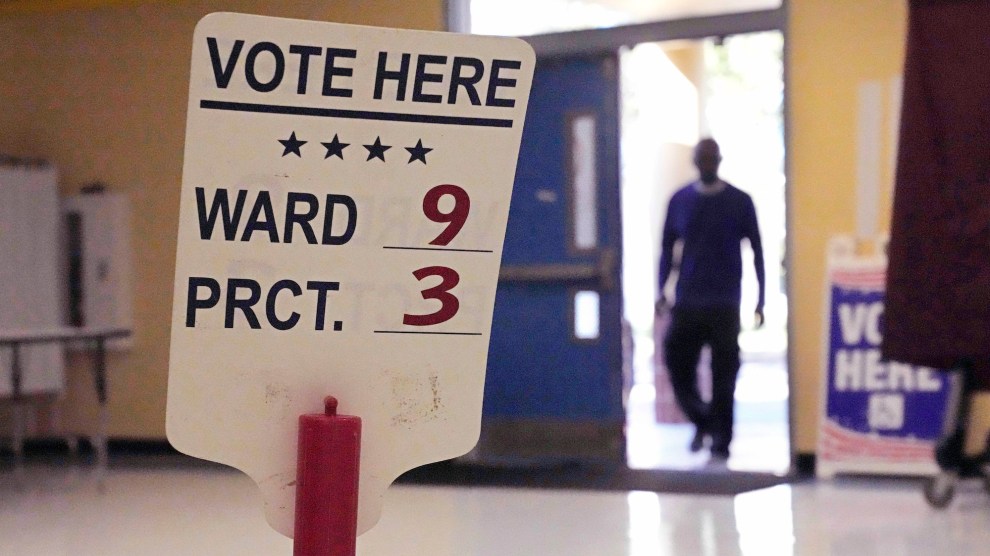
A voter enters his polling place to vote on Election Day at the Martin Luther King Elementary School in the Lower Ninth Ward of New Orleans, Nov. 8, 2022. Gerald Herbert/AP
On Wednesday, the Supreme Court allowed a lower court decision requiring a second majority-Black congressional district in Louisiana to move forward for the 2024 elections, handing down a rare victory for minority representation that also boosts Democrats chances of retaking the House of Representatives.
The case, Landry v. Callais, took a convoluted path to the high court. In June 2022, a federal district court ruled that, under the Voting Rights Act, Louisiana must create a new majority-Black district in a state where Black voters were a third of the population but held a majority in only one of the state’s six congressional districts. The Supreme Court temporarily blocked that ruling for the 2022 election, but following the Court’s decision in Allen v. Milligan in June 2023 that Alabama had to create a second majority-Black congressional district, Louisiana was ordered to do the same. The state’s Republican-controlled legislature reluctantly held a special session in January 2024 to create a new majority-Black district that favored Democrats.
A group of “non-African American” voters then challenged that map and in April a federal district court panel, with two Trump-appointed judges writing for the majority, struck it down, arguing that race was the predominant factor in drawing the district—even though Louisiana had been specifically ordered by another federal court to create the majority-Black district.
Civil rights groups and the state of Louisiana then appealed that ruling to the Supreme Court. It represented an unlikely instance when Black voters and a Republican-controlled Southern state were more or less on the same side, and also a rare example of the Supreme Court delivering a victory for minority representation, given the Court’s well-documented hostility to voting rights. That includes gutting the Voting Rights Act on multiple occasions and holding that partisan gerrymandering can’t be challenged in federal court.
However, the 6-3 decision on Wednesday was not without internal controversy. The three liberal justices dissented, not because they disagreed with the finding, but how the court reached it. The conservative supermajority invoked the Purcell principle—the idea that changes to voting rules should not be made too close to an election—to reinstate Louisiana’s map with two majority-Black districts. But the liberal justices thought the case should be decided without relying on Purcell, which has often been used by the conservative justices to overrule lower court rulings that struck down discriminatory voting laws and gerrymandered maps because they allegedly occurred too close to an election date.
As University of Texas law professor Steve Vladeck put it, “it’s a short-term win for Black voters in Louisiana, but a long-term expansion of a controversial principle for how federal courts handle election-year voting cases going forward.”


