





Erika Eichelberger

Erika Eichelberger

Reporting Fellow

Erika Eichelberger is a reporting fellow in Mother Jones' Washington bureau. She has also written for The NationThe Brooklyn Rail, and TomDispatch. Email her at eeichelberger [at] motherjones [dot] com. 

Get my RSS |

Elizabeth Warren Slams Federal Regulators Over Bank Money Laundering

| Thu Mar. 7, 2013 1:56 PM PST

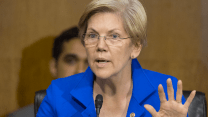
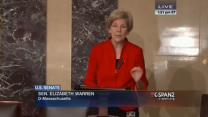
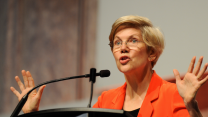
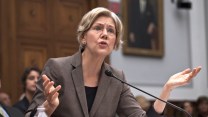
On Thursday, the Senate held a hearing to ask federal regulators why they are not stopping banks from allowing money laundering. Sen. Elizabeth Warren (D-Mass.) was the highlight of the show, slamming a Treasury official who refused to weigh in on whether the banks should face more severe penalties.

In December, the giant international bank HSBC was fined $1.9 billion for illegally allowing millions in Mexican drug trafficking money to be laundered through its accounts. But it's not just HSBC—this is a systemic problem. Ten banks have been penalized in recent years for failure to comply with anti-money laundering rules. The Senate banking committee held the hearing in order to interrogate regulators at the Federal Reserve, Treasury Department, and the Office of the Comptroller of the Currency about why they are not doing more to stop these kinds of shenanigans.

All of the regulators said they were working on improving regulations and enforcement and protested that it was up to the Department of Justice—not them—to decide whether prosecution was appropriate. (The Justice Department did not have a witness at the hearing.) They were reluctant to weigh in on whether they thought HSBC should have faced trial, even though they consult closely with the DOJ on bank activities. That infuriated Warren:

The US government takes money laundering very seriously for a good reason. And it puts strong penalties in place… It's possible to shut down a bank... Individuals can be banned from ever participating in financial services again.  And people can be sent to prison. in December, HSBC admitted to... laundering $881 million that we know of... They didn't do it just one time... They did it over and over and over again… They were caught doing it, warned not to do it, and kept right on doing it. And evidently made profits doing it. Now, HSBC paid a fine, but no individual went to trial. No individual was banned from banking and there was no hearing to consider shutting down HSBC's actives in the US.... You're the experts on money laundering. I'd like your opinion. What does it take? How many billions of dollars do you have to launder for drug lords and how many sanctions do you have to violate before someone will consider shutting down a financial institution like this?

David Cohen, the undersecretary for terrorism and financial intelligence at Treasury, responded that his department had imposed on HSBC "the largest penalties we've imposed on any financial institution."

Warren got annoyed. "I'm asking: what does it take to get you to move towards even a hearing to consider shutting down operations for money laundering?" she said.

Cohen kept evading and Warren got more annoyed. "I'm not hearing your opinion on this," she said. "What does it take even to say, 'here's where the line is'? Draw a line, and if you cross that line you're at risk for having the bank closed."

Cohen said he had views, but couldn't get into it.

"It's somewhere beyond $881 million in drug money," Warren concluded on her own, and went on to spell out the injustice of it all. "If you're caught with an ounce of cocaine, you're going to go to jail... But if you launder nearly a billion dollars for international cartels and violate sanctions you pay a fine and you go home and sleep in your own bed a night."

"How would you explain this to your neighbor?" Sen. Jeff Merkley (D-Ore.) asked, noting that the fine slapped on HSBC amounted to about one percent of its profits over 10 years. "Does that really send a message?"

The regulators reiterated they were working on improving oversight and such, but admitted that they were not doing enough. Jerome Powell, who is on the board of governors at the Federal Reserve, conceded that big banks may not only be too big to to fail, but also too big to prosecute. "Until we finish [writing the rules implementing Dodd-Frank financial reform law] I couldn't look [my neighbor] in the eye… I don't think it's fair."

Advertise on MotherJones.com

Known and Suspected Terrorists Can Buy Guns in America

| Thu Mar. 7, 2013 10:42 AM PST
bomb

Under current federal law, being a known or suspected terrorist doesn't disqualify you from buying guns and explosives. A Democratic Senator has introduced a bill that would close what he calls the "Terror Gap."

On Tuesday, Sen. Frank Lautenberg (D-NJ), reintroduced the bill—it's called the Denying Firearms and Explosives to Dangerous Terrorists Act—saying in a statement, "our gun laws have gaping holes that allow known and suspected terrorists to walk into a gun store and leave with legally purchased deadly weapons."

Right now, people on terrorism watch lists often aren't allowed to get on planes, but the federal government is has no way to stop them from buying weapons unless a background check shows they are prohibited for another reason, like if they are mentally ill, or an undocumented immigrant, or have a criminal record. Lautenberg's bill would give the Attorney General the authority to stop the sale of guns or bombs when a background check shows that the purchaser is a known or suspected terrorist, and the AG "reasonably believes" that the person may use the weapon in connection with a plot against Americans. (One problem: many people on terror watch lists are not in fact terrorists.)

According to the Government Accountability Office, people on the terror watch lists were cleared to proceed with a weapons purchase ninety-one percent of the time, a total of 1,321 times, between February 2004 and December 2010. Nidal Malik Hasan, the accused Fort Hood shooter, for example, had ties with Yemen-based cleric Anwar al-Awlaki.

"This is common-sense legislation that does not infringe on a gun-owner’s rights, and will protect our troops and our nation," the veterans group Vet Voice Foundation said in a press release in February.

Not shockingly, the bill has broad bi-partisan support in both chambers. The Bush administration endorsed the legislation. The NRA, however, opposes the measure. In 2011, the gun rights group said the bill was "aimed primarily at law-abiding American gun owners." The no-guns-for-terrorists bill has been reintroduced for years and has gone nowhere.

Lautenberg says he hopes the proposal will be included in the package of gun measures now being considered in Congress. "From attacks on Ft. Hood to Mumbai, terror plots carried out using guns and readily available explosives are more and more common," Lautenberg said, "and we must act to stop terrorists from getting these weapons and killing Americans."

The Government Still Doesn't Want You to Know What Caused the Financial Crisis

| Wed Mar. 6, 2013 10:19 AM PST

In the aftermath of the 2008 financial meltdown, the US government launched a vast investigation, but it still doesn't want you to know the details of what it found.

In January 2011, the Financial Crisis Inquiry Commission (FCIC) created by Congress put out its final report. But it only released a portion of all the source documents it scoured, so last year the government accountability group Cause of Action filed a lawsuit seeking the release of those documents, including emails, memoranda, and draft reports. Last week, the DC district court announced it was dismissing the case. But it's not over yet: COA vowed on Tuesday that it will appeal the decision. In a statement, the group said the judge's ruling that the documents were not subject to the Freedom of Information Act was "a misapplication of the law," and said that "COA will continue to fight to shed light on the workings of our government."

The FCIC was created in 2009 and given an $8 million budget and a lot of power to subpoena witnesses and documents, and give whistleblower protections to those who would come forward with information. The commission was also plagued by partisan division. Its final report in 2011 faulted failures in financial regulation, excessive borrowing, a lack of transparency, and risky investments, among other causes—but Republicans on the committee put out their own conflicting report. Meanwhile, the commission said it could not release all related documents but vowed that they "will eventually be made public through the National Archives and Records Administration." (Which has yet to happen.)

As Jay Rosen, a journalism professor at New York University, told my colleague Nick Baumann at the time:

The [final] report, as I understand it, says [the financial crisis] was a preventable thing and preventable by lots of different measures. The Republican dissent is that this was caused by Fannie Mae and Freddie Mac. That's one of those disputes where it's not just two interpretations of common facts diverging from one another. Those are two different narratives coming out of the same commission, which lead in two different policy directions and really tell two different stories.

There are powerful incentives in certain institutions to just leave it at that. The most obvious one is the "he said/she said" journalism, where you say, "This is what the commission Republicans said, this is what the Democrats said, and really—who can tell." The release of documents provides a way for people to provide a check on that tendency.

As Baumann reported, FCIC chairman Phil Angelides worried at the time that "there's going to be a very conscious, deliberate effort to rewrite [the] history [of the crisis], to wave this away like it was a bump in the road." Keeping the primary source documents hidden from the public makes that easier, of course.

COA suggested that another financial meltdown could loom if the public can't hold the government accountable for exactly what happened in the lead up to the 2008 crisis. "The President has signed into law regulations, like [the] Dodd-Frank [financial reform bill], without the American people fully understanding what caused our economic meltdown or what went into the creation of the FCIC's report," the group said, adding that it's not even clear if the taxpayer-funded FCIC conducted a full investigation.

As Michael Perino, a law professor at St. John's University in New York who has written about the investigation of the causes of the Great Depression, told Baumann in 2011: "Opening up all those materials would allow independent investigators to pore through them and reach their own conclusions."

Number of Anti-Government Groups Hits Record High

| Tue Mar. 5, 2013 1:05 PM PST
soldier and flag

The number of conspiracy-peddling anti-government groups hit a record high last year, according to a report put out Tuesday by the Southern Poverty Law Center, which also found that hate groups in general remain at near-record levels.

Between 2000 and 2012, the number of hate groups, defined the by SPLC as those that verbally attack minority groups, rose from 602 to more than 1,000. The number declined slightly last year—from 1,018 to 1,007—but the number of so-called "patriot groups," groups that generally believe the government is conspiring to take Americans' guns and freedoms and impose one-world rule, hit a record high of 1,360 in 2012, up from 149 in 2008.

"We are seeing the fourth straight year of really explosive growth on the part of anti-government patriot groups and militias," Mark Potok, senior fellow at the SPLC said on a conference call Tuesday. "That's 913 percent in growth. We've never seen that kind of growth in any kind of group we cover."

Why so much hate and paranoia? The culprits are pretty predictable: a liberal black president, the wider shift in demographics in the country, and the mainstreaming of formerly marginal conspiracies like Agenda 21, says Potok.

Although these groups aren't necessarily involved in violence or criminality, their rise still has advocates worried. "Only a small percentage acts violently, but they should raise red flags and cause concern," Daryl Johnson, former senior domestic terrorism analyst at the Department of Homeland Security, said during the conference call. And Potok says that immigration reform, gun control legislation, and the increasing social acceptance of LGBT rights have the potential to further fuel growth of these groups.

On Tuesday, the SPLC sent a letter to the Department of Homeland Security urging it to amp up its non-Islamic domestic terrorism monitoring. The agency has done a lot less monitoring on non-Islamic terror since 2009, when a leaked DHS report revealing a resurgence of the radical right caused an uproar amongst GOP lawmakers and right-wing talk show hosts. The controversy spurred Homeland Security secretary Janet Napolitano to withdraw the report and dismantle the domestic non-Islamic terrorism unit that had written it.

Johnson, whose team at DHS wrote the report, says that since then, "nothing at the Department of Homeland Security regarding this issue has changed. DHS has one or two analysts looking at right-wing extremism. Meanwhile it has dozens of analysts and resources looking at home-grown Islamic extremists."

"We need to stand up a domestic terrorism unit and start analyzing this threat," he says.

Dem Bill Would Ban "Saturday Night Specials"

| Tue Mar. 5, 2013 8:08 AM PST

On Tuesday, Rep. Luis Gutierrez (D-Ill.) introduced a ban on "Saturday Night Specials," which are really cheap, crappy handguns traced to a whole lot of crimes.

As Congress considers gun control measures in the wake of the bloody Newtown massacre, the national focus on urban violence has sharpened as well. Gutierrez' congressional district includes Chicago, one of the most violent cities in the country. Saturday Night Specials, or "junk guns," which are small and easily concealable, and made with inexpensive, shoddy materials, are disproportionately associated with in the violence in low-income urban neighborhoods. Of the top ten most-traced crime guns by the ATF from 2000, half were junk guns.

"This is an issue that has been important to me for many years," Gutierrez said at a press conference on Monday. "Removing this dangerous subset of handguns from streets of Chicago and communities across the country will save lives."

At least eight states already have laws regulating junk guns, and there is evidence that laws banning the sale of such guns can reduce gun deaths. A 2002 study published in the American Journal of Epidemiology found that Maryland’s junk gun ban reduced firearm homicides in the state by almost 9 percent between 1990 and 1998, and saved an average of 40 lives a year.

In 2003, the NAACP sued 45 gun manufacturers for targeting minority neighborhoods with these kinds of guns, alleging that the "negligent marketing" of Saturday Night Specials in black and Hispanic neighborhoods encouraged violence in those areas.

But it's not so simple. Some say the ban itself would disadvantage poor minority communities. A 1983 National Institute of Justice study found that "[t]he people most likely to be deterred from acquiring a handgun by exceptionally high prices or by the non-availability of certain kinds of handguns are not felons intent on arming themselves for criminal purposes (who can, if all else fails, steal the handgun they want), but rather poor people who have decided they need a gun to protect themselves against the felons but who find that the cheapest gun in the market costs more than they can afford to pay."

At the same time, junk guns are so badly made and inaccurate that some experts consider them inappropriate for self defense.

The proposed ban on the easily-concealed handguns comes just as an appeals court ruled that Illinois has to permit concealed carry in the state. "I think that this legislation is especially timely," Gutierrez said, as "state legislators are grappling with sensible safeguards and restrictions for a conceal and carry law."

Fri May. 17, 2013 2:29 PM PDT
Tue May. 7, 2013 9:02 AM PDT
Tue Apr. 30, 2013 9:38 AM PDT
Thu Apr. 18, 2013 8:23 AM PDT
Thu Mar. 28, 2013 7:33 AM PDT
Mon Mar. 25, 2013 9:26 AM PDT
Thu Mar. 21, 2013 10:46 AM PDT
Tue Mar. 5, 2013 8:08 AM PST
Mon Feb. 25, 2013 4:12 AM PST
Thu Feb. 14, 2013 8:06 AM PST
Tue Feb. 12, 2013 12:06 PM PST
Sat Feb. 2, 2013 11:29 AM PST
Thu Jan. 24, 2013 8:48 AM PST
Thu Jan. 10, 2013 7:55 AM PST
Mon Jan. 7, 2013 7:37 PM PST