Is Buying Green a Moral Offset?

Photo via Flikr user <a href="http://www.flickr.com/photos/eric731/">eric731</a>.

Get your news from a source that’s not owned and controlled by oligarchs. Sign up for the free Mother Jones Daily.


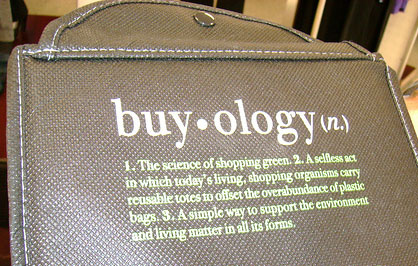
While consumers can restore their eco-ego through carbon offset programs after buying an SUV or plane ticket, new research suggests that buying green products functions as a type of “moral offset.”

Researchers at the University of Toronto questioned the assumption that the “green consumer” is also socially responsible and a humanitarian. The study found that making environmentally responsible consumer choices leads people to make unethical decisions (or at least not as nice ones) later on:

“the halo associated with green consumerism has to be taken with reservations. While mere exposure to green products can have a positive societal effect by inducing pro-social and ethical acts, purchasing green products may license indulgence in self-interested and unethical behaviors.”

The researchers conducted three experiments in which students were asked to purchase or evaluate green products, or buy conventional ones, and then participate in an “unrelated” task. In each experiment, students who didn’t buy green products acted more altruistically and honestly in the second task than those who did. In the words of the researchers, “people act less altruistically and are more likely to cheat and steal after purchasing green products as opposed to conventional products.” However, if you consider that 98 percent of so-called “green products” are based on misleading claims, then that moral high ground is even shakier.

So are Prius drivers and folks who drink organic, fairly traded coffee not as nice as those driving a conventional sedan and drinking Starbucks? Seems like a question to ask the Girl Scouts and Salvation Army: Are people more generous in front of Safeway or Whole Foods?


BEFORE YOU CLICK AWAY!

December is make or break for us. A full one-third of our annual fundraising comes in this month alone. A strong December means our newsroom is on the beat and reporting at full strength. A weak one means budget cuts and hard choices ahead.

The December 31 deadline is closing in fast. To reach our $400,000 goal, we need readers who’ve never given before to join the ranks of MoJo donors. And we need our steadfast supporters to give again today—any amount.

Managing an independent, nonprofit newsroom is staggeringly hard. There’s no cushion in our budget—no backup revenue, no corporate safety net. We can’t afford to fall short, and we can’t rely on corporations or deep-pocketed interests to fund the fierce, investigative journalism Mother Jones exists to do.

That’s why we need you right now. Please chip in to help close the gap.

BEFORE YOU CLICK AWAY!

December is make or break for us. A full one-third of our annual fundraising comes in this month alone. A strong December means our newsroom is on the beat and reporting at full strength. A weak one means budget cuts and hard choices ahead.

The December 31 deadline is closing in fast. To reach our $400,000 goal, we need readers who’ve never given before to join the ranks of MoJo donors. And we need our steadfast supporters to give again today—any amount.

Managing an independent, nonprofit newsroom is staggeringly hard. There’s no cushion in our budget—no backup revenue, no corporate safety net. We can’t afford to fall short, and we can’t rely on corporations or deep-pocketed interests to fund the fierce, investigative journalism Mother Jones exists to do.

That’s why we need you right now. Please chip in to help close the gap.

We Recommend

Latest

Sign up for our free newsletter

Subscribe to the Mother Jones Daily to have our top stories delivered directly to your inbox.

Get our award-winning magazine

Save big on a full year of investigations, ideas, and insights.

Subscribe

Support our journalism

Help Mother Jones' reporters dig deep with a tax-deductible donation.

Donate

