Here’s Something Else Donald Trump Is Totally Wrong About

<a href="http://www.shutterstock.com/pic-152853110/stock-photo-successful-man-raising-arms-after-cross-track-running-on-summer-sunset-fitness-male-athlete-with.html?src=BZ06znTUSE1DSYgrClfA-A-1-17">Dirima</a>/Shutterstock

Get your news from a source that’s not owned and controlled by oligarchs. Sign up for the free Mother Jones Daily.


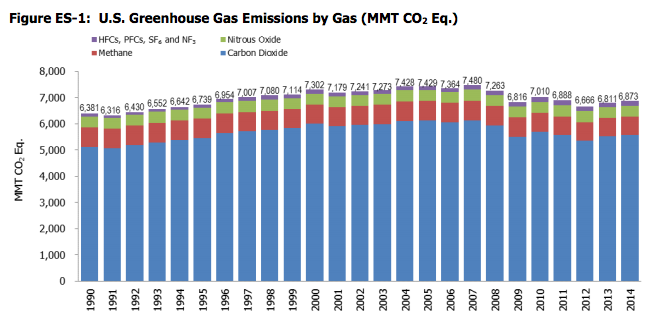
The only way to stop climate change is to drastically reduce, and ultimately eliminate, greenhouse gas emissions. If you want to know how well we’re doing on that goal, a good place to start is the Environmental Protection Agency’s official GHG database. And frankly, the picture isn’t very pretty.

The total level of US emissions in 2014 wasn’t very different than it was 30 years ago:
EPA

However, total emissions is a fairly misleading way to look at progress on climate change. Most of these emissions come from fossil fuels burned to make energy—either electricity from power plants or gas for cars and trucks. So emissions are heavily influenced by economic activity; a downturn in the economy would mean people drive less, factories use less electricity, etc., and the outcome would be lower emissions. At least, that’s the way things used to be.

Over the last few years, the United States and many other countries around the world have seen an unprecedented disconnect between gross domestic product and emissions. Thanks to an increasingly large share of energy coming from renewables and vast improvements to energy efficiency, emissions can now be increasingly “decoupled” from economic activity. In other words, it’s now possible to grow the economy without growing emissions.

A new analysis from the World Resources Institute illustrates how this trend is already playing out around the world. It’s a bit of good news, and a solid rebuttal to anyone who says saving the climate means killing the economy—looking at you, Donald Trump:


WRI

More Mother Jones reporting on Climate Desk

BEFORE YOU CLICK AWAY!

December is make or break for us. A full one-third of our annual fundraising comes in this month alone. A strong December means our newsroom is on the beat and reporting at full strength. A weak one means budget cuts and hard choices ahead.

The December 31 deadline is closing in fast. To reach our $400,000 goal, we need readers who’ve never given before to join the ranks of MoJo donors. And we need our steadfast supporters to give again today—any amount.

Managing an independent, nonprofit newsroom is staggeringly hard. There’s no cushion in our budget—no backup revenue, no corporate safety net. We can’t afford to fall short, and we can’t rely on corporations or deep-pocketed interests to fund the fierce, investigative journalism Mother Jones exists to do.

That’s why we need you right now. Please chip in to help close the gap.

BEFORE YOU CLICK AWAY!

December is make or break for us. A full one-third of our annual fundraising comes in this month alone. A strong December means our newsroom is on the beat and reporting at full strength. A weak one means budget cuts and hard choices ahead.

The December 31 deadline is closing in fast. To reach our $400,000 goal, we need readers who’ve never given before to join the ranks of MoJo donors. And we need our steadfast supporters to give again today—any amount.

Managing an independent, nonprofit newsroom is staggeringly hard. There’s no cushion in our budget—no backup revenue, no corporate safety net. We can’t afford to fall short, and we can’t rely on corporations or deep-pocketed interests to fund the fierce, investigative journalism Mother Jones exists to do.

That’s why we need you right now. Please chip in to help close the gap.

We Recommend

Latest

Sign up for our free newsletter

Subscribe to the Mother Jones Daily to have our top stories delivered directly to your inbox.

Get our award-winning magazine

Save big on a full year of investigations, ideas, and insights.

Subscribe

Support our journalism

Help Mother Jones' reporters dig deep with a tax-deductible donation.

Donate