Plastic. Fantastic?

Can we learn to live with (and even love) plastic?

—Photo: Chris Jordan

IN THE 1850s, the titans of the American billiards industry faced a vexing problem. A mere eight balls could be carved from the tusks of a large Asian elephant, but the species, once populous, had been hunted into near extinction—a casualty of the demand for ivory for everything from cue balls to corsets. Fearing the parlor game's demise, manufacturer Michael Phelan offered a $10,000 reward to anyone who could create an artificial material that mimicked ivory's unusual mix of pliability and durability. "If any inventive genius would discover a substitute for ivory, possessing those qualities which make it valuable to the billiard player, he would make a handsome fortune for himself, and earn our sincerest gratitude," Phelan pleaded. When a New York chemist named John Wesley Hyatt subsequently debuted a synthetic ivory pool ball made from a compound called celluloid, it was lauded as revolutionary. Plastic had arrived, ready to save the planet.

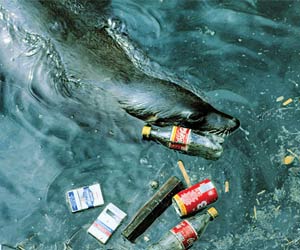
More than 150 years later, the story could hardly be more different. As the most visible evidence of a disposable, trash-addled society, plastic has become the emblem of a world swimming in waste. Reportedly, plastic shopping bags are used an average of just 12 minutes before being thrown away. Every year, more than 500 billion plastic bags are discarded worldwide; they wave from tree branches so abundantly that South Africans have dubbed them their "national flower," and no fewer than six countries have enacted bans. Shredded packaging fouls shorelines and turns up in the stomachs of trout, albatross, and sea turtles (which mistake plastic bags for jellyfish). In the Pacific Ocean, currents feed scraps into a thousand-mile-wide gyre of synthetic jetsam. (See Where Plastics Go to Kill.)


story continues below story continued from above

Plastic's capacity for near-infinite proliferation initially seemed like a boon. Compared with wood or metal, it was seen as "an infinite material," notes Jeffrey Meikle, the author of American Plastic: A Cultural History. Originally made from coal tar, the waste produced by coking coal for incineration, plastic used almost no extra resources and yet could be churned out by the ton. "It was a striking innovation," Meikle says. "From the scrap heap of industry, you could create essentially as much plastic as you want."

And therein lay the rub. Inexpensive to make and easy to discard, plastic morphed from an engineering triumph into a global scourge. In 1960, Americans sent 390,000 tons of plastics to the landfill; today we annually trash more than 28.5 million tons—around 11 percent of all municipal waste. Plastic doesn't biodegrade, and the very characteristic that makes it so versatile—its protean ability to be resilient or stiff, soft or hard, opaque or transparent—makes it extremely difficult to recycle efficiently. Even the most common recyclable categories of plastic (No. 1 water bottles, for instance) consist of incompatible polymers with different melting points. In 2007, less than 7 percent of Americans' plastic waste was recycled (mostly milk jugs and water and soda bottles), as opposed to 55 percent of paper.

A 2000 survey by the American Chemistry Council (ACC) found that fewer than half of Americans had a positive opinion of the miracle material; 25 percent "strongly believed" that plastic's environmental negatives outweighed its benefits. The industry claims the ratings have improved, though it declines to release new data.

Even loyalists admit that plastic has an image problem. When I asked Robert Krebs, spokesman for the ACC, for ways in which plastic has benefited the environment, he sent me a digital dump of documents and studies—everything from an EPA review asserting the superiority of plastic grocery bags over paper (they take less energy to produce and transport, and consume fewer resources) to a report on the fuel savings from plastic car parts. But Krebs sounded glum when he contemplated plastic's pariah reputation. "Fifty percent popularity puts you down there with the trial lawyers," he said with a tired sigh. For a popular material, plastic is remarkably unpopular.

Yet there is still a case to be made for plastic. In the spring of 1980, a young researcher at the Worldwatch Institute named Christopher Flavin published a 55-page report titled "The Future of Synthetic Materials." Obscure as it was, the paper created a stir. Flavin challenged the environmentalist dogma that plastic was an eco­logical disaster and was bleeding the country of large amounts of petroleum—in the midst of an oil crisis, no less. In fact, Flavin argued, plastics were uncommonly efficient, often taking less energy to produce than the materials, like aluminum and glass, that they replaced. And plastics were relatively thrifty, energy-wise. (Today, 120 billion pounds of plastic are generated each year using less than 5 percent of world oil supplies. In the United States, most plastic is made with natural gas, using about 5.6 percent of our gas output.) Moreover, plastics begat other savings, Flavin noted. They made packaging lighter, reducing the amount of fuel needed for shipping, and preserved food more effectively, meaning less breakage and waste. Plastic window tinting reduced the use of air conditioning, while spray foam insulation minimized heat loss.

Now the president of Worldwatch, Flavin has moderated his opinion of plastic. He now worries about toxicity (the carcinogens in PVC and additives such as bisphenol-A in food-grade plastics, for instance), plastics in the ocean, and solid waste, a byproduct of the "massive throwaway culture" that he believes plastics have engendered. Nonetheless, he still considers synthetics "one of the higher and better uses for oil," especially on the carbon front. "It's a better value for the material," he explains. "You're not throwing carbon into the atmosphere"—because making plastic doesn't burn oil—"and the quantities are so much smaller than what we use for transportation. My guess would be that we'll end up using oil for synthetic materials long after we stop using it for basic combustion." Though he'd like to see us use a lot less plastic, Flavin recognizes that there aren't always sustainable alternatives. "It would certainly be very difficult to live a plastic-free life today," he says. "It's in so many things. But there are a lot of problems with natural materials, too. There's really no bright line between 'natural is good' and 'synthetic is bad.' The world is more complicated than that." We may be stuck with plastic, but sometimes it may be the lesser evil.

However, plastic requires more than just an image makeover if it's going to make a positive contribution to a more energy efficient, less disposable world. "I think the case is fairly clear that we need to stop wasting petroleum for single-use products, like plastic bags and water bottles that get used for a few minutes and discarded," says Allen Hershkowitz, a senior scientist with the Natural Resources Defense Council. "What's less clear is what we do next, and how we do it in a cost-competitive and ecologically sound way."

The solution may be for plastic to keep doing what it does best—evolving, in essence, to become a better substitute for its current form. Flavin has hopes for the next generation of compostable plastics, like the corn-based plastic that's turning up in cutlery and food packaging. These "natural" plastics are less toxic to produce and more easily disposed of, yet they still have complicated environmental lives. (See "Infinite Pest.") Many plastics labeled as biodegradable will break down only in high-heat commercial composting facilities, not if they're put in backyard composts or just left to the elements. Nonetheless, when they're disposed of properly, bioplastics easily beat conventional plastics on the waste front. Future generations of bioplastics made from agricultural waste and produced with renewable energy could even be carbon negative.

The quest for the 21st century's artificial ivory cue ball—a plastic that's "nontoxic, totally biodegradable, easily recycled," as Flavin puts it—has a long way to go. Market analysts estimate that it could be another 20 years before bioplastics make up even 5 percent of the global plastics market. Yet Hershkowitz says demand, and rising oil costs, will push companies like DuPont and BASF to pursue alternatives. "The writing's on the wall for this," he says. "And that's a good thing."

The key, explains Flavin, is to focus not solely on what new plastics will be used for, but where they will go when they're thrown away, and then engineer them to break down accordingly. Making plastics whose final feat is to disappear without a trace, he says, "will be a complex engineering challenge that will keep many people employed for years to come."

Get Mother Jones by Email - Free. Like what you're reading? Get the best of MoJo three times a week.
Comments
no profile pic for comment author

Turning Plastic into Oil

Hi Jennifer,

Thanks for an excellent article. What is your take on turning plastic back into oil. We looked at an example in Japan just last week and published an article on OurWorld 2.0.

http://ourworld.unu.edu/en/2009/04/14/plastic-to-oil-fantastic/

There is a video brief with the article.

no profile pic for comment author

the large supermarkets have

the large supermarkets have stoppped giving out plastic bags unless specifically asked to do so. Instead they encourage customers to use recyclable "greener" bags and offer more incentives for customers to stop using plastic bags. Hopefully as time goes on, the reliance on plastic bags will diminish.

no profile pic for comment author

Thank you for providing this

Thank you for providing this article to your readers. I have known for quite awhile how bad plastic is & have gone to great lengths to avoid it. However it still sneaks in, it is almost impossible to get certain things that aren't at least packaged in plastic. I wish everyone would realize what great danger there is to our biodiversity & of course humans w/our dependence on this horrible material. When humanity is finally aware of this toxic plague it will probably be too late. Actually, do to plastics chemical make-up, even if all plastic was eliminated tomorrow, we would still be living with its toxic legacy.

no profile pic for comment author

The damask rose.

Often, when
a green and
delicate rose
appears near an
hopeful hedge,
a passing cloud
invents an emotion,
and even a smile,
like beautiful
thoughts in the
sun of your song.

Francesco Sinibaldi

no profile pic for comment author

Plastics, economics, and value

One poster calls plastics a horrible material. Tell that to the man with the pacemaker full of plastics parts. Metal? Too heavy and allergenic. Glass? Wood? Are you kidding? Without plastics your refrigerator most likely would be metal. You couldn't afford it ... or move it. Plastic water pipes last far longer than cement or metal and don't leak nearly as easily. Care to tote a metal mobile phone or iPod? Ever dropped a glass milk bottle? It's like a small hand grenade. It could easily be dropped by a child.
Yes, we have too much plastic litter, as well as paper, metal, glass, and wood. Shall we blame the materials? It is WE who throw them away. If instead we actually practiced the three Rs--reduce, reuse, recycle--rather than read and speak of them, we'd have a chance -- but time is running out.
The computer you're using is impossible without plastic. Try getting through the day without plastics. Better idea: find out how to live with them.

no profile pic for comment author

response to robiodo

Hi, I agree with most of what you're saying. The three R's are great, and even better when used. I think when people say plastic is evil, or better yet when I say plastic is evil, I'm referring to it's current state. It would be better if we could make a plastic that was really biodegradable. It would be great if we could make plastic that wasn't so toxic to life as we known, the toxic contents within plastic as we know it today are responsible for almost all of our cancer related problems, as well as some studies that point to these toxins contributing to our obesity epidemic, type 2 diabetes, and a large amount of birth defects. The bottom line is that we need a better plastic, one that's not killing us off, along with the world around us. If you're interested you should check out these links:

http://www.youtube.com/watch?v=O1NNIx8Mc_k

http://www.youtube.com/watch?v=watbi_vU3SA

http://www.youtube.com/watch?v=3DVKztb-uTw

http://www.youtube.com/watch?v=ZAICNec9970

Byrd

No Excuse

In fact, there is no excuse for plastic in this day and age. The only reason we still have it is due to the petrochemical industry. Similar biodegradable substances can easily be made from hemp, but the petrochemical industry fights it tooth and nail. I had hoped that hemp might have found a champion in Obama, but it appears he's been bought off as well and continues to use the term marijuana, just as WR Hearst intended. Ignorance knows no bounds when money is at stake.

no profile pic for comment author

Plastic!

Plastic, plastic everywhere
Although the wrap did shrink,
Plastic, Plastic everywhere.
Why is it in the "drink"?

no profile pic for comment author

a better hierarchy?

i'd include a few more than "reduce, reuse and recycle". how about?
1. reject (do i need this product?)
2. repair (can i extend the useful life of what i have?)
3. reuse (ditto 2)
4. reduce (can i do with less of something?)
5. recycle (can i prevent this going to landfill and give it another life?
6. relax (i've done my best up until now)

it is difficult to do without plastic, but we can minimise its use, use it where it has clear cradle-to-grave advantages, reduce its toxicity, not discard it after carrying the groceries home, make it truly biodegradable. history has shown us that when we put in the effort, we can mitigate or solve problems such as these.

no profile pic for comment author

packaging

America lives on packaging. It's not the bags we get at the grocer, it's everything we buy.
Bring a new product home . Remove the first layer of plastic. Now, you have another layer separating the parts. Remove that, here's another layer....and another...and another.
Instead of buying a pound of nails at the local hardware store, we go to Home Depot and buy ten packs of 20, ALL sealed up in damn near indestructible plastic.
The worst of it is that we have been convinced that the only proof of a product's worth is how much plastic it's wrapped in.

You might have brought it home in your Prius, but you just stripped a Suburban's worth of petroleum off the product when you opened it.

no profile pic for comment author

We must learn to accept many

We must learn to accept many things as inevitable and rather than trying to demonise them, we should learn to use them more efficiently and effectively. A sustainable future lies in development (a constant improvement) rather than growth (more and more). So it is with plastics. They are probably as beneficial as they are detrimental to our environment, and we need to focus our efforts (legislative, R&D, and personal) to shift this balance more towards the positive and less towards the negative. Believe me, I would love to see a world free of plastic bags and bottles, but I recognise the may be a utopian dream. Let's make what we have better rather than focus on what cannot be achieved.

no profile pic for comment author

The World is Changing

The world is changing - and I hope for the better too. Where I'm from, the large supermarkets have stoppped giving out plastic bags unless specifically asked to do so. Instead they encourage customers to use recyclable "greener" bags and offer more incentives for customers to stop using plastic bags. Hopefully as time goes on, the reliance on plastic bags will diminish.

Debbie McCann
Beat Anxiety Panic Attacks - Naturally!

no profile pic for comment author

It's not paper and not plastic

The article details the problems with plastic bags and also the problems with paper. The responsible solution is for consumers to use reusable, washable cloth bags and for stores to sell food in ways that does not require packaging standardized portions into containers. Like all grocers did in the past and Farmer's Markets do today.
___
Web Design in Los Angeles
Los Angeles Web Development

no profile pic for comment author

Green Plastic Bottles

Between biodegradable plastic and eco friendly plastic bottles which just use less plastic, how much more greenwashing are we going to take?

no profile pic for comment author

plastic will start to

plastic will start to disappear i hope so. its so bad for the environment. When i go to the store they do not offer it unless you ask which is a good thing.

no profile pic for comment author

tiffany jewelry

of tiffany jewelry on ebay are cheaper than tiffany jewellery outlet store, why is that?

You will find the newest tiffany jewelry on sale fashion release on their official website.

I am planning to give my wife a big surprise with tiffany and co as a birthday gift, but I don’t know which one to choose, any ideas?

no profile pic for comment author

We are providing all kinds

We are providing all kinds of louis vuitton handbags, wallets and purses in ourgucci Online Store, all items of which have the most popular styles and are the newest and at discounted prices.

We also provide helpful shopping guide tips for you to choose and compare our bags and other accessories. Get your sale of replica handbags today and you will never be disappointed with it.

Post a comment
Alternately, you may login to or register an account
The content of this field is kept private and will not be shown publicly.
  • Web page addresses and e-mail addresses turn into links automatically.
  • Allowed HTML tags: <a> <ul> <ol> <li> <blockquote> <img>
  • Lines and paragraphs break automatically.

More information about formatting options


Jail.org - Inmate Search
Criminal records, instant public records & people search & current court records. www.jail.org

U.S. Public Records Search
Search County & State Court Records, Criminal records, Vital and Adoption Records www.PublicRecordsInfo.com

Records.com - People Search
Public Records and Background Checks. Instantly Search Criminal Records, Addresses and Court Records www.Records.com

Court Records & County Records
Find Instant Public Records, Criminal Records as Well as County Property Records Search. www.PublicRecordsIndex.com

Mother Jones Podcast
Get in on the conversation! We talk about culture, politics, the environment, the economy and more. Listen now!

TalkBackTees.com
A treasure trove of liberal wit, wisdom and quotations, from ancient to modern, on colorful, cotton tees.

Support Independent Artists
Amazing art, crafts, apparel, paper-goods and more. A carefully curated selection of sundries since 1999.

FREE CONNECTIONS FOR GREEN SINGLES
Meet progressive singles in the environmental, vegetarian & animal rights community who share your values