Waste Not, Want Not
We've finally reached a point where we can't keep hyperconsuming—and that's a good thing.
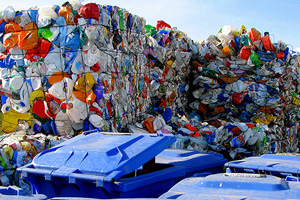
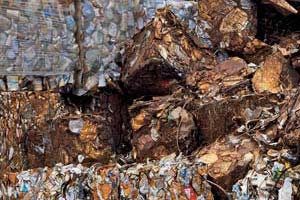
ONCE A YEAR OR SO, it's my turn to run recycling day for our tiny town. Saturday morning, 9 to 12, a steady stream of people show up to sort out their plastics (No. 1, No. 2, etc.), their corrugated cardboard (flattened, please), their glass (and their returnable glass, which goes to benefit the elementary school), their Styrofoam peanuts, their paper, their cans. It's quite satisfying—everything in its place.
But it's also kind of disturbing, this waste stream. For one, a town of 550 sure generates a lot—a trailer load every couple of weeks. Sometimes you have to put a kid into the bin and tell her to jump up and down so the lid can close.
More than that, though, so much of it seems utterly unnecessary. Not just waste, but wasteful. Plastic water bottles, one after another—80 million of them get tossed every day. The ones I'm stomping down are being "recycled," but so what? In a country where almost everyone has access to clean drinking water, they define waste to begin with. I mean, you don't have a mug? In fact, once you start thinking about it, the category of "waste" begins to expand, until it includes an alarming percentage of our economy. Let's do some intellectual sorting:
There's old-fashioned waste, the dangerous, sooty kind. You're making something useful, but you're not using the latest technology, and so you're spewing: particulates into the air, or maybe sewage into the water. You wish to keep doing it, because it's cheap, and you block any regulation that might interfere with your right to spew. This is the kind of waste that's easy to attack; it's obvious and obnoxious and a lot of it falls under the Clean Air Act and Clean Water Act and so on. There's actually less of this kind of waste than there used to be—that's why we can swim in most of our rivers again.
There's waste that comes from everything operating as it should, only too much so. If carbon monoxide (carbon with one oxygen atom) exemplifies pollution of the first type, then carbon dioxide (carbon with two oxygen atoms) typifies the second. Carbon monoxide poisons you in your garage and turns Beijing's air brown, but if you put a catalytic converter on your tailpipe it all but disappears. Carbon dioxide doesn't do anything to you directly—a clean-burning engine used to be defined as one that released only CO2 and water vapor—but in sufficient quantity it melts the ice caps, converts grassland into desert, and turns every coastal city into New Orleans.
There's waste that comes from doing something that manifestly doesn't need doing. A hundred million trees are cut every year just to satisfy the junk-mail industry. You can argue about cutting trees for newspapers, or magazines, or Bibles, or symphony scores—but the cascade of stuffporn that arrives daily in our mailboxes? It wastes forests, and also our time. Which, actually, is precious—we each get about 30,000 days, and it makes one a little sick to calculate how many of them have been spent opening credit card offers.
Or think about what we've done with cars. From 1975 to 1985, fuel efficiency for the average new car improved from 14 to 28 miles per gallon. Then we stopped worrying about oil and put all that engineering talent to work on torque. In the mid-1980s, the typical car accelerated from 0 to 60 mph in 14.5 seconds. Today's average (even though vehicles are much heavier) is 9.5 seconds. But it's barely legal to accelerate like that, and it makes you look like an idiot, or a teenager.
Then there's the waste that comes with doing something maybe perhaps vaguely useful when you could be doing something actually useful instead. For instance: Congress is being lobbied really, really hard to fork over billions of dollars to the nuclear industry, on the premise that it will fight global warming. There is, of course, that little matter of nuclear waste—but lay that aside (in Nevada or someplace). The greater problem is the wasted opportunity: That money could go to improving efficiency, which can produce the same carbon reductions for about a fifth of the price.
Our wasteful habits wouldn't matter much if there were just a few of us—a Neanderthal hunting band could have discarded six plastic water bottles apiece every day with no real effect except someday puzzling anthropologists. But the volumes we manage are something else. Chris Jordan is the photographer laureate of waste—his most recent project, "Running the Numbers," uses exquisite images to show the 106,000 aluminum cans Americans toss every 30 seconds, or the 1 million plastic cups distributed on US airline flights every 6 hours, or the 2 million plastic beverage bottles we run through every 5 minutes, or the 426,000 cell phones we discard every day, or the 1.14 million brown paper supermarket bags we use each hour, or the 60,000 plastic bags we use every 5 seconds, or the 15 million sheets of office paper we use every 5 minutes, or the 170,000 Energizer batteries produced every 15 minutes. The simple amount of stuff it takes—energy especially—to manage this kind of throughput makes it daunting to even think about our waste problem. (Meanwhile, the next time someone tells you that population is at the root of our troubles, remind them that the average American uses more energy between the stroke of midnight on New Year's Eve and dinner on January 2 than the average, say, Tanzanian consumes in a year. Population matters, but it really matters when you multiply it by proximity to Costco.)
Would you like me to go on? Americans discard enough aluminum to rebuild our entire commercial air fleet every three months—and aluminum represents less than 1 percent of our solid waste stream. We toss 14 percent of the food we buy at the store. More than 46,000 pieces of plastic debris float on each square mile of ocean. And—oh, forget it.
These kinds of numbers get in the way of figuring out how much we really waste. In recent years, for instance, 40 percent of Harvard graduates have gone into finance, consulting, and business. They had just spent four years with the world's greatest library, some of its finest museum collections, an unparalleled assemblage of Nobel-quality scholars, and all they wanted to do was go to lower Manhattan and stare into computer screens. What a waste! And when they got to Wall Street, of course, they figured out extravagant ways to waste the life savings of millions of Americans, which in turn required the waste of taxpayer dollars to bail them out, money that could have been spent on completely useful things: trains to get us where we want to go—say, new national parks.
Perhaps the only kind of waste we've gotten good at cutting is the kind we least needed to eliminate: An entire industry of consultants survives on telling companies how to get rid of inefficiencies—which generally means people. And an entire class of politicians survives by railing about government waste, which also ends up meaning programs for people: Health care for poor children, what a boondoggle.
Want to talk about government waste? We're going to end up spending north of a trillion dollars on the war in Iraq, which will go down as one of the larger wastes of money—and lives—in our history. But we spend more than half a trillion a year on the military anyway, more than the next 10 nations combined. That almost defines profligacy.
We've gotten away with all of this for a long time because we had margin, all kinds of margin. Money, for sure—we were the richest nation on Earth, and when we wanted more we just borrowed it from China. But margin in other ways as well: We landed on a continent with topsoil more than a foot thick across its vast interior, so the fact that we immediately started to waste it with inefficient plowing hardly mattered. We inherited an atmosphere that could buffer our emissions for the first 150 years of the Industrial Revolution. We somehow got away with wasting the talents of black people and women and gay folks.
But our margin is gone. We're out of cash, we're out of atmosphere, we're out of luck. The current economic carnage is what happens when you waste—when the CEO of Merrill Lynch thinks he needs a $35,000 commode, when the CEO of Tyco thinks it would be fun to spend a million dollars on his wife's birthday party, complete with an ice sculpture of Michelangelo's David peeing vodka. The melted Arctic ice cap is what you get when everyone in America thinks he requires the kind of vehicle that might make sense for a forest ranger.
Getting out of the fix we're in—if it's still possible—requires in part that we relearn some very old lessons. We were once famously thrifty: Yankee frugality, straightening bent nails, saving string. We used to have a holiday, Thrift Week, which began on Ben Franklin's birthday: "Beware of little expenses; a small leak will sink a great ship," said he. We disapproved of frippery, couldn't imagine wasting money on ourselves, made do or did without. It took a mighty effort to make us what we are today—in fact, it took a mighty industry, advertising, which soaks up plenty more of those Harvard grads and represents an almost total waste.
In the end, we built an economy that depended on waste, and boundless waste is what it has produced. And the really sad part is, it felt that way, too. Making enough money to build houses with rooms we never used, and cars with engines we had no need of, meant wasting endless hours at work. Which meant that we had, on average, one-third fewer friends than our parents' generation. What waste that! "Getting and spending, we lay waste our powers," wrote Wordsworth. We can't say we weren't warned.
The economic mess now transfixing us will mean some kind of change. We can try to hang on to the status quo—living a Wal-Mart life so we can buy cheaply enough to keep the stream of stuff coming. Or we can say uncle. There are all kinds of experiments in postwaste living springing up: Freecycling, and Craigslisting, and dumpster diving, and car sharing (those unoccupied seats in your vehicle—what a waste!), and open sourcing. We're sharing buses, and going to the library in greater numbers. Economists keep hoping we'll figure out a way to revert—that we'll waste a little more, and pull us out of the economic doldrums. But the psychological tide suddenly runs the other way.
We may have waited too long—we may have wasted our last good chance. It's possible the planet will keep warming and the economy keep sinking no matter what. But perhaps not—and we seem ready to shoot for something nobler than the hyperconsumerism that's wasted so much of the last few decades. Barack Obama said he would "call out" the nation's mayors if they wasted their stimulus money. That's the mood we're in, and it's about time.
Values
-
tagged as:
- solution
Agreed.
Vales make up an economy. Values shape our most base desires and efforts that achieve those needs are the essence of the human economy.
This hyperconsumerism reminds me of a person who feels hungry and chronically tries to squelch that hunger with junk food. The consumption is not nutritionally satisfying so we stuff ourselves. The stuffed feeling replaces any real feeling of true health and vitality and we end up in a vicious cycle, a dis-ease.
Truly our economy is diseased. The cure is finding the path that of investment in real value.
The Great Communicator,
The Great Communicator, Ronald Reagan, was our permissive parent. He told us the American Dream had no limits, and thereby aided and abetted Madison Avenue in selling us the disposable lifestyle. Even as Earth Day was born, our feet were set on the road to the landfill with a push a few years later from "Daddy" Reagan.
When I was a kid in the '50 I remember my mother separating the garbage from the "tin" cans (both ends removed and flattened with both ends inside) from the trash that was thrown away. When Earth Day came I was in High School and and thought that we were destined to return to that more responsible life. Everything from Madison Avenue was "natural" and "green" just as it is now. An old '60s song once proclaimed "Everything Old is New Again." Yeah, until it get old.
climate change
population implosion
http://tinyurl.com/2rc5a9
Government geoengineering through aerosol dispersal may be causing heating of the lower atmosphere.
http://www.carnicom.com/gwmodel.htm
http://tinyurl.com/globalwarmingisascam
http://tinyurl.com/peakoilisalie
http://tinyurl.com/aerosolcrimes
http://www.carnicom.com
http://www.bariumblues.com
Dumpster Diving
Preach all you want. Dumpster diving is asinine.
Dumpster Preacher
Preach all YOU want, I've found books and furniture that matched my asian theme and whole (functioning) computers and a brand new pair of Levi's 501s and christmas lights and ornaments and matching luxury bathroom rugs and a prada purse with 75 dollars and a bottle of valium tucked in it in the trash. It's like treasure hunting.
and...
diamond earrings and fancy hair care products and houseplants and make-up and baby clothes and car seats and bicycles and ceiling fans and art supplies and office supplies and frozen porterhouse steaks and . . . .
Who is we?
-
tagged as:
- solution
I'm always amused to hear lefties talk about how "we" need to do that, or "we" need to do this. In this case, "we" apparently need to stop "hyperconsuming" (whatever that is). Anyway, can I expect Bill McKibben, et al, to lead us in this wonderous bag lady society that they seem to advocate? Or will it be more liberal hypocrisy, where "we" means the rest of us, but not them.
-Ken
http://www.LaserGuidedLoogie.com
Ken, i recycle as much as my
Ken, i recycle as much as my city will let me (they dont take all types of plastics).... how does that make me a bag lady? it has hardly influenced my lifestyle at all, other than the fact that i have 2 bins instead of 1 in my kitchen. i drink tap water..... "liberal hypocrisy"... you know, not every liberal is private jet, cadillac driving Al Gore.
Right on, Bill
This article made me think of Reverend Billy Talen, spiritual leader of the Church of Life After Shopping and Green candidate for mayor of NYC. He's been talking about switching from the unsustainable, unfulfilling consumerist model to a more community-based economics. Check out his campaign site at
http://voterevbilly.org/
Dumpster Diving Rules!
There isn't anything you can't find DDing, believe me. I used to work in retail management, and in receiving. When there is excess or slightly damaged merchandise, it is tossed out in large quantity. It is not always resold or returned to vendor. We even tossed 14K gold jewelry into the trash. Disgusted, some of us got together and put a stop to that practice. My experience years ago in that work led me to embrace frugality and recycling, as well as green living.
Last year I found cases of acrylic paints for crafts, a dumpster full of Halloween costumes and treasures, antique furniture and trunk, books, clothing, toys, you name it! And, yes, food in better shape than what is in some refrigerators!
Sheesh, even if this is a
Sheesh, even if this is a joke, would you let your male child jump up and down inside a dumpster???
Dumpster Diving
-
tagged as:
- solution
» Would you let your male child [dumpster dive]?
Sure, I taught three daughters how to do it, including how to glean in the Safeway dumpster in order to get produce to feed chickens. If you don't get the necessity of this yet, see Dmitry Orlov's talk:
http://vodpod.com/watch/1421369-social-collapse-best-practices-by-dmitry...
Whether you "get it" now or wait until it's forced upon you is your choice, but it's easier (psychologically at least) now while it's optional. Waiting until you are forced to is shortsighted IMO, and can lead to psychological unpleasantness.
Poorly researched, false, and pure drivel
-
tagged as:
- result
The experiments were done a hundred years ago: carbon monoxide does NOT trap heat. That was the specific question the experiments sought to answer, and answer it they did: NO!
Then there's the complete misunderstanding of why the eastern Antarctic ice shelf calves icebergs. The ice sticking out over the water GETS TOO THICK TO SUPPORT ITSELF and breaks off.
Gees, guy, I have serious leftward tendencies, but can any of you even read? Global warming is a hoax, and a contemptible one at that.
I'm also quite disappointed that the real cause for a disposable society was not identified and vilified: debt as money. When all money is a debt, you stop working to produce wealth and start working to produce an income stream (very different), and stop looking to the long term and start producing what will produce quickly repeatable profits: disposable goods.
Think a little deeper, please. This was rather embarrassing to read.
It certainly was embarrassing to read
I mean your comment, Anonymouse. First, the human part of climate change is not about carbon monoxide it’s about carbon DI oxide, among other gases (methane, water vapor, nitrous oxides, ozone…)
Second, at the last meeting of the Global Warming Conspiracy Club, which we held in Yankee Stadium, with the overflow filling up Central Park and Madison Square Garden, we voted you onto the Most Dangerous Dense People list. Then we gave out awards for the 49,627 scientific studies we’ve faked so far in 128 different fields. I had to go out for coffee for everyone (bummer) so I missed the highlight—when the Eastern Antarctic Ice Shelf said what a RELIEF it was to finally let go of all that thick ice all at once, after holding it for over a million years. Wow! Talk about constipation!
Third, money as debt is the root of all evil? We’re thinking you should change suppliers cause the acid you just dropped is bummin us all out. Money as debt… what does it have to do with prehistoric people driving horses off cliffs or ancient royalty ordering subjects to fight wars or even our addiction to television, chemicals and the energy equivalent of 87 slaves each? Well, we all got a laugh out it anyway, that someone would actually write about such a lame reason for problems and in the same letter ask people to think deeper.
Fourth, there’s no such thing as working to produce wealth. Wealth is all around us—or was, when we had a functioning natural ecosystem, before we turned it into toxic waste and junk food. We just didn’t know it. All the work? That’s just to distract us from our real problems.
Fifth. Hear that sound? That’s the sound of 876,000 non-card carrying members of the club all laughing at you.
Global warming deniers are a hoax—and a contemptible one at that—that we’ve made up to stir up controversy and get ourselves mentioned in the papers (anonymously, of course).
for me, it seems to boil
-
tagged as:
- solution
for me, it seems to boil down to an issue of personal restlessness. It's all the 'doing' that is consuming the planet's life support systems. and, in my estimation, a lot of this doing is based on immature motive, myself included. i think our whole society would benefit from just slowing down a bit, breathing a little
The paper industry is just
The paper industry is just that--an industry. For every tree they cut, they plant 4 so they can have some to cut down in the future, too. It is good for the economy to use paper and good for the environment, too because of the improvement of 4 trees instead of 1. It actually takes more energy to recycle and transport (think Co2 emitting trucks and use of extra fuel) all that paper to recycling plants than it does to just let it become humus in a landfill. It also takes a lot of clean water and extra chemicals to break down already formed and pressed fibers (paper and especially cardboard). We have a lot of space to dump. Supposedly, we have the biggest shortage on clean water, though. Just a thought.
If THEY did not put
If THEY did not put dangerous chemicals and toxins into the water, like FLOURIDE, for example, I would drink out of the tap.
10 years ago I got a notice from my water company saying that a new mixture of water effective New Years Day 1999 would kill your goldfish. Yum.
Tap vs bottled water
Just to set the record straight: bottled water is processed in a plant, runs through filters, tubes, whatever containing all kinds of chemicals, and then ends up in a plastic bottle containing phthalates, and other stuff leaches out of the plastic.
In consumer tests, tap water is usually found to taste better and to contain less chemicals.
You've just fallen for the marketeers, who claim unproven benefits and have managed to convince people that tap water is dangerous.
Recycling, waste and overpopulation
-
tagged as:
- solution
Excellent information by all writers: however, recycling will not work until we give every bottle, can and plastic container bought at ever store a 10 cent deposit return incentive. That, and only that action will bring successful recycling to the USA and world. Otherwise, the amount of waste extends beyond our comprehension and its destruction of our world, especially our oceans with such nightmares as the Great Pacific Garbage Patch with 3 million tons of plastic swirling in an area twice the size of Texas. Over 46,000 pieces of plastic on every square mile of ocean! Plastic drift nets killing millions of marine creatures. We continue poisoning our water, land and air with 72,000 chemicals being injected 24/7. Nature cannot outrace our abuse. But she will effectively kick our rear ends in the final equation. Finally, we must stabilize human population if we are ever going to solve the rest of our environmental dilemmas. Frosty Wooldridge www.frostywooldridge.com Author: America on the Brink: The Next Added 100 Million Americans
"Now see this…. Humanity,
"Now see this….
Humanity, this planet, and all that encompass it, are as a large body of water, a river flowing.
Israel/USA, are a hand, stirring the water as they have done for some time now believing that they control the flow of the water, influence it. Splashing in the water will draw attention……..
But as anyone will tell you….remove the hand from the water and the river will continue to flow in it’s inevitable course. There is no hole left where the hand once was in the water.
This renders the hand that stirred the water inconsequential, irrelevant in the course of the flow of the water.
Israel/USA are the hand. It tires. It becomes weary. It has spent its energy.
When they are inevitably removed, the river will continue to flow, and they Israel/USA will prove themselves irrelevant. They will cease to exist.
This is the law. Think about it. And rejoice."
Recycling issues with plastic water bottles
-
tagged as:
- solution
I would like to add my comment about bottled water and the recycling issues of the plastic bottles involved. There are litigimate reasons for buying good quality bottled water. Most municipal water supplies add both chlorine and flouride to the water. Both are carcinogins and flouride is also a neurotoxin. (Please do your own research -- lots on the internet!) In order to avoid these chemicals, I do buy good quality spring water. In order to limit the plastic waste from the use of small bottles, I buy mine in 1 gallon or larger containers. I then fill my personal stainless steel bottle for traveling or just fill up my glass cups at home.
Also, many home filtration systems do not filter out flouride. (Clorine will dissipate if it stands out for a few minutes.) However, with more awareness, safer methods to clean the water (other countries use methods that are less toxic -- again lots of information on the internet) and the elimination of flouridation (a industrial byproduct/poison) would help solve this issue. Needed is public awareness and input into our city and county government 's water treament decision making and policies. This, in itself, would help reduce the plastic issue as more people use the municipal water supply and obviously be a great cost savings for municipalities (that flouride does cost!)
This article made me feel
This article made me feel nauseous. I want to swear off all bottled water. For one thing, it's not possible that all of the water sitting around in plastic bottles is pure and free from some degree of contamination from the plastic. But I know of no way to eliminate nitrates from the water---filters can't do that--and in my area, which is heavily farmed, the water is filled with nitrates. What to do?
Waste not
Is waste a noun? I've be saying in my presentations and discussions for years that: "waste is not a waste intil you take the action of wasting it." I contend that action starts in human design, engineering, and manfacturing. We need to be the piece of nature that we are by thinking and acting accordingly. Stop designing anything with the intent to waste(a verb).
John A.
Really excellent post.. I
Really excellent post..
I want to say that the waste should be recycled in order to produce some positive changes n our environment and the government should take certain actions to do so!
projeksiyon
Thank You
tiffany jewelry
of tiffany jewelry on ebay are cheaper than tiffany jewellery outlet store, why is that?
You will find the newest tiffany jewelry on sale fashion release on their official website.
I am planning to give my wife a big surprise with tiffany and co as a birthday gift, but I don’t know which one to choose, any ideas?
We are providing all kinds
-
tagged as:
- result
We are providing all kinds of louis vuitton handbags, wallets and purses in ourgucci Online Store, all items of which have the most popular styles and are the newest and at discounted prices.
We also provide helpful shopping guide tips for you to choose and compare our bags and other accessories. Get your sale of replica handbags today and you will never be disappointed with it.
Welcome to our company, our
Welcome to our company, our company Huayi Trade Co.,LTD are good at selling the top quality designer bags (Balenciaga ,Chanel , Chloe' ,Christian Dior ,Dolce&Gabbana , Fendi , Gucci , Hermes , Galliera GM ,Miu Miu , Prada ), they are mirror image bags which are identical to the real onesLouis Vuitton Galliera GM . Our company locates inthe leather town in China, Speedy 25since 2003 we did this business we have won great trust and popularity from our customers from all over the world. We areexpanding our business, any inquiry for wholesale business is warmly welcome, Louis Vuitton Speedy 25just contact us, you can get our prompt reply.We have enlish speaking representative to answer phone call, or we can call you if convenient for you.