Fierce, investigative journalism doesn’t happen by accident—it happens because readers like you make it possible. Every dollar you give before midnight Friday to support our nonprofit newsroom will be matched dollar-for-dollar. We can’t do our work without you. Don’t miss this chance!
The deadline’s almost here! Fierce, investigative journalism doesn’t happen by accident—it happens because readers like you make it possible. Every dollar you give before midnight Friday to support our nonprofit newsroom will be matched dollar-for-dollar. We can’t do our work without you. Don’t miss this chance!
This is it: the last day of June, and we’re close to our fundraising goal for our corruption project. But we’re not quite there yet! So if you haven’t contributed yet, today’s the day. Please help us out. I thank you, and Hilbert and Hopper thank you too. I have promised them a brand new box if we meet our goal.
When Kamala Harris took on Joe Biden over his past opposition to forced busing, my initial reaction was that it sounded scripted and kind of fake. Apparently I was right:
Her campaign had spent months fixated on Biden, whose support from black voters has kept him atop all of the early polls. They gamed out several scenarios in which she could use her personal story as a point of contrast with his decades-long record, including over his opposition to busing.
….[Harris] prepped with a small team of aides….Biden was played by Harris’ national press secretary, Ian Sams….Harris herself ended up settling on a line that within minutes would appear in social media memes and just a few hours later would be screen printed on t-shirts selling for $29 on her website: “That little girl was me,” she said, of her desegregated class.
Harris knew she had to break Biden’s grip on the black vote, and she cold-bloodedly went about planning how to do it. But did it work?
Data compiled by the Democratic polling firm Democracy Corps showed Biden’s favorability with African-American voters actually going up a net 18 percent after the debate….But the same survey also showed that the percentage of people who would vote for Biden and consider voting for him went down 11 points from 81 percent to 72 percent.
So Harris’s attack actually hurt her with black voters but helped her overall. How about that?
In any case, the fact that this was a planned attack isn’t necessarily a mark against Harris. It’s annoying to people like me, who get tired of the endless outrage playacting, but it probably seems a lot more real to people who don’t inhale politics daily. It also demonstrates that Harris can be ruthless when she wants to be, and as they say, politics ain’t beanbag. As long as it stays under control, a little bit of ruthlessness is something that every winning candidate needs now and again.
A few months ago I linked to a widely-cited report saying that renters’ incomes have increased by only 5% since 1960. This seemed unlikely since every single income group has recorded far higher growth rates during this period. It also wasn’t clear to me how the report calculated “renters’ incomes” in the first place.
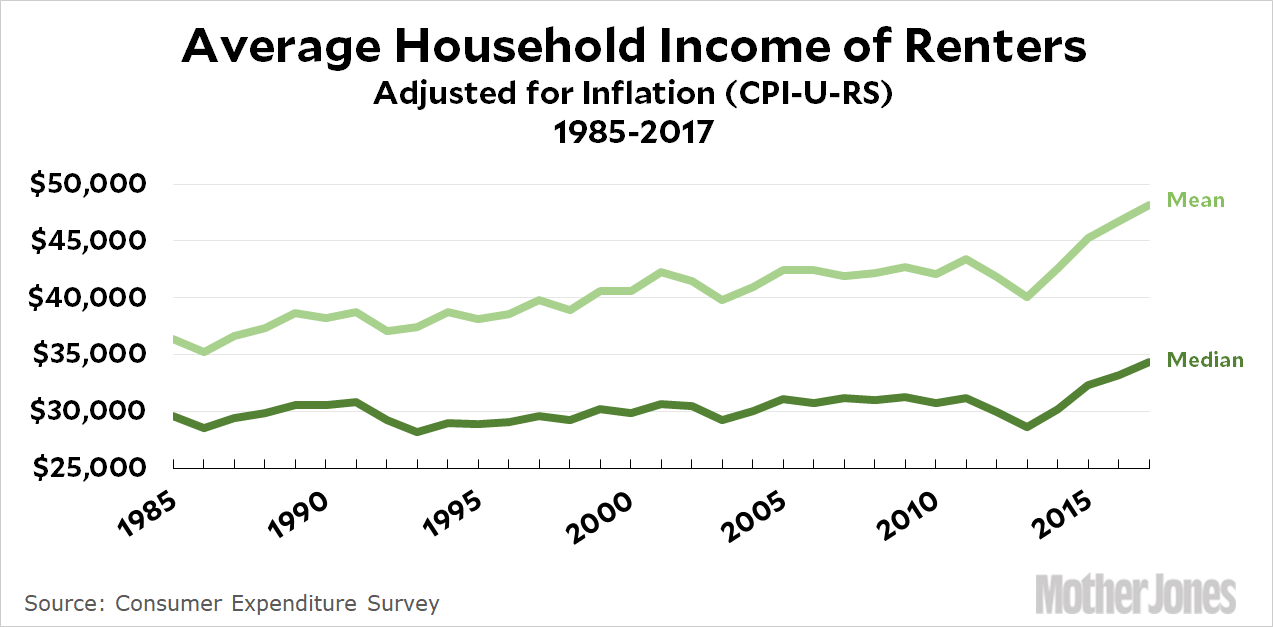
But today is our lucky day! This kind of data is (I assume) available via an analysis of census microdata, but that’s well above my pay grade. However, while poking around the Consumer Expenditure Survey I discovered that every year they report incomes of renters and homeowners. They report only means, not medians, but I estimated medians based on normal census income figures. This probably understates the actual median income, but that’s OK since we’re mostly interested in growth. Here’s the chart:
This only goes back to 1985, but it shows that median renter income has increased about 16 percent since then, though there was a very long period of flatness in there. Renter income increased about 5 percentage points from 1985-2011, and about 11 points since 2014.
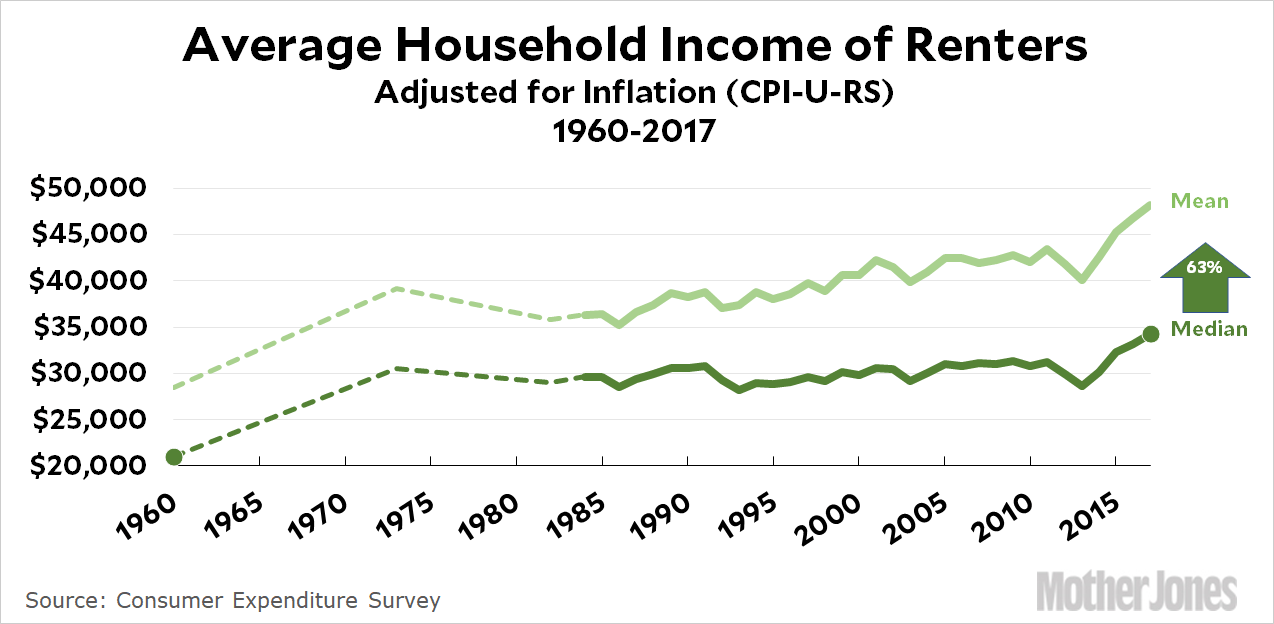
Now, this doesn’t tell us anything about the increase since 1960, but it’s hardly possible that it’s lower. The ’60s were a period of strong income growth: even the lowest income groups—which correlate very well with renters’ income—saw increases of 45 percent from 1960-73 and then a decline of 5 percent between 1973-82. With these numbers in hand, here’s my best estimate of the growth of renters’ incomes since 1960:
From 1973 through 2011 growth was basically zero. But the ’60s showed strong growth and so have the past few years. Put it all together, and renters’ incomes have grown somewhere in the neighborhood of 63 percent, maybe more. It’s certainly a far cry from 5 percent.
President Trump and Chinese President Xi Jinping agreed to a cease-fire on trade that will remove some curbs on Huawei Technologies Co. buying high-tech equipment from the U.S., for the moment lifting one cloud over the global economy. Under the cease-fire, the U.S. agreed to put off additional tariffs on Chinese goods indefinitely. In response, China will start buying large amounts of American farm products, Mr. Trump said.
Somebody help me out here. The restrictions on Huawei were based on national security, right? Huawei networking products supposedly have secret backdoors that allow the Chinese government to spy on us, and it’s all so secret that nobody is willing to provide any actual evidence about this. But it’s there! So death to Huawei.
But if that’s the case, how can Huawei be a routine bargaining chip in a trade war? What’s going on here?
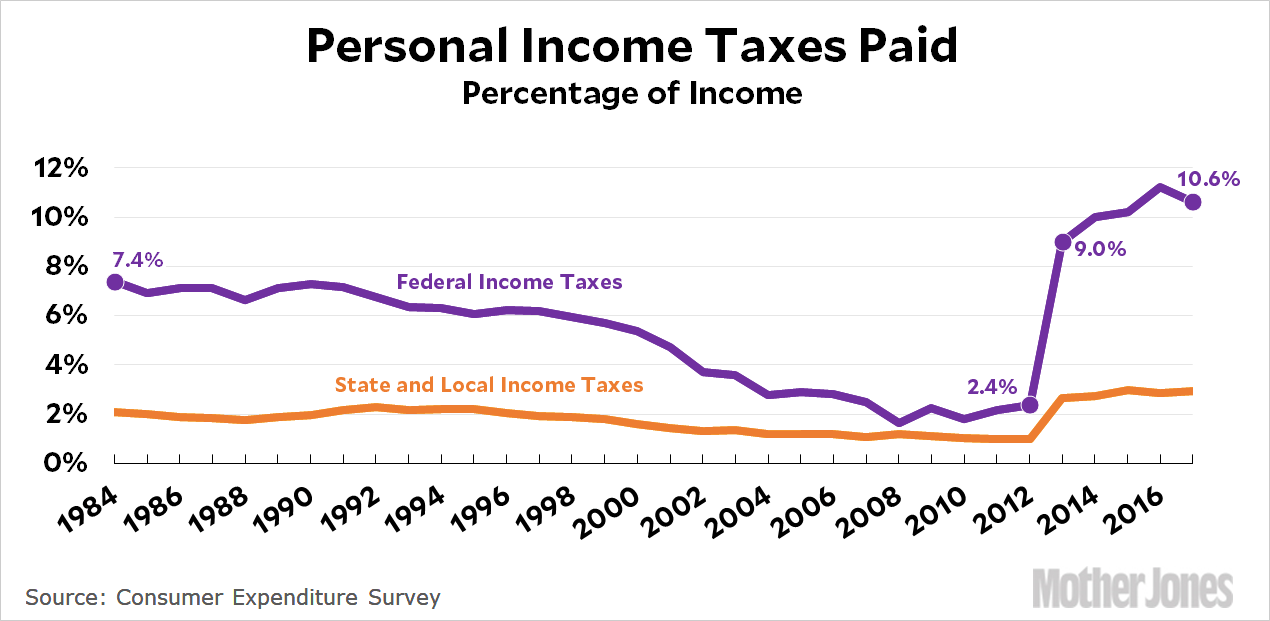
After posting some numbers for income and consumption among different generations this morning, I found myself diddling around with the Consumer Expenditure Survey later in the day. As I did so, I discovered some anomalies and peculiarities that made me wonder if the stuff I had posted was really very reliable. More about that later. For now, I just want to toss out one of the anomalies. According to the CES, here are average personal income taxes paid over the past few decades:
Taxes more than tripled between 2012 and 2013. The chart looks much the same if you display it as percentage of income:
Again, taxes tripled over the course of a single year. The biggest jump is in federal taxes, but state and local taxes also increased a lot from 2012 to 2013.
What’s going on here? Obviously tax payments didn’t really increase that much. Other sources confirm this, and we would have heard screams from sea to shining sea if they had. The only thing that happened in 2013 was that the Bush tax cuts were allowed to expire for the top 1 percent—but an increase of a few percentage points on one percent of the population simply wouldn’t affect things very much. In any case, looking at other tables confirms that the CES records a huge tax jump even for income groups that don’t include the top 1 percent.
This is very peculiar, and I can’t figure out what could be going on here. But I know that a few people who are pretty knowledgeable about this stuff read my blog now and again, so this is a plea for anyone with an explanation to let me know what’s happening.
And while you’re at it, does anyone know why the CES income figures differ so much from the Census figures? They often don’t even agree about whether incomes went up or down, let alone what the precise values are.
UPDATE: The answer turns out to be simple: in 2013 the BLS changed the way it estimated taxes. Instead of surveying people, which produced a lot of nonresponses, they started using NBER’s TAXSIM calculator.
That’s fine, but it means all the tax data before 2013 is useless. If you’re making a time series, it also means that the after-tax income figures are useless. That’s too bad, since changes in tax rates affect the real-world income that households have to spend. But that’s life. Only the before-tax figures are reliable—and I think even that’s at least a little questionable.
I think Brad DeLong makes a good point today. It’s true that we lost a lot of traditionally blue-collar-male jobs to China in the early aughts, but the trade deficits that crowded-out those jobs also had a mirror-image effect:
Imports crowd-in traditionally-male blue-collar wholesale trade jobs, and finance traditionally-male blue-collar construction (and capital-goods manufacturing) jobs.
If you look at all traditionally-male blue-collar jobs—wholesale, construction, manufacturing, and mining—what you get is not a story of the trade deficit, but rather a story of (a) macro shocks to aggregate demand, and (b) the long-run technology-and-preferences trend—some of which is automation….[The China shock was] a big deal for places that found their manufactures competing with new imports from China, yes. But not for blue-collar traditionally-male employment in the country as a whole.
Needless to say, the exact effect of the China shock depends a lot on precisely what you define as “blue-collar-male jobs,” and you can make the effect bigger or smaller depending on where you draw the line. Still, there’s no question that some other jobs got better at the same time that manufacturing declined. This means the overall effect of the China shock is smaller than we usually think it is.
But before the China shock we had the dotcom bust and afterward we had the Great Recession, which devastated all the traditionally blue-collar-male jobs. The manufacturing jobs are the most obvious ones because they had already undergone years of decline, but the loss was just as great (or greater) among truck drivers and construction workers and warehouse workers. The real problem, as DeLong says, is that we recklessly inflated two bubbles in a row and then failed to do enough to recover from them. And when we did finally recover, most of the income gains went to the affluent, not to blue-collar workers.
That’s the problem, not China.
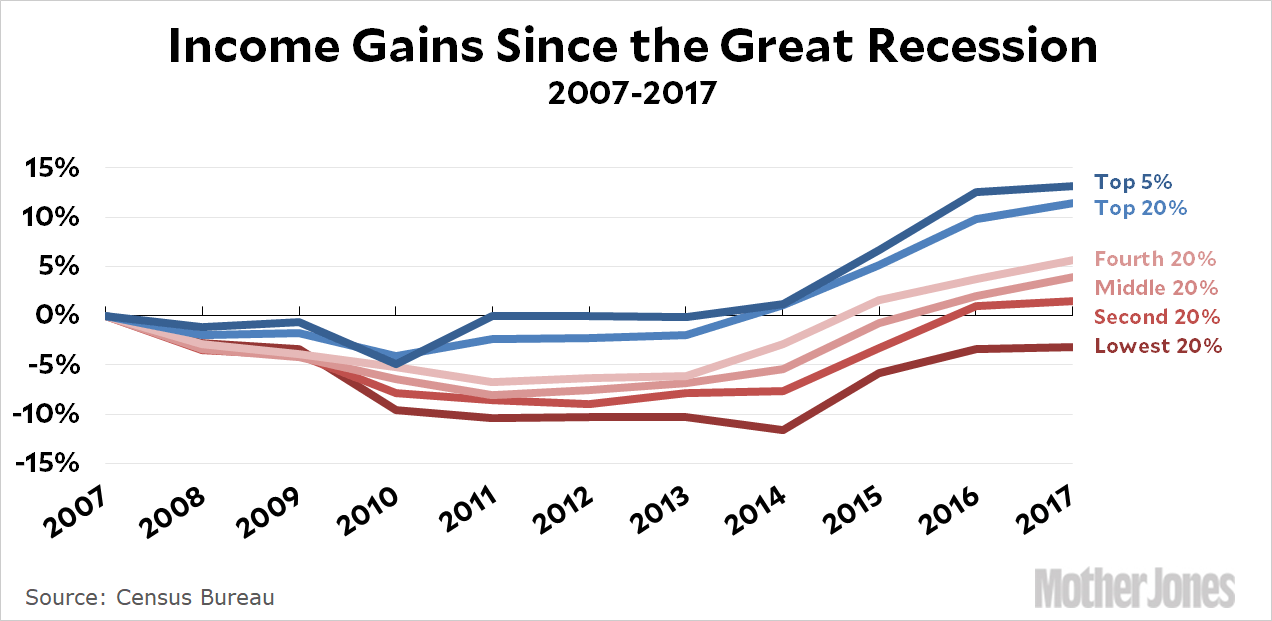
UPDATE: Several people have suggested that the growth of the top 20 percent only looks strong because it includes the top 1 percent. What would that line look like if it excluded the top 1 percent (i.e., included only the 80th percentile through the 99th percentile)?
Census data won’t tell us that, so I headed over to the tables on high incomes put together by Thomas Piketty and Emmanuel Saez. They show that both the top 10 percent and the top 1 percent have grown at about the same rate since 2007. It’s pretty reasonable to think that the top 20 percent looks a lot like the top 10 percent, which suggests that’s it’s also grown at about the same rate as the top 1 percent. In other words, if you exclude the top 1 percent, the chart would hardly change at all.
Apple Inc. is manufacturing its new Mac Pro computer in China, according to people familiar with its plans, shifting abroad production of what had been its only major device assembled in the U.S. as trade tensions escalate between the Trump administration and Beijing….With the previous Mac Pro model, released in 2013, Apple Chief Executive Tim Cook trumpeted plans to build it in the U.S. Apple invested $100 million in tooling and other equipment for a plant in Austin, Texas, run by contract manufacturer Flex Ltd. Each computer was stamped with “Assembled in the USA.”
The interesting part of this is the optics. Financially, it doesn’t matter to Apple. The Mac Pro is a tiny part of their revenue, and the extra cost of keeping it in the US would barely show up on their balance sheet. If they thought that moving production to China would produce even the tiniest scintilla of blowback, they wouldn’t do it.
But they don’t. Apparently Donald Trump’s once fearsome tweet machine isn’t what it used to be.
Democrats are trying to start a populist v. populist campaign against Trump, which is a fight they cannot win. Democratic populists talk as if the only elite in America is big business, big pharma — the top 1 percent. This allows them to sound populist without actually going after their donor bases — the highly educated affluent people along the coasts.
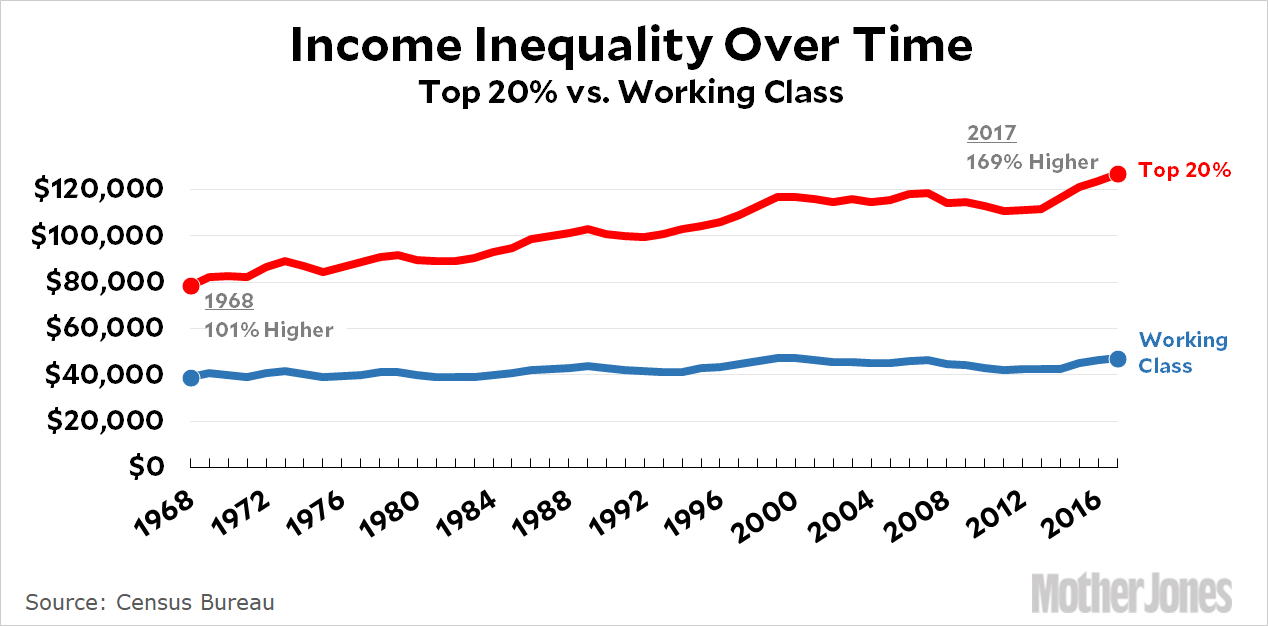
But the big divide in America is not between the top 1 percent and the bottom 99. It’s between the top 20 percent and the rest. These are the highly educated Americans who are pulling away from everybody else and who have built zoning restrictions and meritocratic barriers to make sure outsiders can’t catch up.
Is Brooks right? Let’s go to the numbers!
Yep, the top 20 percent has indeed been pulling away from everyone else. But I’d put this differently than Brooks. The vast wealth of the top 1 percent is important for macro reasons: it sucks away a lot of income that could be going elsewhere and distorts the normal system of rewards we expect from a mixed economy. However, the top 20 percent are important for optical reasons: these are the folks that working class families are more likely to compare themselves to. The fact that they make 0.01 percent as much as Mark Zuckerberg instead of 0.1 percent as much doesn’t register. But the fact that they make a third as much as the upper middle class instead of half as much—well, that’s a whole lot easier to see, and the consequences are far more obvious.
On the rest of Brooks’s list, I kinda sorta agree with him. Not on policy, mind you, but on the fact that Dems may be moving too far left for public comfort. This was pretty obvious last night when immigration came up and was treated like a mirror image of the 2012 Republican campaign. Back then, Republicans all seemed to be in a contest to show who could be toughest on the border. A wall! No, a wall with a moat! No, a wall with a moat filled with alligators!
Democrats seem to be inching the opposite way, and last night almost none of them were willing to endorse the idea of deporting anyone except hard core felons. As Brooks says, “So now you’ve got a lot of candidates who sound operationally open borders.” This is exactly what Donald Trump is trying to make them sound like, and they’re cooperating. This is probably bad policy and bad politics.
Brooks also criticizes Democrats for being critical of the economy, but I don’t see a problem with that. Nor do I see a big problem with the aspiration of getting rid of private insurance, though I agree that it needs to be done carefully.
Roughly speaking, my advice is to go after all income inequality. Attack the top 1 percent for sucking up all the income that would go to workers if we still had labor unions around to fight for them. But then point to the upper middle class as an example of what everyone could aspire to if income were more equitably shared. That’s my recommendation, and it’s worth every penny you paid for it.
This is the kind of thing that I suppose Fox News will mock someday, but it’s a good idea:
The CROWN Act, which passed the state Senate in April, was approved by the state Assembly on Thursday. It would outlaw policies that punish black employees and students for their hairstyles. Supporters say the bill’s acronym reflects its intention: creating a respectful and open workplace for natural hair. If signed by Gov. Gavin Newsom, the bill would legally protect people in workplaces and K-12 public schools by prohibiting the enforcement of grooming policies that disproportionately affect people of color, particularly black people. This includes bans on certain hairstyles, such as Afros, braids, twists, cornrows and dreadlocks.
It’s sad that we need something like this, and no, it’s not the biggest issue facing our nation. But there’s no reason black people shouldn’t be able to wear their hair naturally, just like everyone else, and if this bill makes them more comfortable doing it, then it’s a good thing. Who cares what Fox News thinks?
Can you pitch in a few bucks to help fund Mother Jones' investigative journalism? We're a nonprofit (so it's tax-deductible), and reader support makes up about two-thirds of our budget.
We noticed you have an ad blocker on. Can you pitch in a few bucks to help fund Mother Jones' investigative journalism?