• How Do Boomers and Millennials Really Stack Up?

    As you know, I’ve spent a fair number of posts trying to persuade people that millennials don’t have it any harder than the generations before them. It’s really true, too. So here’s another bite at the apple.

    This time I went to the Consumer Expenditure Survey from the Bureau of Labor Statistics. It’s exactly what you think it is: a survey that estimates how much people make and how much they spend. Here are the results for the most recent three generations, all of them at times when they were about 30 years old:¹
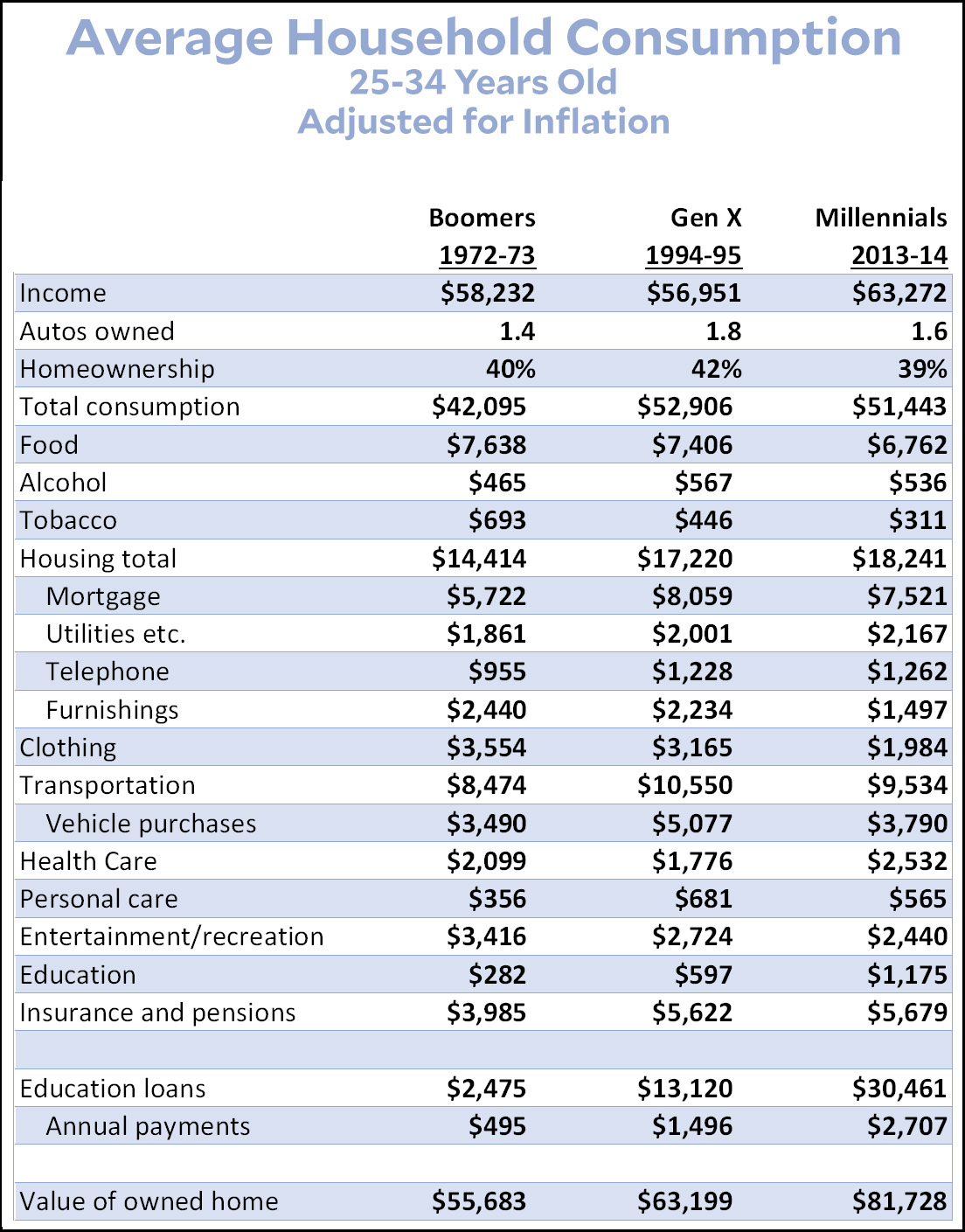
    (NOTE: This table has been corrected and updated. It now shows income before taxes rather than income after taxes. Explanation here. The mortgage line has been corrected to show total mortgage payments, not just interest charges.)

    There are a few interesting things to note:

    • Income growth has been sluggish but not zero since 1972. Millennials make more money than either Xers or boomers. In addition, they pay lower taxes.
    • Auto ownership among millennials is higher than boomers and a little lower than Xers.
    • Both boomers and millennials spend about the same percentage of their incomes. Xers are the odd ones out here, spending mearly all of their income and owning homes at a slightly higher rate.
    • That said, homeownership is similar for all three generations, and identical between millennials and boomers.
    • I broke out telephone charges just because a lot of people might not realize that nothing much has changed on that front. Yes, we all own cell phones now, but back in 1972 we paid the equivalent of nearly $100 per month just for local calls on a normal landline plus a little bit of long distance calling.
    • Millennials, on average, spend about $1,000 more per year on education loans compared to Xers, and about $2,000 more than boomers.
    • Total housing costs have gone up about $4,000 per year since 1972. However, food, clothing, and entertainment cost significantly less.
    • Health care spending hasn’t changed much.

    Overall, young millennials face higher costs than young boomers did, but they also have higher incomes. When you add it all up, millennials have about the same amount of money left over at the end of the year as boomers, but they get quite a bit more for their spending (cell phones, computers, internet access, better cars, videogames, etc.).

    As always, keep in mind that these figures are averages. So housing, for example, is an average of everyone from the poorest renter to the richest McMansion owner. Obviously things might be different for a very specific demographic (like, say, a 30-year-old college educated woman working at a nonprofit and living in New York City). But on average, the CES gives a pretty good idea of how different generations compare.

    ¹TECHNICAL NOTES: Choosing representative years is tricky. My main goal was to avoid cherry picking years that were peaks or troughs of economic cycles. This made the whole exercise difficult. I chose 1972-73 for the boomers because that’s what was available. They didn’t conduct the CES every year back then. For Gen X I chose 1994-95. This makes the Xers a little older than the boomers, but I wanted to avoid choosing a year close to the 1991 recession. Millennials posed a real problem. The ideal comparison year is around 2008, but that’s the peak of the housing bubble and wouldn’t be representative. Likewise, a few years later is in the trough of the Great Recession, which receded very slowly. In the end, I chose 2013-14 because it seemed like the earliest year that was solidly part of an economic expansion. This makes the millennials in the survey older than the other the other two generations, but I needed to avoid the Great Recession by several years to get a fair comparison. You can argue with my choices, but the key is that all of these years are fairly similar: several years into an economic expansion but not at the peak of a bubble (1999, for example, or 2008).

    Also, by coincidence, 1972-73 is the peak year of postwar income growth. After that, income growth slumped and has been sluggish ever since. So we’re comparing recent generations to boomers in their best years.

    Education loans come from the Fed’s Survey of Consumer Finances. For 1972-73 (before the SCF existed), I plugged in a rough estimate based on CES data. The annual payments are based on a 15-year repayment schedule using interest rates prevalent at the time.

    For the inflation adjustment I used the CPI-U-RS, backed out from the Census Bureau’s historical income figures.

  • Thursday Night Debate Wrap-Up

    NBC News

    I didn’t have a strong reaction to tonight’s debate. The three candidates who commanded the stage best were Biden, Harris, and Sanders, but I didn’t feel that any of them decisively beat the others. Biden seemed a little too laundry-listish and Sanders was Sanders. So if you put a gun to my head, I guess I’d say Harris had the best night. Here are some other miscellaneous observations:

    Unlike last night, Donald Trump came up constantly tonight. I assume no one is surprised that everybody on stage thought he was a very bad president?

    Please, can we never again have a “go down the line and just one or two words from each of you” question?

    Once again, no one seemed willing to get into much detail on climate change. I suppose that’s normal for a campaign, but for a bunch of folks who all agree that climate change is an existential threat, it’s a little spineless that they aren’t even willing to endorse a carbon tax.

    I hate to say this, but Joe Biden seemed to have a bit of a hard time finding the words he wanted to find. It wasn’t a good look for someone whose biggest negative is his age.

    Did Kamala Harris come across as passionate or angry? I’m not sure. However, I think she wins the zinger contest with her (undoubtedly preplanned) quip about how viewers don’t want a food fight, they want to know who’s going to put food on the table.

    However, Pete Buttigieg gets a strong second place for his response to which country he’d talk to first: “Well, we don’t know who we’ll piss off the most over the next two years.”

    Marianne Williamson is really annoying.

    UPDATE: As usual, I wrote all this before listening to any other commentary. Now, after listening to a bit of it, it appears that the MSNBC folks think the highlight of the debate was Kamala Harris going after Joe Biden for (supposedly) telling us what great people those old Southern segregationist senators were. I guess I just react differently to this kind of stuff. To me, it seemed rehearsed and fake, not genuine outrage.

    But that’s just me.

  • Watching the Nightly News Might Be Good For You

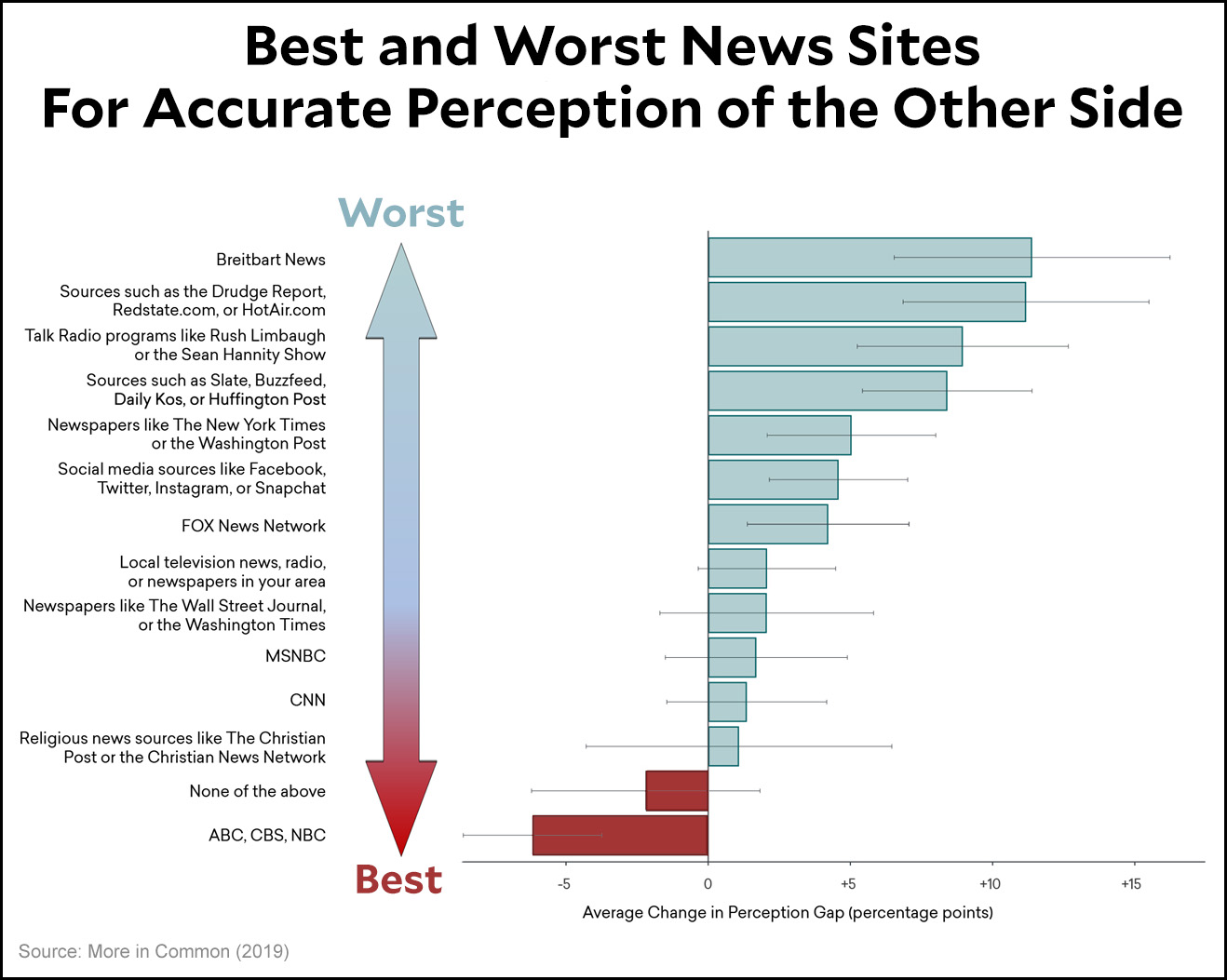
    Here’s an interesting graphic from a survey done by More In Common. It’s not about which media sources are the most accurate. It’s about which media sources do the most to improve the accuracy of your perceptions of your political opposites:

    If this is right, every single type of news media makes your perceptions of the other side less accurate. The only exceptions are the old-school nightly network news shows.

    There’s plenty to argue with here. There’s the definition of “accurate” for starters. There are those massive error bars. And there’s the question of whether mainstream news sources are actually at fault for any of this. For example, if Republican political leaders are more extreme than Democratic political leaders—and the New York Times mostly quotes political leaders—then readers might indeed get a wrong impression of what the average Republican thinks. But that’s more the fault of the political leaders than the Times.

    Still, it’s kind of interesting. I guess those feel-good stories at the end of every nightly news show—which I hate because I’m a cranky misanthrope—actually do some good after all.

  • Lunchtime Photo

    Today marks the end of Kate and Ken week. Thanks guys! For their final selection, they unknowingly picked a triptych. This is a photo of some trees on a foggy morning along the Blue Ridge Parkway, each of them photoshopped in a different way. The top photo is black and white. The middle photo uses desaturated color to emphasize the fog. The bottom photo uses bright, saturated color with the sunny patch emphasized. Collect all three!

    May 9, 2019 — Near Blowing Rock, Blue Ridge Parkway, North Carolina
    May 9, 2019 — Near Blowing Rock, Blue Ridge Parkway, North Carolina
    May 9, 2019 — Near Blowing Rock, Blue Ridge Parkway, North Carolina
  • The Wayfair Walkout, Explained?

    An HHS tent city for immigrant children in Tornillo, Texas.U.S. Department of Health and Human Services/ZUMA

    Yesterday I wondered aloud why Wayfair employees objected to Wayfair selling beds to the government for use in immigrant detention facilities. I got many answers, none of them even remotely on point, which makes me think the real answer is that lots of people don’t actually understand what’s happening. Here’s a quick review.

    Back in 2018, President Trump instituted a “zero tolerance” policy for border prosecutions that had the effect of taking children away from their parents. However, that policy ended after a few weeks when a court ordered it halted. Since then, the number of separations has been small—though not zero, for reasons that are a little unclear.

    So there are some number of children in federal custody who have been separated from their parents. The number of them who are in detention facilities (as opposed to being placed in homes) is smaller yet, but again, the actual number is fuzzy. Maybe a thousand? A few hundred? I don’t know, and it’s not clear if anyone knows.

    However, the vast majority of the children in custody are unaccompanied minors. Mostly these are teenagers who arrive at the border alone, while some are teens or younger children who arrive with other asylum seekers who are not their parents. Right now this amounts to 10-15,000 children, by far the bulk of immigrant children in federal custody.

    But here’s the key issue: these children are not supposed to be in the custody of the Border Patrol at all. Within 72 hours they’re supposed to be transferred to the Department of Health and Human Services—and most of them are. But some of them stay in CBP facilities for days or weeks, and the conditions in these facilities are horrible.

    So there are several things in play here:

    • These are children. They can’t simply be processed and released.
    • The CBP facilities will always exist. The Border Patrol has to put people somewhere when they’re first apprehended. However, the conditions in these facilities should be decent and children should be transferred out within the legally mandated 72 hours.
    • The children in HHS custody should also be held in decent conditions. The vast majority of them are unaccompanied minors who are not being reunited with their parents because they entered the US alone. They typically remain in HHS facilities until case workers can place them with a sponsor in the United States.
    • The remaining children who were separated from their parents should be returned to them. The Trump administration has been dragging its heels on this for a long time.

    There’s no question that the huge spike in asylum seekers has caused a crisis within the Border Patrol and, to a lesser extent, HHS. They simply aren’t set up to deal with the kinds of numbers they’ve been handling over the past few months. Right now they’re scrambling to improve conditions in their facilities, and that includes things like buying tents and food and beds and so forth. This is perfectly sensible, and there’s no reason any company should have qualms about selling stuff on a normal, commercial basis to help CBP and HHS in this effort.

    POSTSCRIPT: None of this has anything to do with ICE facilities, which are for immigrants arrested by ICE within the United States. That’s a whole different can of worms.

  • The Trump Doctrine: Bash Our Friends, Cozy Up to Our Enemies

    The Trump Doctrine, our president’s unique brand foreign policy, is alive and well:

    President Trump, arriving in Japan on Thursday, opened his latest foreign trip much as he did his last one, lashing out at America’s allies, including his hosts, just before sitting down with them to talk through differences on issues like security and trade. In the hours before and after leaving for an international summit meeting, Mr. Trump assailed Japan, Germany and India.

    ….By contrast, Mr. Trump said nothing critical about the fourth leader on his diplomatic schedule for Friday, President Vladimir V. Putin of Russia….Nor did he say anything negative about his breakfast date for Saturday morning, Crown Prince Mohammed bin Salman of Saudi Arabia.

    For years, Republicans insisted that President Obama was harsh toward our friends and friendly with our enemies. This was nonsense driven mostly by Obama’s neutral attitude toward Israel, but now we have a president who really and truly does this. But Trump likes Israel, so I guess it’s all OK.

    And speaking of Israel, I’ve noticed some befuddlement over the fact that Cory Booker and Amy Klobuchar were lukewarm toward the Iran deal at last night’s debate. This was one of President Obama’s premier achievements, so why the shade? The answer, I think, is that Booker and Klobuchar are both strong supporters of Israel, and Israel never liked the Iran deal. Does anybody have a better explanation?

  • Should We Repeal Section 1325?

    NBC News

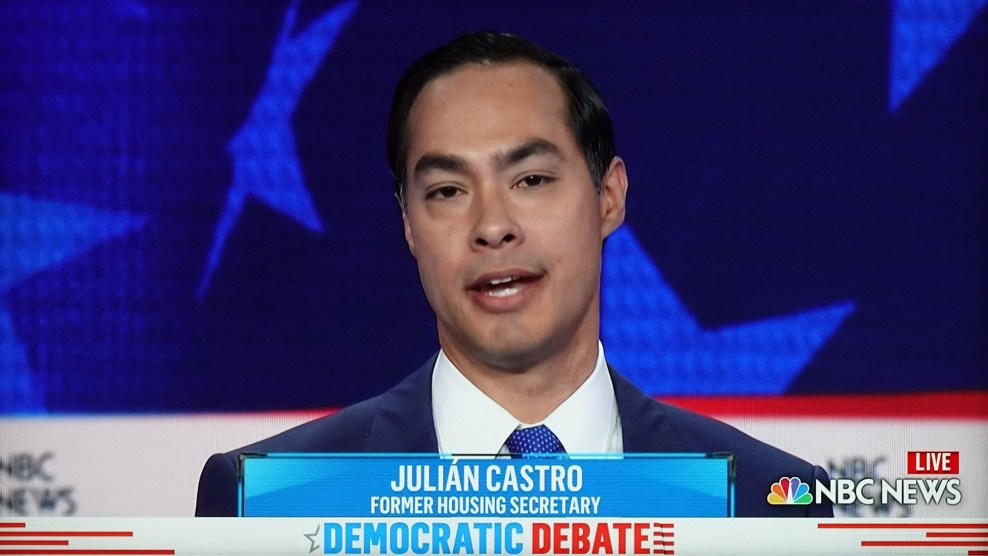
    Julián Castro probably confused a lot of people with his call to “repeal Section 1325” at last night’s debate. This is something that’s been peculiar for a long time and is likely to divide Democrats.

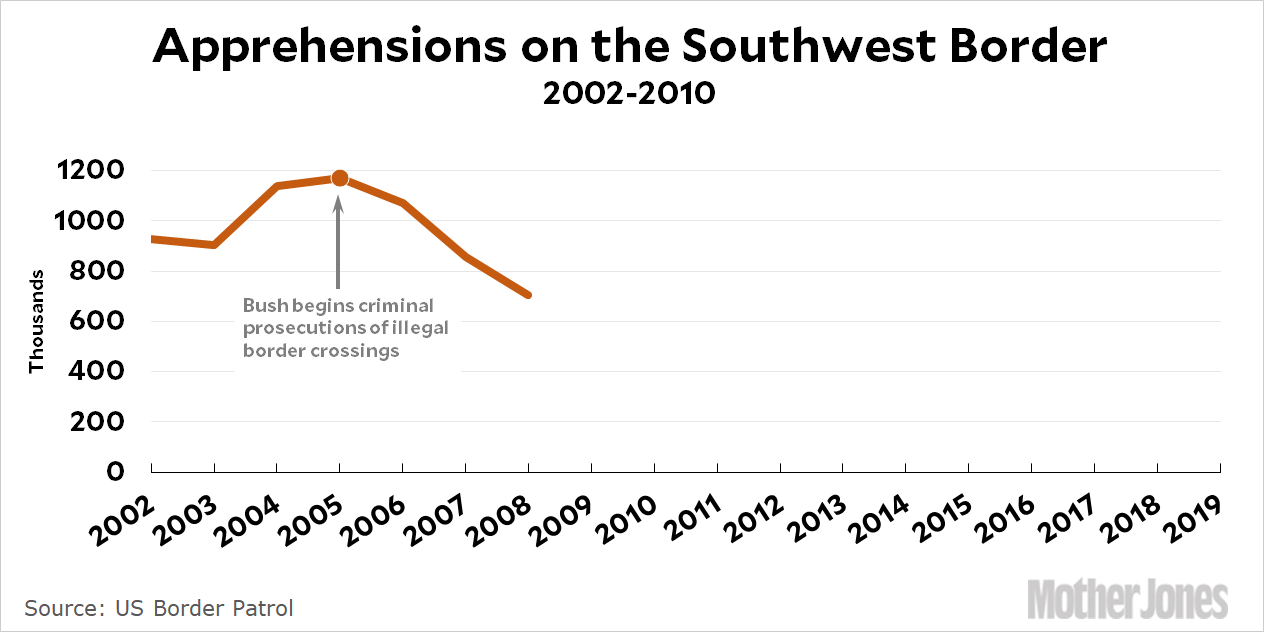
    The whole thing starts in 2005, when George Bush decided to start prosecuting undocumented immigrants in criminal courts. This was done under the authority of Section 1325 of the penal code, which had never been used before. It’s never been 100 percent clear to me why Bush did this, but the ostensible reason was that it would act as a deterrent to illegal border crossings. At first, there was a defensible case to be made for this:

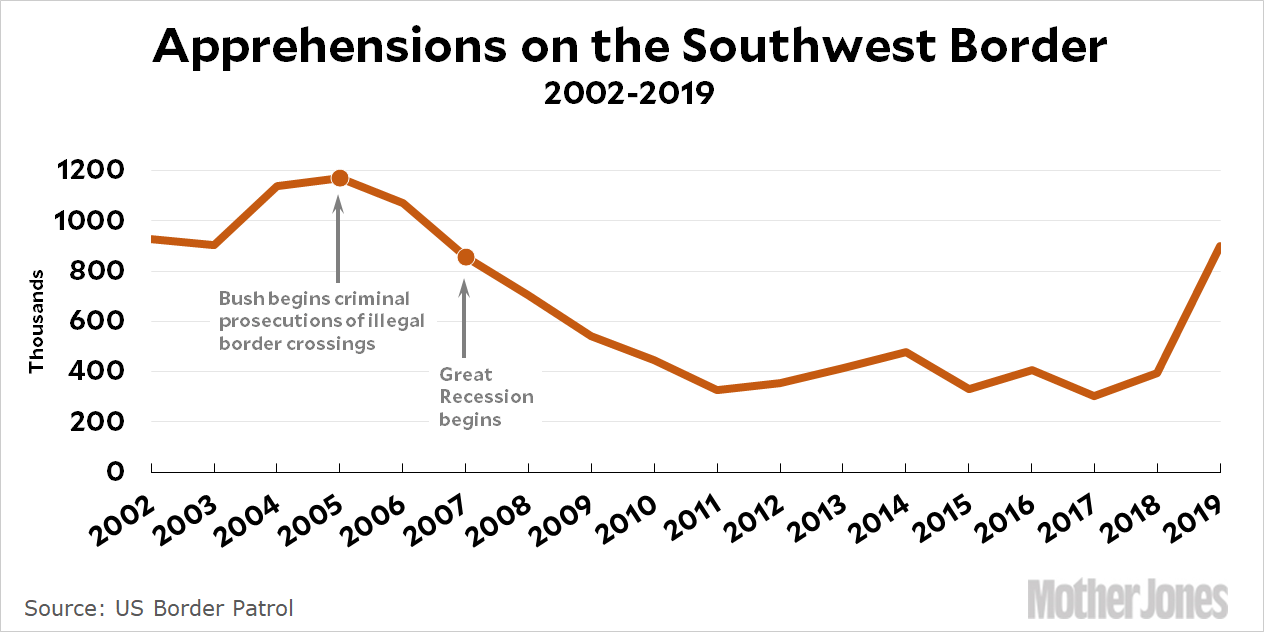
    The prosecutions began in 2005 and expanded over the next couple of years. And sure enough, illegal border crossings declined. When Barack Obama became president, he continued the prosecutions:

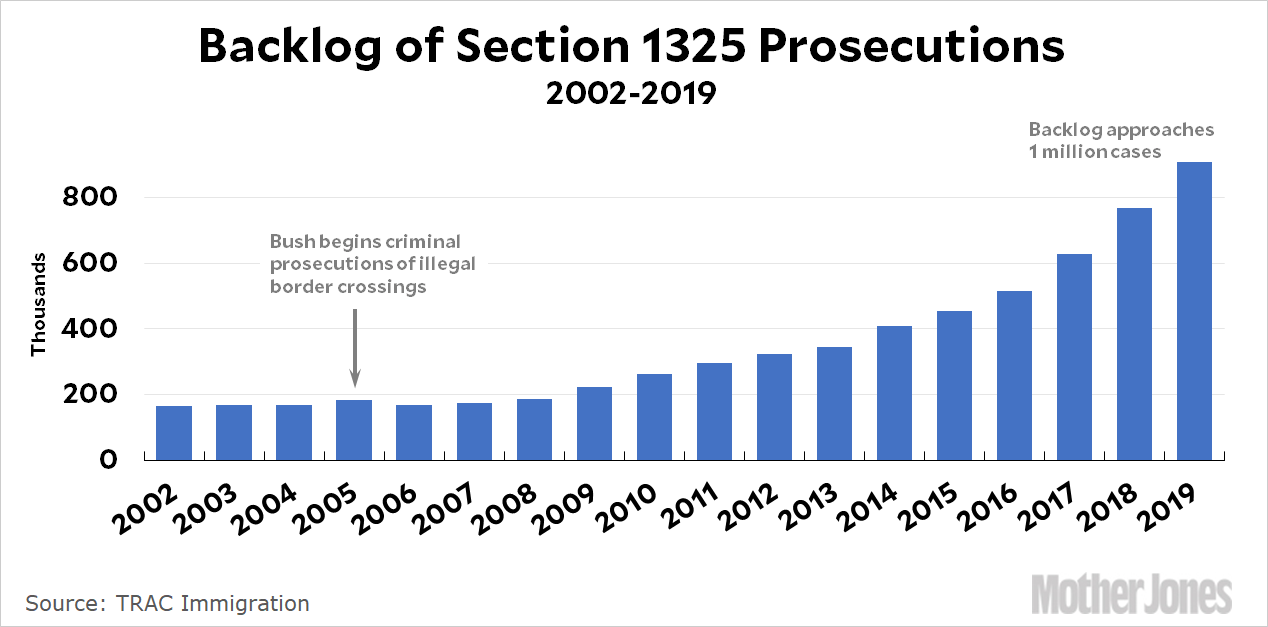
    This is where things get dubious. Nobody seriously believes that Section 1325 prosecutions are responsible for this entire decline. It was mostly due to the Great Recession, which wrecked the US economy and eliminated a lot of the jobs that motivated migrant workers to cross the border. So the question now becomes: just how much of this decline is due to Section 1325 prosecutions? There’s no simple answer to that, but it’s a good guess that, in fact, the decline in 2006 is just noise and the decline in 2007 might be due partly to Section 1325 and partly to the shaky US economy. The rest is probably driven entirely by the economic collapse. In other words, it’s likely that the prosecutions actually had only a modest effect on the overall picture. Further evidence for this is the fact that prosecutions are monumentally backlogged:

    The average wait for a case to be heard is now more than two years. It seems unlikely that this acts as a serious deterrent to illegal border crossings, but I suppose reasonable people can disagree about that. However, it also costs a lot of money and makes a joke out of our judicial system.

    So Castro’s point is: why continue this? Why not ditch the Bush/Obama prosecutions and just return to the previous system, which was less formal but probably just as effective? Technically, this doesn’t actually require the repeal of Section 1325, merely a return to its historical non-enforcement, but repealing it would obviously be a more permanent change.

    Border prosecutions have now been going on so long that everyone accepts them as a fact of life. This is why you hear endless calls for more judges and more resources to reduce the insane backlog of cases. That’s one answer. Another is to simply stop the prosecutions and end the backlog instantly. That’s Castro’s proposal, but not all Democrats are ready to accept it.

  • Supreme Court Kills Citizenship Question on 2020 Census

    On the bright side of things this morning, the Supreme Court did manage to kill the citizenship question on the 2020 census. Barely:

    In the end, though, Chief Justice John Roberts concluded that Commerce Secretary Wilbur Ross had gone too far in treating them like idiots. If you’re going to claim that a citizenship question is necessary, you need to take at least a minimal bit of care in spinning your lies. Ross didn’t bother with that, and that was too much to swallow.

    UPDATE: I went too far. The court left open the possibility of Ross cleaning up his lies and trying again. However, there’s virtually no time left to do that, since the census forms need to be printed very soon. This is most likely the end of the citizenship question.

  • Republicans on Supreme Court Rule In Favor of Republican Gerrymandering

    Pennsylvania’s 7th congressional district, drawn to help Republicans maintain a political edge.Mother Jones; National Atlas

    The Republican majority on the Supreme Court has ruled that it’s OK for Republicans to continue gerrymandering their way to victory:

    The 5 to 4 decision was written by Chief Justice John G. Roberts Jr. and joined by the court’s other conservatives. “We conclude that partisan gerrymandering claims present political questions beyond the reach of the federal courts.,” Roberts wrote. “Federal judges have no license to reallocate political power between the two major political parties, with no plausible grant of authority in the Constitution, and no legal standards to limit and direct their decisions.”

    I’m sure we’re all shocked by this, aren’t we? But don’t worry: if Democrats ever start winning the gerrymandering wars, I’m sure that Roberts will suddenly decide to look a little harder for a plausible grant of authority in the Constitution. In the meantime, this will continue to represent a far more genuine threat to democracy than anything the Russians do.

  • Democratic Debate Wrap-Up

    NBC News

    I watched tonight’s debate, but I was in and out of the room a bit so I didn’t see every single minute. I’m not going to try to distinguish winners or losers, but instead I’ll just toss out a few miscellaneous observations:

    On most subjects, there was a scrum of candidates all trying to interrupt as soon as the first person had finished answering the question. But when the subject was climate change, the stage was eerily quiety. Most of these folks don’t really want to talk about it. I think they’re afraid of saying something that will be interpreted as asking people to make an actual sacrifice.

    Beto O’Rourke wasn’t very impressive. It’s just a little too obvious that he’s talking in platitudes instead of taking a detailed stand on anything.

    Elizabeth Warren says health insurance companies made $23 billion in profits last year. That sounds bad. But total health care spending last was $3.5 trillion. This means that insurance profits amounted to 0.6 percent of the total. I’d be happy to get rid of private insurers and get that to zero, but 0.6 percent isn’t a super persuasive argument for doing it.

    Julián Castro sounded pretty good. He’s clear and well-briefed, and his answers seem to be well motivated by both principle and pragmatism. I wouldn’t be surprised if he moves up a few points in the polls.

    Elizabeth Warren didn’t make any mistakes or anything, but she didn’t dominate the stage or really distinguish herself. That’s probably OK for now.

    Chuck Todd practically begged the candidates to say that they’d try to get rid of the filibuster if they were elected. Surprisingly, hardly any of them took the bait.

    John Delaney is very annoying.