Whenever I hear the phrase “prime age workers” I have a hard time not thinking of cattle stockyards. But that’s just me. All it really refers to is workers aged 25-54, those who are in the “prime” of their working years. It’s a useful construct because it eliminates things like kids who are in college and older adults who perhaps retire at different rates. The assumption is that between the ages of 25-54, basically everyone who wants to work is available to work. That makes it a good metric for analyzing the labor force.
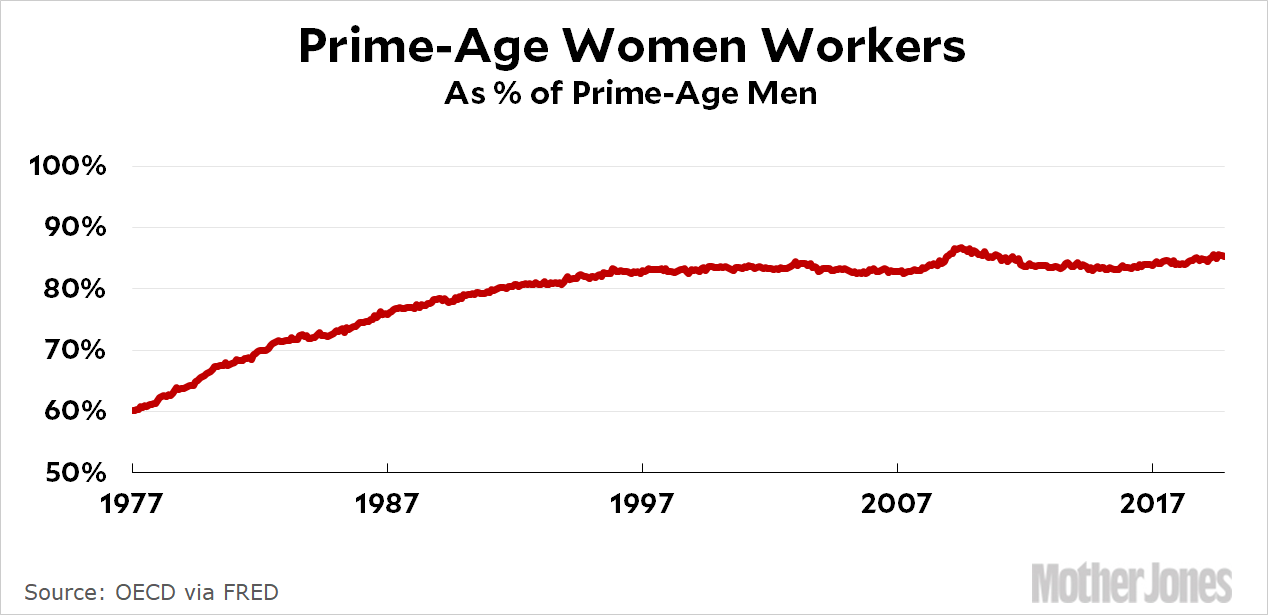
This popped into my brain after reading the dozenth story about how there are now more women in the workforce than men. In particular, women made up 50.04 percent of the workforce in the most recent count. But that includes everyone, and there are some other statistical artifacts that creep into this as well. A better way of looking at this is the percentage of prime-age working women as a ratio of the percentage of prime-age working men. Here it is:
If prime-age men and women were working at the same rate, this ratio would be 100 percent. In reality it’s only 85 percent. That’s up a lot—really a lot—over the past 40 years, but it’s still well below even. Among prime-age workers, the share of men working is still considerably more than the share of women working.
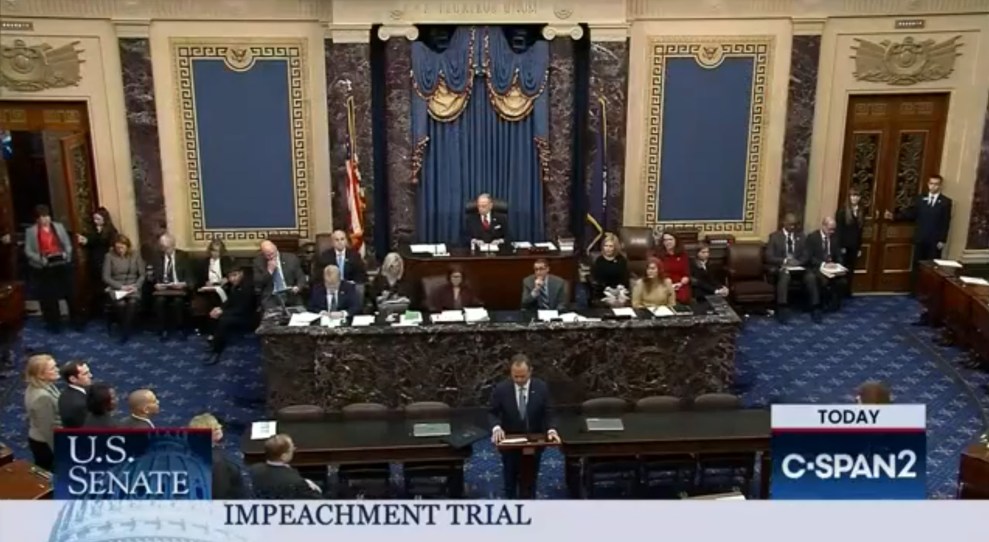
McConnell’s organizing resolution, which he circulated late Monday afternoon, offers each side 24 hours to make their opening arguments starting on Wednesday but compressed into two session days. It is unclear whether Democrats would press to use all their time, which could push testimony past midnight.
After the House managers and Trump’s lawyers make their case, senators will be allowed 16 hours to question the opposing sides.
After that, the sides will debate for a maximum of four hours on whether to consider subpoenaing witnesses or documents at all, followed by a vote on whether to do so.
….The Senate trial also won’t automatically admit evidence from the House process, according to GOP officials, a key difference from the impeachment trial of President Bill Clinton more than two decades ago. Though the material will be printed and made available to senators, it won’t be automatically admissible unless a majority of senators approve it.
McConnell is obviously trying to get this over with quickly, and he’s also trying to bore people to death by forcing Democrats to hold the floor for hours on end. Hopefully Democrats are smart enough not to take the bait. These opening arguments, after all, aren’t aimed at senators, most of whom already know how they’re going to vote. They’re aimed at the public, and that means they need to be short, pointed, and simple. If Democrats can’t actually convict Trump, they can at least use the impeachment trial to introduce the American public to the highlights of what Trump did.
(The Trump side is already well aware of this. As the Post article says, their defense brief is “a legalese version of the scorched-earth rhetoric commonly used in the president’s Twitter feed.” That’s for the benefit of Fox News and talk radio, not the Senate floor.)
The only real question mark in this whole affair is whether the Senate will vote to call witnesses. My guess, as usual, is that McConnell will hold his caucus together and vote down a motion to subpoena witnesses, but you never know. All it takes is three or four defectors.
Anyway, it looks like things will start Wednesday and probably end sometime next week.
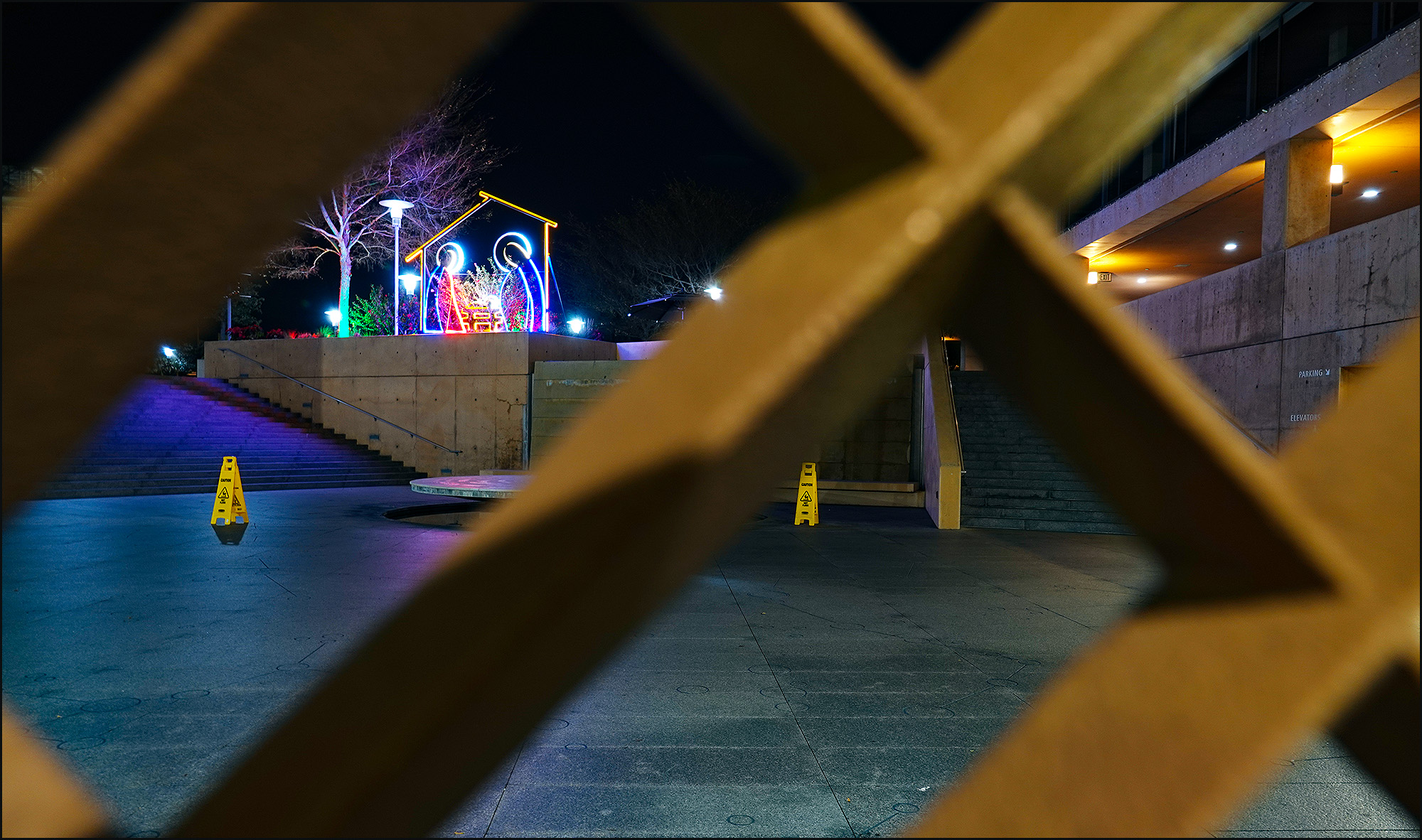
Today I have a lunchtime photo extravaganza for you. A couple of weeks ago I used one of my dex nights to head up to Los Angeles and take pictures of the LA Cathedral. I’ve driven by the cathedral many times since it opened in 2002, but I’ve never actually been there, and I figured it was past time.
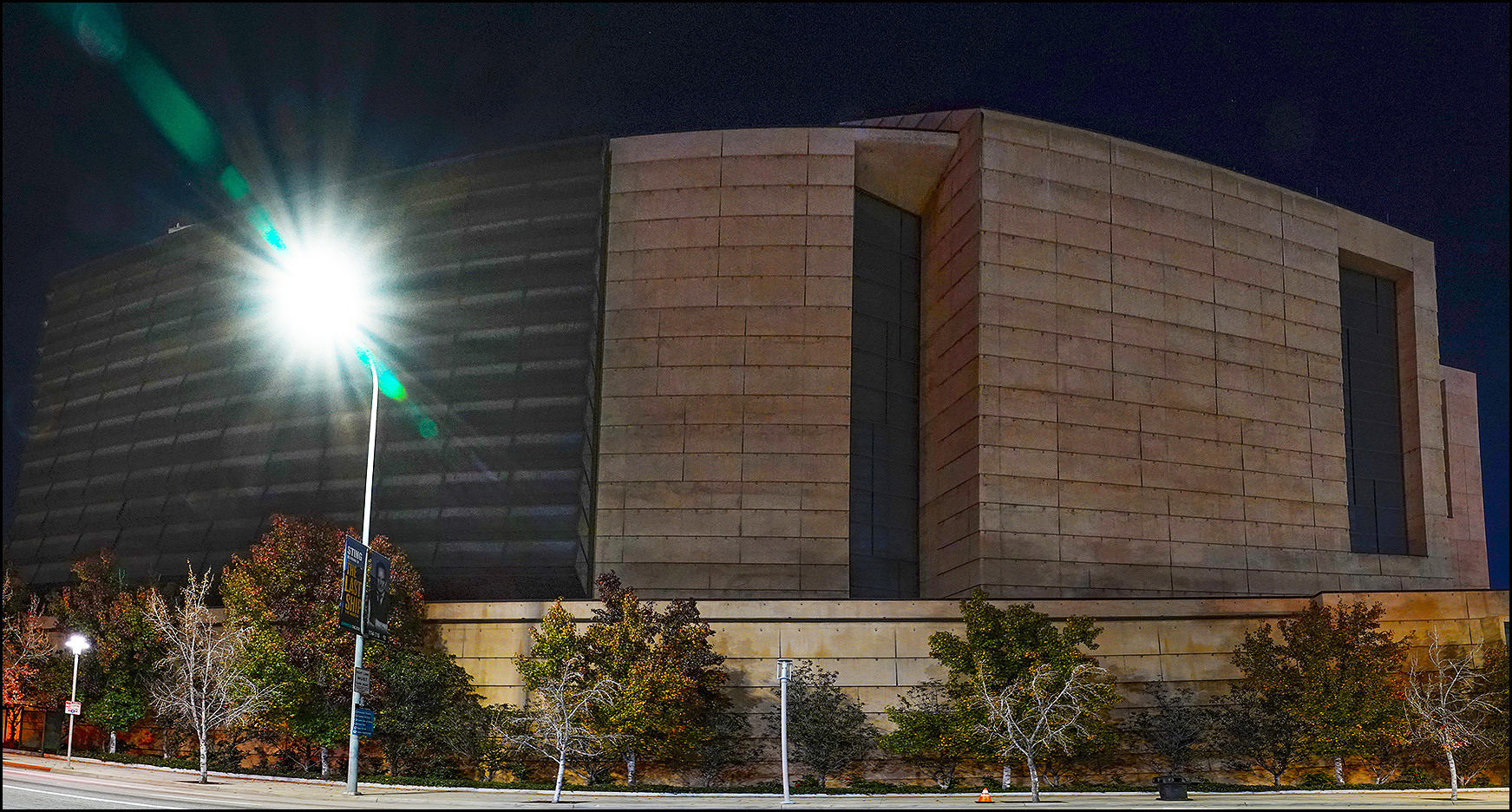
The cathedral itself keeps pretty short hours, but I didn’t know if the grounds were accessible more generally. The answer, it turns out, is no, for a simple reason: the place is built like an urban fortress and the gates are shut until the cathedral itself opens. The only thing missing to keep people out is concertina wire on top of the surrounding walls. The wall along Temple St. is upwards of 20 feet high, and the Grand Ave. side, which features a bell tower, is only slightly less intimidating:
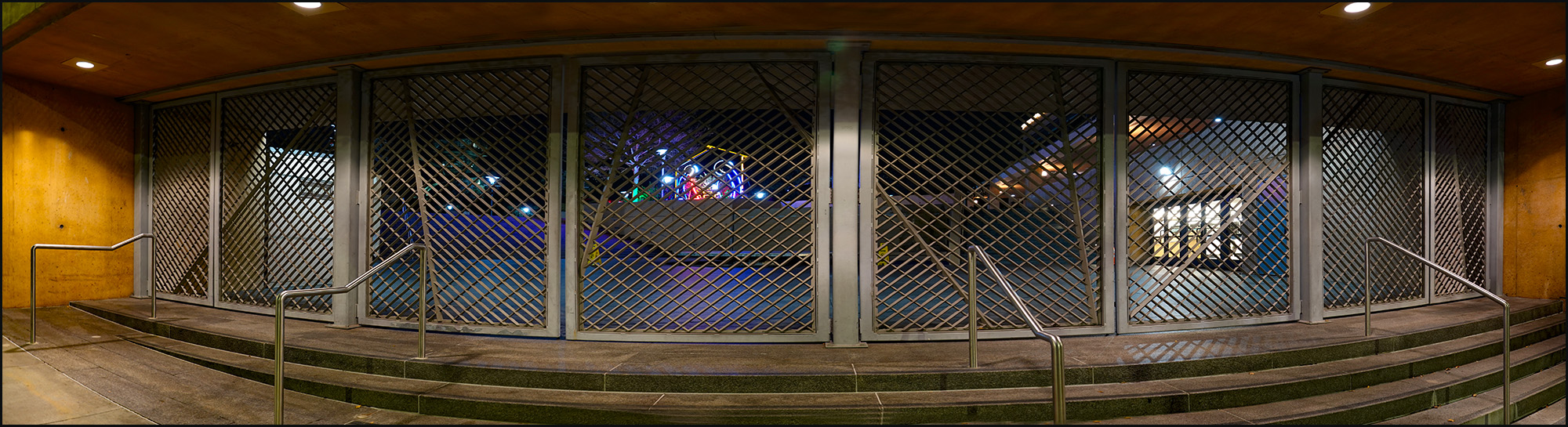
On Temple St. near Hill you’ll find the pedestrian entrance. There’s only one, and it has the look and feel of the entrance to a prison:
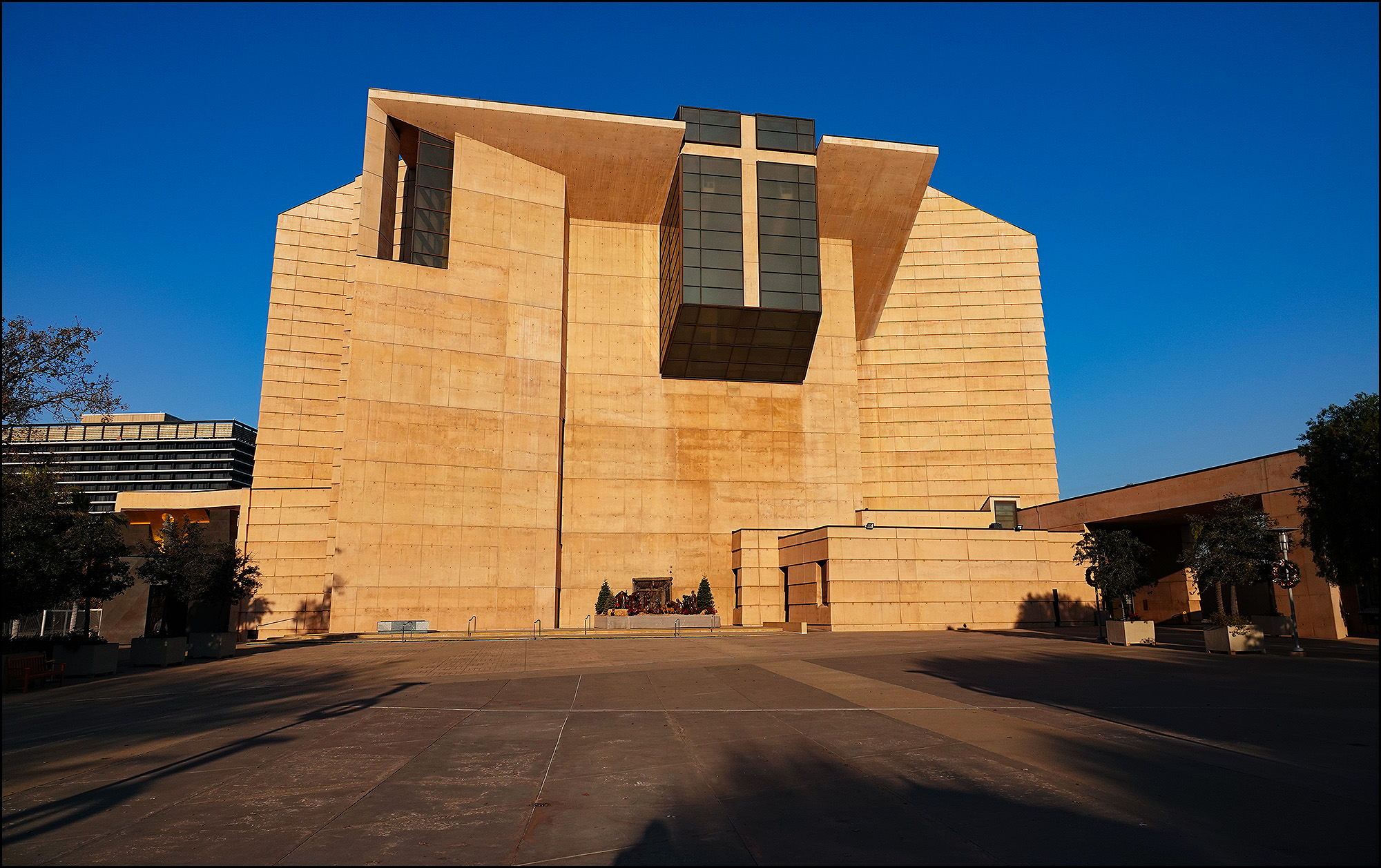
The cathedral grounds don’t open until 9 am on Saturdays, but it turns out the parking structure opens at 8 am and you can get into the grounds from there. That was lucky for me, since 8 am provides the ideal winter light for photographs and shows off the cathedral at its best:
Architectural connoisseurs are apparently fond of this brutalist-meets-colonial-revival building, but I find it pretty hideous, with absolutely nothing to make it look even slightly welcoming. The front facade—which is actually the rear of the cathedral—is a towering blank wall with the doors hidden off to the sides and a vast, empty courtyard in front. I suppose the courtyard was meant to remind us of the look and feel of the public plazas that typically sit in front of European cathedrals, but it does just the opposite. European plazas are open to the public and are usually bustling with people. The LA Cathedral’s courtyard sits behind walls and is completely lifeless most of the time. The entire structure is built forbiddingly of concrete, but the sand color is warm and appropriate.
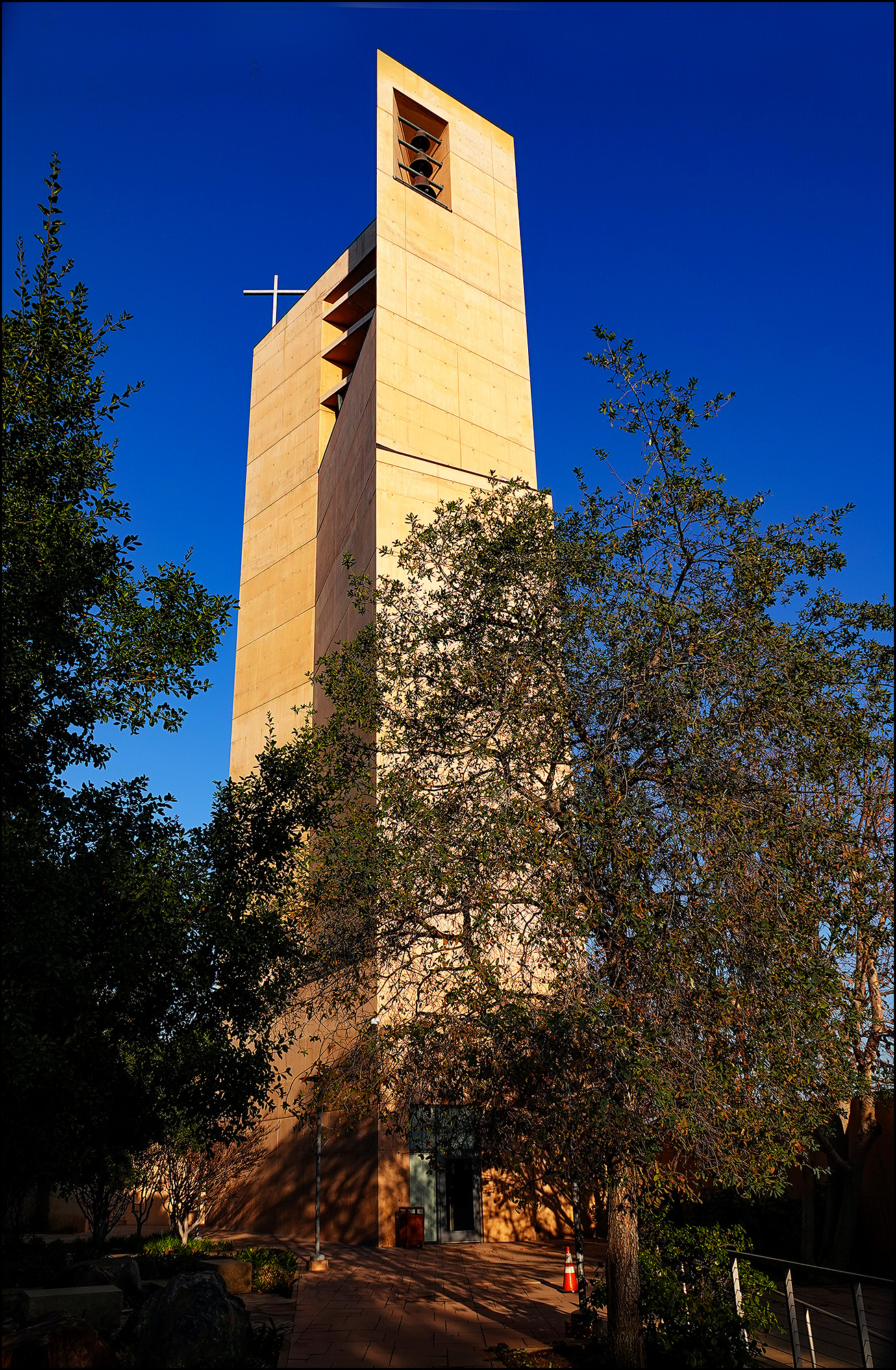
Here’s the bell tower:
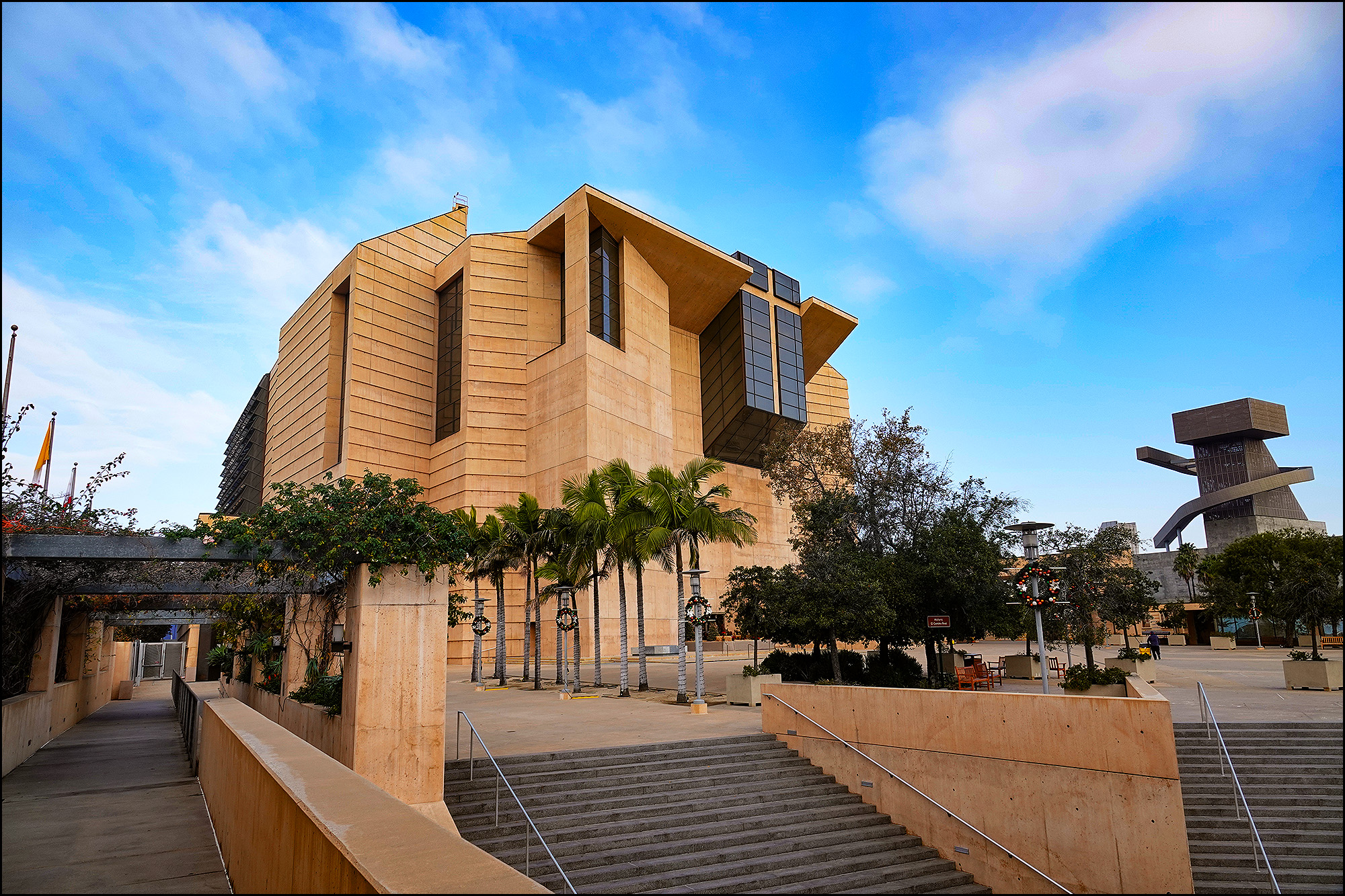
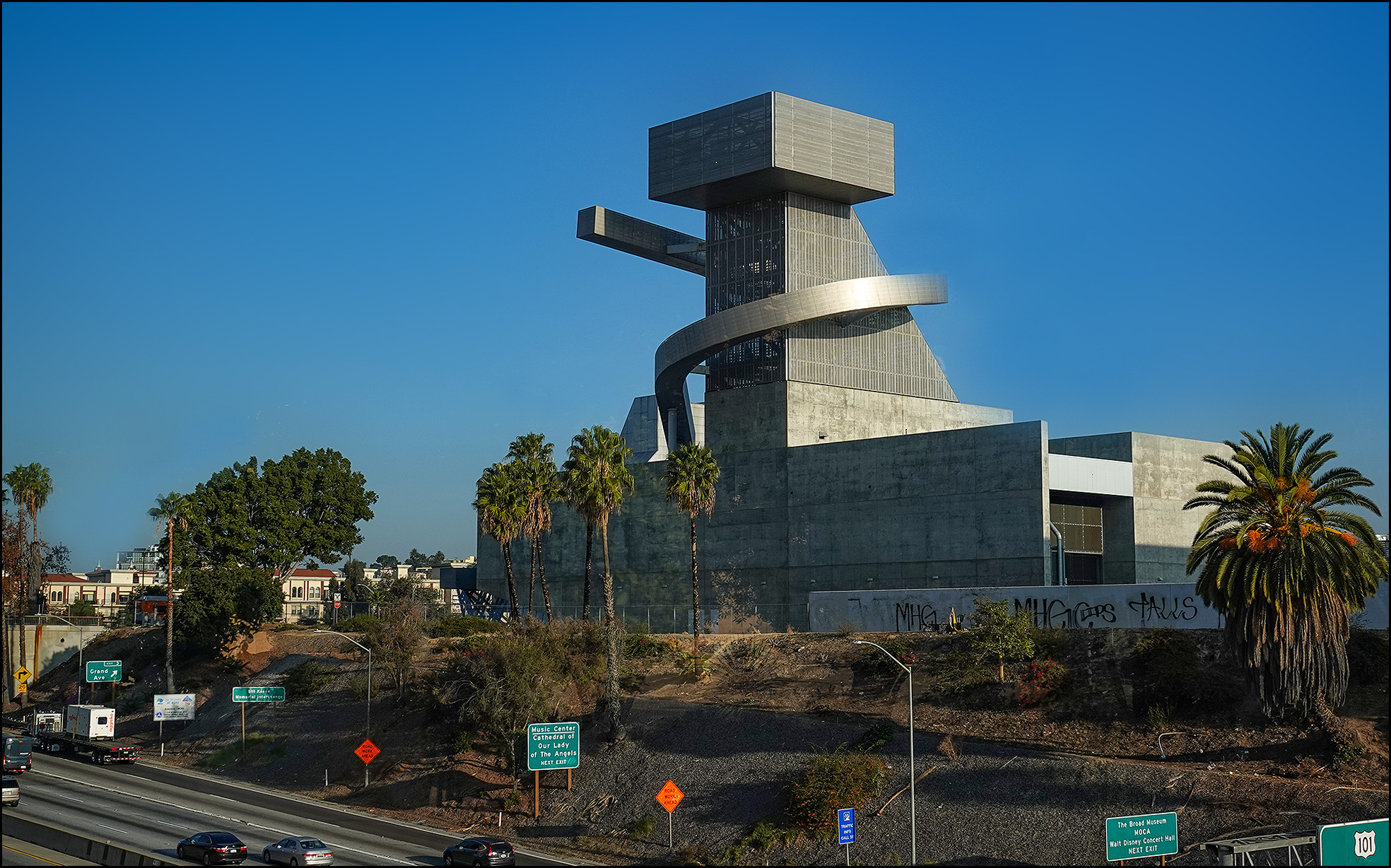
And here’s another view of the exterior of the cathedral taken an hour later after the light had softened, along with the giant robot monster threatening to tear it to pieces:
Wait. A robot monster? Yes indeed, that’s what it looks like. In reality, it’s the tower at Grand Arts High School on the other side of the Hollywood Freeway. It was originally intended to be functional, with a meeting space inside and a viewing platform on top, but that never happened. So it’s just a thing:
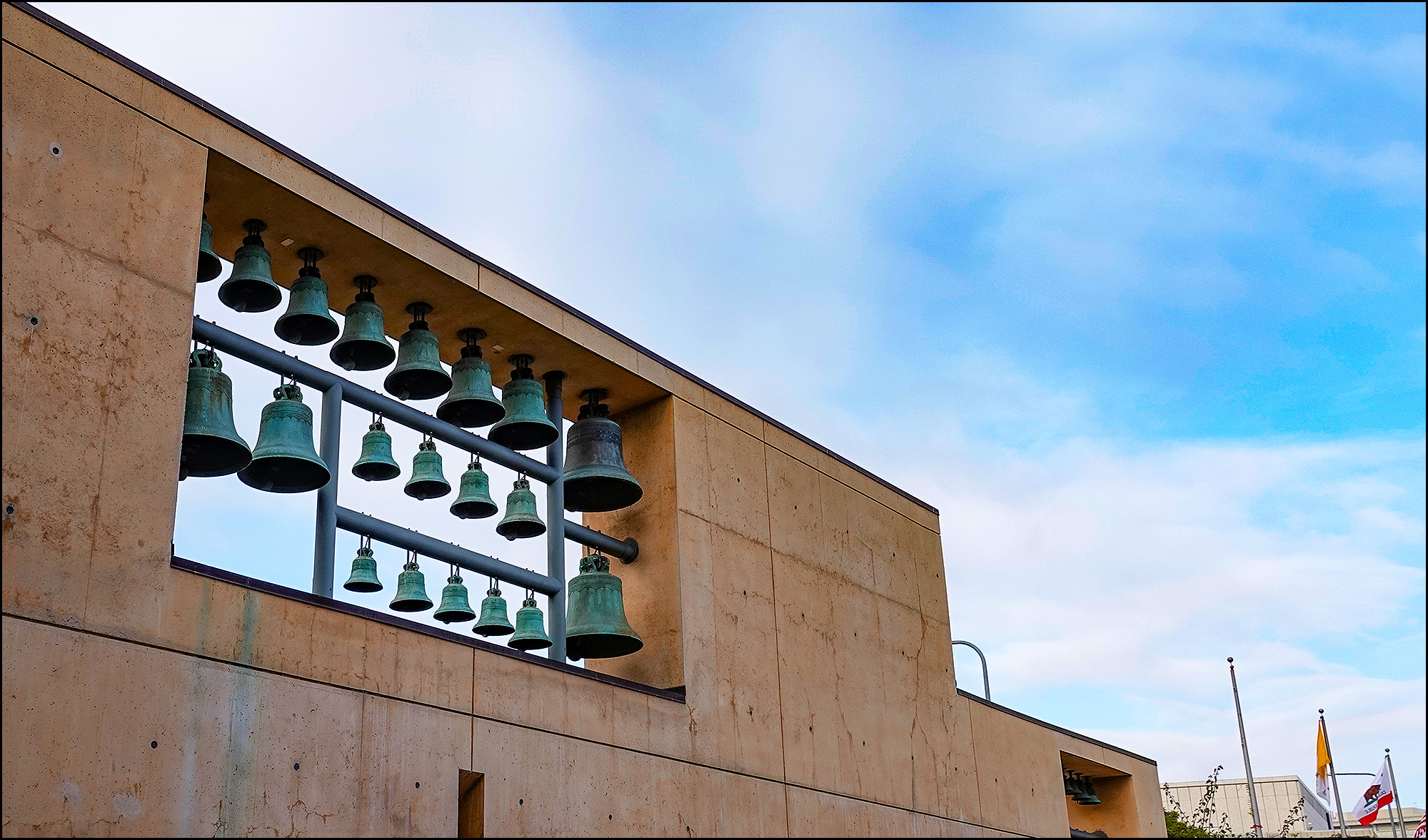
Back to the cathedral, then. The wall along Temple St. features a set of bells in a style meant to pay homage to the California missions:
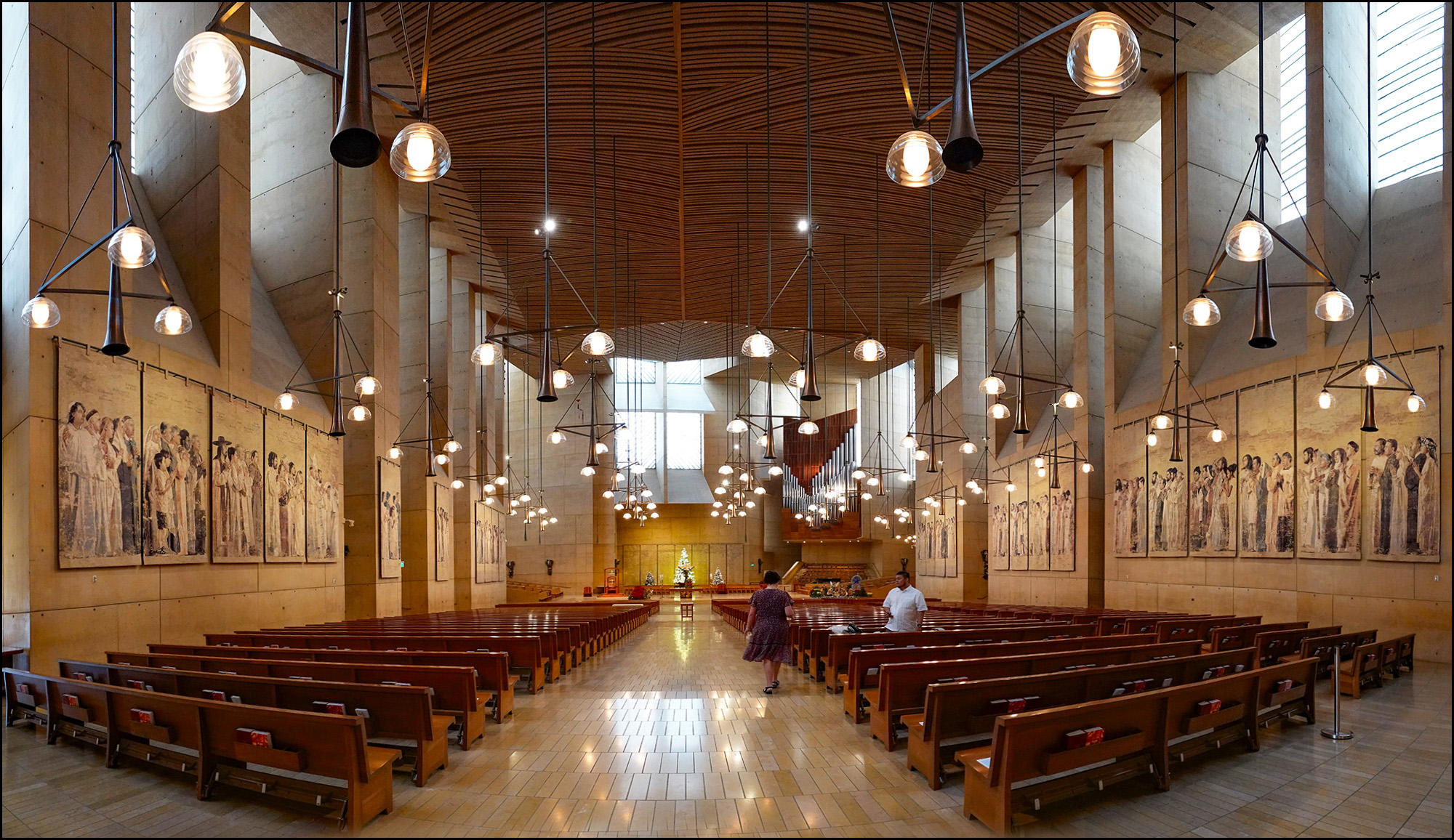
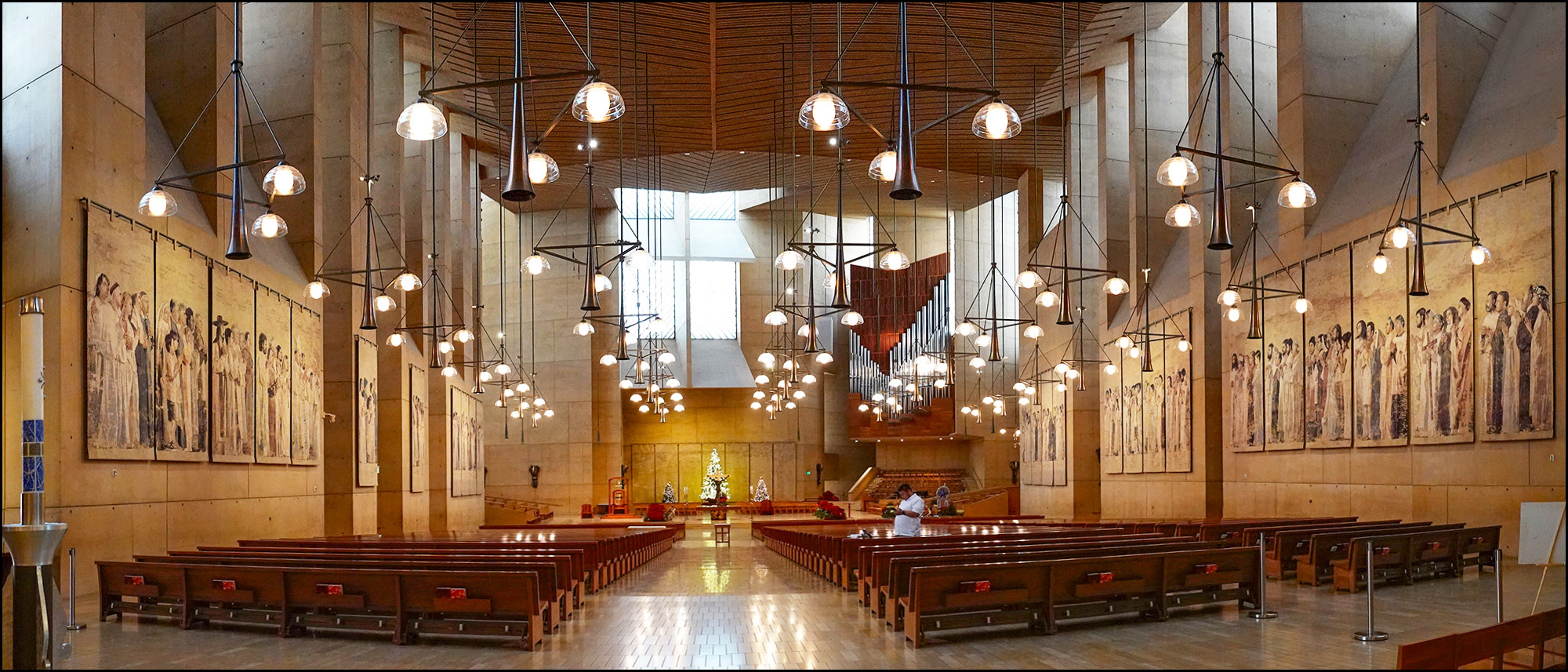
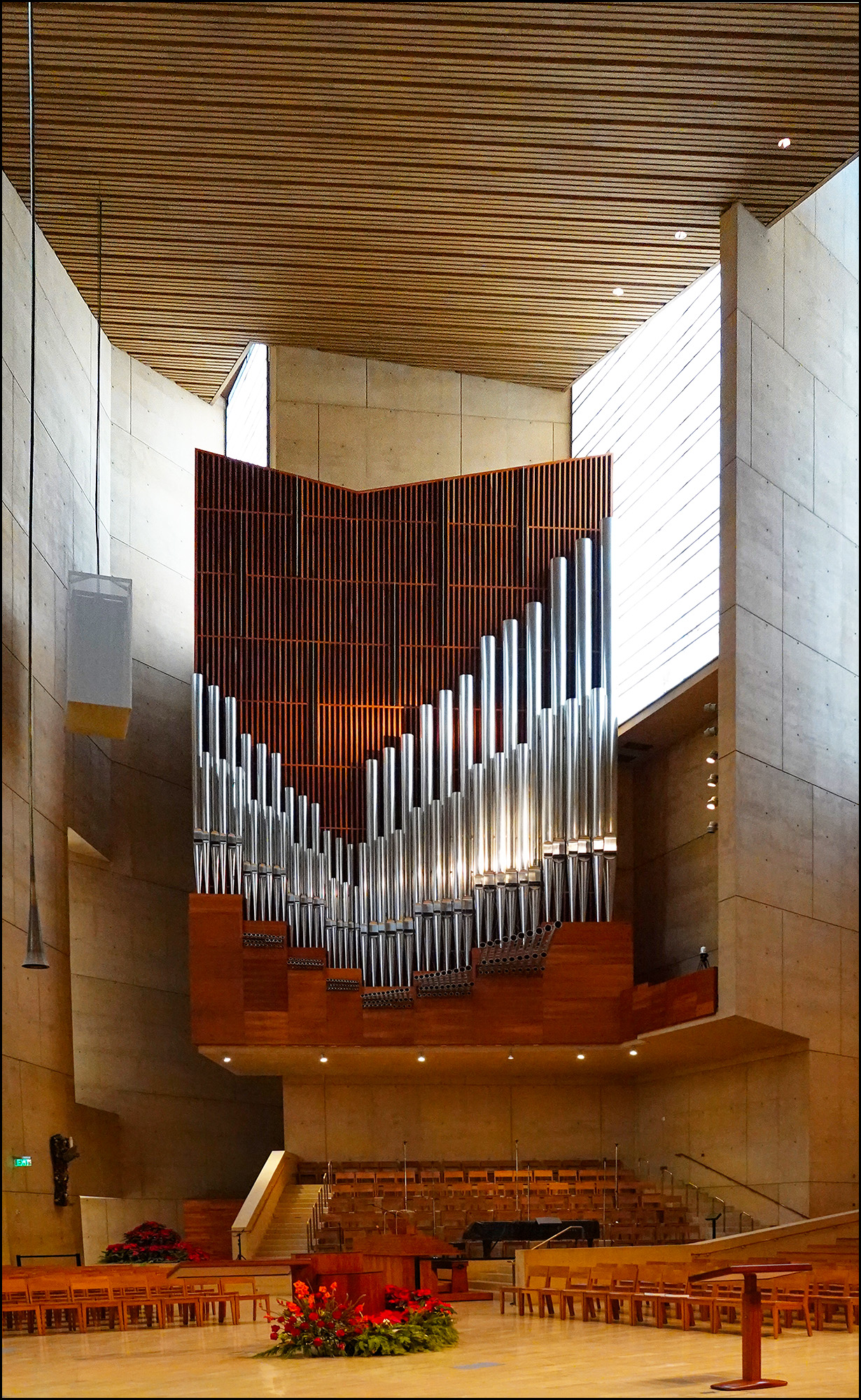
Surprisingly, the interior of the cathedral turns out to be lovely, warm, and welcoming. It was also a great opportunity to produce a panoramic view, which Photoshop did flawlessly. Here are two views, one taken from the rear of the nave (six frames stitched together) and one taken from a bit further back in the baptistry (four frames):
The organ has 6,019 pipes:
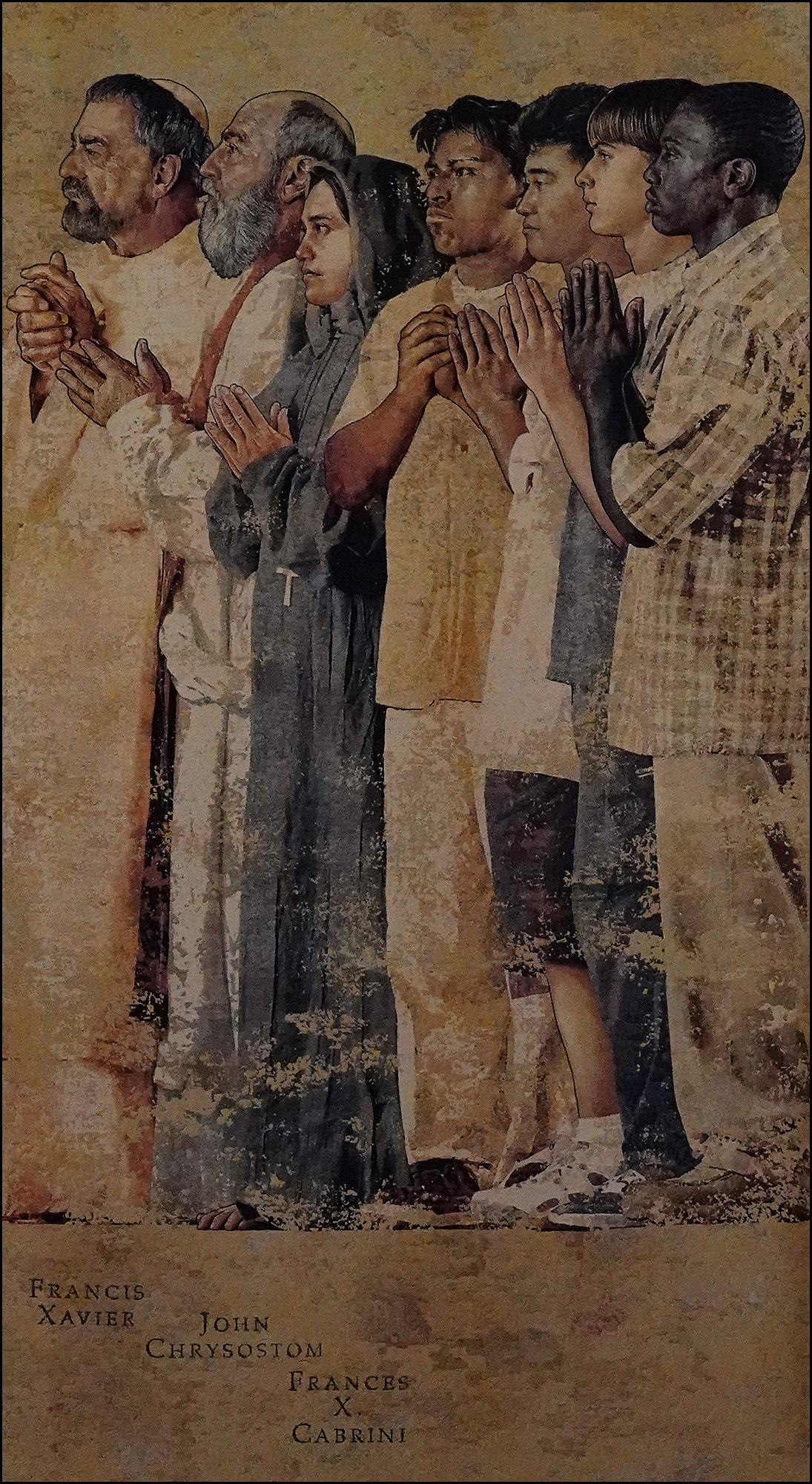
The sides of the nave are decorated with tapestries featuring images of various saints. I call this one the Tapestry of the Unknown Saints:
The Buttigieg surge and the Sanders mini-surge have faded. Elizabeth Warren has steadied after dropping nearly ten points since November. Meanwhile, Joe Biden has been slowly gaining back the ground he lost at the end of 2019 and he’s now back in the lead—though only by a few points.
And Amy Klobuchar continues her slow but continuous improvement. She’s not likely to win Iowa, but she could do well enough to surprise people.
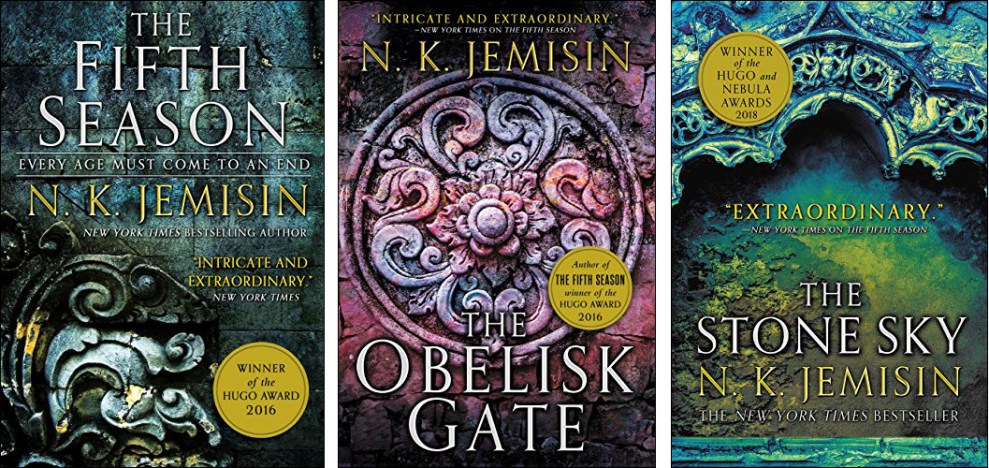
This is neither here nor there, but the New Yorker has a nice profile this week of N.K. Jemisin, who became my new favorite author a couple of years ago. Judging from the reception of her Broken Earth trilogy—which won three consecutive Hugo awards—she is everybody else’s favorite new author too. Broken Earth was great; you should read it. The Inheritance Trilogy was also great; you should read it too. I’m reading the Dreamblood Duology right now, so I can’t say for sure yet that it’s also great. But the odds are in its favor.
Sadly, Jemisin’s next book is, yet again, a trilogy. Since I don’t read trilogies until they’re finished, this means there’s no new Jemisin for me until 2022 or so. I shall have to make do with lesser authors in the meantime.
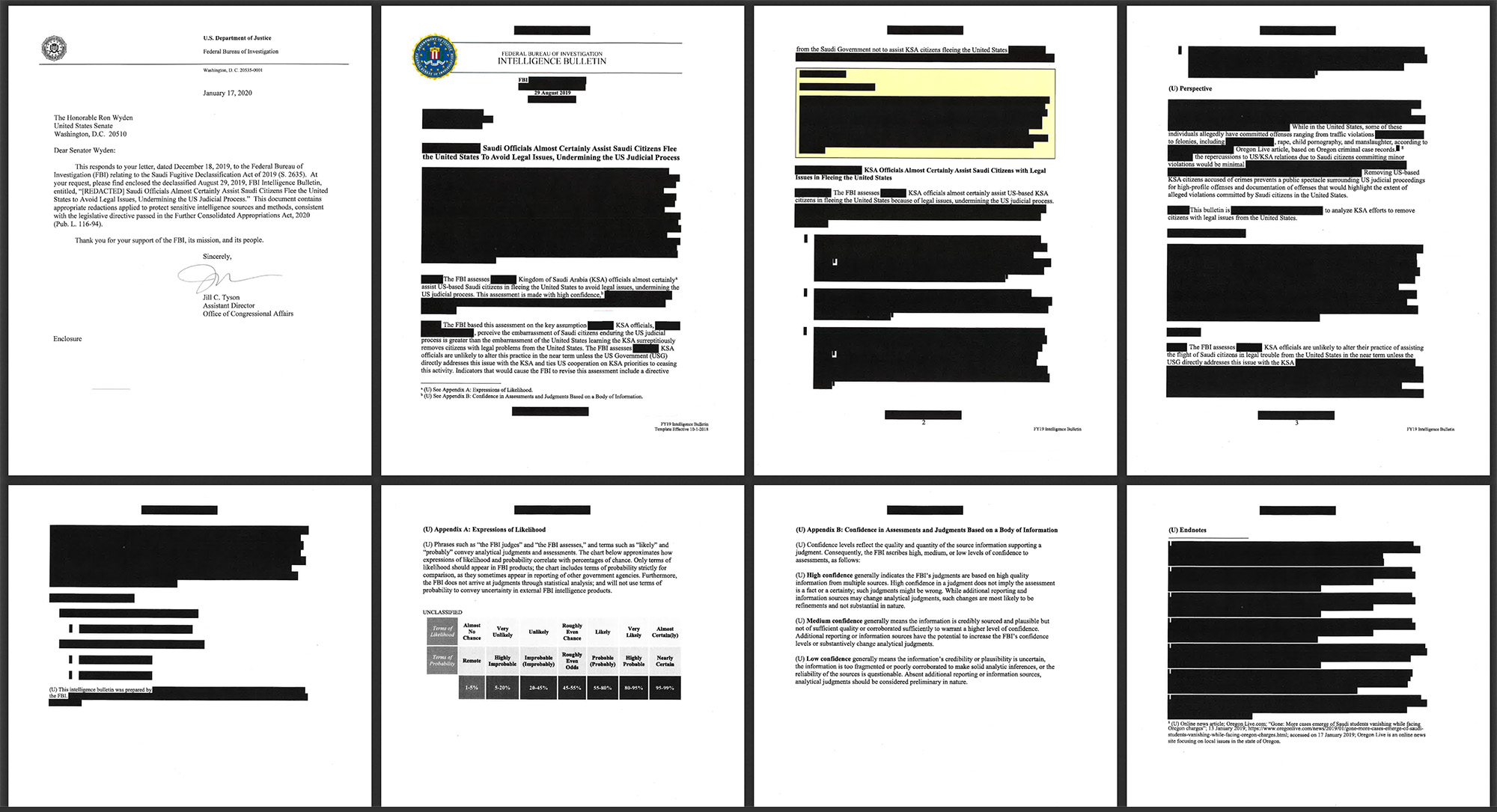
In a document declassified and released on Friday, the FBI said that officials of the Persian Gulf nation “almost certainly” help their citizens accused of committing crimes, including manslaughter, rape and possession of child pornography, to flee the United States.
“The FBI based this assessment on the key assumption [that] Kingdom of Saudi Arabia officials perceive the embarrassment of Saudi citizens enduring the U.S. judicial process is greater than the embarrassment of the United States learning the KSA surreptitiously removes citizens with legal problems from the United States,” the FBI intelligence bulletin said.
The FBI heavily redacted the seven-page document, which the agency was made to declassify under a requirement that U.S. Sen. Ron Wyden (D-Ore.) inserted in an appropriations bill signed by President Trump Dec. 20. Wyden said in an interview that the findings “make it clear that the Saudis have been lying,” adding that, “if these are our friends, who needs enemies?”
Apparently this was so heavily classified that it took an explicit order from Congress to make it public. And even at that, it was massively redacted:
It’s great that our friends treat us with such high regard now that Donald Trump has made us respected in the world again.
There’s a type of political opinion that I call a barstool view of the world. It’s the kind of thing some guy (always a guy) announces after a beer or six, and it’s always the product of massive ignorance. For example: “Screw the Middle East. We should just get the hell out and let them fight things out for themselves.”
As you might guess, I try to avoid opinions like that. And yet, my current opinion about the Middle East is, approximately, that we should get the hell out and let them wage their own wars. If we need to intervene to protect ourselves, as in the Afghanistan war, fine. We should intervene and then get out. But that’s it.
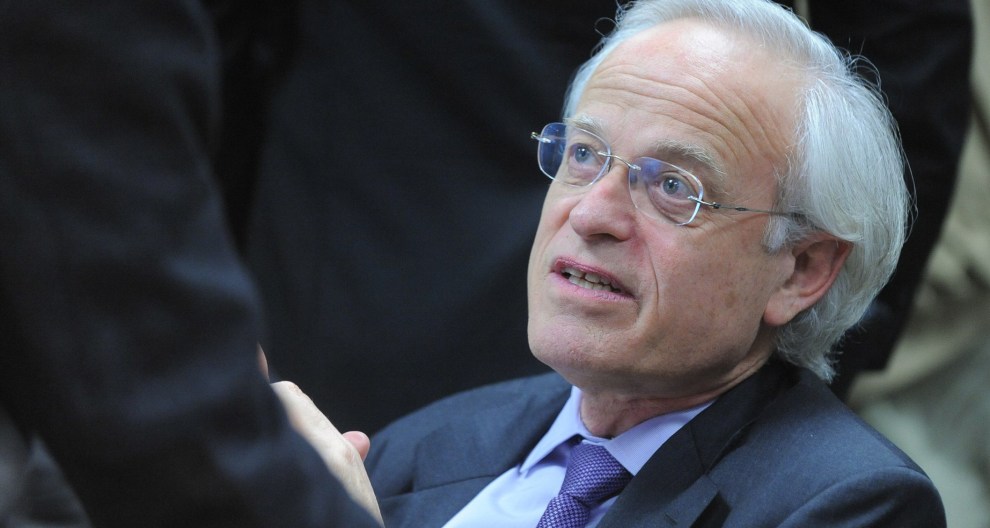
Naturally I realize that this is just a barstool opinion, and real life calls for a much more nuanced view. But does it? Martin Indyk has been deeply involved in the Middle East for decades, serving roles under both Presidents Clinton and Obama, and apparently he too thinks we should just get the hell out:
The Middle East Isn’t Worth It Anymore
Previously, presidents of both parties shared a broad understanding of U.S. interests in the region, including a consensus that those interests were vital to the country—worth putting American lives and resources on the line to forge peace and, when necessary, wage war.
Today, however, with U.S. troops still in harm’s way in Iraq and Afghanistan and tensions high over Iran, Americans remain war-weary. Yet we seem incapable of mustering a consensus or pursuing a consistent policy in the Middle East. And there’s a good reason for that, one that’s been hard for many in the American foreign-policy establishment, including me, to accept: Few vital interests of the U.S. continue to be at stake in the Middle East. The challenge now, both politically and diplomatically, is to draw the necessary conclusions from that stark fact.
….In the past, the U.S. has had two clear priorities in the Middle East: to keep Gulf oil flowing at reasonable prices and to ensure Israel’s survival. But the U.S. economy no longer relies on imported petroleum….As for Israel, it is still very much in America’s national interest to support the security of the Jewish state, but its survival is no longer in question.
….We cannot afford to turn our backs on the Middle East….Yet after the sacrifice of so many American lives, the waste of so much energy and money in quixotic efforts that ended up doing more harm than good, it is time for the U.S. to find a way to escape the costly, demoralizing cycle of crusades and retreats. We need a sustainable Middle East strategy based on a more realistic assessment of our interests. It is time to eschew never-ending wars and grandiose objectives—like pushing Iran out of Syria, overthrowing Iran’s ayatollahs or resolving the Israeli-Palestinian conflict—in favor of more limited goals that can be achieved with more modest means.
Granted, this is a nuanced version of “get the hell out,” but only slightly. Indyk thinks we should continue to be diplomatically involved in the Middle East, and also that there are occasionally American interests strong enough to require military action. But they are few and far between. There is hardly anything left in the Middle East that’s worth going to war for.
Also of interest: Indyk doesn’t quite come right out and say this, but he nods toward the idea that leaving Mideast oil supplies less certain might be a good thing. America itself doesn’t need Mideast oil anymore, and if other countries have to choose between protecting Gulf sea lanes and reducing their dependence on fossil fuels, maybe that will nudge them toward reducing their dependence on fossil fuels. The whole world would benefit from that.
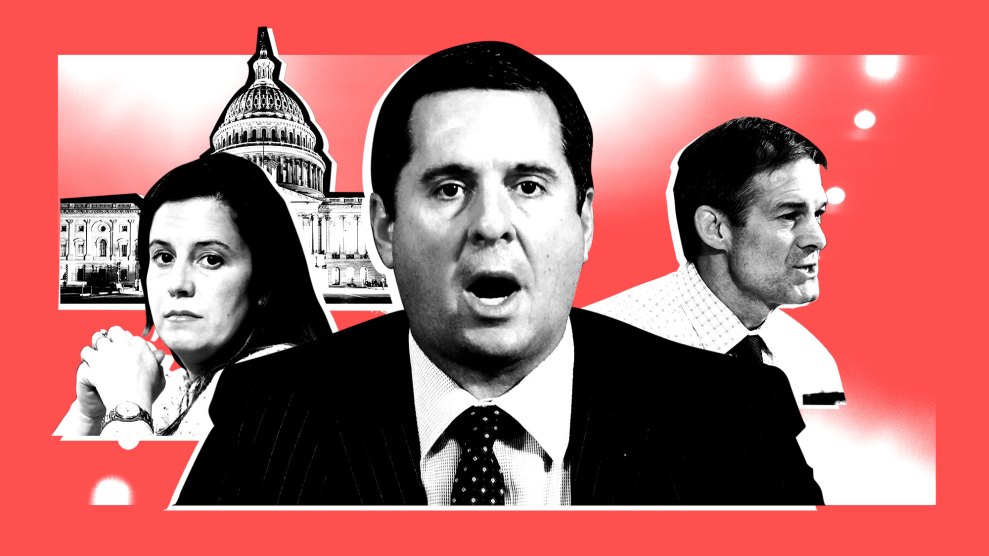
The text messages between Lev Parnas, who functioned as Rudolph W. Giuliani’s emissary to Ukrainian officials, and Derek Harvey, an aide to Rep. Devin Nunes, the ranking Republican on the House Intelligence Committee, indicate Nunes’s office was aware of the operation at the heart of impeachment proceedings against the president — and sought to use the information Parnas was gathering.
….Records that the House Democrats released in December first showed calls between Parnas and Nunes. At the time, Nunes said he couldn’t remember speaking with Parnas. On Thursday, Nunes told Fox News that he had reviewed his records, which refreshed his memory of having one conversation.
Uh huh. There aren’t a lot of politicians in Washington that I truly loathe. I mostly figure politics is politics, and what do you expect? But Nunes is in a class by himself. I really and truly hope he comes to a richly deserved bad end somehow.
His tiny company, Clearview AI, devised a groundbreaking facial recognition app. You take a picture of a person, upload it and get to see public photos of that person, along with links to where those photos appeared. The system — whose backbone is a database of more than three billion images that Clearview claims to have scraped from Facebook, YouTube, Venmo and millions of other websites — goes far beyond anything ever constructed by the United States government or Silicon Valley giants.
….Without public scrutiny, more than 600 law enforcement agencies have started using Clearview in the past year, according to the company, which declined to provide a list. The computer code underlying its app, analyzed by The New York Times, includes programming language to pair it with augmented-reality glasses; users would potentially be able to identify every person they saw. The tool could identify activists at a protest or an attractive stranger on the subway, revealing not just their names but where they lived, what they did and whom they knew.
I am supposed to be outraged by this, but I can’t bring myself to be. I’m only surprised it’s taken this long. In the end, I’m still a Brinite, even though David Brin himself isn’t. I basically believe that privacy is dead; there’s nothing much we can do about it; so we might as well get used to it.
Elsewhere, the National Archives blurred some signs in a photo they exhibited. Some random conductor on an Amtrak train asked a passenger to move for no apparent reason, but it turns out the passenger was president and director-counsel of the NAACP Legal Defense and Educational Fund. So naturally this is a front-page story. A bunch of LA teachers are in a rage after a Delta pilot with engine trouble dumped fuel and splattered a school, which was sort of disgusting but almost certainly not harmful. I couldn’t care less about any of these stories.
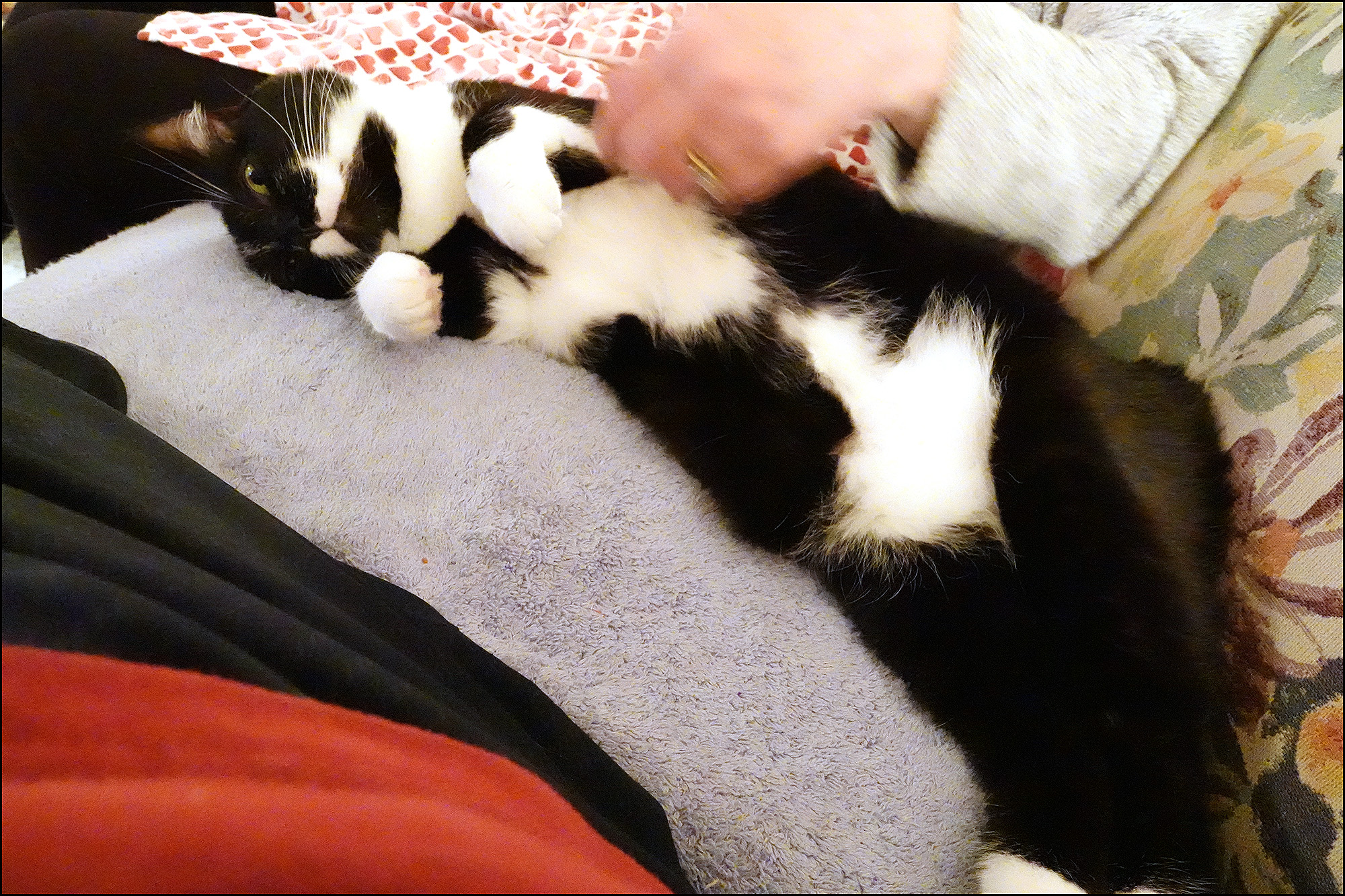
Here is Hilbert engaged in his second favorite activity: getting a tummy rub from Marian. (His first favorite activity is getting brushed by Marian.)
By the way, the towel he’s on is not there to keep cat hair from accumulating. It’s to provide a place for Kevin’s feet that won’t wreck the fabric. It seems to me that sofa fabric should be able to stand up to a couple of feet, but apparently that’s not a widely held view.
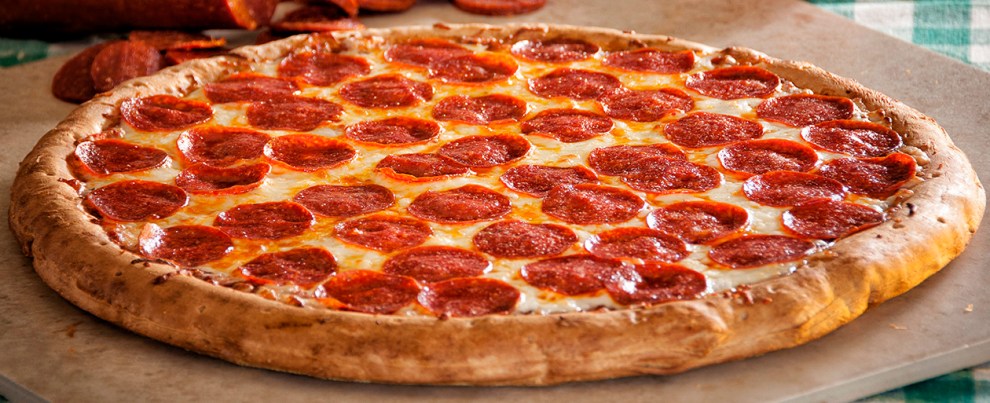
Trump administration proposes changing school menus to allow more potatoes and pizza and fewer vegetables and fruits
Critics say the changes, which roll back a Michelle Obama initiative, would make eating at school less healthy and serve industry interests, while backers say they give schools more flexibility about what to serve.
Just in case you’re curious, this is yet another culture war issue, just like the toilets and the dishwashers and the light bulbs. Lots of working-class folks consider this stuff a bunch of elitist liberal rulemaking that continually makes their lives harder. Remove phosphates from dishwasher soap and your dishes don’t get as clean. Ban incandescent bulbs and you’re stuck with expensive bulbs that don’t look right. Get rid of straws and plastic bags and you make both shopping and eating a pain in the butt. Get rid of pizza at lunch and you’re basically telling parents that they aren’t feeding their kids right.
Oh, and the school lunch thing is a Michelle Obama initiative, so ditching it is an especially petty way of getting back at Barack Obama via his wife. It’s pure Trump and his fans love it.
UPDATE: A reader reminds me that Trump did this on Michelle Obama’s birthday. What a sad excuse for a human being he is.
And we respect that! But maybe you’re of a mind to support our work directly instead? We have until December 31 to raise the last $400,000 we need to keep our nonprofit newsroom running at full strength into 2026. Will you make a gift today?
We noticed you have an ad blocker on. Can you pitch in a few bucks to help fund Mother Jones' investigative journalism?
Billionaires own the media,
but they don’t own us.
At Mother Jones we know these aren’t conventional times, and they require unconventional coverage. That’s what deliver every day: fierce, independent journalism you can’t find elsewhere. Perhaps never in the history of our country has that been more necessary than now. But we can’t do it without reader support—your support. Please chip in today.
Billionaires own the media,
but they don’t own us.
At Mother Jones we know these aren’t conventional times, and they require unconventional coverage. That’s what deliver every day: fierce, independent journalism you can’t find elsewhere. Perhaps never in the history of our country has that been more necessary than now. But we can’t do it without reader support—your support. Please chip in today.