• Medicare For All Is Not a Pipe Dream

    Employers currently pay about $10,000 per employee for health insurance. This comes directly out of your paycheck, but most people can’t be convinced of this. If you were to tax them $10,000 for all-in universal health care, they’d see it as losing $10,000 per year. And who knows? Corporations aren’t known for their benevolence, and there’s no guarantee that if you eliminated their health care obligation they’d use that savings to increase everyone’s wages. So maybe “most people” are right.

    This is why I continue to think that anyone who’s in favor of Medicare for All should also be in favor of funding a big chunk of it via a payroll tax on employers. That way, the people paying for health care stay roughly the same and no one is the victim of a massive tax hike. There are, of course, still details to work out. Who pays for contractors? How much do corporations pay for part-time employees? Etc. But those are not insurmountable problems. They can be worked out. And when they are, it works out to employers paying about $5 per employee hour for health insurance. According to the BEA, Americans work about 250 billion hours per year, so a payroll tax on corporations of $5 per hour of paid employee labor comes to:

    • $1.25 trillion

    Current federal and state spending on Medicare and Medicaid comes to:

    • $1.25 trillion

    If you figure that Medicare for All will cover 85 percent of health care expenses—which is about average for other health care systems—then households will continue paying about:

    • $500 billion

    Other federal spending comes to about:

    • $100 billion

    This adds up to $3.1 trillion. Total current health care spending is about $3.6 trillion, which means we need to find about $500 billion more. That’s it. You may assume any combination of your favorite spending cuts and tax increases to fill this gap. If, like me, you assume that spending won’t change (getting rid of private insurance overhead will be balanced by covering more people), then you need a $500 billion tax increase. This is hardly chump change, but it’s also far from insurmountable. We can start by reversing the Republican tax cut of 2017, and then finish up by adding a fairly modest additional tax on the rich.

    In other words, this isn’t that hard. But you have to keep all the current funding in place if you want to avoid gargantuan numbers. And here’s what the public gets for this:

    • Health care is easy. Just show your M4A card when you see a doctor and you’re done. No fighting with insurance companies.
    • Everyone is covered from the day they’re born.
    • You don’t lose your coverage if you lose your job.
    • Your coverage doesn’t change whenever your employer decides to save some money by switching insurance companies.
    • Every doctor and hospital is paid via M4A, so you can see any doctor you want. You don’t have to worry about whether your doctor is part of your insurance company’s network.
    • No surprise billing ever.

    What’s not to like?
  • What Is There to Say About Ken Starr?

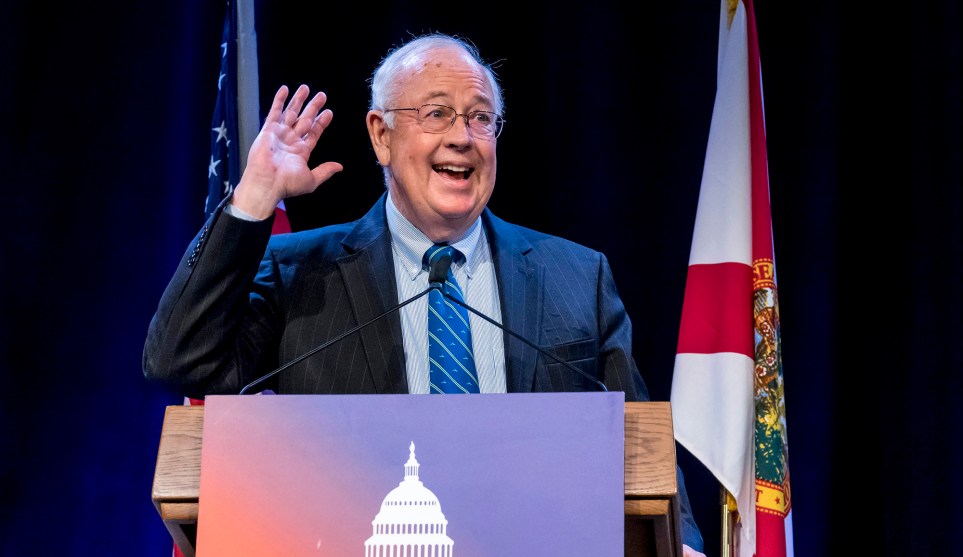
    I’ve now had my morning corn flakes and . . . I still have nothing to say about Ken Starr. He’s certainly bucking for Sean Hannity’s title as most egregious partisan hack of the Trump era, though I’m not sure if this move quite gets him into first place. Time will tell.

    UPDATE: This gets to the heart of the matter, doesn’t it?

  • If You Want to Cancel Student Debt, You’re Going to Need Congress

    The incredible shrinking Congress.Kevin Drum

    Luke Herrine, a PhD student at Yale University, contends that a president can cancel a great deal of student debt unilaterally. Over at Vox, Ella Nilsen tells us that Elizabeth Warren agrees:

    Her argument is that if the Education Department has the power to collect all this debt, it also has the power to stop doing so. Herrine argues that, much like the US attorney general or any prosecutor has the absolute discretion to bring or dismiss criminal charges, the US education secretary also has absolute discretion to collect student debt for 42 million Americans or cancel it.

    “It’s really just the same thing — there’s nothing unique about criminal prosecution,” Herrine told Vox in an interview. “The secretary would have that discretion and authority, rather than having to go back to Congress or appeal to the attorney general to do some of that work for them. There’s nothing on the face of the statute that limits how or for what those authorities can be used.”

    ….Warren’s campaign cited legal experts at Harvard Law School who concluded the same thing: “The power to create debt is generally understood to include the power to cancel it,” said a letter written by Eileen Connor, director of the Legal Services Center of Harvard Law School….The key question here is whether Congress envisioned the Higher Education Act to be used to give the education secretary such broad power in canceling more than $1 trillion worth of student debt.

    This is getting out of hand. When President Obama signed the DACA executive order, which defers deportation for immigrants brought into the country illegally as children, he did so under the theory that immigration law gave an unusual amount of latitude to the executive branch. That was questionable, and it will eventually be decided by the courts, but at least it was a theory. Conversely, the notion that the executive can simply choose not to collect debt seems no more plausible than Donald Trump’s notion that he can withhold aid to Ukraine just because he feels like it.

    For starters, no, this isn’t “just the same thing” as prosecutorial discretion. That’s a longstanding prerogative at all levels of government. Unilaterally canceling debt isn’t.

    And while the power to create debt may include the power to cancel it, that’s not at issue here. The question is who gets to cancel it. Congress certainly can, but there’s no reason to think that the president can do it without clear statutory authority.

    Finally, how far do we want to take this? Can President Trump eliminate the corporate income tax by simply directing the IRS not to collect it? Could President Sanders hand out loans to renewable energy companies and then turn them into outright grants by deciding not to collect them? Once we go down this road, there’s no telling where it stops.

    Congress has the power to delegate broad authority to executive branch agencies, but while that power may be broad, it’s not infinite. It depends largely on the wording of the enabling statute. So the key question is the one at the end of the excerpt above: did Congress intend to give the education secretary power to cancel vast swaths of student debt unilaterally? I think we all know the answer to that.

  • Notre Dame Needs No Stinking Spire

    Washington Post

    The Washington Post tries to divert our attention from impeachment today with a long piece about the rebuilding of Notre Dame. The big question is whether the ugly-ass spire should be rebuilt:

    Philippe Villeneuve, chief architect of the country’s historic monuments service, said in a broadcast interview that he would resign rather than allow a modern spire — as proposed by French President Emmanuel Macron — to be built atop the cathedral’s roof. In response, Georgelin told the architect to “shut his gob.”

    ….Beginning in the mid-1220s, much of Notre Dame was remade to be more in line with contemporary architectural tastes. The two western towers were finished and a [horrid] spire was added to the crossing of the nave and transept….By the late 18th century, the original [horrid] spire was removed before it could collapse from decay….The cathedral remained without a spire until 1859, when [an even more hideous one] designed by Eugène Emmanuel Viollet-le-Duc was added as part of an extensive 20-year renovation.

    Hmmm. Perhaps I have let my opinion seep into this blog post? In any case, put me on Team Nothing. Rebuilding Notre Dame without the spire will improve it considerably and cost less. Now quit arguing and get to work.

    BY THE WAY: Jokes aside, the Post article is a good one if you’re interested in this kind of thing.

  • Ukraine Opens Investigations Into Ukrainegate

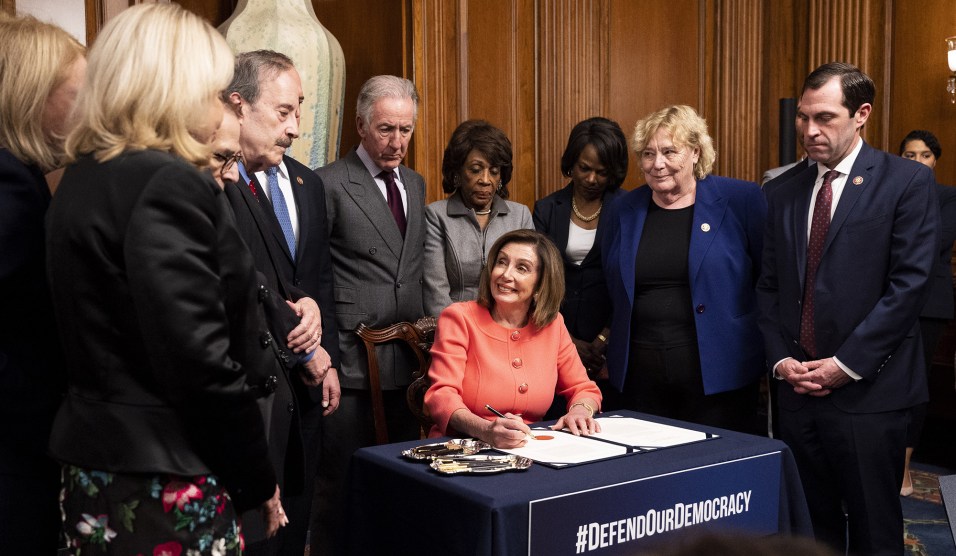
    Nancy Pelosi seems pretty happy to be finally signing articles of impeachment against President Trump.Michael Brochstein/ZUMA

    President Trump did his best to force Ukrainian leaders to open an investigation of Joe Biden. They never did. But today, Trump finally got his investigations:

    Ukrainian authorities announced a probe Thursday into possible surveillance of U.S. Ambassador Marie Yovanovitch before she was dismissed from her post by the Trump administration. The statement by Ukraine’s Interior Ministry followed the disclosure of new documents related to the impeachment case against President Trump.

    ….In a separate probe, Ukraine investigators said they were looking into a suspected Russian hack into computers at Ukrainian gas company Burisma, which is at the center of the impeachment inquiries….Interior Minister Arsen Avakov met Thursday with an FBI representative based in Ukraine and officially requested U.S. assistance in the two cases, according to a Ukraine government official, who spoke on the condition of anonymity to discuss ongoing investigations.

    These are not the investigations Trump wanted, but hey, beggars can’t be choosers.

    In related news, the inspector general for the GAO says Trump broke the law by withholding aid to Ukraine last year. “Faithful execution of the law does not permit the president to substitute his own policy priorities for those that Congress has enacted into law,” the IG wrote. “The withholding was not a programmatic delay.”

    That’s a lot of shit hitting the fan on the same day that articles of impeachment were finally transmitted to the Senate. Coincidence?

  • Parnas: Trump Knew Everything

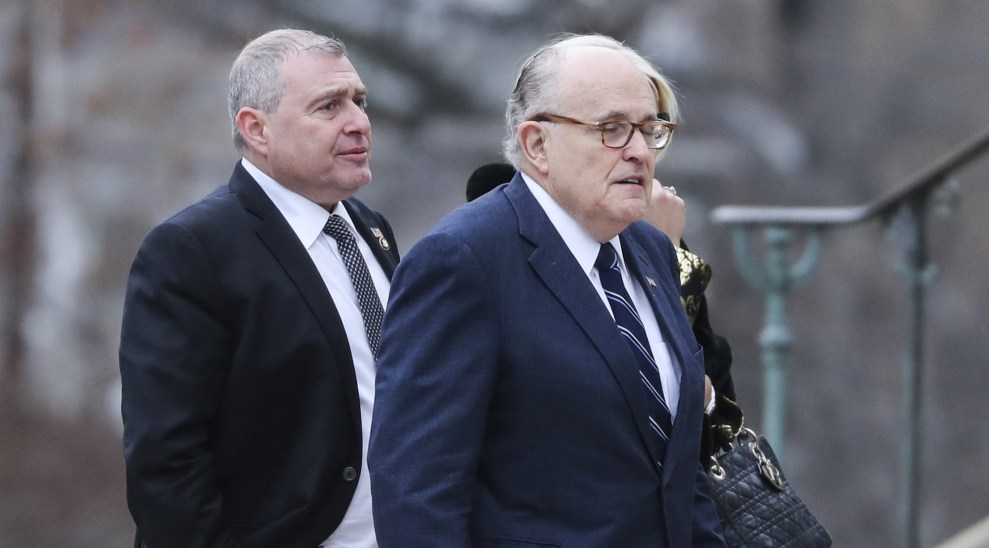
    Lev Parnas and Rudy Giuliani at the funeral of George H.W. Bush in December.Alex Edelman/ZUMA

    I’ve been asleep nearly all afternoon—thanks, dex!—and upon waking up I find that Rachel Maddow is interviewing Lev Parnas, one of Rudy Giuliani’s many shadowy accomplices in the Ukraine affair. And Parnas is . . . just absolutely dumping on every single person associated with Ukrainegate. Giuliani. Trump. Bill Barr. Devin Nunes. Mike Pence. He’s implicating them all massively in the plan to extort Ukrainian president Volodymyr Zelensky into announcing an investigation of Joe Biden. This goes along with the huge dump of text messages from Parnas and others released today by House Democrats.

    This post is just a placeholder. Parnas’s interview with Maddow has been detailed and it seemingly matches up with what we know. But I have no idea how much of it will eventually be corroborated. For now, then, all I can say is that this looks explosive, but it’s best to wait a bit before automatically believing everything Parnas has said. More later.

  • Lunchtime Photo

    This little girl is sitting on her father’s shoulders and eating a pastry of some kind purchased from a local street vendor. Like me, she’s watching the glockenspielers parade around the town square of Ubaté on Battle of Boyacá Day. I think the pastry is basically a handmade version of a Pop Tart, or something like that.

    August 7, 2019 — Ubaté, Colombia
  • The “Phase One” China Trade Deal Looks Legit

    Oh look, a new trade agreement:

    President Trump on Wednesday signed a partial trade deal with China, securing a promise that Beijing will purchase specific amounts of U.S. goods and services while retaining many of the import penalties he put in place over the past two years.

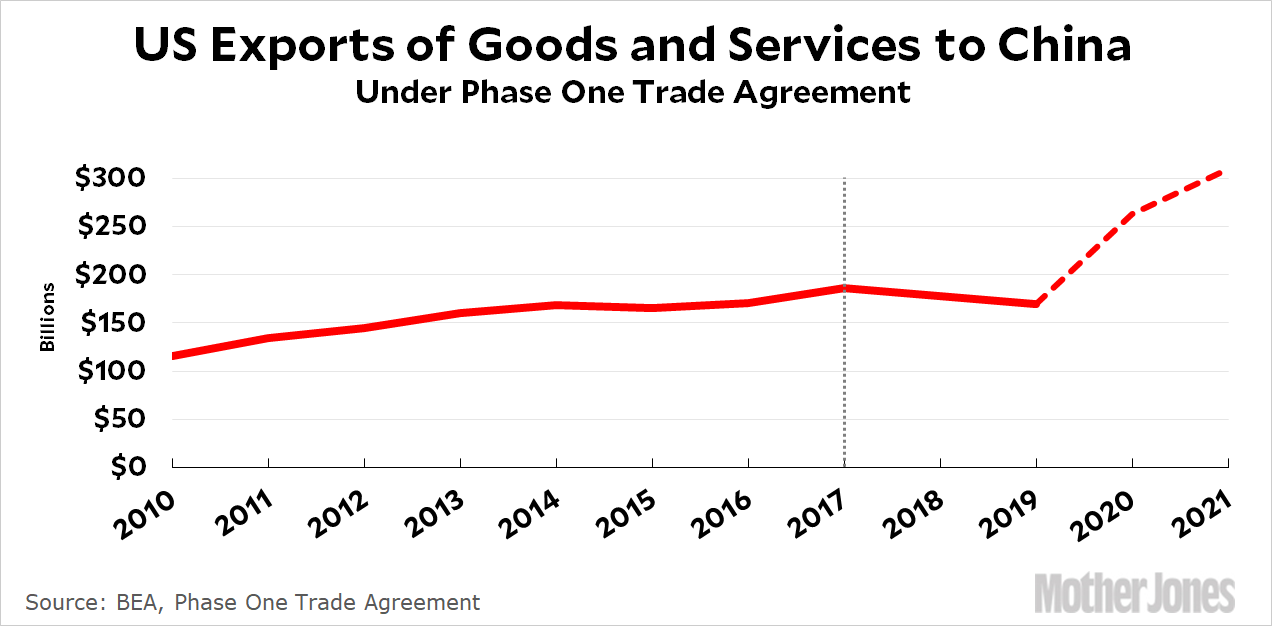
    The text of the agreement is finally available, and it looks legit. It says China “shall ensure” that it purchases an additional $200 billion of American goods and services in 2020 and 2021 compared to the “2017 baseline.” That baseline doesn’t seem to be spelled out anywhere, which is probably because US and Chinese estimates of trade goods are sometimes quite different. Still, that’s only a little bit of wiggle room. If the Chinese follow through, US exports to China will look like this:

    I was skeptical that this trade deal contained clear wording about Chinese purchase commitments, but unless I’m missing something it seems to.