• The Bond Rating Fiasco Is Back

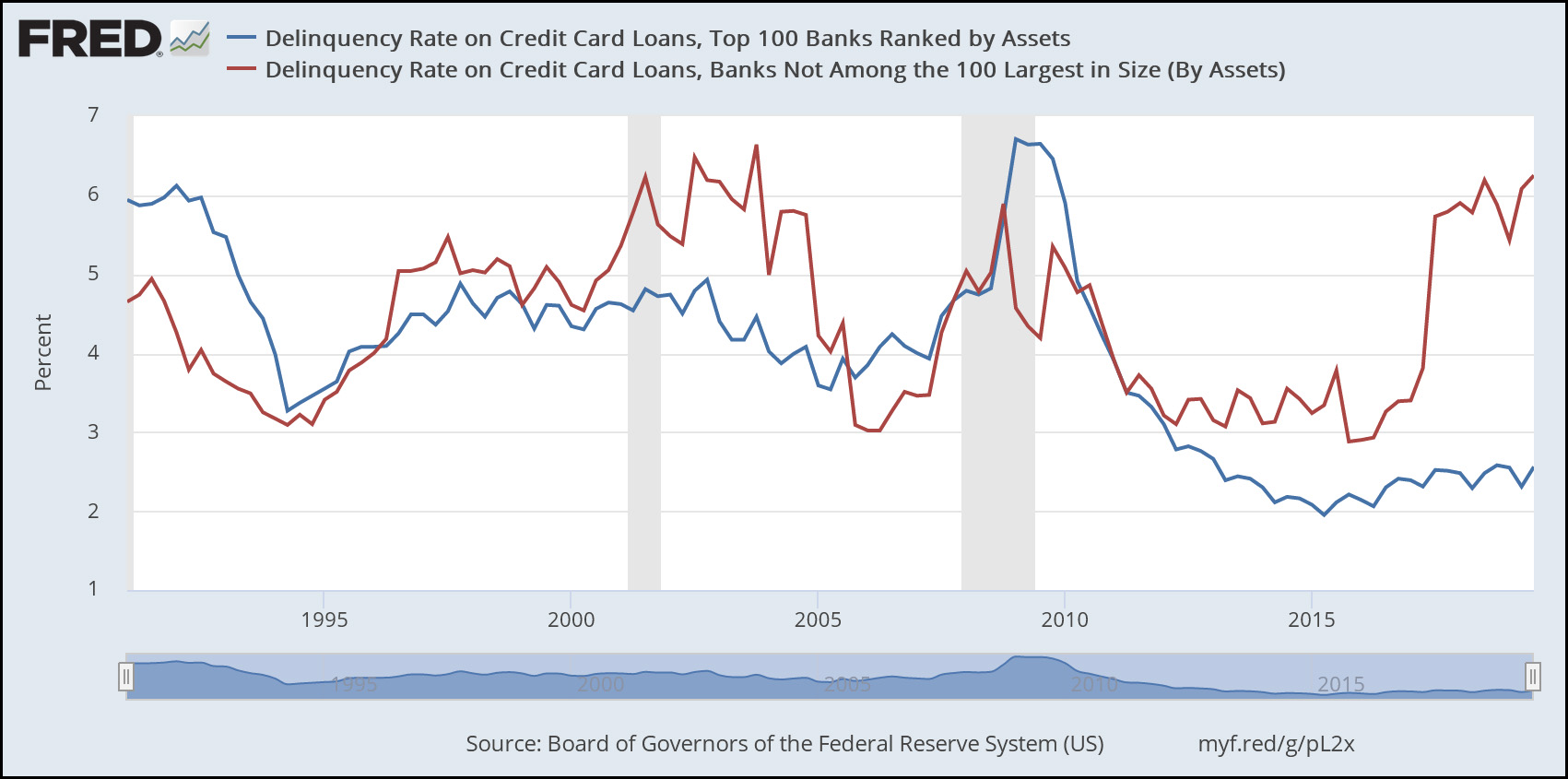
    The Wall Street Journal reports that bond rating firms are once again in brutal competition, which allows bond issuers to promote only the highest rating their funky new products receive:

    Fierce competition among ratings firms in a fast-growing corner of the bond market is allowing issuers to cherry pick the most favorable ratings. The result is that securities deemed safe by the ratings firms have increasingly smaller cushions against losses.

    The security in question is a cross between two of Wall Street’s hottest markets—commercial mortgage bonds, which are backed by mortgage payments on apartment buildings, malls and the like—and collateralized loan obligations, which are pools of bonds backed by payments on corporate borrowings.

    I won’t pretend that the ratings fiasco of the aughts was a huge driver of the 2008 financial collapse. Still, it played a role. By routinely slapping AAA ratings on opaque and complicated securities, rating agencies helped make them more popular than they otherwise would have been. When the collapse came, this meant the world was flooded with trillions of dollars worth of CDOs that had iffy counterparties and lots of hidden risk, essentially causing the entire market to freeze up because no one knew for sure which issues were solid and which ones weren’t. This made an already bad situation even worse.

    And now it’s happening again. Of course it is. Because Wall Street is incapable of keeping lessons in its tiny collective head for more than about five or six good years. Then the Minsky cycle seizes them yet again.

  • Donald Trump Is a Keynesian

    At the Washington Post, Jeff Stein summarizes something that’s been obvious for a while. President Trump’s economic policy is basically a lefty one:

    From trade to spending, from the Federal Reserve to paid parental leave, Trump has embraced policy changes that historically are more in line with the approach of Democrats — establishing a forceful role for government in setting the terms of the economy — than of Republicans.

    ….On trade, Trump has reached a “phase one” trade deal with China that reportedly includes promises to buy far more in U.S. exports. He has completed a revamp of the North American Free Trade Agreement with Mexico and Canada that some liberals are cheering for labor protections and pharmaceutical policies. Trump co-opted a demand from the left to urge the Fed to cut interest rates despite the relatively strong economy, a position the central bank ultimately adopted after seeing signs the economic expansion might waver.

    The president has blown away traditional GOP concerns over the rising federal deficit, cutting bipartisan deals to expand government spending and even extend a new paid-leave benefit to the federal workforce. He unilaterally implemented a farm bailout that could prove more expensive than the auto bailout was a decade ago — a move that conservatives had criticized as wasting taxpayer dollars.

    Not everything Trump has done is out of the lefty playbook. Progressives favor trade deals with stronger labor and environmental protections, for example, but they don’t generally favor massive trade wars that are mostly aimed at reducing trade deficits. At the same time, conservatives don’t favor massive trade wars either. For the most part, Trump’s trade policy is purely born out of his own id.

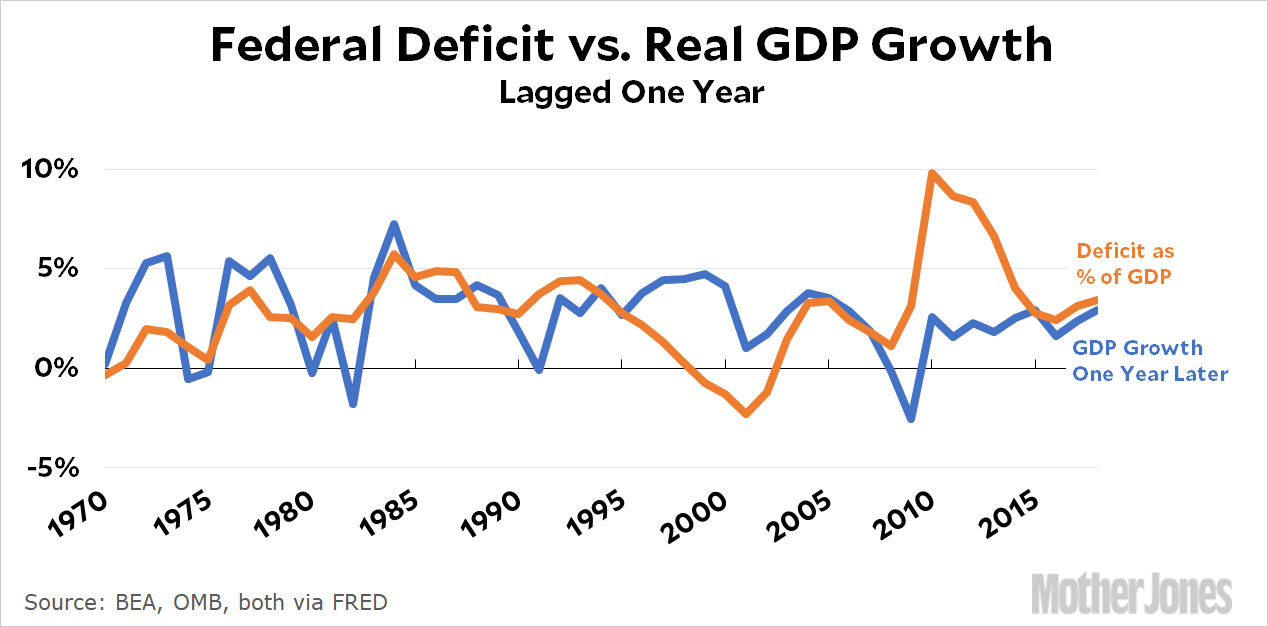
    As for the other things, Trump isn’t adopting them because they’re progressive. He’s adopting them for the same reason that conservatives often adopt them: they work, and he wants the economy to be in good shape for his reelection. Republicans haven’t objected very much because, despite their constant jeremiads about deficits and big government and bailouts, they too know perfectly well that this stuff works. This understanding won’t last into the next Democratic administration, of course, but the Trump presidency is basically the final and most abject admission by conservatives that neo-Keynesian economic policy is mostly correct.

    But it’s been a long time since they seriously believed anything else anyway. They tried out supply-side economics during the Reagan era and discovered that it was a great campaign tool but it didn’t really work as economic policy. Since then they’ve retained rhetorical allegiance to Arthur Laffer’s famous napkin, but in real life there’s nothing left of it in conservative circles except for its usefulness as a pretext for passing tax cuts for their main constituents: corporations and the rich.

    In other words, we are all Keynesians now. Still.

  • Kevin Drum, Cub Photographer

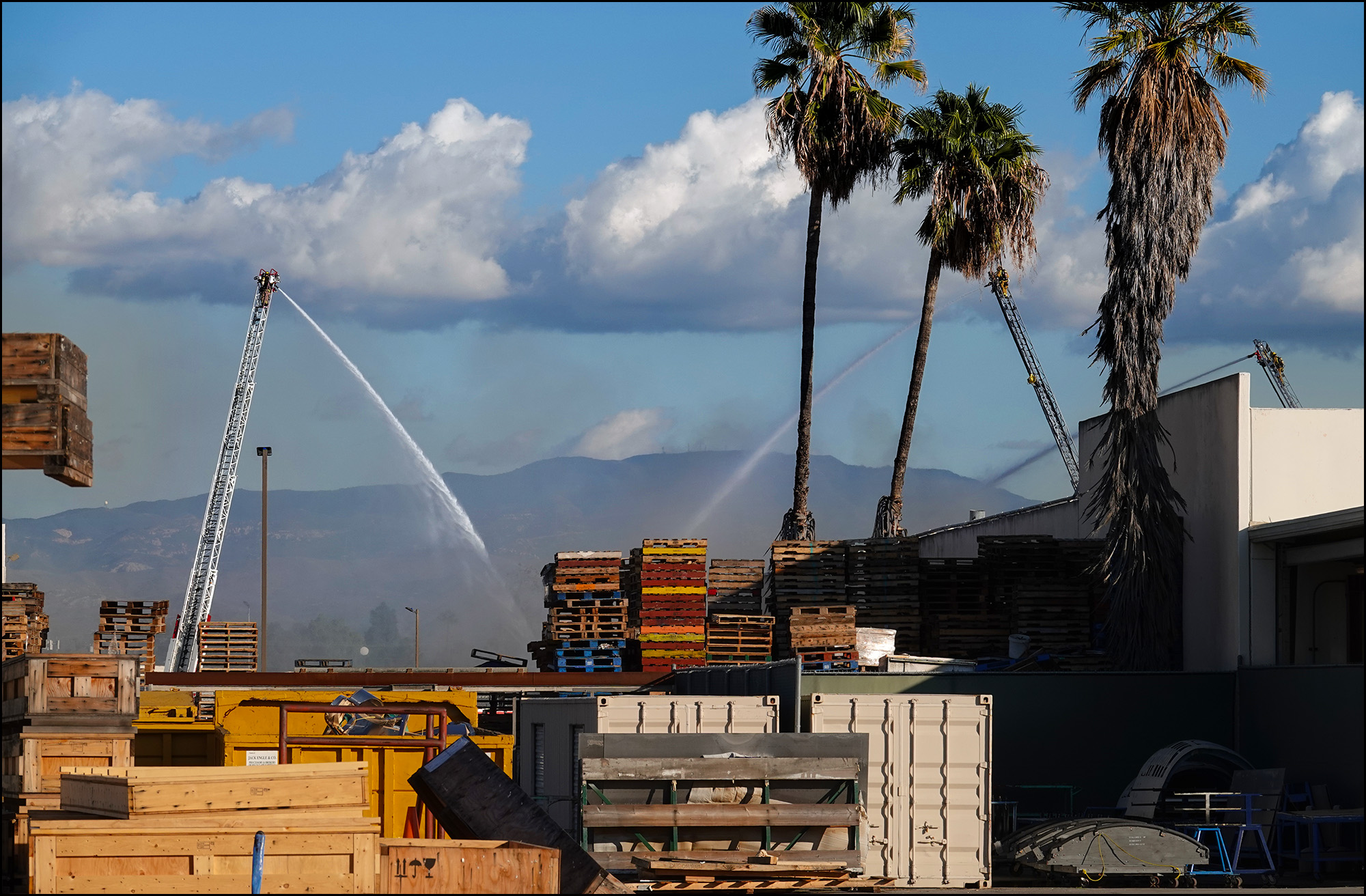
    I was driving around on Friday afternoon with my camera when I got distracted by a plume of smoke nearby. Tonight is dex night and I’m already bored, so you get to hear all about it. Here’s the plume:

    Let’s go see what it is! Great gouts of smoke were coming from a building behind the Coca-Cola bottling plant on Grove St. in Orange:

    Lots of other people were there taking pictures too:

    I drove out to Batavia St. to get a better look at the firefighting. This had been going on for over an hour by the time I got there:

    Here’s a closeup of the firefighter at the top of one of the ladders. Not bad for my little camera:

    And here’s the artsy shot, because why not?

    December 27, 2019 — Orange, California

    According to the Orange Fire Department, the fire was at Lake Management Inc., which, ironically, is exactly what it sounds like: LMI is a company that manages lakes, ponds, water features, retention basins, and so forth. No word yet on how the fire started.

  • Here Are a Few Things Lots of Liberals Believe That They Shouldn’t

    What should I do to ring out the decade? I know! Let’s make people mad at me. With that in mind, here’s a (non-exhaustive) list of things that lots of liberals believe even though they shouldn’t.

    1. Head Start (and similar pre-K programs) raise student achievement. There’s evidence that they have positive effects on many things, which makes universal pre-K one of my favorite social programs. But their effect on long-term academic performance ranges from zero to small, depending on the study.
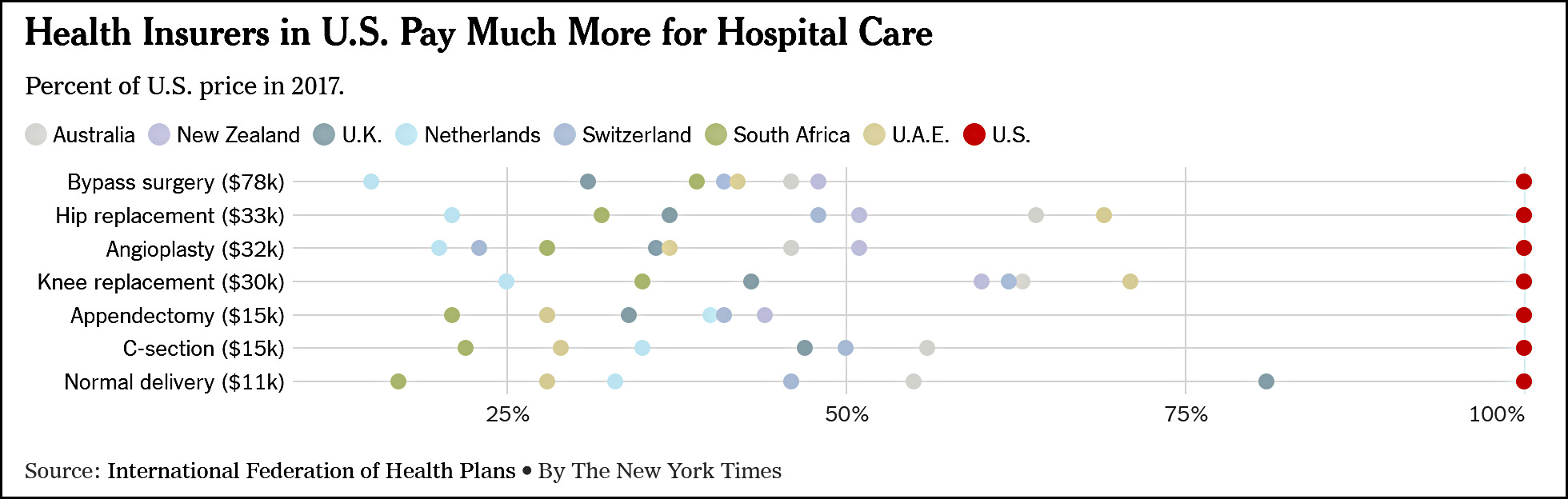
    2. American health care is expensive because of private insurance. Nope. It’s expensive because health care providers charge way more than they do anywhere else. This includes doctors, nurses, pharmaceutical companies, device manufacturers, hospitals, and so forth. Insurance adds a little bit to that, but it’s nowhere near our biggest problem.
    3. We have a retirement crisis. There’s virtually no evidence that retirement is any worse today than it used to be. Ditto for future retirement. In fact, the over-65 demographic is doing better than any other age group. That said, Social Security for the bottom third of the income distribution has always been too stingy, and we ought to increase it.
    4. The black/white test score difference is all about test prep, biased tests, etc. At most, the best evidence suggests that things like test prep account for a small fraction of the black-white difference in test scores. This is important. The black-white gap in education is one of America’s biggest failures, and the only way to fix it is to acknowledge that it’s real, not to toss it off as merely a statistical artifact.
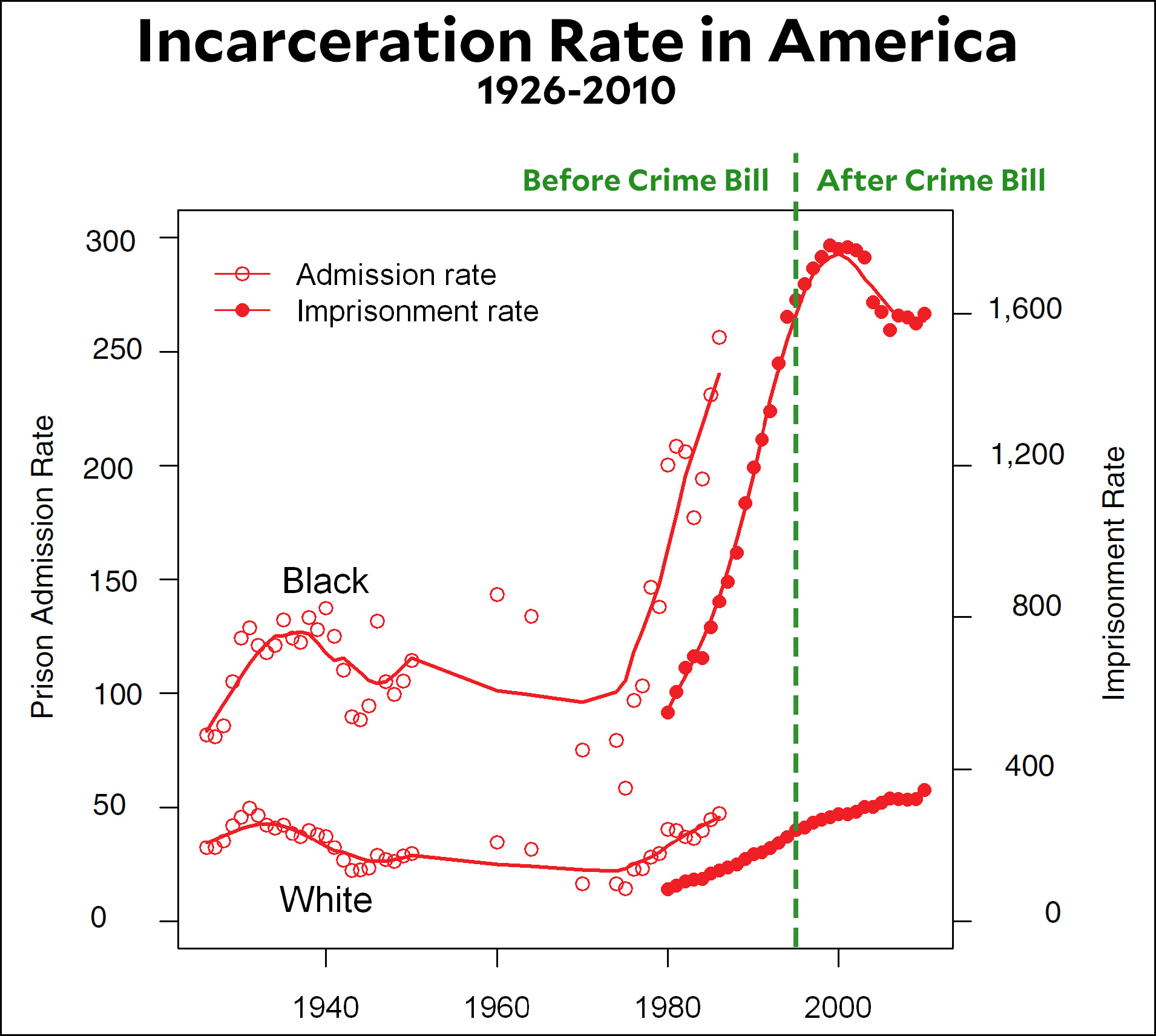
    5. The 1994 crime act was responsible for mass incarceration. Mass incarceration started in the mid-70s, and by the mid-90s prison space had more than quadrupled. The 1994 crime act had only a tiny effect on prison building, and by 1998 the total number of prisoners had already begun to decline. For what it’s worth, black incarceration rates have also dropped substantially over the past couple of decades.
    6. Charter schools don’t work. Some of them work, some of them don’t. Instead of pretending that they’re all failures, we should be putting our energy into figuring out why the good ones work and how we can learn from them.

    I would now like some good conservative to create a similar list for his colleagues. Obviously you can start with the whole business of tax cuts supercharging the economy, but I want half a dozen more beyond that.

  • Trump’s Tariffs Are Raising Prices and Slashing Employment

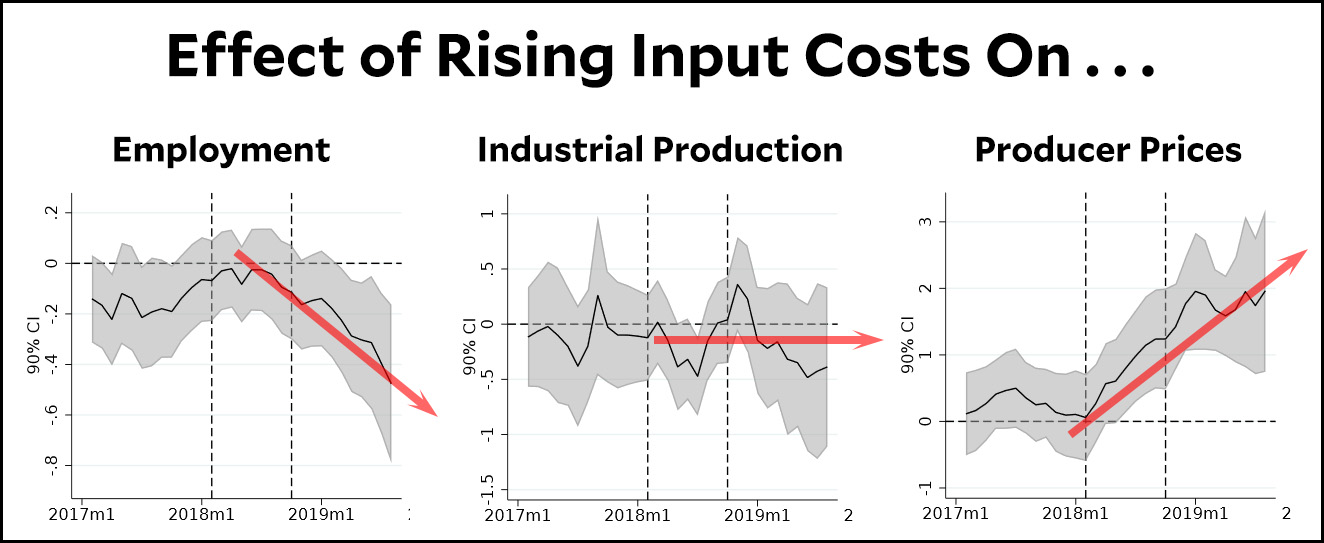
    So how are Donald Trump’s tariffs doing? We already know that they’re costing American consumers a bundle, but what’s their effect on the manufacturing sector? Aaron Flaaen and Justin Pierce took a look at various industries to see how sensitive they were to tariffs, and then used that data to calculate the overall effect of tariffs on US manufacturing. Here’s one piece of their analysis:

    Total industrial production has remained fairly steady—though it started to show some weakness in 2019—but employment in affected industries was down substantially and producer prices were up substantially.

    In additional to rising input costs, the authors also calculate the effect of import protection and foreign retaliation. The effect of import protection is minimal, but the effect of foreign retaliation is the same as input costs: there’s no big effect on industrial production, but employment is down and producer prices are up.

    If this study holds up, it means that Trump’s trade war is (a) costing American families about $1000 per year, (b) cratering employment in the affected sectors, (c) sending producer prices up, and (d) putting hundreds of American farmers face to face with bankruptcy. Nice work, Mr. President.

  • American Sanctions Bite Europe Yet Again

    Stefan Sauer/DPA via ZUMA

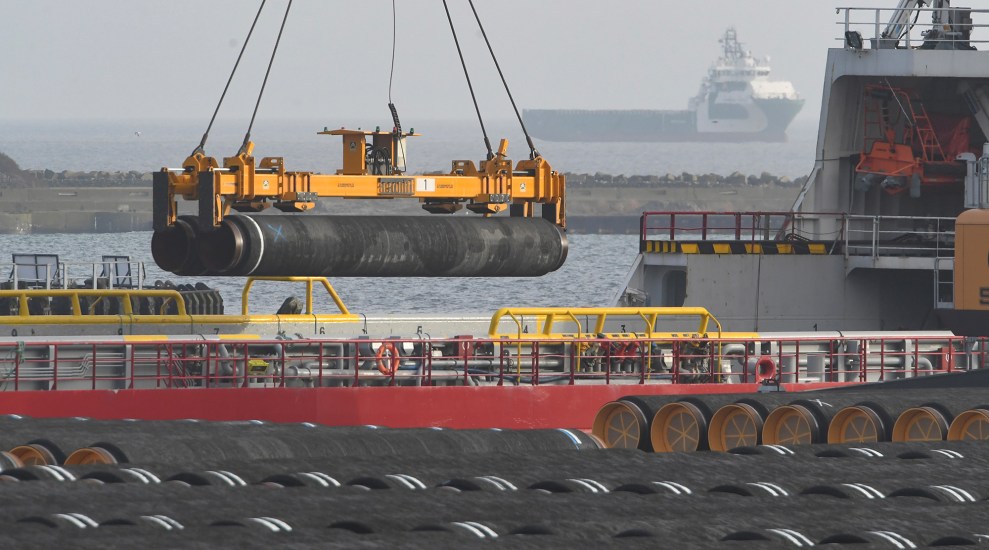
    With a sparkling new gas pipeline from Russia to Germany nearly finished, US sanctions have brought construction to a halt with only 160 kilometers left to go. Germans are pissed:

    The U.S.’s move sparked outrage in Germany, prompting senior officials and politicians to call for a coordinated approach to protect the strategic interests of European Union members against future U.S. sanctions.

    ….A senior German government official said, in response to the pipeline sanctions, that Germany would make a renewed European push to build a firewall against U.S. sanctions when it takes over the EU’s rotating presidency next year. One goal would be to create a separate financial infrastructure that would allow European companies to escape the scope of U.S. sanctions. The banks involved would have to be based in jurisdictions out of the U.S.’s reach, such as China or possibly Russia, the official said.

    American use of financial sanctions has been out of hand for a while, seemingly our automatic response to anything in the world we dislike. Add this to all the Trumpish trade and tariff actions of the past couple of years and Europeans are starting to wonder if they really want to be the US sidekick in yet another cold war against our enemies du jour.

    Having said that, though, it’s worth noting that this squabble is all about . . . fossil fuels. Germany is one of the most reliable fighters against climate change in the world, but in the past decade they have decommissioned their nukes, continued mining huge amounts of coal, and are increasing their dependence on Russian natural gas. If that’s what the serious climate change fighters are doing, can you imagine what the rest of the world is doing?

    The answer is: pretty much nothing. This is why I have finally decided that our only hope is massive climate R&D.