• China Is Buying Lots of US Soybeans

    The New York Times reports a familiar story:

    More than a year into the trade dispute, sales of American soybeans, pork, wheat and other agricultural products to China have dried up as Beijing retaliates against Mr. Trump’s tariffs on Chinese imports.

    I was curious about the latest data on soybeans, so I hopped over to the USDA to look it up. I expected to see the usual data showing soybean shipments to China falling off a cliff, but instead I got a surprise:
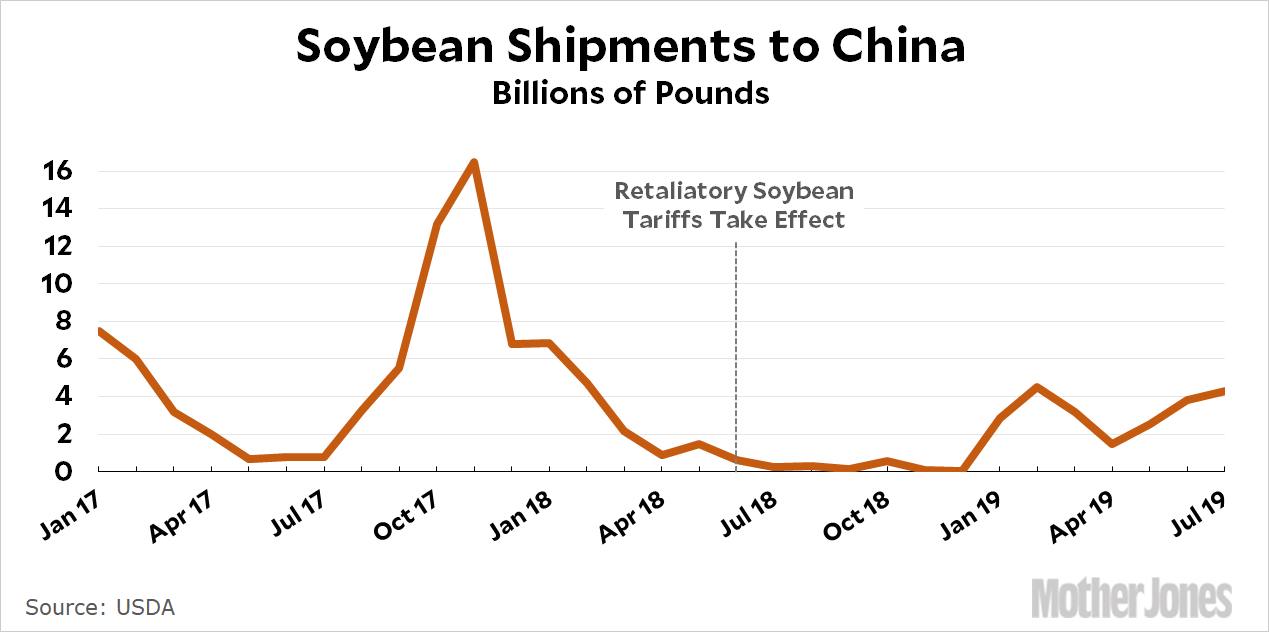
    Soybean shipments did fall off a cliff in 2018, but in 2019 they staged a surprising recovery. If anything, soybean exports to China this year are running a little ahead of their 2017 rate.

    Some of this could be due to game playing by the Chinese government, which buys soybeans itself and then resells them to private companies, thus circumventing its own tariffs. Whatever the reason, the actual volume of shipments is now back to normal, or nearly so. However, the price of soybeans, which had been fairly stable since 2016, has declined since the Chinese tariffs took effect, dropping from about $9 per bushel to $8 per bushel. So farmers have definitely taken a hit, but to say that shipments have “dried up” really isn’t right.¹

    The story on wheat is a little different:
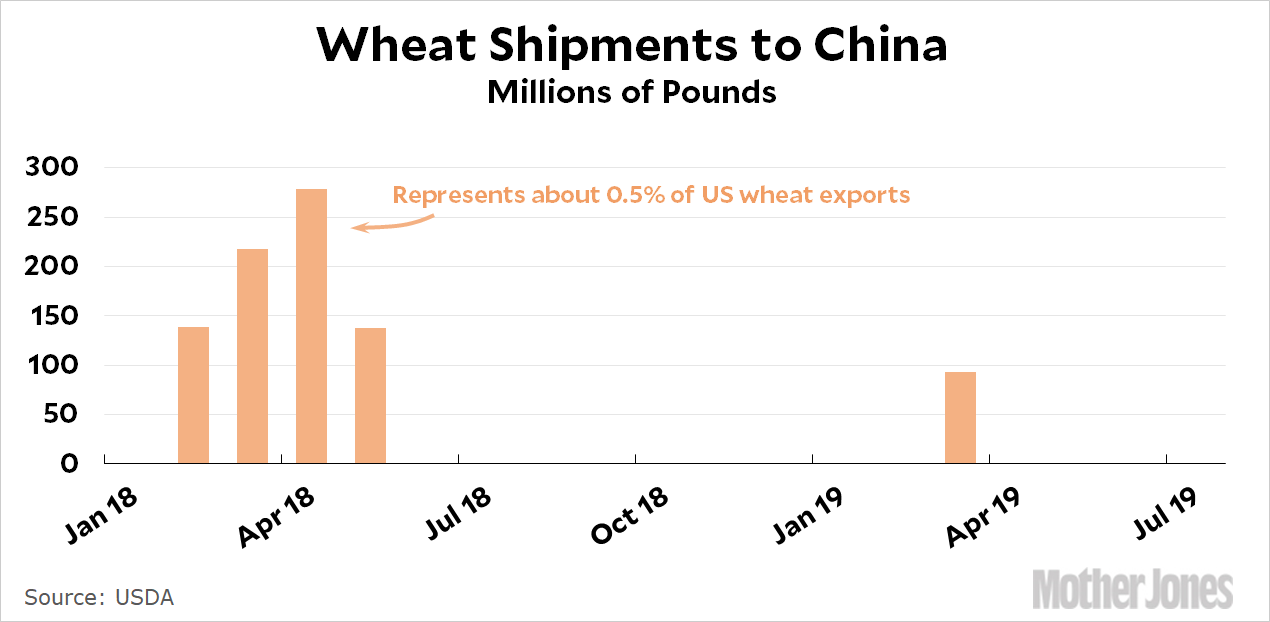
    Wheat shipments really did dry up, but they never amounted to much in the first place. At the same time, both US production of wheat and total US exports of wheat were up in 2018 and 2019, and prices have been steady. Chinese tariffs don’t appear to have had any effect at all on US wheat farmers.

    Finally, here’s the USDA’s projection of total agricultural exports:
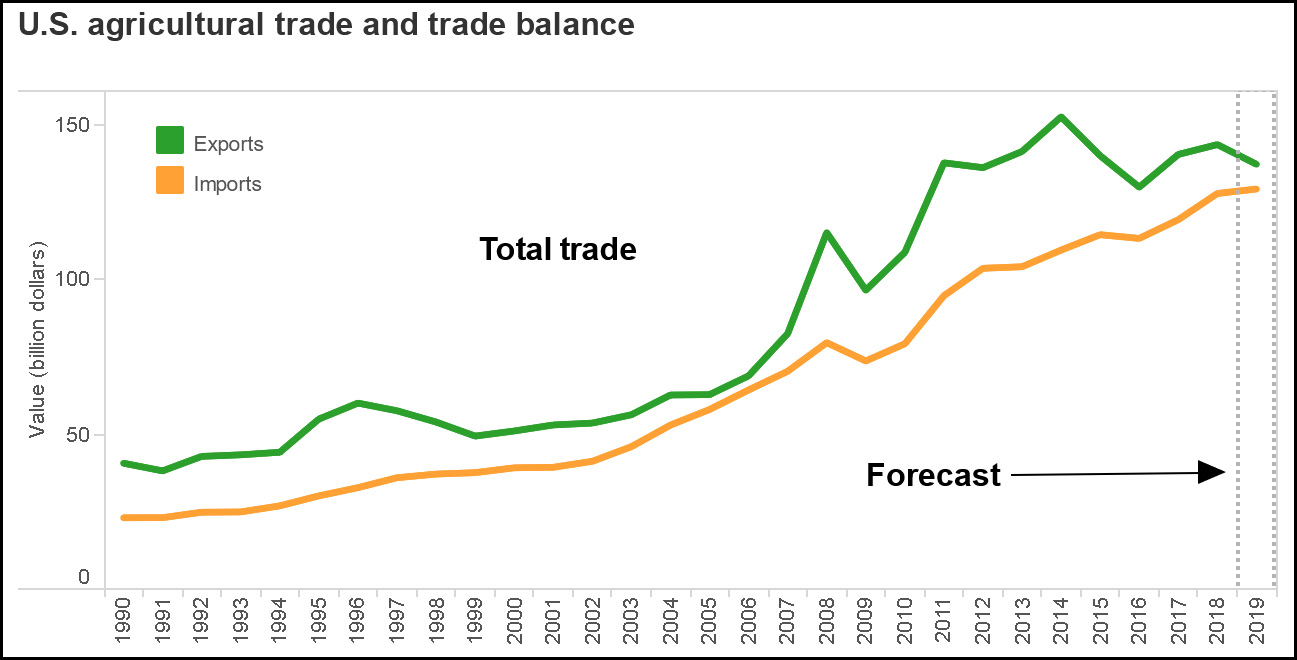
    Beware of farm lobbyists who compare 2019 exports to 2014: they’re just cherry-picking an unusually good year as a baseline. In reality, total agricultural exports were up in 2018 and are projected to decline about 4 percent this year, only a fraction of which is due to China.

    ¹Needless to say, this could change going forward after China announced new retaliatory tariffs in response to Trump’s increased tariffs from last week.

  • Lunchtime Photo

    Most of the deer I saw on my Blue Ridge Parkway expedition were shy and ran away before I could snap a picture of them. But not this one. In fact, it was so un-shy that I literally had to clap my hands and yell at it just to get it to turn its head. It finally did once or twice, but even though I was quite near it soon went back to ignoring me and munching on the grass.

    May 6, 2019 — Simmons Gap, Skyline Drive, Virginia
  • Lowe’s Exec In Trouble for “Small Hands” Gaffe

    Joe McFarland, a Lowe’s executive paid $4 million per year, is in trouble over his description of a power drill:

    McFarland, wearing a camouflage vest and seated in front of a sign that said “Lowe’s LoweDown,” went on to tout the features of this week’s spotlight item: “The thing is compact. It fits anywhere.” And a customer profile: “Some of our Hispanic pros with smaller hands, this is perfect for them.”

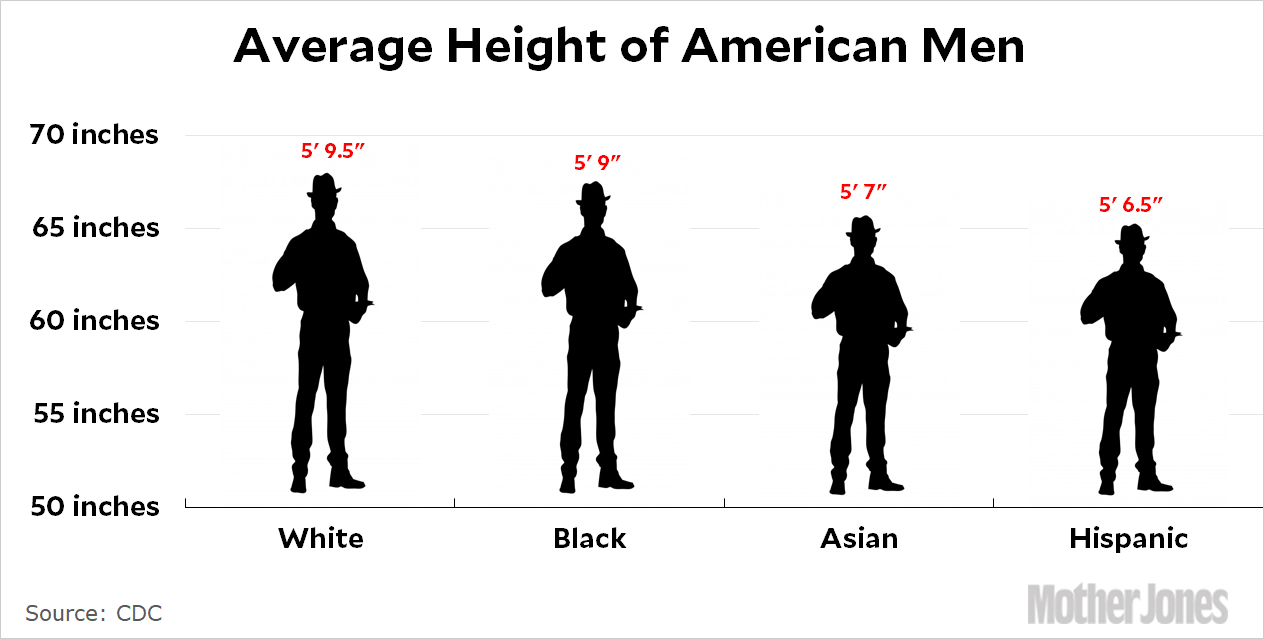
    Well, that was stupid, and McFarland heard about it instantly. Still, I know you’re wondering: do “Hispanic pros” really have small hands? Naturally I’m here to help:

    According to the European Journal of Clinical Nutrition, the formula for hand size in men is:

    Hand Breadth = (Height – 86.783) + (.195 * age) / 5.122.

    For a 35-year old, this suggests that the average Hispanic male has a hand breadth of 17.4 centimeters compared to 18.9 for white males. That’s a difference of a little more than half an inch. So McFarland may have been impolitic, but he wasn’t wrong. Perhaps we should send a $99 DeWalt 12 volt cordless drill to Donald Trump?

  • Chart of the Day: The Amazon Is Burning, But Not Everyone Cares

    The Amazon is burning and everyone is appalled. Almost everyone, anyway. Jeffrey Hoelle, who has done field research in the Amazon, says the residents of the rainforest often have a very different view:

    A cattle rancher put it to me bluntly a few years ago: “You all tell me not to deforest. It’s easy, isn’t it? Mix a drink there [in the U.S. or Europe], and talk. Now why do we have to stop deforesting? I agree that we should not deforest more, but we have a lot of people here. How will they live? What is the average income in the USA? Give that much to every person here. Then we can all sit around and watch the little birds fly.”

    This is the dynamic I was talking about yesterday. Everyone wants to halt climate change but no one wants to give up whichever part of it they depend on. The coal miners want to keep mining coal. The Germans want to get rid of their nukes. Fossil fuel companies want to keep drilling for oil. Drivers don’t want a big gas tax. And people who depend on the Amazon for their living don’t want to give up their clearcutting.

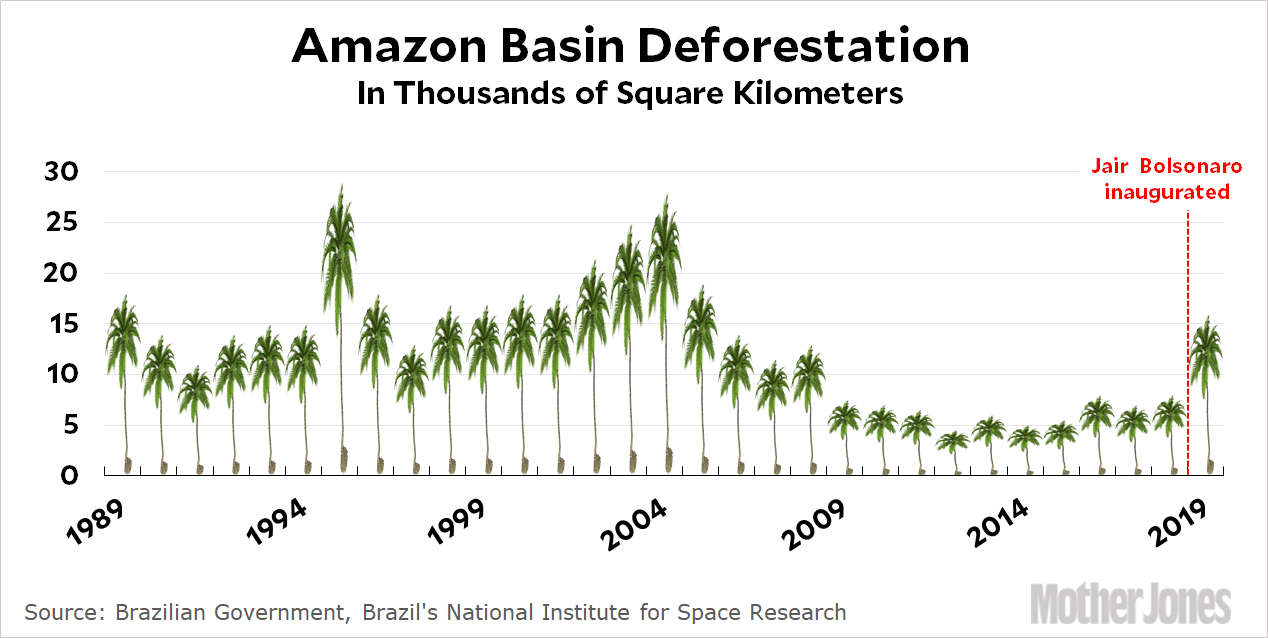
    The saddest part of this is that for many years we were making substantial progress in the Amazon. Then Jair Bolsonaro, the Brazilian Donald Trump, took office:

    We are not yet back up to the bad old days of the ’90s, but Bolsonaro has been in office less than a year. Give him time.

    But Bolsonaro aside, that cattle rancher represents billions of people who live in poor countries. Sure, global warming is bad. But we live in shacks. Call us back when you’re willing to cut your carbon emissions back to the level of a rural Chinese farmer.

    This is a hard argument to refute. Clearly the global West is not going to collectively agree to live like Chinese peasants. Just as clearly, the Chinese peasants aren’t willing to live in shacks while we sit around watching football on 60-inch TV screens in our air-conditioned houses while we lecture them about climate change. This is the hinge point on which the future of climate change depends. Even if we magically decarbonized the entire economies of America and Europe, it would have little effect unless developing countries also agree to rein in their carbon emissions at their current very low levels.

    There’s no simple answer to this. But it has to be answered by any climate plan worth the name.

  • What’s the Point of a Wealth Tax?

    Album / Metropolitan Museum of Art, NY

    The Wall Street Journal catches up today with the lastest fad among Democrats: taxing wealth, not just income. But conservatives aren’t sold:

    Many conservatives argue that taxes targeted at the rich could hinder investment in ways that would hurt everyone’s wages and discourage the creation of wealth in the first place. New taxes on wealth would complicate tax administration and bring unknown economic consequences. “It would be incredibly disruptive to markets,” said Sen. John Thune (R., S.D.). “People would start looking for how to game it and ways to shield and shelter.”

    Oh dear. Rich people would start looking for ways to game a wealth tax. They’d never do with an income tax, so I guess we’re stuck.

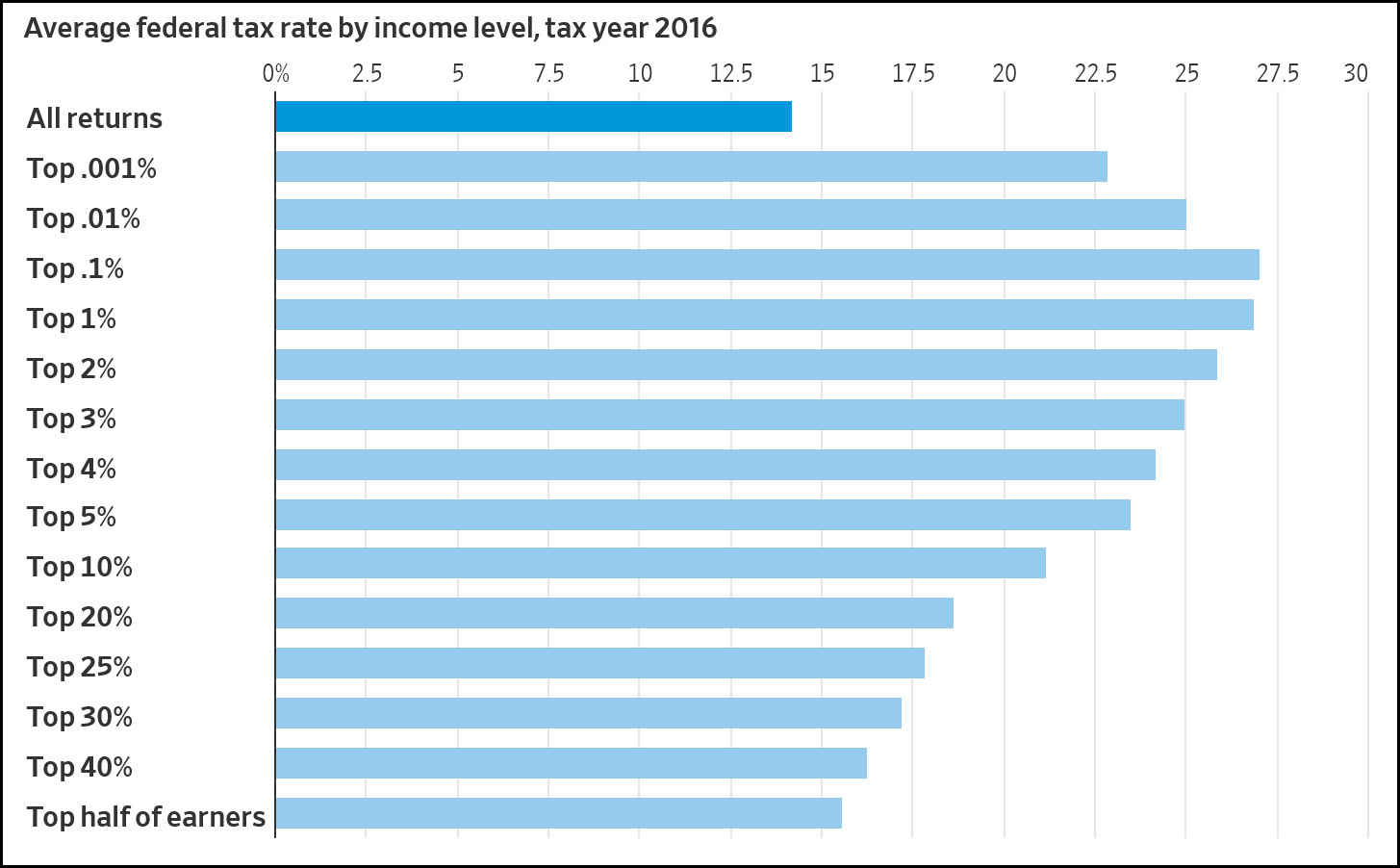
    This is as laughable as it sounds, but there is another reason to go slowly on this. The Journal presents this chart of income tax payments:

    Just for starters we could keep the income tax progressive for the super-rich. If effective rates kept going up, with the top .001 percent paying around 35 percent, that would take a chunk out of wealth all by itself. That’s the place to start. Beyond that we could raise rates on capital gains taxes, which is paid almost exculsively by the wealthy, and perhaps treat Social Security taxes like Medicare taxes, which apply to all income instead of only income up to a certain limit.

    Assuming you have the political will to do it in the first place, these are all quick and easy changes that are well understood and easy to implement. They don’t require complicated definitions and they don’t require an entirely new enforcement arm of the IRS. And they’d raise loads of money.

    If it’s not enough, maybe a progressive VAT? That would put us on a level playing field with most other advanced economies.

    By the time we were done with all that we’d probably be taxing something between 40-50 percent of all income, which is as much as any country in the world takes in. There’s really no need to look around for funky alternatives when everything we need to tax the rich and fund our lefty dreams is right in front of us.

  • Hiding Our Problems Is No Way to Solve Them

    Douglas R. Clifford/Tampa Bay Times via ZUMA

    New York City has a problem. It sponsors lots of selective classes for gifted children, but these classes are predominantly white and Asian, with very few black and Hispanic students. There are lots of things you could say about this state of affairs, but I really don’t think this is the answer:

    A high-level panel appointed by Mayor Bill de Blasio is recommending that the city do away with most of these selective programs in an effort to desegregate the system, which has 1.1 million students and is by far the largest in the country.

    ….The plan includes all elementary school gifted programs, screened middle schools and some high schools — with the exception of Stuyvesant High School and the city’s seven other elite high schools, whose admission is partially controlled by Albany. Gifted programs and screened schools have “become proxies for separating students who can and should have opportunities to learn together,” the panel, made up of several dozen education experts, wrote in the report.

    Ever since they’ve existed, gifted programs have provoked opposition from people who consider them elitist. So in a sense this is nothing new.

    But what is new is the reasoning behind this recommendation: black and Hispanic kids perform persistently and embarrassingly worse in school than white and Asian kids, so let’s fix this awkward situation once and for all by pretending it doesn’t exist. I can hardly think of a better way to make sure the testing gap is never addressed.¹ The problem is that this head-in-the-sand approach won’t work forever. Eventually—in eighth grade, in high school, in college, or out in the real world—it won’t be possible to hide that gap anymore. And we will have failed yet another generation of children.

    I’m biased because I attended a gifted program starting in 4th grade and my mother taught gifted kids for more than 20 years. I know what they can do. And there are reforms that sound like good ideas to me. For example, starting gifted programs in first grade based on tests taken in kindergarten strikes me as ridiculous. And I also favor changes that rely somewhat less on testing and somewhat more on other factors that guarantee a minimum level of participation from every geographic area. But eliminating the entire program because it exposes something that embarrasses us—something that should embarrass us—is the worst possible response.

    ¹Not that we’re doing a bang-up job now even though we do know about it. I’ll grant you that.

  • “Talking Down” the Economy Isn’t a Thing

    Xinhua via ZUMA

    Matthew Gertz reports on the latest conspiracy theorizing from Donald Trump and his friends at Fox News:

    President Donald Trump and his allies at Fox News have settled on a strategy to deal with the possibility of an oncoming economic recession: Blame the media.

    ….Lou Dobbs, whose Fox Business show Trump watches religiously and who at times has advised the White House, levied the charge even before Trump did….The narrative quickly took hold on Fox News and Fox Business as hosts accused the press of “talking down the economy deliberately” and trying to “make this economy go into recession.” For Sean Hannity, this was evidence that journalists are willing to threaten the economic security of millions of Americans for political gain. “Some are desperately hoping — hoping and praying, hoping and praying Americans will lose their jobs, lose their savings, see a major decrease in their retirement, 401(k)s,” he claimed on Wednesday night….Fox News hosts Jeanine Pirro and Jesse Watters continued to push the conspiracy theory narrative through the weekend. Trump did too, tweeting from the G-7 meeting in Biarritz, France, that the news media is “trying to force a Recession” because journalists “hate” the United States.

    Gertz rightly says that this is stupid because, in fact, no one in the media is rooting for a recession. But it’s stupid for an even more fundamental reason: it doesn’t matter. Recessions don’t happen because people start talking about them. They happen because the economy overheats a bit and investors turn from bullish to bearish. The proximate cause might be a housing bust, a dotcom bust, an oil spike, or a bank failure, but only if the economic fundamentals are there in the first place.

    I realize that Fox News doesn’t care about this, but I guess my challenge to them is this: can you name a single recession ever that was triggered by talk? They can’t, and they know it.

  • Lunchtime Photo

    When I saw this driving north out of Bogotá, I was immediately reminded of the Forest Moon of Endor. I could almost smell the ewoks gamboling about in that field.

    Unfortunately, this scene was the one that caused me to pull over to the side of the road and get out of the car just for a few seconds to snap a picture. A few seconds later the car was locked with my keys in it. This is the price I pay for being a Star Wars geek.

    August 5, 2019 — Chocontá, Colombia
  • As of 2017, Millennials Are Doing OK

    Over at the Atlantic, Annie Lowrey says that Millennials are screwed if we head into another recession:

    For adults between the ages of 22 and 38, after all, the last recession never really ended….The Millennials graduated into the worst jobs market in 80 years….As of 2014, Millennial men were earning no more than Gen X men were when they were the same age, and 10 percent less than Baby Boomers—despite the economy being far bigger and the country far richer. Millennial women were earning less than Gen X women.

    Kids of the 1980s and 1990s have had a new, huge, financially catastrophic demand on their meager post-recession earnings, too: a trillion dollars of educational debt….The toxic combination of lower earnings and higher student-loan balances—combined with tight credit in the recovery years—has led to Millennials getting shut out of the housing market, and thus losing a seminal way to build wealth. The generation’s homeownership rate is a full 8 percentage points lower than that of the Gen Xers or the Baby Boomers when they were the same age.

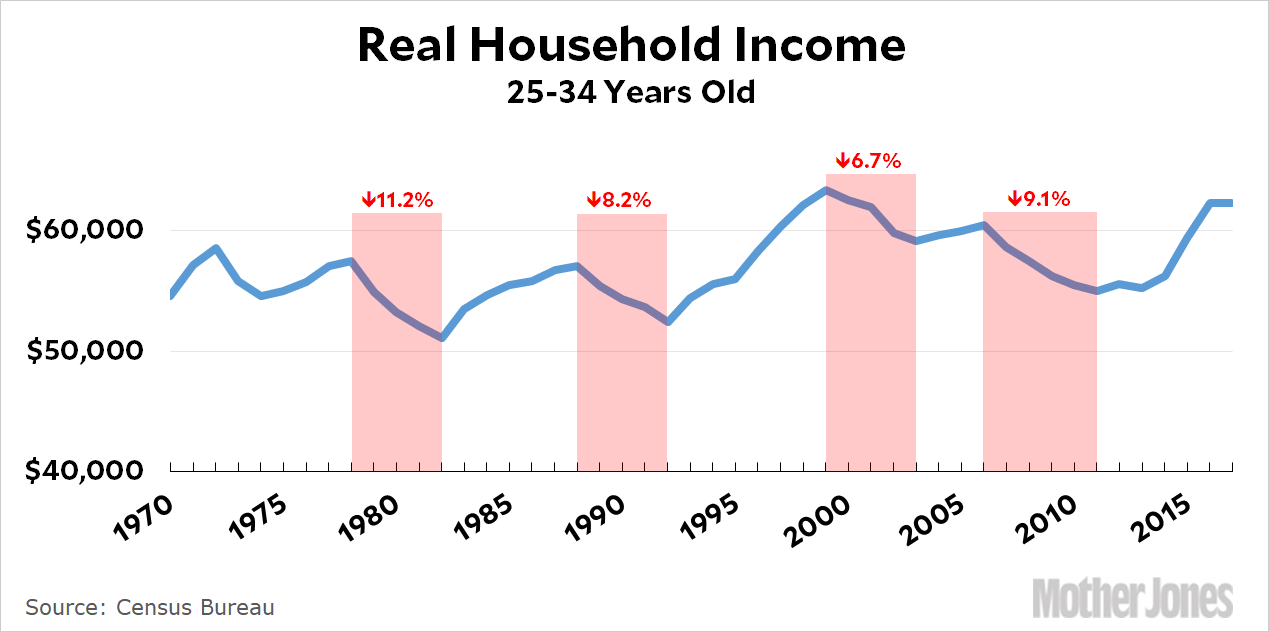
    As of 2014? Let’s at least look at the figures through 2017:

    This is why it’s so important not to cherry-pick years when you do income comparisons. If you choose 1999 to represent Gen Xers and 2014 to represent Millennials, you’re comparing the peak of an economic boom to the trough of a recession. A longer look provides a better idea of what really happened: the income of young families did indeed plummet during the Great Recession, declining by 9.1 percent from peak to trough. This is about the same as the 1990 recession and not as bad as the 1980 recession. Since then, their household earnings have rebounded and in 2018 almost certainly went even higher than the peak year of the dotcom boom.

    Homeownership rates are also not quite as bad as all that. The housing bust unquestionably hurt Millennial homeownership, but it’s roughly four points lower than its pre-recession average, not eight.

    Student debt among Millennials is much higher than it was among Boomers and Gen Xers. The average annual loan payment is around $3,000 compared to half that for Gen Xers and close to zero for Boomers. In other words, Millennials who went to college have student loan expenses about $1,500 higher than Gen Xers and $2,500 higher than Boomers. On the bright side, as of 2017 Millennials earn about $4,000 more than young Boomers and pay less in taxes.

    FWIW, the generation that really made out was Gen X, not Boomers. They had high incomes, high homeownership rates, low student debt, and were relatively lightly affected by recessions.

    Millennials have certainly drawn a bad hand in some ways. At the same time, I don’t think there’s any need to exaggerate just how bad it is. Middle-class incomes in America have grown sluggishly for decades, and that’s hurt everyone not in the top 10 percent. But has it hurt Millennials more than any other generation? That’s a lot less clear.

  • Chart of the Day: Doctors Are Just Winging It

    Austin Frakt highlights this chart from a 2013 special issue of the British Medical Journal:

    OK fine, how about some examples?

    There are countless other examples of common treatments and medical advice provided without good evidence: magnesium supplements for leg cramps; oxygen therapy for acute myocardial infarction; IV saline for certain kidney disease patients; the avoidance of peanuts to prevent allergies in children; many knee and spine operations; tight blood sugar control in critically ill patients; clear liquid diets before colonoscopies; bed rest to prevent preterm birth; the prescribing of unnecessary medications, to list just a few. In some of these cases, there is even evidence of harm.

    Hmmm. My doctor told me to take magnesium supplements for leg cramps. Maybe I should save myself a few bucks and stop.