• Quote of the Day: DHS Is On the Chopping Block

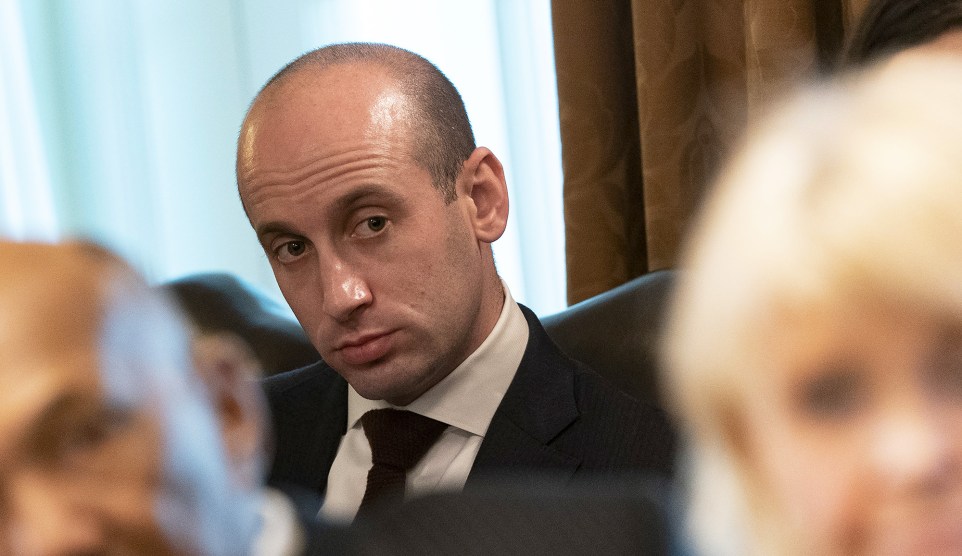
    Senior Advisor for Policy Stephen Miller.Chris Kleponis/CNP via ZUMA

    From an unnamed senior administration official:

    There is a near-systematic purge happening at the nation’s second-largest national security agency.

    So far this includes:

    • Kirstjen Nielsen, secretary of Homeland Security
    • United States Citizenship and Immigration Services director Francis Cissna
    • Office of the General Counsel’s John Mitnick
    • Secret Service director Randolph “Tex” Alles
    • Immigration and Customs Enforcement director-nominee Ron Vitiello

    According to CNN, Trump recently “empowered” Stephen Miller to lead the administration’s border policies and Miller is starting out with “what amounts to a wholesale decapitation” of the Department of Homeland Security leadership.

  • Donald Trump Created the Crisis at the Border

    Mani Albrecht/U.S. Customs and Border Protection via ZUMA

    I haven’t seen anyone make an argument about immigration that seems kind of obvious to me—and, I suspect, to President Trump himself. Here it is.

    Up until 2017, illegal immigration across the southern border was fine. It had been decreasing for years; it was at historically low levels; and there were no regular caravans of asylum seekers coming up from Guatemala. The first of the recent caravans began in 2018, and at first they seemed like the ones we had seen before from time to time: they started with a few thousand people and then shrunk as they got farther north. By the time they reached the US border, they were modest in size and created only modest problems.

    But then, later in 2018, as Election Day approached, Trump suddenly went bananas. There were armies of migrants marching toward our border! Mexico has to stop it! Build the wall!

    But this backfired. Not only did Republicans get walloped at the polls, but Trump’s constant howling acted as a great marketing campaign for the caravans. Instead of scaring migrants away, he made them more aware of asylum as a way of escaping from their country. The result was more caravans than ever before, and eventually, enough people at the border that we really did have something of a crisis on our hands. But it’s a crisis mostly of Trump’s own making. He decided that yelling about the brown hordes was more useful than making a deal of some kind with Democrats, and the result was more families seeking asylum than ever before.

    I suspect that Trump understands this at a gut level. The migrant crisis happened on Trump’s watch. Presidents get blamed for stuff that happens on their watch. So Trump is taking the blame for the migrant crisis. He can squawk forever about Democrats not being willing to build his wall, but in the end he owns the migrant crisis and the public will hold him to account for it. I think that’s fair, since I suspect that putting immigration front and center for the past two years has largely caused the crisis. But even if you disagree, it doesn’t matter. Trump is president. Fair or not, he takes the blame. He knows this, and it panics him.

    Trump himself, of course, is too dimwitted to think of any solution other than getting even louder and tougher. That’s not likely to work, but it’s his only play.

  • When It Comes to Student Debt, Doctors Are the Least of Our Worries

    Last night 60 Minutes ran a segment about the massive loans that med school students have to take out—and the “radical” solution that NYU found to this. It was basically just a feel-good bit of fluff, but it sure pissed me off anyway. Why? Let me count the ways:

    • Of all the groups to focus on who are suffering under the burden of student debt, they chose doctors? Seriously?
    • The “radical” solution turned out to be . . . raising money from a bunch of billionaires to subsidize tuition. This is radical?
    • There’s no mystery about making medical school free. It’s free in many European countries. But in return doctors have to accept lower pay.
    • The allegedly great thing about free tuition is that it allows students to graduate with low or no debt. This in turn gives them the freedom to choose lower-paying specialties or to set up shop in rural areas. That sounds great, but is there any evidence that this actually happens? Since none was offered, I suspect there isn’t.
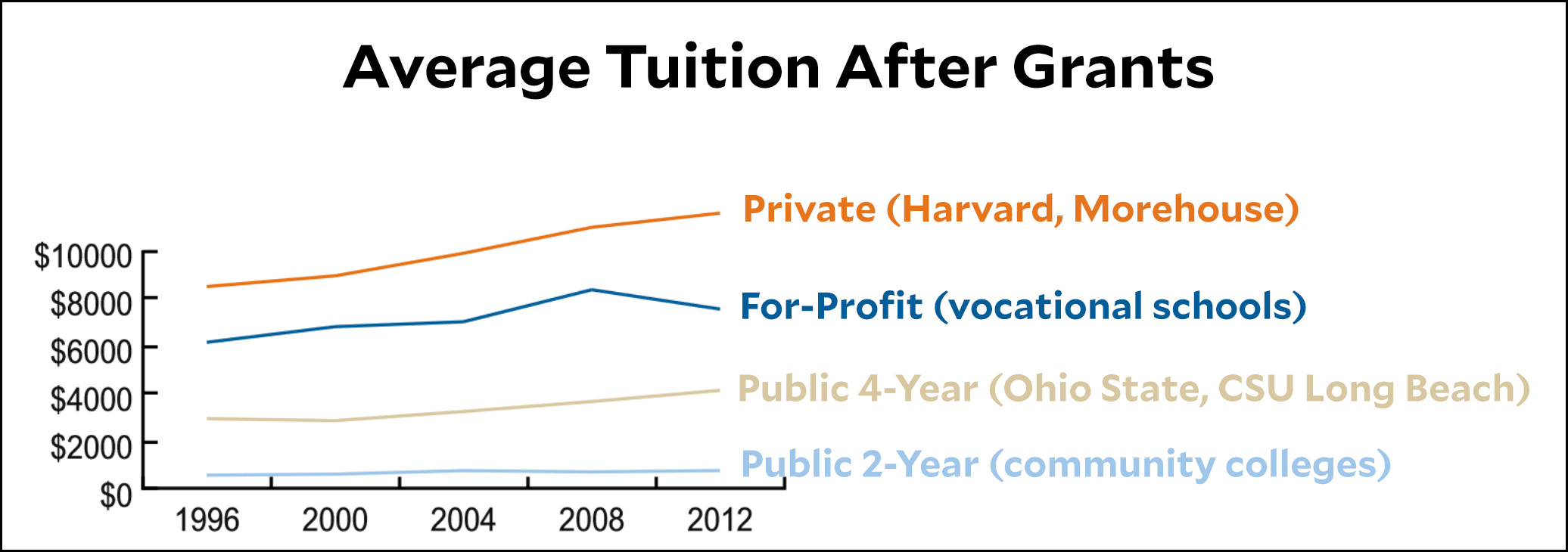
    • The increase in student loan burdens is a widespread problem. I feel sorry for doctors with $200K debts, Harvard grads with $80K debts, and state university grads with $40,000 debts. But all of these people are at least pretty likely to be able to pay off these loans. The real losers are the trade school grads—or, worse, dropouts—who leave with $20,000 debts. I suppose that doesn’t seem like a lot to Lesley Stahl, but for the many folks who have basically been conned into attending for-profit trade schools and end up with no real improvement in their job prospects, it’s a huge sum. These are the people who really deserve our attention.

    I suppose there are more important things to get pissed off about than a segment about doctors on 60 Minutes. But I’d still like to see them pay as much attention to the state university grads and the trade schools folks, who are way less able to afford their loans than most doctors.

  • Do Big Cities Make a Country Richer?

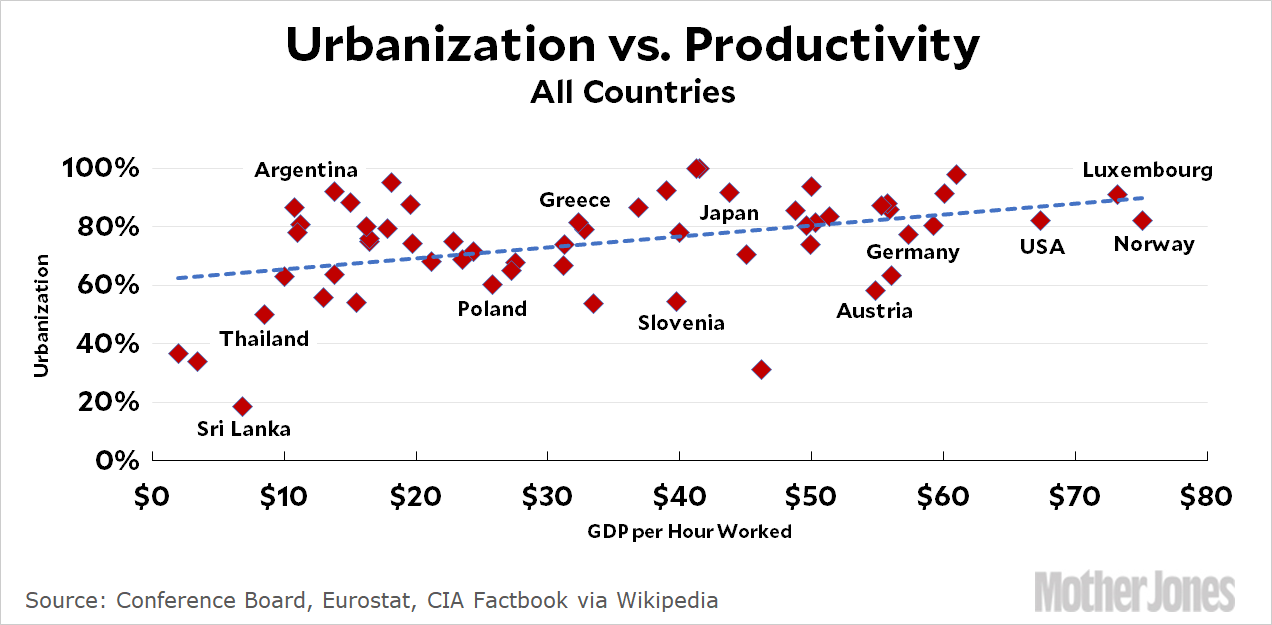
    This is a bit out of the blue, but earlier today I was pondering the idea that big cities make a country more prosperous. One way of looking at this is to do a simple comparison of the countries of the world based on their productivity and their degree of urbanization. “Urbanization” isn’t precisely defined, which makes this pretty rough but still sort of interesting. Here’s the comparison for a wide assortment of countries whose productivity is measured by the Conference Board and Eurostat:

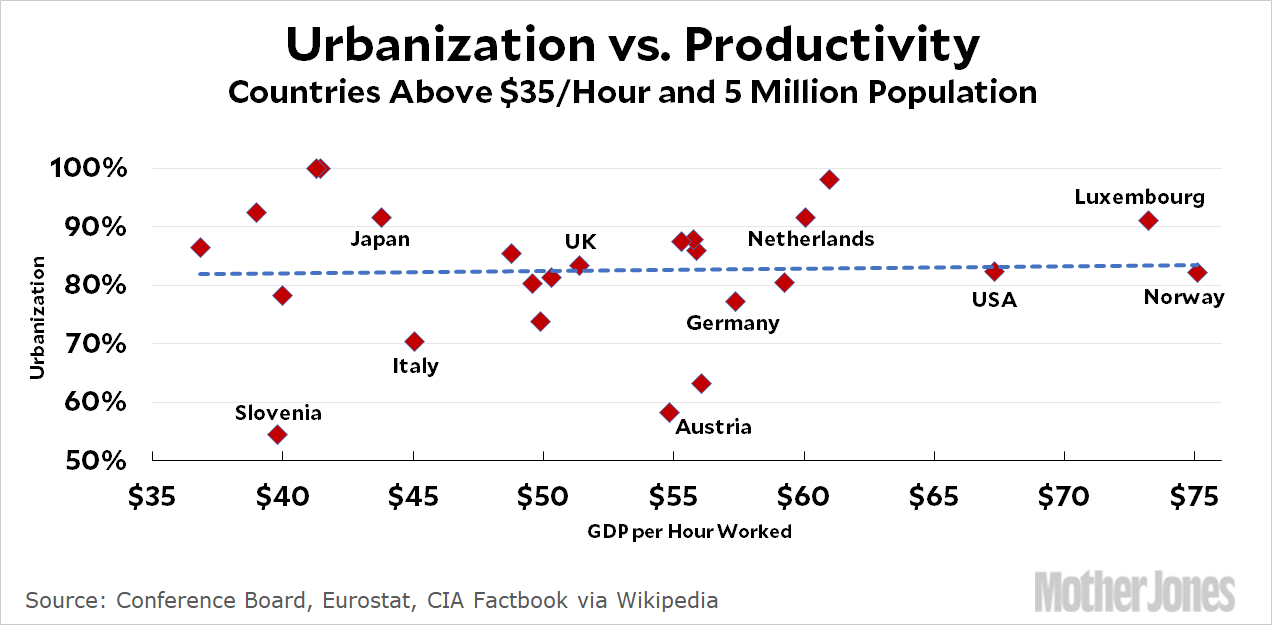
    Sure enough, higher urbanization = higher GDP. But here it is for a smaller selection of rich countries:

    Urbanization does seem to be associated with higher productivity if you compare across all countries, but the effect disappears at about $35 per hour worked. Above that level—and above 50 percent urbanization—the association disappears.

    There are probably lots of ways to tweak this to show whatever you want, and this kind of crude scatterplot isn’t something to be taken too seriously. Still, I was surprised that even in a simple plot like this there was no association at all. Take it for what it’s worth.

  • Donald Trump Has Shot Himself In the Foot on Immigration

    The Washington Post reports that President Trump plans to double the number of guest workers allowed into the country:

    DHS and the Labor Department plan to grant an additional 30,000 H-2B visas this summer on top of the 33,000 H-2B visas they had planned to give out, the agencies confirmed.

    Trump says there is a national emergency at the southern border because too many people are trying to come to the United States. On Friday, he implored migrants to turn around and go home. “We can’t take you anymore,” Trump said Friday while standing at the border in California. “Our country is full.”

    But his administration is giving a different message to some short-term workers. With the additional visas, the Trump administration is on track to grant 96,000 H-2B visas this fiscal year, the most since 2007, when George W. Bush was president.

    Translation: we need more workers to clean our hotel rooms.

    It’s a funny thing. Given who he is and the trust that his base puts in him, Trump could have negotiated a historic compromise on immigration. Back in late 2017, he was riding high enough that he could have gotten significant concessions from Democrats. It would have truly given him something to brag about.

    The Ann Coulters of the world would have screamed, and the Freedom Caucus would have voted against it, but so what? He would have told his base that it was the toughest—but fairest!—immigration bill ever passed, and they would have believed him. Hell, they would have cheered him. And it would have been genuinely bipartisan.

    Instead he listened to Stephen Miller and got nothing. His base is still loyal, but they would have stuck with him anyway. He’s gotten nothing out of this. What a moron.

  • Friday Cat Blogging – 5 April 2019

    I was at the top of the stairs and happened to have my camera in my hand when Hopper and Hilbert came tearing into the house last week. Hopper stopped on the stairs and I took the picture you see below. Note the immense, puffy tail. Obviously something got their attention out on the patio, but I don’t know what. A squirrel? A dog passing by? Could be anything.

    Today we have a bonus cat! A bonus kitten, actually. Yesterday the Washington Post ran a piece about Dean Nicholson, who is currently bicycling around the world. He started in Scotland, and eventually made his way to Bosnia—where a kitten by the side of the road stole his heart and became his companion for the rest of the journey, riding along in a pouch on the front of the bike. A couple of pictures from Nicholson’s Instagram page are below. Click here for more.

  • Blue-Collar Wages Are Nothing to Crow About Yet

    How have ordinary blue-collar workers been doing lately? To hear the financial press tell it, their wages are skyrocketing. “It’s still a workers’ labor market” says Vox, while the Wall Street Journal warns of dire days ahead for corporate profits.

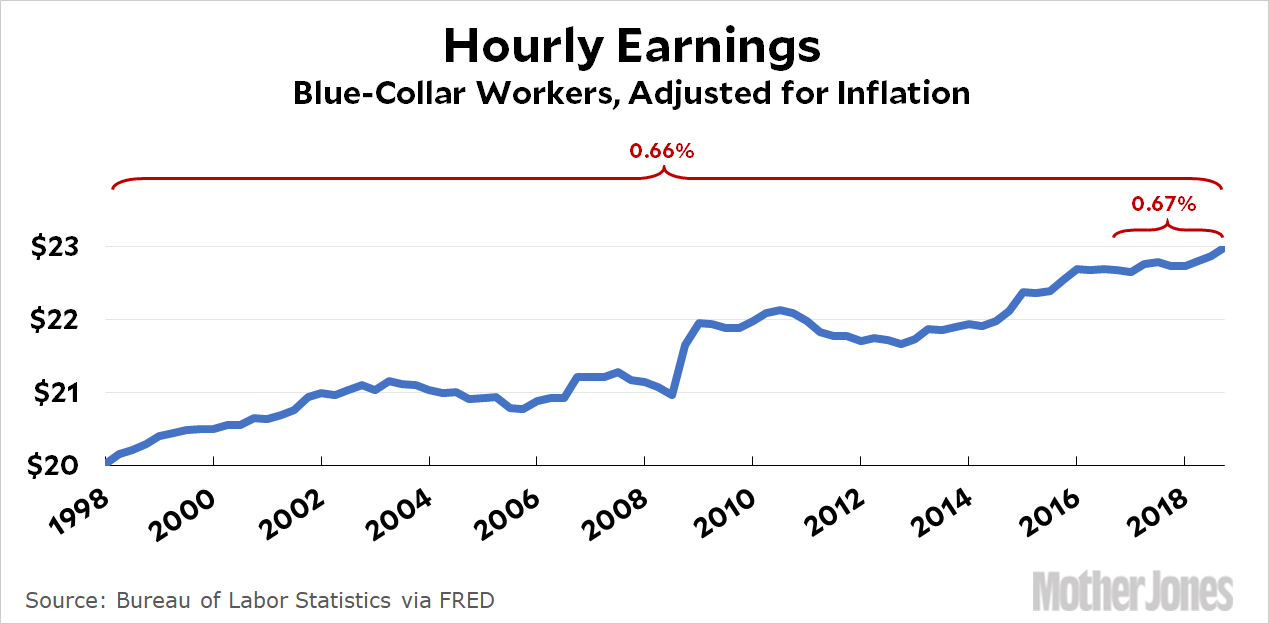
    But let’s not get carried away. Thanks to low inflation, workers have been doing fairly well for the past few months. But if you look at quarterly data for the past two years compared to the past 20 years, here’s what you get:

    During 2018 blue-collar wages went up about 1.1 percent. It was a decent year, but it was just making up for a lackluster 2017. Over the past two years together, blue-collar wages have gone up 0.67 percent per year. That’s nearly identical to the 20-year trend, which has seen blue-collar wages increase 0.66 percent per year.

    If blue-collar wages continue to rise at 1-2 percent per year for four or five years, then we’d have something to be happy about. But we’re nowhere close to that. We’ve had one year of middling-good growth, a few months of good growth, and that’s all. There’s really nothing extraordinary going on here.

  • Public Views on Abortion Have Been Rock Steady for 40 Years

    Over at Bloomberg, Ramesh Ponnuru argues that an incrementalist approach has served the anti-abortion movement well:

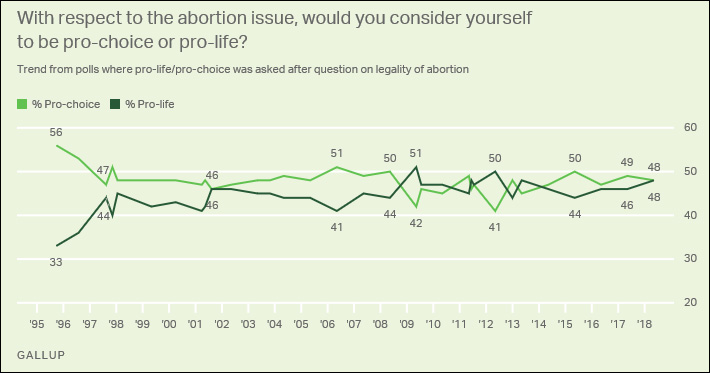
    Polling does not suggest that pro-lifers’ incrementalist approach has led to entrenched support for abortion in our culture. The movement’s turn toward incrementalism coincided with a substantial increase in the percentage of Americans who identified with it. In 1995, Gallup found that 56 percent of Americans considered themselves pro-choice and only 33 percent considered themselves pro-life. Its latest finding was a much more even 49-45 plurality for the pro-choice side.

    That sounds impressive, but I’ve warned you before not to believe anyone who suggests that public opinion has changed in any dramatic way on abortion. To see this, let’s go straight to the Gallup poll that Ponnuru mentions:

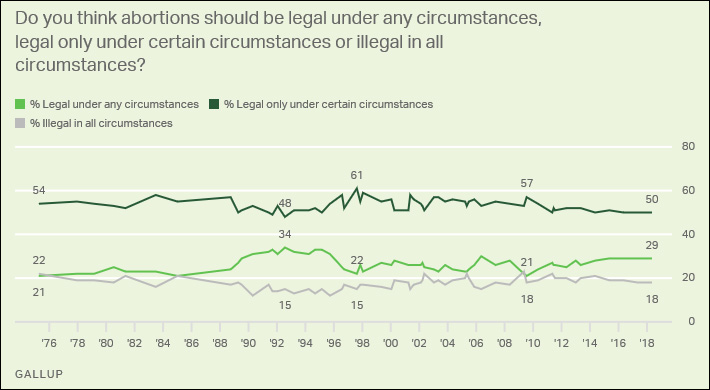
    This looks pretty flat, no? If you squint, you might see a very slight increase in pro-life voters, but that’s all. However, it is true that if you cherry pick the year 1995 as your starting point, it looks like the pro-life forces have made substantial gains. So what happened in 1995? Let’s take a look at another Gallup chart that has a longer timeframe:

    If you ask what people think, rather than asking them to identify with a group they may or may not fully understand, it turns out that nothing happened in 1995. In fact, nothing much has happened since 1976. This time, if you squint, you can see a slight increase in “always legal” and a slight decrease in “always illegal,” but that’s it. There’s just not much going on, and support for banning abortion entirely is, and always has been, a very small minority position.

    Obviously this could change. If a conservative Supreme Court overturns Roe v. Wade, I’ll bet we’d see some change. For now, however, nearly half a century of polling data suggests that public opinion is all but set in concrete. Americans mostly think abortion should be legal, with disagreement around the edges about just how permissive the rules should be (especially in the second trimester). Only a fifth of the public thinks it should be banned.

    That’s it. That’s the way it was 40 years ago and that’s the way it is today.

    UPDATE: I originally said that public opinion on abortion seemed to be “set in cement.” I have been informed that this is very, very wrong, and the correct term for this figure of speech is “set in concrete. I have corrected the text.

  • “Theory of Change” Is Disarmingly Simple

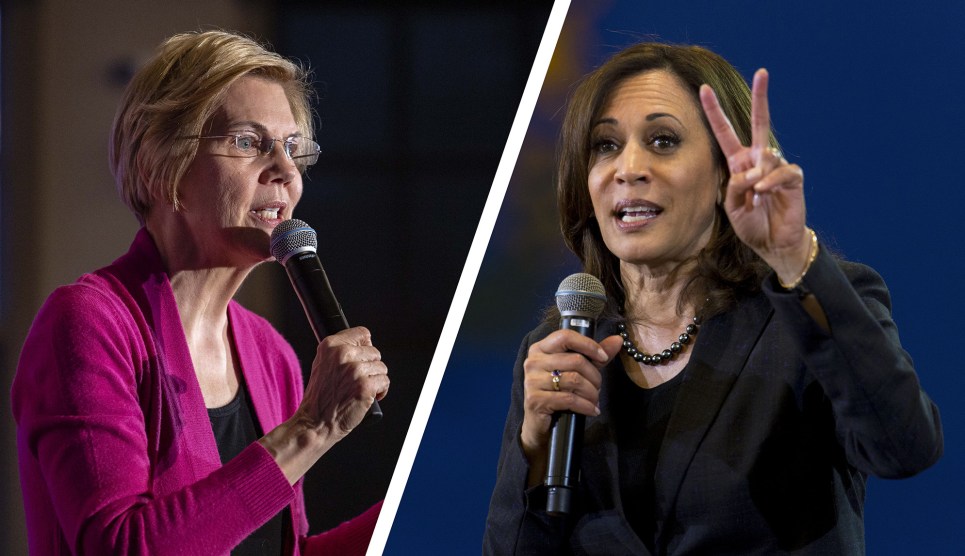
    KC McGinnis/ZUMA; Brian Cahn/ZUMA

    All the talk these days is about the “theory of change.” Every Democratic candidate is supposed to have one: after all, policy talk is all well and good, but how are you going to actually get legislation passed? Ed Kilgore ponders the problem:

    There is not [] any easy equivalence between the audacity of policy proposals and the willingness of candidates to consider the “process” changes that could make achieving these policies possible, as shown by Bernie Sanders, the “radical” who wants to preserve the filibuster and the current system for selecting Supreme Court justices

    ….These differences matter, perhaps more than policy differences, since progressive ideas are nothing more than fantasies if you don’t have the means to achieve them. It’s easy for Sanders to say he will mobilize enough support for his policies to overwhelm congressional Republicans and force them to go along. But Obama had a similar theory (one that at the time I labeled “grassroots bipartisanship”), and it turned out simply to be wrong once the presidential election ended and things got real.

    Quite so. This is why I’m not overwhelmed by, say, Elizabeth Warren’s blizzard of policy proposals. Quite aside from whether I agree with all of them, it’s just cheap talk unless you can get Congress to back you up. Two weeks ago, for example, the House voted 420-0 to ask for the Mueller report to be released. That was cheap talk. When it came time to vote on actual action (i.e., a subpoena), Republicans unanimously voted against it.

    It’s good that we’re talking about this, but less good that we’re making it more complicated than it really is. All you have to do is take a look at the past and ask what Democrats needed to pass big liberal legislation and the answer suddenly becomes easy: big Democratic majorities in Congress. That’s it. It’s what made the New Deal possible, the Great Society possible, and Obamacare possible. Its lack is what killed Bill Clinton’s health care plan. There are, it’s true, a few counterexamples of big things that were passed on a bipartisan basis: the Civil Rights Act, the Clean Air Act, ADA, the 1986 tax reform, and a handful of others. However, nearly all of these were passed under Republican presidents and all of them were passed more than 30 years ago.

    It’s been more than half a century since Republicans were willing to cross the aisle to vote for progressive legislation. So here’s the only theory of change that matters:

    • Get a Democratic majority in both houses.
    • Ditch the filibuster.
    • Pass whatever legislation is acceptable to the 50th most liberal senator.

    This in turn suggests that two things are important:

    • The coattails of whatever Democrat runs for president, which is basically her ability to persuade the public to vote for liberal change.
    • The ability of the party and the grass roots to elect more liberal senators.

    That’s really about it. The precise level of progressiveness of the president matters only slightly since the bottleneck for legislation will almost certainly be Congress. Elizabeth Warren may be more progressive than Kamala Harris, but Harris would still be the better choice if you think her coattails would be stronger, her public appeal for liberal change would be stronger, and therefore she’d be likely to produce a more liberal 50th senator.

    Unfortunately, this doesn’t make your decision easier. It makes it harder. It’s fairly easy, after all, to compare candidates based on their stated policy preferences, since those are usually set down in black and white. It’s a lot harder to figure out which one will have the stronger coattails in moderate states. Hard or not, though, it’s what matters.