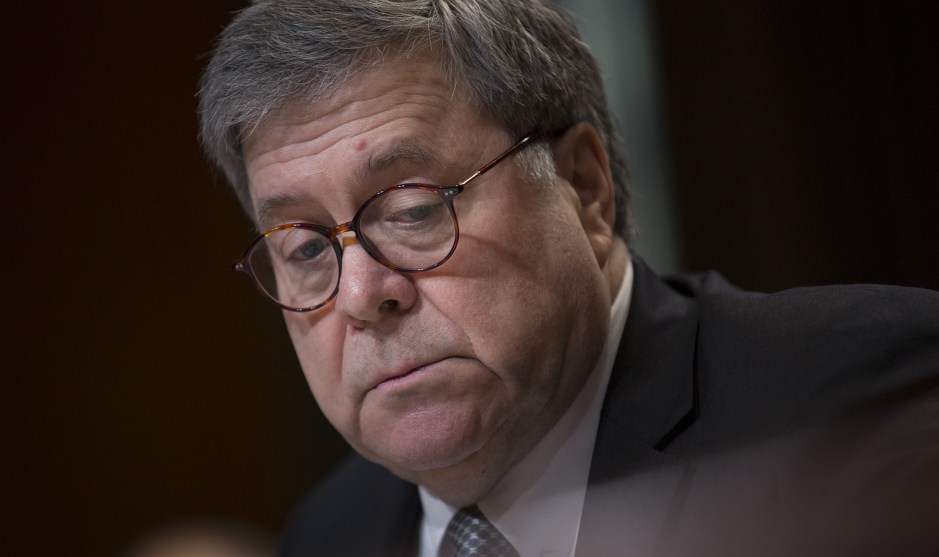
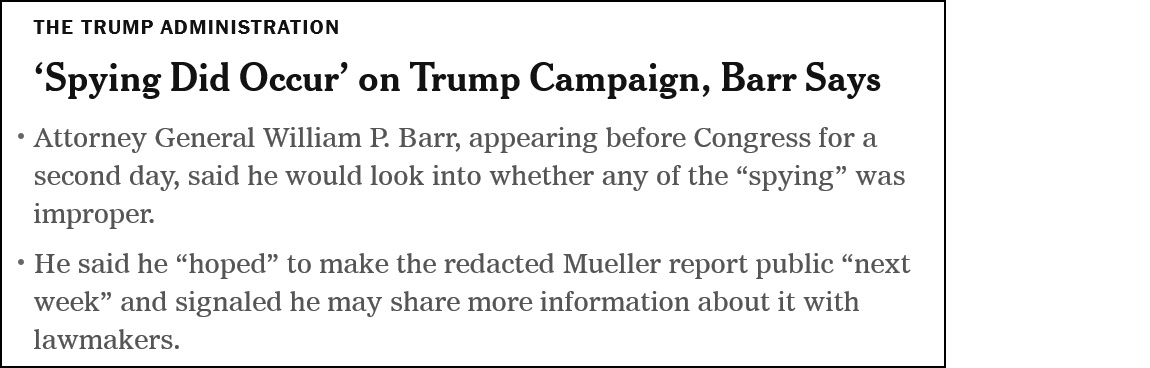
Barr: I think spying on a political campaign is a big deal. … There were a lot of rules put in place to make sure that there’s an adequate basis before our law enforcement agencies get involved in political surveillance. I’m not suggesting those rules were violated, but I think it’s important to look at that.
Sen. Jeanne Shaheen (D-N.H.): But you’re not suggesting that spying occurred?
Barr: I don’t … well … I guess you could — I think spying did occur. Yes, I think spying did occur. But the question is whether it was predicated, adequately predicated. And I’m not suggesting that it wasn’t adequately predicated. But I need to explore that.
What Barr is talking about is normally referred to as “investigation.” The FBI did indeed investigate various members of the Trump campaign, and there has never been the slightest evidence that it was improper. The case was precipitated by a tipsy George Papadopoulos telling an Australian diplomat that the Russians had dirt on Hillary Clinton. The Australians reported the meeting and the FBI began its investigation.
So perhaps a better headline would be something like this: “Barr: No Evidence That Trump Investigation Was Improper.”
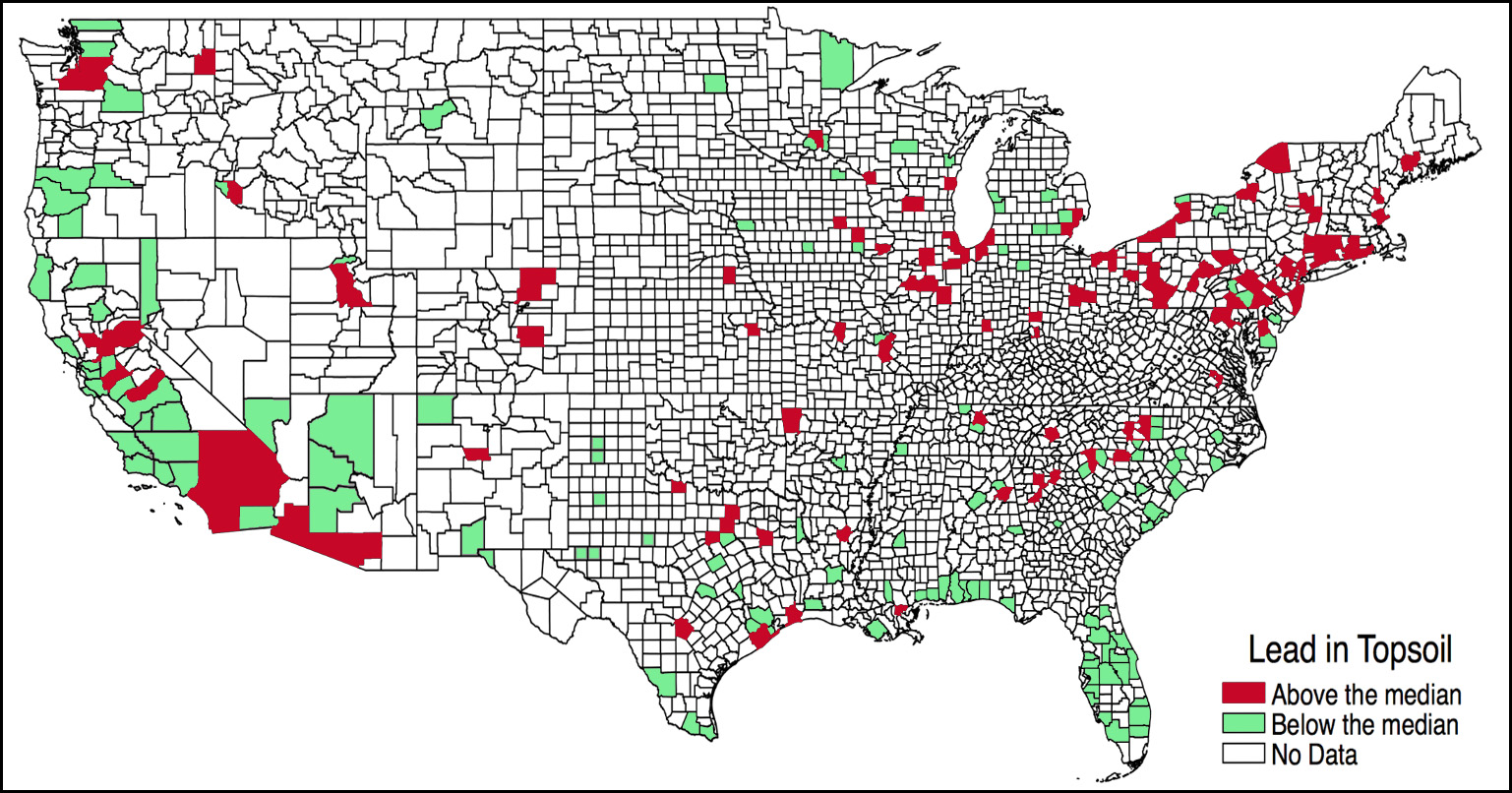
A new study out of Carnegie-Mellon examines the effect of topsoil lead contamination on cognitive problems among toddlers. To start, the authors construct a map of large US counties showing which ones are above and below average in lead contamination:
The green counties have a topsoil lead concentration of about 10 ppm, while the red counties have a concentration of about 20 ppm. The results of the study are simple:
Overall, about 3.5 percent of boys report cognitive difficulties.
In counties with high lead concentrations, this increases to 7.5 percent.
In urban areas with high lead concentrations, it increases to 11 percent.
Consistent with previous studies, the effects on girls are much smaller (though still positive).
The reason I’m highlighting this study is not because it shows that lead poisoning affects cognitive ability. That’s well-known and uncontroversial. However, it also shows specifically that lead in topsoil is a significant factor in producing those cognitive problems. And if topsoil lead affects cognitive ability, then topsoil lead also affects the likelihood of being prone to violent crime later in life. I’ve been banging the drum of topsoil lead for a while—it’s almost certainly a bigger problem than lead in drinking water—and this study is yet another that confirms it’s a serious problem.
Topsoil remediation is eminently achievable. In Norway, they’ve been doing it for years with a goal of zero lead in topsoil. But it’s obviously a big, expensive job. It’s too bad we no longer have leadership in this country that cares about such things.
And a partridge in a pear tree. Trump’s Twitter feed is becoming mostly a conduit for conservative media sycophants and conspiracy theory lunatics these days. Just makin’ America great again, I guess.
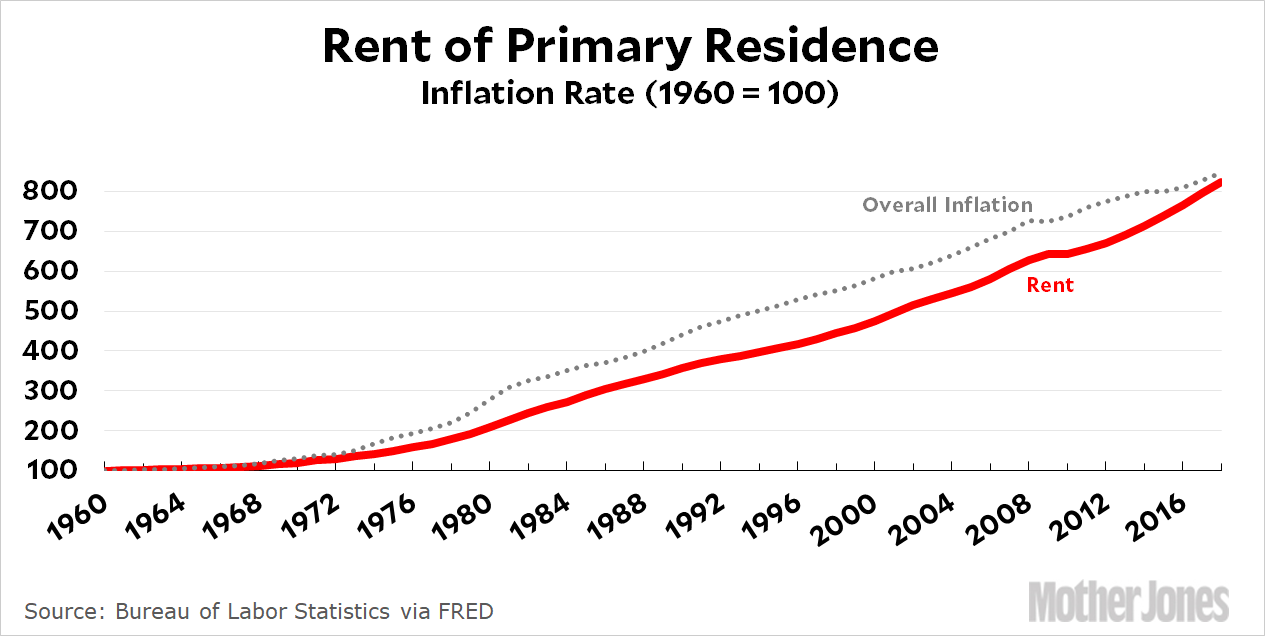
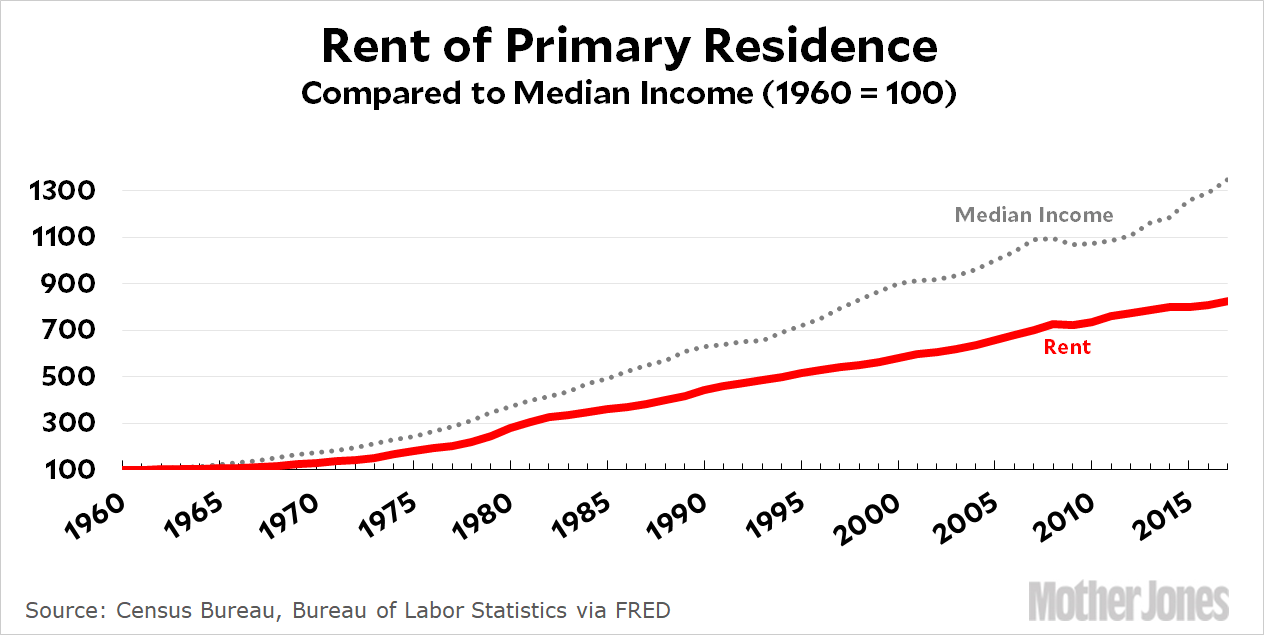
Here’s some more raw data about the housing market. This chart shows how much rent has increased compared to the overall inflation rate since 1960:
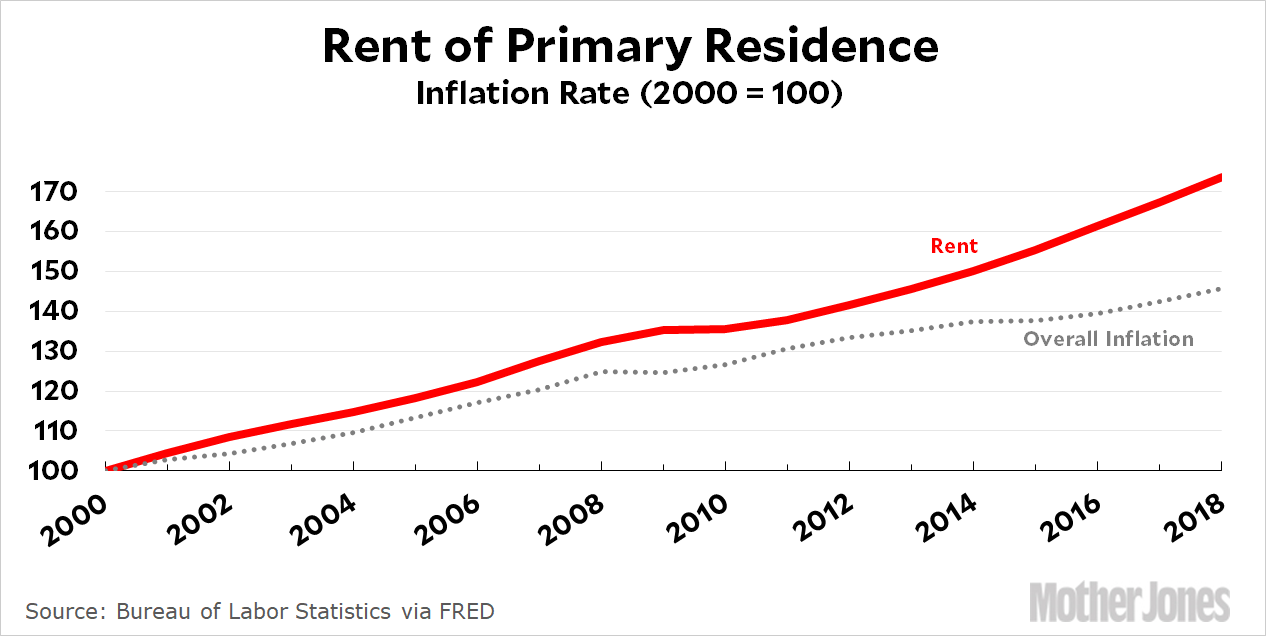
Over this period, rent has increased less than overall inflation. However, around 2000 rent inflation started to catch up. So let’s zoom in:
Since 2000, the rent index has increased 73 percent compared to only 46 percent for overall inflation. So rent has increased about 20 percent in real terms.
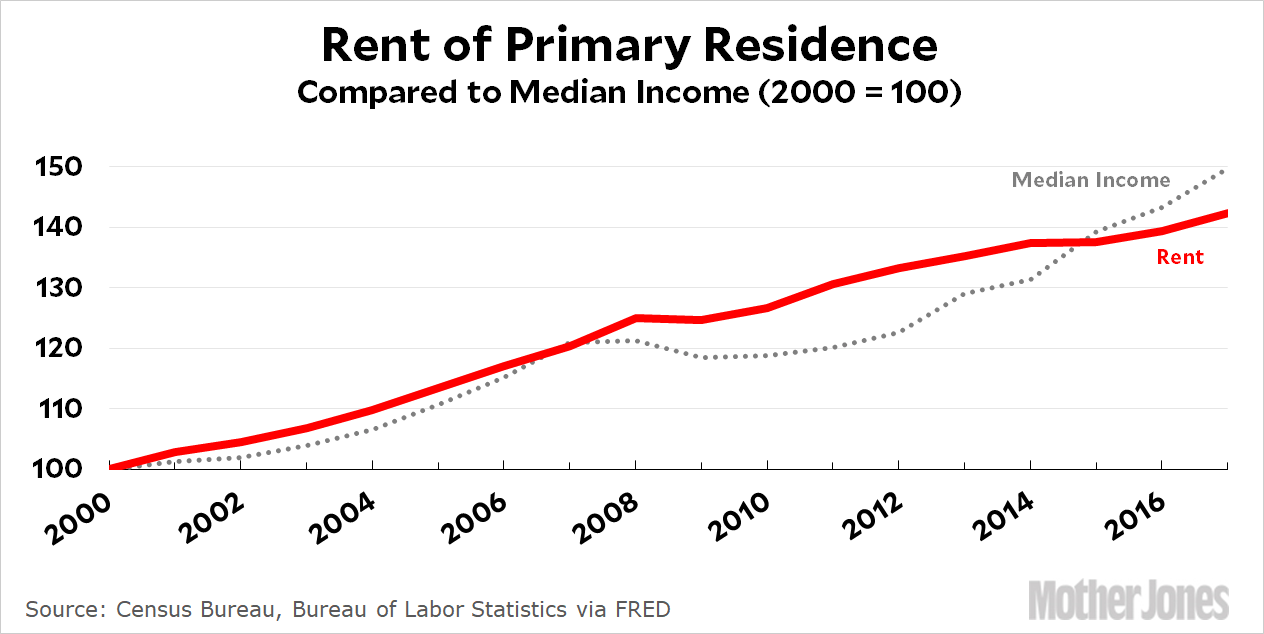
But it’s worth showing this as a percentage of income too. As I’ve been browsing around the internet I’ve seen a surprising number of completely screwed up charts about this. There are charts that compare real income to nominal rent. There are charts that compare real rent to real income but use the wrong numbers for income. There are charts that compare rent to some kind of mythical “renter income.” All of them should set off alarm bells instantly since they inevitably show that rent has increased by some phenomenally high number that no one should believe. So here is median rent compared to median income:
And here’s what we get if we zoom in on the past 20 years:
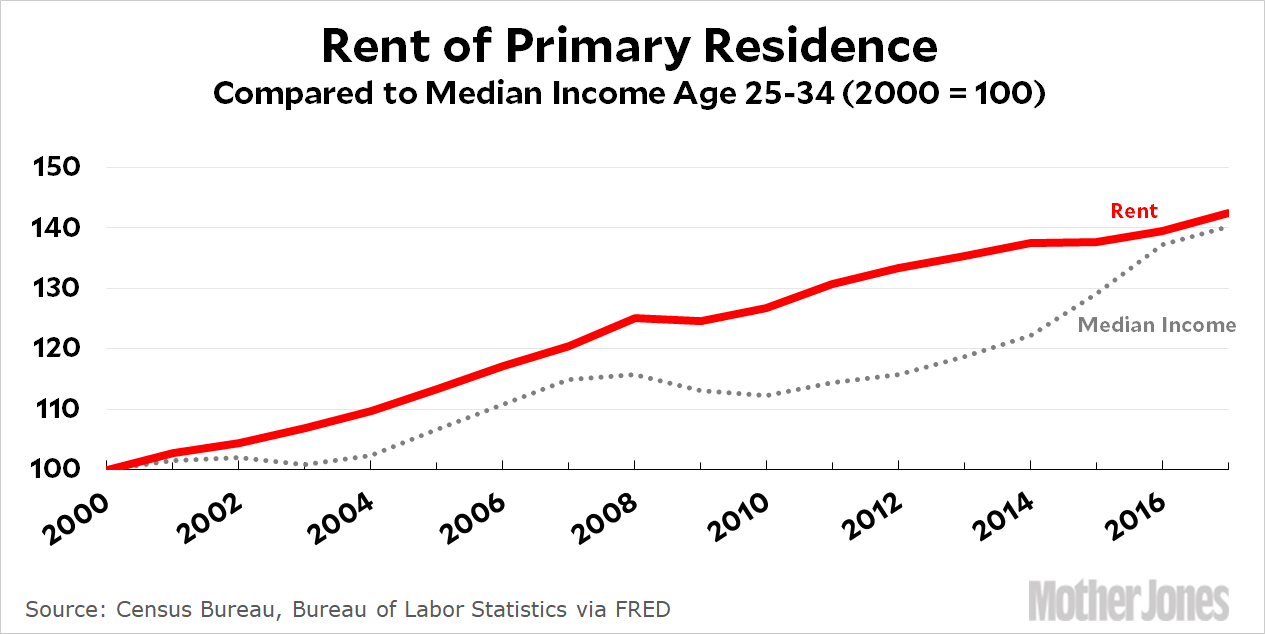
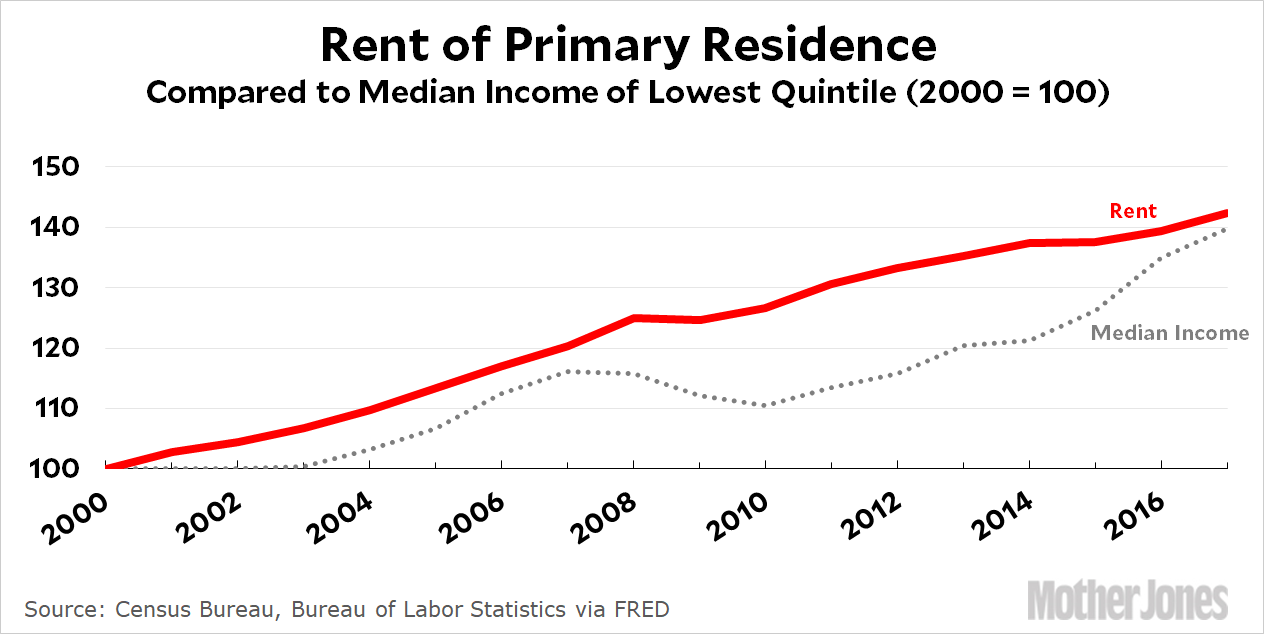
But what about young people, you ask? Or the poor? Here’s the same chart using median income for 25-34 year-olds and median income for the lowest income quintile:
As with everyone else, incomes of the young and poor fell during the Great Recession and then rebounded. They didn’t rebound as much as for older and richer workers, but even so, their income has increased at almost exactly the same rate as rent. The young and the poor, if they rent equivalent housing, are paying only about 1 percent more than they did in 2000.
Once again: this is national data. It tells us nothing about either rent or income in specific big cities. On a national basis, however, it suggests that for the median renter, rent has either been flat or has fallen as a percentage of income over the past 20 years, and over the past 60 years it’s fallen considerably.
While I was out taking pictures of wildflowers last week I realized that I was running low on animal pictures too. So on Saturday I visited our itty-bitty local zoo, home of the brain-damaged bear. Seriously. Apparently the OC Zoo rescued a pair of black bear cubs that had been removed from their mother and has raised them ever since. They’re very tame, since they’ve never been out in the wild, but one of them suffered an irreversible brain injury some years ago. The bear is doing fine, the zoo people say, but might occasionally exhibit some odd behavior. I’m not sure what that is, since I didn’t see anything especially odd during my visit.
However, I really like this picture of one of the bears. She looks like she’s smiling while she gives me some side-eye. Totes adorbs, no?
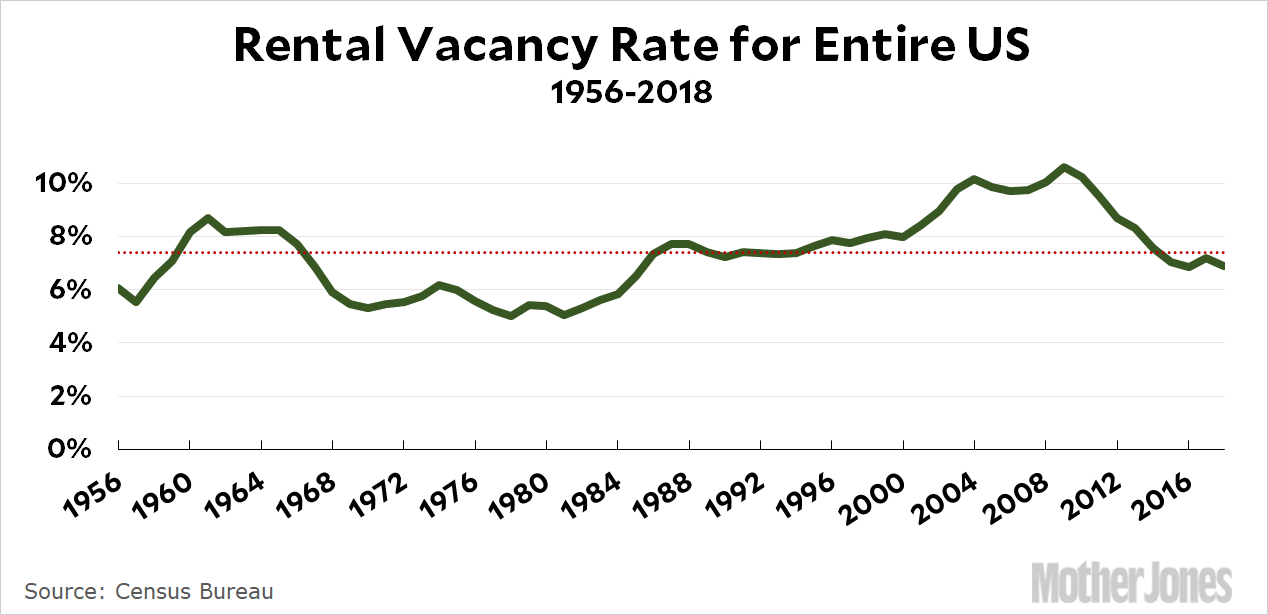
This is, once again, only national data, but it still provides a useful big picture view of what the rental market looks like. When the rental vacancy rate is low, it means the market is tight and rents are likely to increase. Here’s the national vacancy rate for as long as we have data for:
The rental market was noticeably loose during the aughts and then tightened during the Great Recession. But it’s not unusually tight right now. In fact, it’s right at its average for the past 60 years.
This doesn’t tell you anything about, say, the Bay Area or New York City. However, it does tell you that, overall, the market right now is fairly normal. There doesn’t really seem to be any big immediate need for a national program to boost housing.
In 2016, Laleh Shahravesh discovered that her ex-husband was living with a new partner. “I hope you go under the ground you idiot. Damn you. You left me for this horse,” she wrote on Facebook. Her ex-husband’s partner reported this insult to the police in Dubai, where the pair lived, and the police apparently issued a warrant for Shahravesh’s arrest if she ever entered the country. When Shahravesh’s ex-husband died this year, she and her daughter flew to Dubai for the funeral, where she was promptly arrested at the airport.
Just in case I ever forget, please remind me never to visit Dubai.
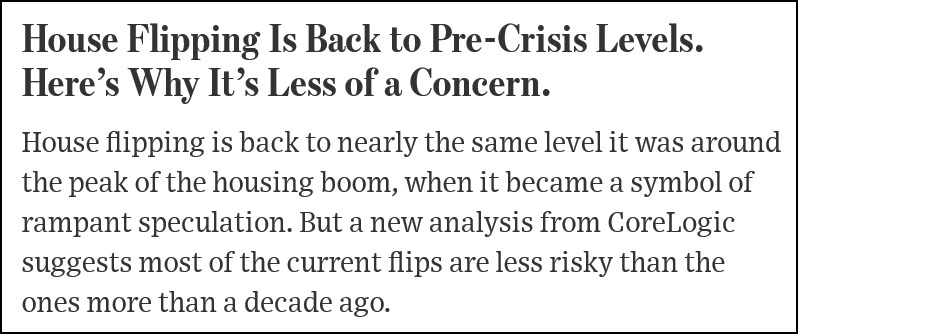
I do so love headlines like this one from the Wall Street Journal:
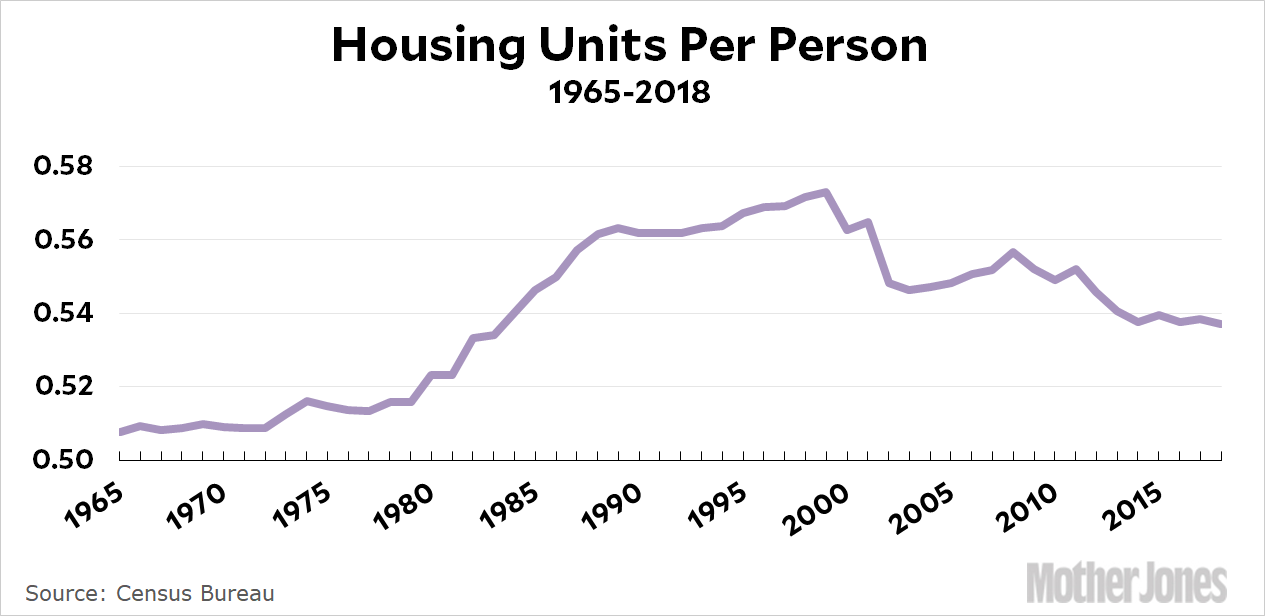
Feel free to read the article if you want. I don’t think I’ll bother, especially since my internet connection has slowed to molasses levels for some reason. However, since we’re on the subject of houses, here’s a chart I made last night:
I was curious to see what the broadest possible look at the housing market would show us. The answer appears to be that housing inventory took a big dive from 1999-2003. Since then it’s been relatively flat, with a bit of a decline during the Great Recession. Since 2014 it’s been at about 1985 levels.
This is nationwide, so it doesn’t account for the housing supply in specific places like the Bay Area or Seattle. On the other hand, it also doesn’t account for generational changes, namely the aging of the baby boomers, which probably reduced the demand for housing. With those caveats, at a first glance it doesn’t look like we have a nationwide shortage of housing. Rather, it looks like the housing boom starting in 1980 went a little too far and corrected in 1999. It doesn’t look especially like a crisis, but maybe I’ll try to look into this a little more deeply later in the day.
According to CNN’s Jake Tapper, Donald Trump began raging at a meeting two weeks ago and demanded that DHS Secretary Kirstjen Nielsen close the port of entry at El Paso. Eventually he was talked out of this:
Trump, however, was insistent that his administration begin taking another action — denying asylum seekers entry. Nielsen tried to explain to the President that the asylum laws allow migrants from Central America to come to the US and gain entry. She talked to the White House counsel to see if there were any exceptions, but he told her that her reading of the law was correct.
….Last Friday, the President visited Calexico, California….Behind the scenes, two sources told CNN, the President told border agents to not let migrants in. Tell them we don’t have the capacity, he said. If judges give you trouble, say, “Sorry, judge, I can’t do it. We don’t have the room.”
After the President left the room, agents sought further advice from their leaders, who told them they were not giving them that direction and if they did what the President said they would take on personal liability. You have to follow the law, they were told.
This is apparently why Trump fired Nielsen: he got tired of being told that stuff he wanted to do was illegal. I suppose this is small change compared to approving the illegal torture of enemy combatants. Or pardoning everyone associated with a scandal you were involved in. Or approving that scandal in the first place. Or ordering the break-in of Democratic Party headquarters. Come to think of it, Republican presidents have a real problem with respecting the law, don’t they? I suppose it was too much to hope that Trump would be any better than his predecessors.
Anyway, I have an answer to this dilemma: nominate Stephen Miller as secretary of Homeland Security. He’s the guy who’s been advising Trump on immigration policy all along, so he’d be obligated to break the law and do whatever Trump wanted. Later, he could be prosecuted for wilfully violating immigration statutes and be put away for five-to-ten with time off for good behavior. Trump would get what he wants and Miller would get what he deserves. It’s win-win.
In related news, Tapper also reports that Trump wants families separated even if they appear at ports of entry requesting asylum. This is illegal and would be a PR disaster, but Trump doesn’t care. “He just wants to separate families,” said an unnamed senior administration official.
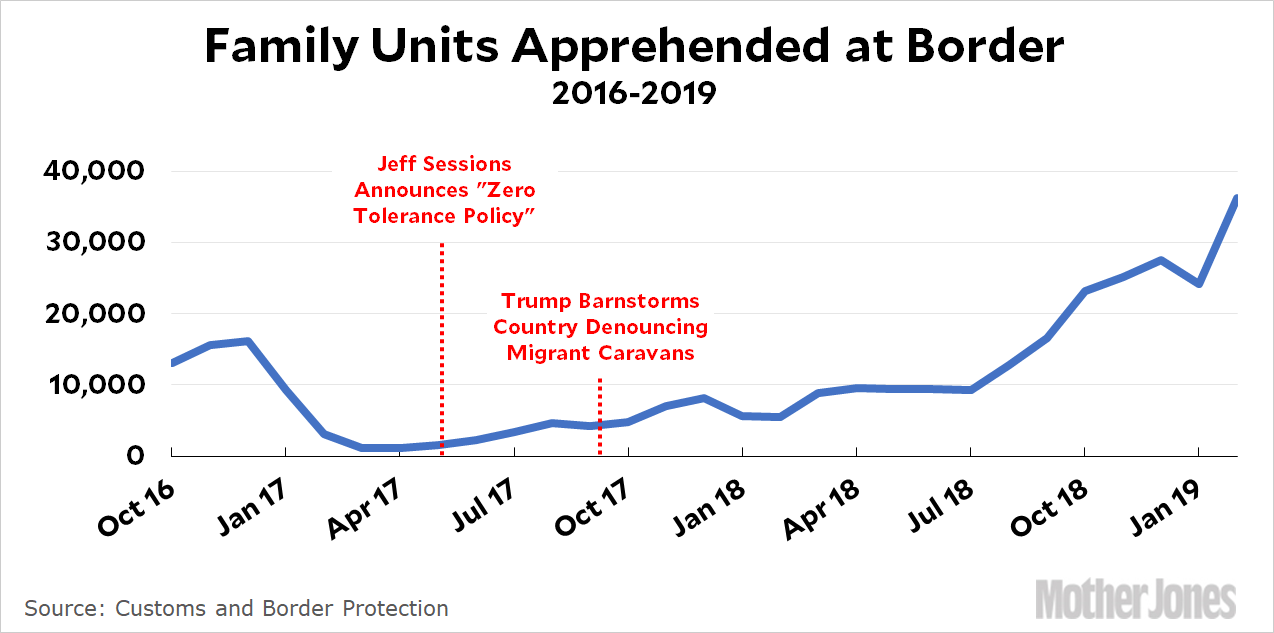
This is no surprise. But here’s the odd part. Trump wants to separate families because he thinks separations deter migrants from coming. And yet, in the year following a huge scandal over separating families, more families than ever are crossing the border. The evidence suggests not only that separating families doesn’t work, but that it actively encourages more families to come. But when your only policy is a big mouth and a desire to crush your enemies, I guess you don’t have many alternatives.
With wildflowers blooming all around us here in Southern California, I’ve been out stocking up on flower pictures for the rest of the year. On Friday I spent a couple of hours walking around the Laguna Coast Wilderness Park and got lots of good pictures. The flowers below are school bells, aka blue-dicks, very common around here, especially in coastal areas.
At least, I think that’s what they are. My wildflower ID skills are improving a bit, but they’re still pretty weak. Corrections welcome.
April 5, 2019 — Laguna Coast Wilderness Park, Orange County, California
And we respect that! But maybe you’re of a mind to support our work directly instead? We have until December 31 to raise the last $400,000 we need to keep our nonprofit newsroom running at full strength into 2026. Will you make a gift today?
We noticed you have an ad blocker on. Can you pitch in a few bucks to help fund Mother Jones' investigative journalism?
Billionaires own the media,
but they don’t own us.
At Mother Jones we know these aren’t conventional times, and they require unconventional coverage. That’s what deliver every day: fierce, independent journalism you can’t find elsewhere. Perhaps never in the history of our country has that been more necessary than now. But we can’t do it without reader support—your support. Please chip in today.
Billionaires own the media,
but they don’t own us.
At Mother Jones we know these aren’t conventional times, and they require unconventional coverage. That’s what deliver every day: fierce, independent journalism you can’t find elsewhere. Perhaps never in the history of our country has that been more necessary than now. But we can’t do it without reader support—your support. Please chip in today.