The Great Lakes are frozen solid! But under President Trump's leadership they will all be thawed out for the enjoyment of the people. And thanks to Trump's expertise in building things, this thaw will take months, not years.MODIS/NASA/ZUMA Wire/ZUMA
From President Donald Trump, speaking to the good citizens of Michigan:
I support the Great Lakes. Always have! They are beautiful. They are big, very deep, record deepness, right?
President Trump: “I support the Great Lakes. Always have. They’re beautiful. They’re big. Very deep. Record deepness, right? And I’m going to get… full funding of $300 million for the Great Lakes Restoration Initiatives.” https://t.co/XmJB00MEjlpic.twitter.com/IQiJBfILMa
Well, no. Lake Baikal is the deepest lake in the world and Crater Lake is the deepest lake in the US. According to Wikipedia, Lake Superior is the deepest Great Lake, making the list at the 37th deepest lake in the world.
Which is not to say that the Great Lakes aren’t great! They are. And President Trump, as usual, is right to point that out, even if nitpicking naysayers like me are inevitably going to attack him.
In Grand Rapids last night, Trump announced that he’s going to make sure the Great Lakes Restoration Initiative is fully funded. Trump’s budget earlier this month proposed slashing that program, which funds the cleanup of the Great Lakes, by 90 percent — from $300 million to $30 million….During his first year in office, Trump called for eliminating the program entirely.
Apparently this is Trump’s new MO: allow his staff to propose huge budget cuts, and then loudly “override his people” when they turn out to be unpopular. That produces headlines like this one:
headline i just saw on local news “President Trump saves Special Olympics”
Theresa May said she’d resign as prime minister if her Brexit plan passed. It failed today. So is she going to resign anyway? Or stick around just to annoy everyone? The world is waiting.
Naturally, I hope she resigns and Boris Johnson becomes PM. This would make Brexit world historically ridiculous, which is really all it deserves. Maybe BoJo will work with Donald Trump to get the UK admitted to the US as four additional states? You guys are going to love Trump’s fabulous new health care system!
Ahem. Yes. I know it’s not a joke. All jokes will hereby cease.¹
¹But only after everyone votes for my blog as the greatest American literary achievement of all time.
This is a noodley post, the kind I’d usually put up on a weekend. But it’s on my mind now, so here it is.
What’s got me interested is an old topic: how social media allows us all to hyperspecialize in what kind of news we consume. Earlier today, for example, I saw a tweet about how the women running for president are being treated differently than the men. That doesn’t seem right to me based on the sense I get from my Twitter feed, but someone else—also liberal, white, middle-class, etc.—with even a moderately different set of people they follow might come to a completely different conclusion. Neither one of us is “right.” Neither one of us could possibly consume enough different news sites to do a serious comparison. So I see a tweet like this…
History is repeating with Warren. She was everyone’s favourite “I’m not sexist, I’d vote for her” shield in 2016, but now nobody wants to actually vote for her.
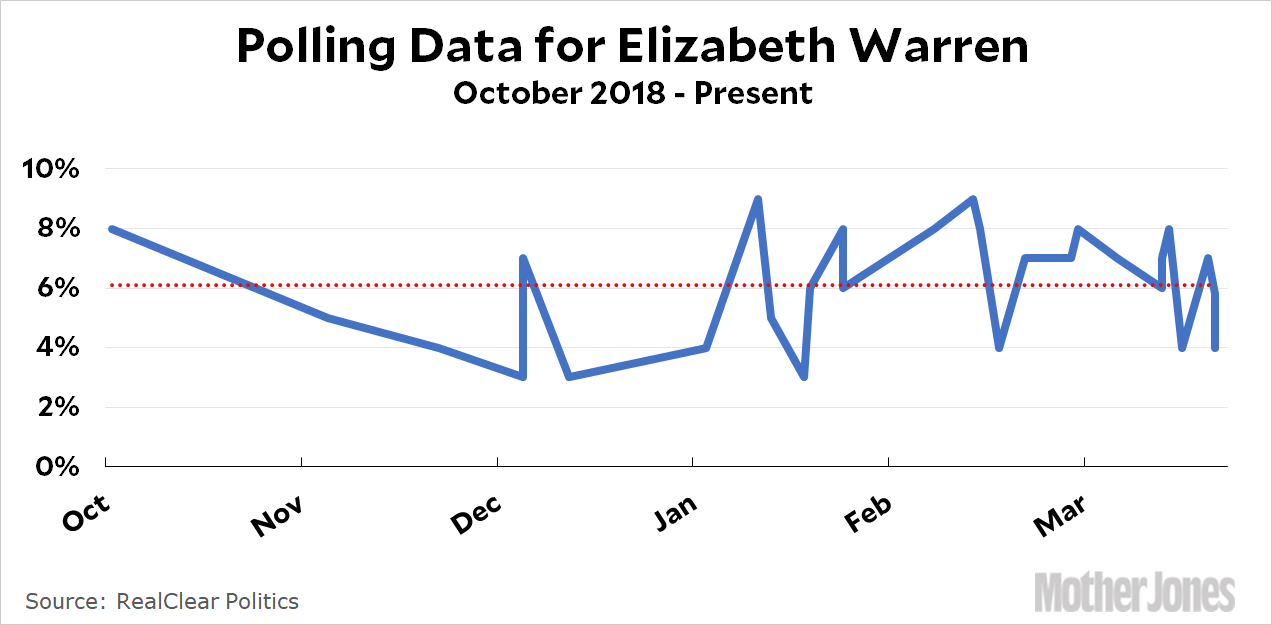
…and I rub my eyes. Warren was never “everyone’s” favorite. Nor is it true that “nobody” wants to vote for her now. What is true—probably—is that this person follows a lot of progressives and got the impression from them that Warren was super popular, and is now surprised when it turns out that she’s polling in the middle of the pack and has been for quite a while:
It’s true that Warren is polling way behind big names like Joe Biden and Bernie Sanders, both of whom happen to be men. But Biden spent eight years as vice president and Sanders is the guy who almost beat Hillary Clinton in 2016. It’s hardly any wonder that they’re at the top of the polls right now.
I don’t mean this as a criticism of Buttigieg. He has a lot to commend. But Buttigieg is enjoying a hearing, including lots of positive media coverage, that no woman in his position could possibly be granted. In part, that’s because, as Jill Filipovic reminds us, we judge women by their accomplishments but men by their potential. Ambition in a man is considered admirable, while it’s considered threatening in a woman.
We’ve seen this time and again. Hillary Clinton’s popularity bounced up and down depending on whether she was seeking an office. Or take Sen. Elizabeth Warren (D-Mass.). Back in 2016, many on the left held up Warren as everything they wanted in a presidential candidate. The key, though, was that Warren wasn’t running. Once she did run, many of those same people decided they weren’t so enamored of her after all. She used to be brilliant and charismatic; now people have decided she’s an inauthentic schoolmarm.
That case came up in a recent conversation I had with Kate Manne, a Cornell philosophy professor and author of “Down Girl: The Logic of Misogyny.” As Manne points out, when each woman currently running entered the race, a fatal flaw was quickly identified: Warren’s Native American ancestry, Sen. Amy Klobuchar’s (D-Minn.) treatment of her staff, or Sen. Kirsten Gillibrand (D-N.Y.) being, well, too ambitious….“The real fatal flaw is ambition,” Manne says, “and wanting to lead, and wanting to have a male-dominated authority position at the expense of men — and particularly white men — in the race. And that implicitly becomes the basis for suspicion and moral condemnation.”
Maybe this is right. But every four years there are always a few new faces like Buttigieg who suddenly command a surprising amount of attention. Remember the 2016 Republican primary, where Ben Carson and Carly Fiorina each spent a few weeks in the spotlight? And 2012, with Herman Cain and Newt Gingrich? As for Hillary Clinton, of course she got less popular when she was running for office. What else would you expect? (And in the end, she did get 65 million votes, after all.)
Then there are all those fatal flaws in the current crop of women running for president. That might be a sign of misogyny, but it might also just be what happens to every candidate who starts to poll strongly. It’s a sign that they’re being taken seriously, and it happens to men too. Right now Biden is performing an apology tour for his treatment of Anita Hill while Bernie Sanders is getting flak for not releasing his tax returns. Buttigieg and Beto O’Rourke will get their turn in the barrel too, I’m sure.
So who’s right about this? It’s always been impossible to say for sure, but it seems even more impossible these days because so many of us form vague feelings about things based on what we scan through in our Twitter or Facebook or Instagram feeds every day. But those are hyperspecialized nano-bubbles. In the same way that liberals and conservatives sometimes seem to live in whole different worlds because of Fox News, people who agree about nearly everything can also end up with wildly different views thanks to the power of social media. Even if we all read, say, the New York Times and the Washington Post, our social media feeds have more power to shape our opinions because they’re populated by people we know and trust.
Of course, the same dynamic takes place outside of social media too. There’s a lot of wailing and gnashing these days about whether “the media” reported on the Trump-Russia scandal fairly over the past couple of years. My sense is that the coverage was generally OK, but it turns out that the criticism is mostly aimed at MSNBC, and specifically at Rachel Maddow. Did they blow it? Beats me. I haven’t watched any prime time cable shows for years. I have no idea what they’ve been saying. I consume almost exclusively print media.
So who’s right about this? Again, I don’t know. In one sense, I think it’s fair to say that not all that many people actually watch these cable shows: a few million total, and maybe half a million in the key 25-54 demographic. That’s about 1 percent of the voting-age population. On the other hand, those few million are political junkies who probably have influence out of proportion to their numbers. So maybe it’s fair to say that I’m missing the boat by not watching them and understanding what they’re up to. I wouldn’t dismiss the influence of Fox News, after all.
So what’s the conclusion here? I don’t have one. I warned you about that in my first sentence, didn’t I? Hell, I don’t even know if the nano-bubbles of social media are really any different than the ordinary nano-bubbles of friends and family. What do you think? Social media nano-bubbles seem more powerful and diverse to me, making it even harder than usual to build consensus, but then, that’s just a sense I’ve built up from my own nano-bubble. What do I know?
In an op-ed over at BuzzFeed, the national director of the Opportunity Starts at Home campaign says that most people think housing affordability is a big problem:
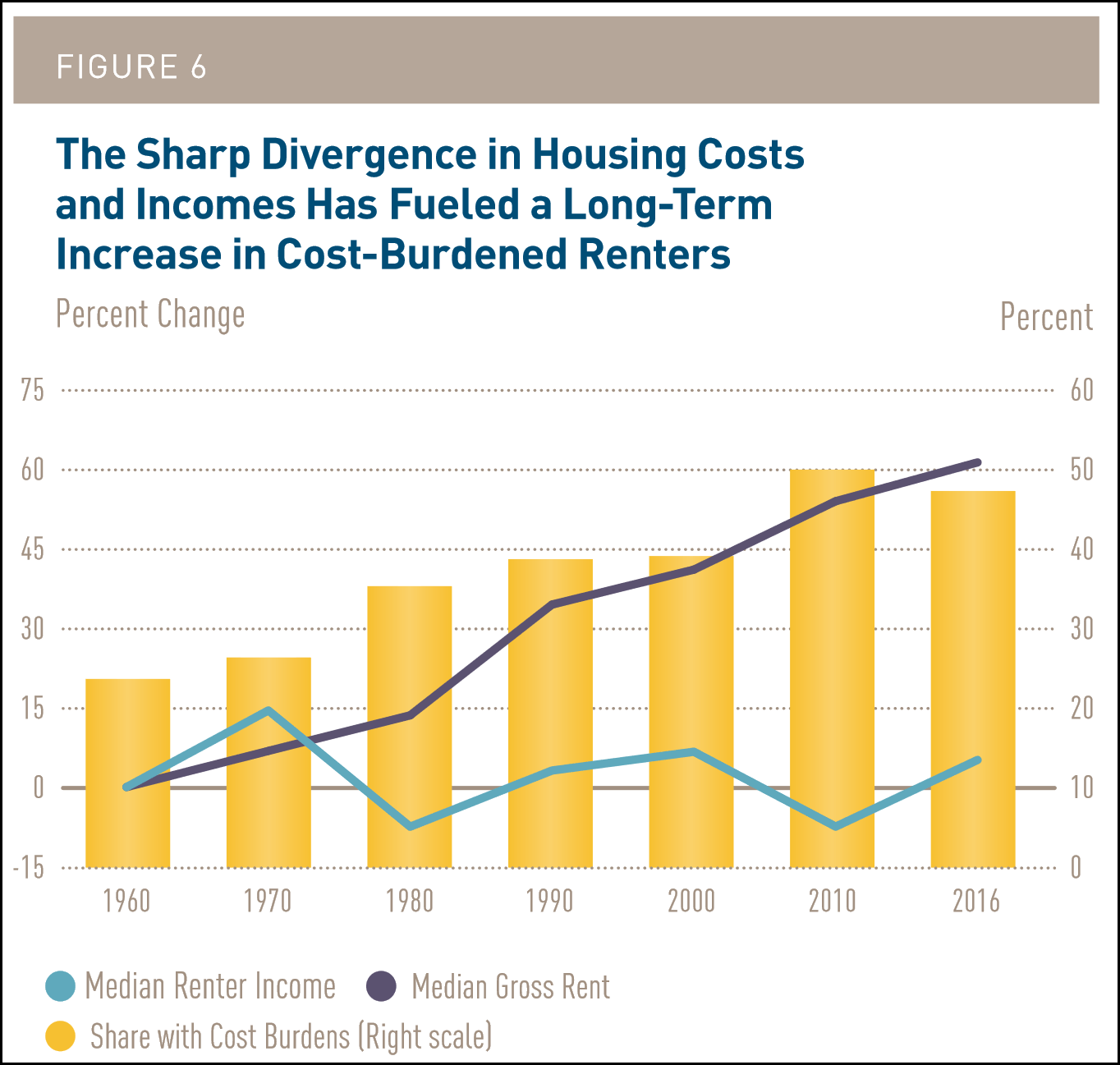
Those people aren’t imagining things: The affordability crisis has indeed reached historic heights, and the data is shocking. Since 1960, renters’ incomes have increased by only 5% while rents have risen 61%.
I agree that housing affordability is a problem, but renters’ incomes have surely gone up more than 5 percent since 1960. What’s going on here? Apparently this figure comes from the annual “State of the Nation’s Housing” report from the Joint Center for Housing Studies at Harvard:
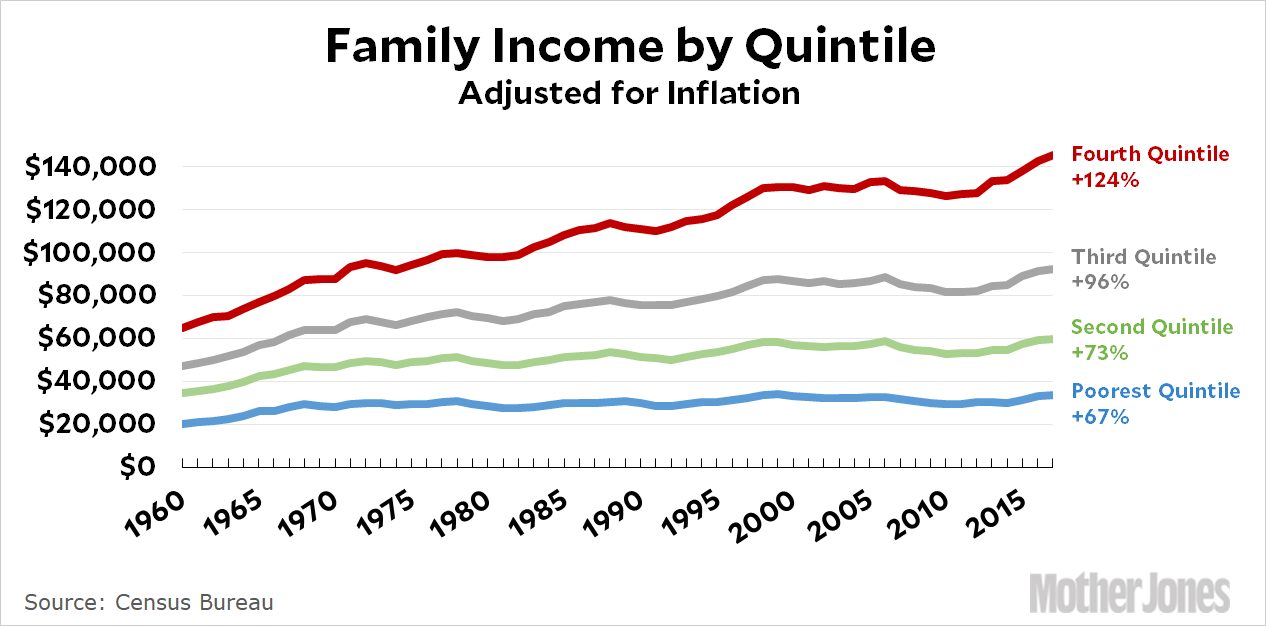
The report doesn’t say where this income data comes from, but it sure doesn’t seem likely. Here are the incomes of the poorest to the richest families since 1960:
These are the raw figures from the Census Bureau. If I use a different inflation measure, incomes have gone up even more. If I break out income by age or education or race, nothing much changes. For every demographic group you can think of, earnings since 1960 have gone up at least 50 percent, and usually much more.
Given all this, what are the odds that renters’ incomes have increased by only 5 percent? Pretty slim, I’d say. In fact, if the JCHS data on rent is accurate, it looks as though incomes have most likely gone up more than rents. Where did this stuff come from?
POSTSCRIPT: The odd thing about this is why the series starts with 1960 in the first place. That’s a long time ago and it includes the booming economy (and incomes) of the 60s. If you start, instead, at 1975, rents have definitely gone up more than incomes at the low end. It’s not 60 percent vs. 5 percent, but it might easily be 50 percent vs. 20 percent.
This is Silverado Creek. It may not look like much to those of you from rainier climes, but the fact that it has any water at all is a little unusual. The original of this picture has plenty of lovely greenery, but I decided it looked better as a contrasty black-and-white photo instead. I converted the sky and the ground to black-and-white separately, using different filter settings, and then merged them back together. It has a nice Old West feel to it that I like a lot.
In case you’re interested, the Justice Department has finally told us something new about the Mueller report: it is “more than 300 pages long.” It’s not clear why they seemed to consider this a state secret to begin with, but it’s finally out in the open.
That’s a lot of pages. I’ll bet there’s some pretty interesting stuff in there.
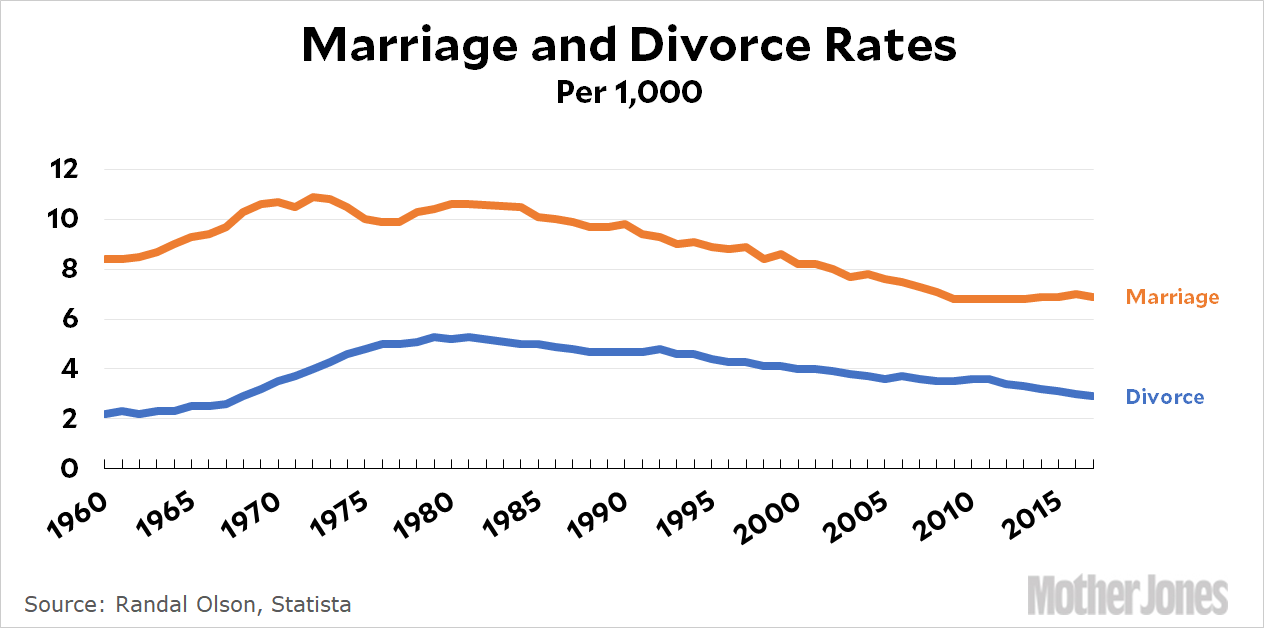
In my Twitter feed, Brad Wilcox is pointing out that the divorce rate in the US is way down from its peak in the early 80s. And he’s right: the annual divorce rate is down by about a third since 1981. That sounds like great news, but you need to put it in context. You see, the marriage rate has also been falling:
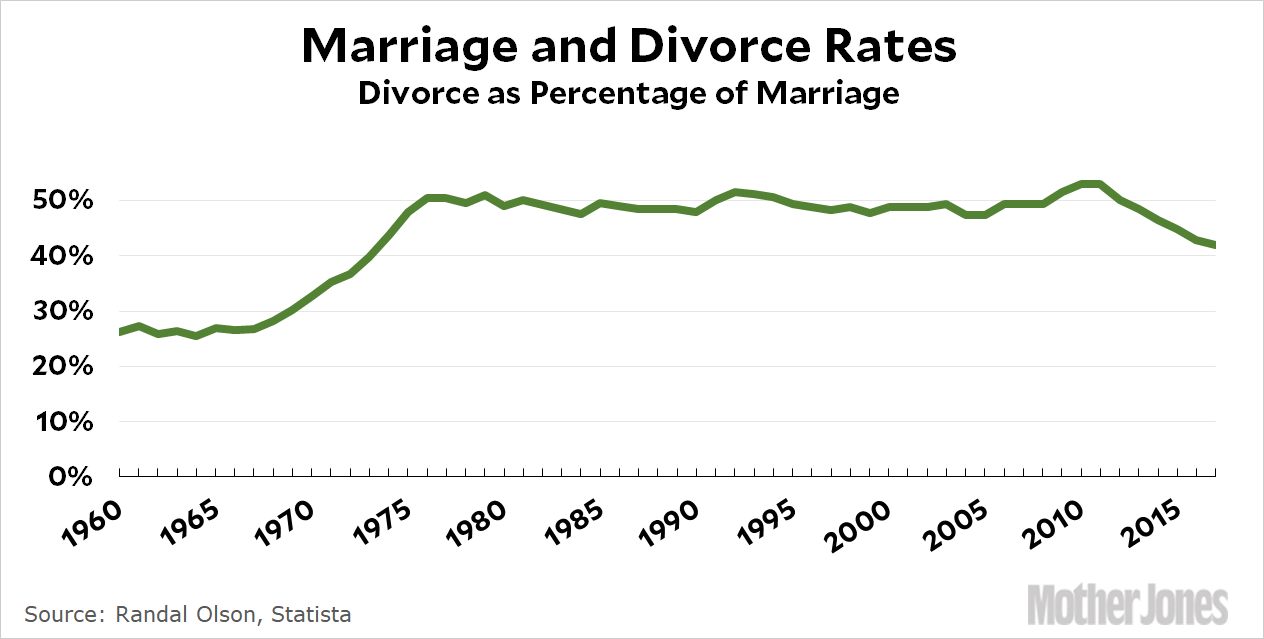
If marriage rates are down, you’d naturally expect fewer divorces. So let’s take a look at the divorce rate as a percentage of the marriage rate:
Divorce as a percentage of marriage has fallen a bit in recent years, but the bigger picture shows that it’s been roughly flat since 1975. There’s something to see here, but not quite as much as it appears at first glance.
The Trump administration’s trade war with China has turned out to be a windfall for another country the president frequently berates: Mexico.
….Mexico has seen gains in shipments to the U.S. in categories in which competing Chinese goods were hit with tariffs, including poster board and air conditioner parts. In all, U.S. imports of goods from Mexico surged 10% to almost $350 billion last year, the fastest growth in seven years. That helped widen the U.S. trade deficit with Mexico by 15% to more than $80 billion, while the growth in shipments from China slowed by about a third.¹
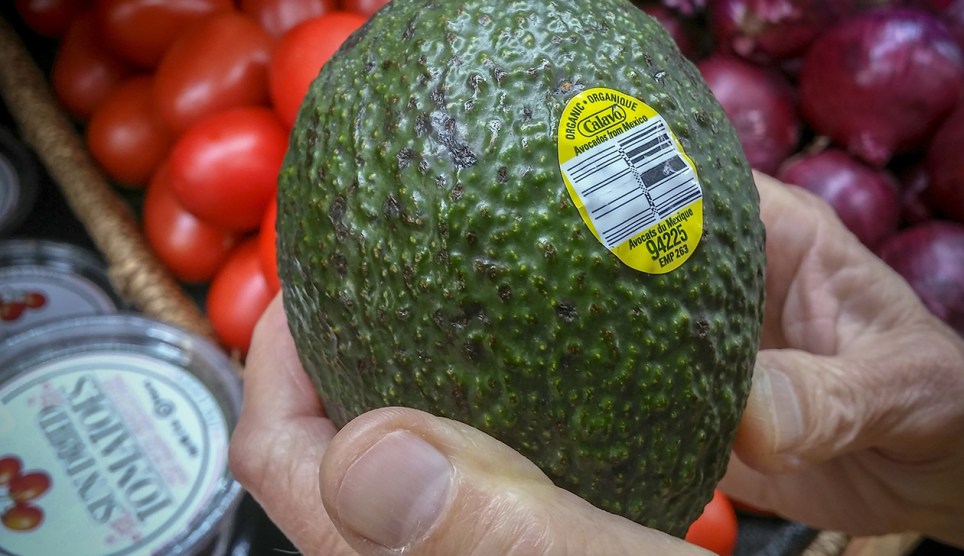
….Mexico’s gain is evident across a diverse span of sectors. After the U.S. levied tariffs on metal ores and their byproducts, Mexico’s exports to the U.S. more than doubled, while China’s sank by a quarter….The trade war also made the U.S. more reliant on produce from Mexico, already the biggest source of vegetables such as cauliflower, carrots and onions. In one stark example, imports of peeled garlic cloves from China sank by almost a quarter after receiving tariffs, while Mexican exports rose 54%.
I’m sure that soon Trump will sign a fabulous new deal with China that will make this all seem like peanuts. After all, trade wars are so easy to win—or so I’ve heard.
¹This is confusing wording. Comparing apples to apples, our trade deficit in goods with Mexico increased 15 percent last year while our trade deficit with China increased by 12 percent.
The BEA revised its estimate of GDP growth in Q4 downward to 2.2 percent today. Team Trump has been using a Q4/Q4 measure of growth so that they can say GDP grew more than 3 percent last year,¹ but using the latest figures even the Q4/Q4 measure has dropped to below 3 percent. It’s now….
2.98 percent
But it rounds up to 3 percent! MAGA!
¹Using the more normal measure, where you simply compare all of 2018 to all of 2017, GDP growth last year was 2.9 percent. Even after the reduced estimate for Q4 it still is—though just barely.
And we respect that! But maybe you’re of a mind to support our work directly instead? We have until December 31 to raise the last $400,000 we need to keep our nonprofit newsroom running at full strength into 2026. Will you make a gift today?
We noticed you have an ad blocker on. Can you pitch in a few bucks to help fund Mother Jones' investigative journalism?
Billionaires own the media,
but they don’t own us.
At Mother Jones we know these aren’t conventional times, and they require unconventional coverage. That’s what deliver every day: fierce, independent journalism you can’t find elsewhere. Perhaps never in the history of our country has that been more necessary than now. But we can’t do it without reader support—your support. Please chip in today.
Billionaires own the media,
but they don’t own us.
At Mother Jones we know these aren’t conventional times, and they require unconventional coverage. That’s what deliver every day: fierce, independent journalism you can’t find elsewhere. Perhaps never in the history of our country has that been more necessary than now. But we can’t do it without reader support—your support. Please chip in today.