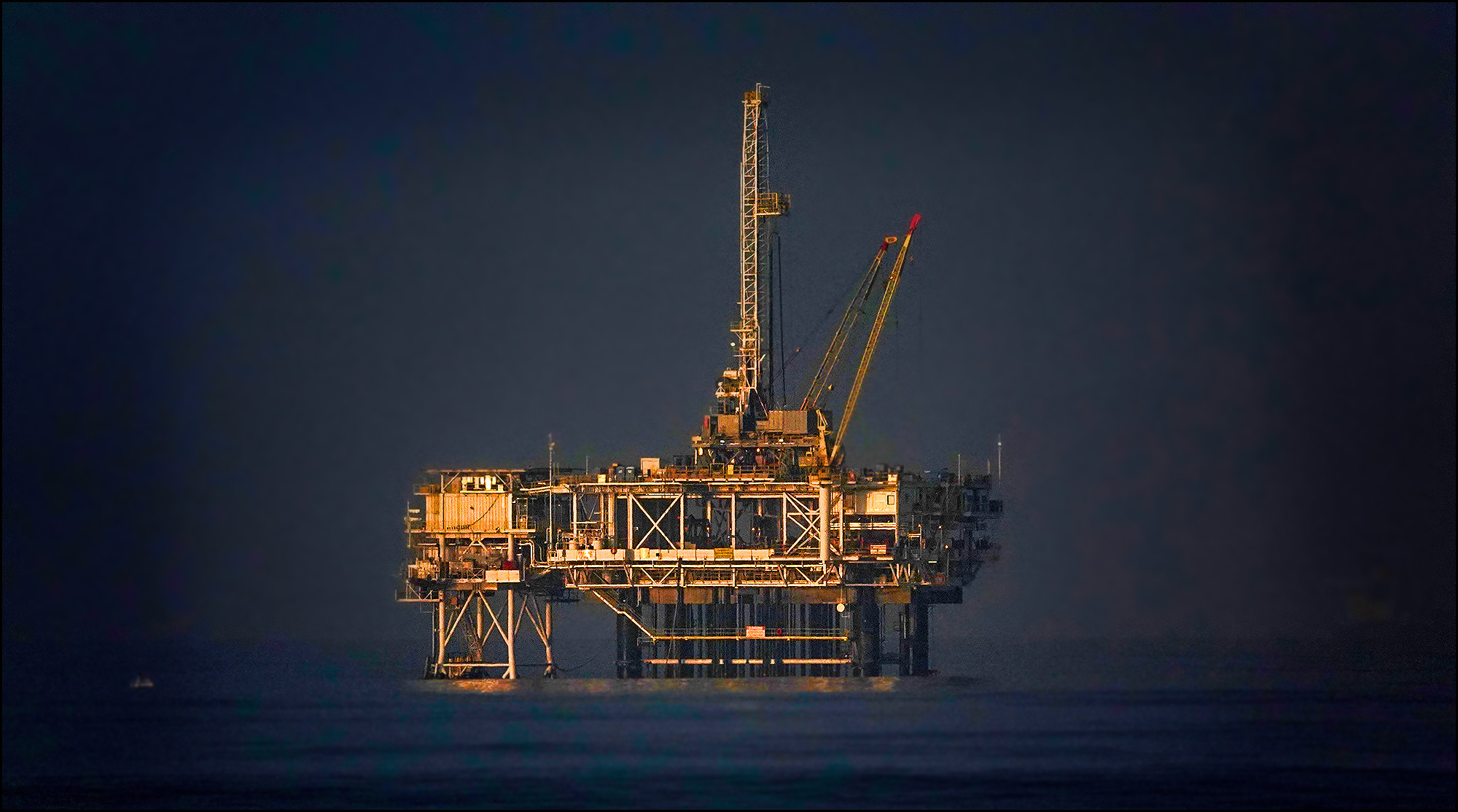
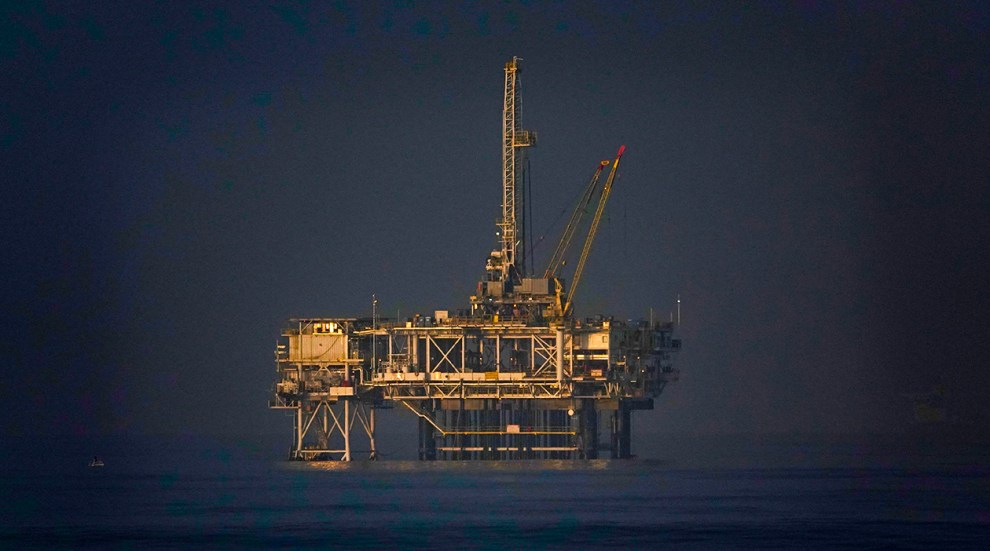
A couple of days ago I needed a picture of an offshore oil rig to illustrate a post. I remembered that I had taken one recently, so I figured I’d just use my own photo. Here’s the original:
But then I decided to dick around a bit in Photoshop. Nothing fancy, just a few minutes of playing with various settings. Here’s the photoshopped version:
Amazing, isn’t it? I should note that I took this picture early in the morning, so the golden glow is legit. It just wasn’t very visible in the original, hazy shot.
Anyway, I guess this is why movie stars look so great on magazine covers. If an amateur like me can make an oil rig look good in three or four minutes, just imagine what a pro can do in several hours.
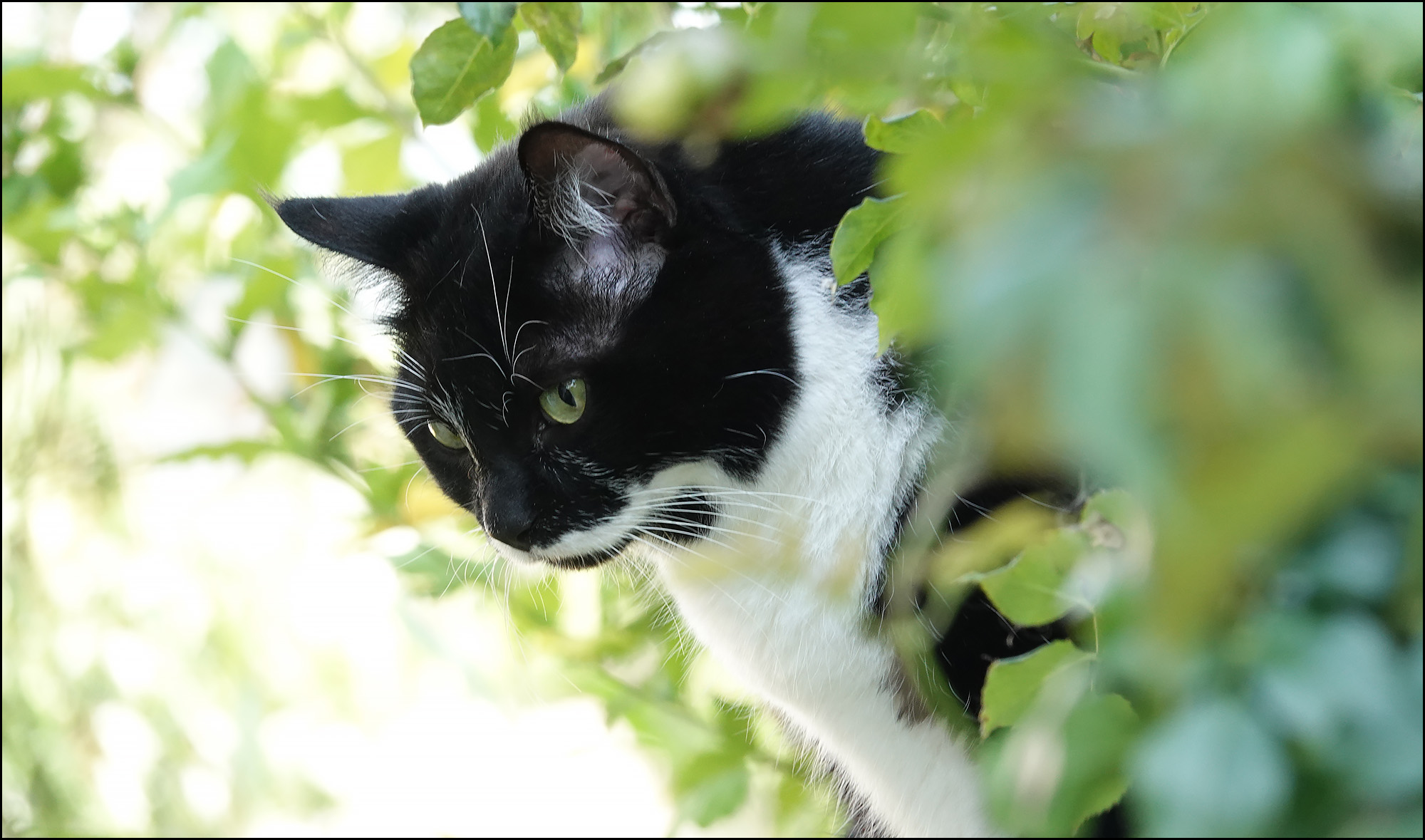
Hilbert is such a handsome cat, isn’t he. And a hungry one. Hopper too. I’m not sure what’s going on. I always feed them a measured amount of food three times a day, and usually there’s still some left in the bowl when the next feeding time comes around. But not anymore. They hoover up the food within an hour or two and then spend the remaining hours begging for more. It’s really weird. This is brand new behavior just in the past couple of weeks. I wonder what’s going on?
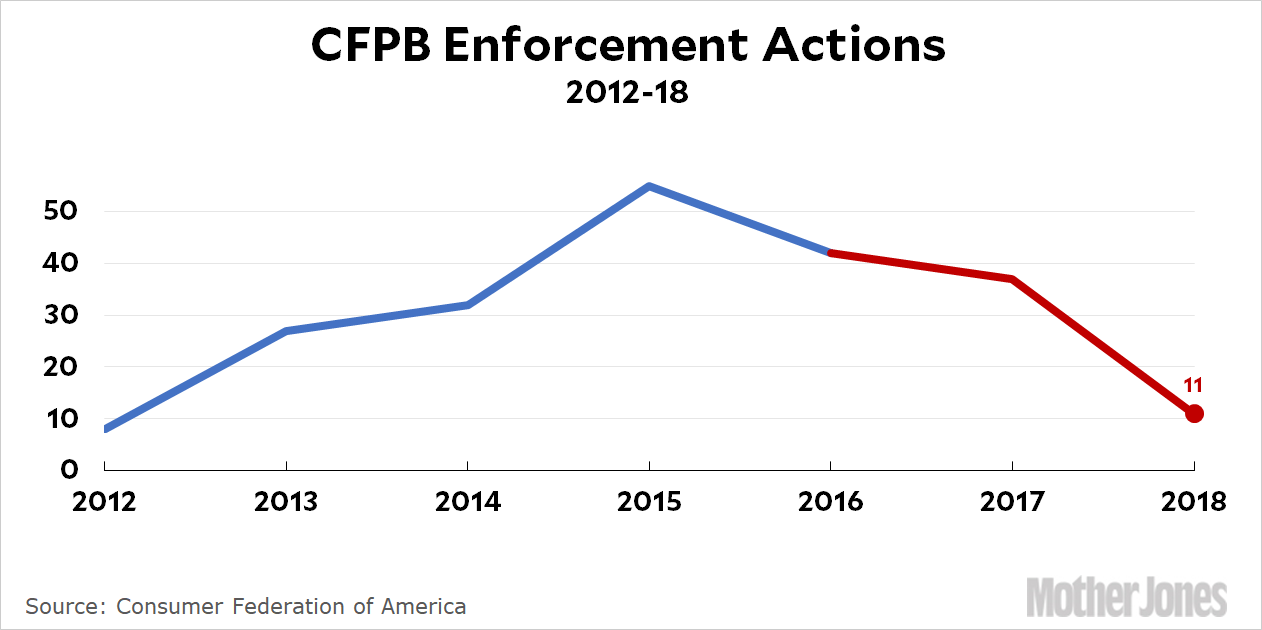
The Consumer Finance Protection Bureau was set up after the Great Recession to protect consumer finances. Republicans hated it from the start, and you can hardly blame them. After all, there are two sides to everything, and if you’re protecting consumer finances you must be protecting them from something. And that something is big banks and other financial corporations. Republicans don’t like it when their CEO pals are told that they have to treat their customers fairly or risk big fines.
Still, there was nothing Republicans could do about it once the CFPB was set up. Its funding comes from the Fed and its director is independent of Congress. But then Donald Trump was elected president. He couldn’t dismantle the CFPB or cut its funding, but he could install a new director who would simply decide not to bother opening any cases. So that’s what he did:
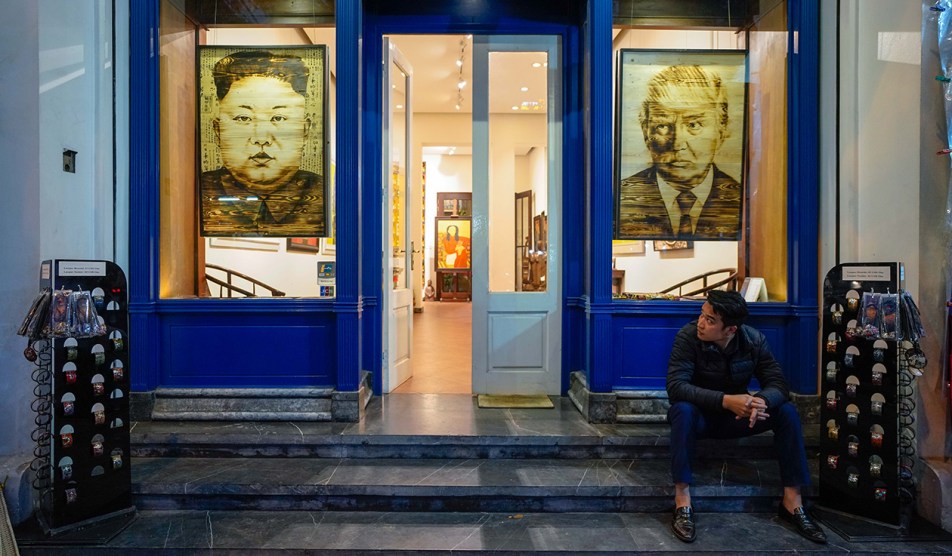
North Korean leader Kim Jong Un will soon make a decision on whether to continue diplomatic talks and maintain the country’s moratorium on missile launches and nuclear tests, a senior North Korean official said, noting the U.S. threw away a golden opportunity at the recent summit between their leaders.
Vice Foreign Minister Choe Son Hui…said the North was deeply disappointed by the failure of the two sides to reach any agreements at the Hanoi summit between Kim and President Donald Trump….[She] said Kim was puzzled by what she called the “eccentric” negotiation position of the U.S. She suggested that while Trump was more willing to talk, the U.S. position was hardened by the uncompromising demands of Secretary of State Mike Pompeo and National Security Adviser John Bolton.
“Personal relations between the two supreme leaders are still good and the chemistry is mysteriously wonderful,” she added.
Well, Choe blamed Pompeo and Bolton and explicitly said nice things about Trump, so who knows what this means? Maybe it’s just an effort to drive a wedge between Trump and his aides. Or maybe Kim Jong Un finally understands that he’ll never get any concessions from the US unless he gives up his nukes—though it’s hard to believe it took him this long to figure that out. Or maybe the North Korean missile program went pear-shaped 15 months ago and they couldn’t do any tests anyway, so they figured they might as well try and make something of it. It’s all very mysterious on both sides.
This is the very last picture from our trip to Ireland and England a couple of years ago. I’ve been waiting for an appropriate hook to use it, but nothing has really presented itself. So I’m finally giving up and using it today to celebrate Pi Day—even though the tube folks have done such a lackadaisical job of creating a diameter for their circle that it suggests a value for pi of about 2.5. And don’t even get me started on the mathematical atrocity of the “Circle” Line. That’s TfL for you, I guess.
No, this is not a story about Donald Trump. It’s about Twitter.
Long story short, yesterday Twitter released a beta version of their new mobile app. It did some stuff blah blah blah, but it also hid the Like and Retweet buttons. This meant you would have to tap first to bring up those buttons, and only then could you like or retweet a tweet. When I say this is apocalyptic, I’m not being snarky. This is literally what Vox’s Aja Romano called it:
Simply removing likes would be bad. But even just hiding both likes and RTs could be apocalyptic.
Hiding likes and retweets is arguably a much more destructive change, because it diminishes Twitter users’ ability to elevate some voices and opinions over others. Retweets and likes have always been crucial tools that allow the greater Twitter community to drown out trolls and other detritus, while simultaneously helping good conversations, viral moments, and underprivileged and marginalized voices gain attention.
I’m a Twitter user, but not a power user. That concession made, I have to say that I have a different take. Romano says that retweets and likes allow the good guys to “drown out trolls and other detritus.” My experience is the opposite: likes and retweets are what allow the trolls to gain an audience in the first place. I’m pretty sure that not once have I ever seen a viral tsunami of harassment get overwhelmed by a viral tsunami of love and kindness.
So Romano and I live in different universes. Which is fine. Probably both universes exist and I just happen to inhabit U-2 instead of U-1. Then Romano continues:
If those tools are hidden by default, it stands to reason that virality on Twitter would cease to exist. The same is true for the fabled “ratio” — the relatively young but widely beloved Twitter meme that involves shading the hell out of tweets that get far more comments than likes and retweets — essentially a snarkier version of a community’s collective downvote. Without easily visible tallies of likes, comments, and retweets, users wouldn’t have a clear indication of when a tweet or a conversation was causing controversy or becoming extremely unpopular. There would be no simple way to tell, for example, exactly how much people on Twitter dislike Paul Ryan, or when a tweet you posted is bad, actually.
This is going to get ugly fast, for which I apologize, but everyone realizes that the fabled ratio is absurd bullshit, right? It’s completely meaningless aside from being an indication that a community of trolls decided to flood someone’s mentions. As for the “easily visible tallies,” I’m sympathetic. As a nerd, I approve of numbers everywhere and anywhere. On the other hand—and I’m just spitballing here—I wonder if we’d all be better off if we simply responded to stuff that got our attention instead of constantly joining mobs of people who hate something that someone said on Twitter?
As near as I can tell, there are two versions of “going viral” on Twitter. The first is cute animal videos. The second is insane mobs seeking to destroy someone’s life. I like cute animal videos, but I’m really not sure this is a great tradeoff. And let’s be honest here. If something is prevented from going viral simply because you have to go the trouble of tapping first and then joining the mob, maybe it doesn’t really deserve to go viral in the first place?
You know, the left plays a tougher game, it’s very funny. I actually think that the people on the right are tougher, but they don’t play it tougher. Okay? I can tell you I have the support of the police, the support of the military, the support of the Bikers for Trump — I have the tough people, but they don’t play it tough — until they go to a certain point, and then it would be very bad, very bad.
Look, he’s not saying anything here, OK? He’s just making a point. He’s just asking the question. So get off his back.
From Joe Balash, assistant secretary for land and minerals management, speaking to oil exploration companies last month:
One of the things that I have found absolutely thrilling in working for this administration is the president has a knack for keeping the attention of the media and the public focused somewhere else while we do all the work that needs to be done on behalf of the American people.
I dunno. If I were genuinely doing work on behalf of the American people I’d probably want everyone to know about it. On the other hand, if I were working on behalf of the oil exploration industry I’d probably be pretty happy that no one was paying attention to me. So I think we know what Balash is really thrilled about, don’t we?
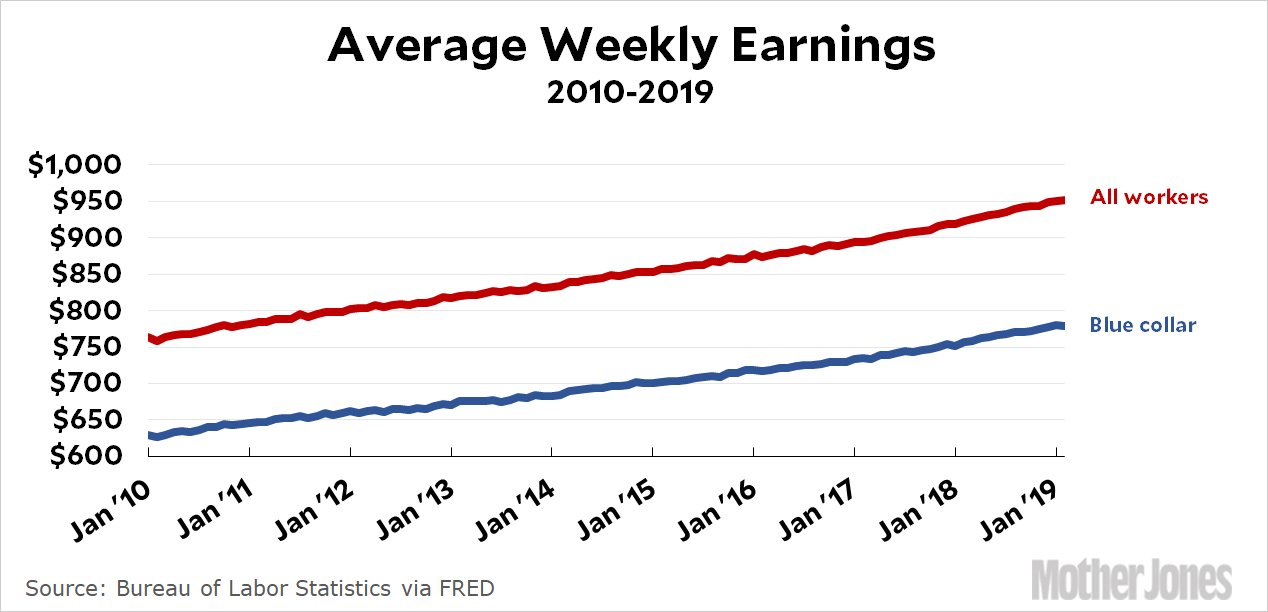
Are wages going up more for low-income workers than for the middle class? It’s a little hard to see in the data unless you zoom way in. For example, here are hourly wages for all workers vs. blue-collar workers, who make up roughly the bottom 70 percent:
If these two curves look the same to you, give yourself a gold star. Blue-collar wages are up 23.8 percent since 2010 while all wages are up 24.5 percent. That’s as good as identical. So let’s take a closer and more precise look at just the past couple of years:
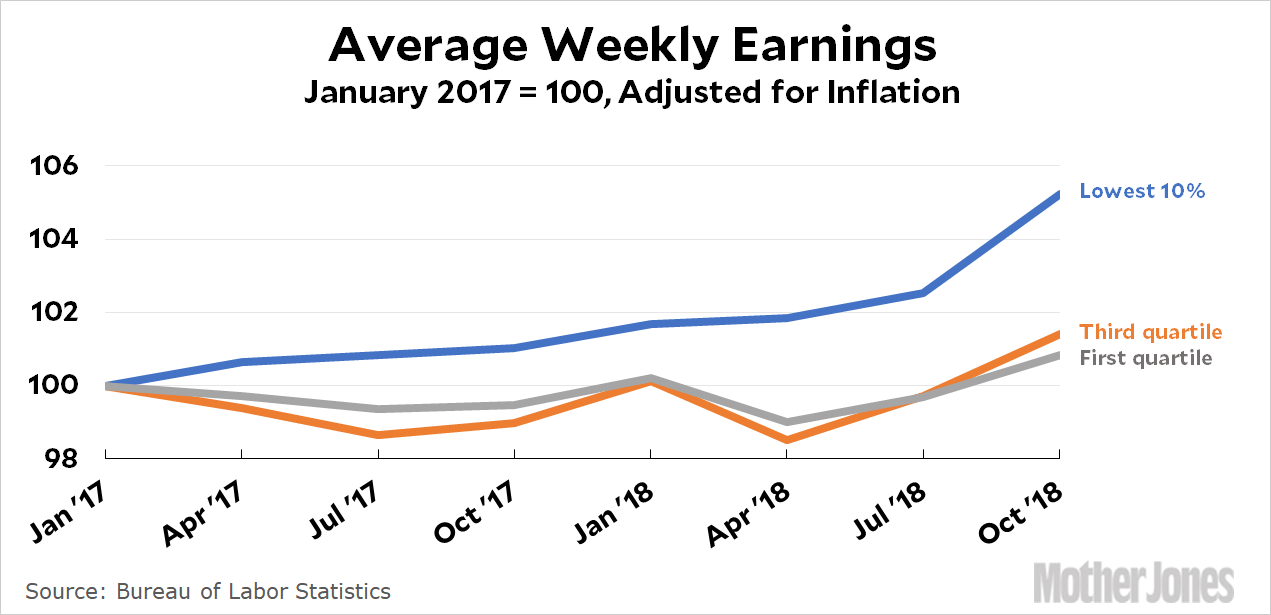
In the past two years, earnings of the first and third quartiles have continued to grow at the same rate. However, folks at the very bottom of the income ladder have seen their earnings grow faster. What does this mean?
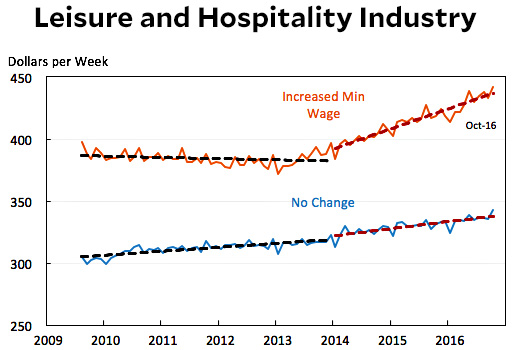
Average earnings for the bottom decile come to about $11 per hour, which is very much in minimum wage territory. A couple of years ago CEPR took a look at how the minimum wage affected earnings, and what they found is that raising the minimum wage had very little effect on workers who earned median wages or above. However, it did have an effect on the very lowest-paid workers, like those in the leisure and hospitality industry:
The orange line shows earnings in the 22 states that raised their minimum wage between 2014-16. The blue line shows earnings in states that didn’t. The effect is obvious: for very low-income workers, their earnings depend largely on state changes to the minimum wage.
CEPR doesn’t have a more recent study, but 23 states raised their minimum wage between 2017-18. If the effect is the same as in the earlier years, you’d expect higher earnings growth among very low-wage workers but not among ordinary low-wage workers. And that’s exactly what we see in the more recent data. So, yes, it’s true that earnings have gone up for very low-income workers, but this is largely because of minimum wage increases in blue states, not because of anything that Donald Trump or the Republican Party has done.
They could help these people if they wanted to. For example, they could raise the federal minimum wage. But they refuse to. They just don’t care about low-wage workers.
I took this picture from my car door window just as I was turning into my neighborhood. It was right after a heavy rain, and the sun was shining on the pavement. It just goes to show that a lovely shot can pop up anywhere.
And we respect that! But maybe you’re of a mind to support our work directly instead? We have until December 31 to raise the last $400,000 we need to keep our nonprofit newsroom running at full strength into 2026. Will you make a gift today?
We noticed you have an ad blocker on. Can you pitch in a few bucks to help fund Mother Jones' investigative journalism?
Billionaires own the media,
but they don’t own us.
At Mother Jones we know these aren’t conventional times, and they require unconventional coverage. That’s what deliver every day: fierce, independent journalism you can’t find elsewhere. Perhaps never in the history of our country has that been more necessary than now. But we can’t do it without reader support—your support. Please chip in today.
Billionaires own the media,
but they don’t own us.
At Mother Jones we know these aren’t conventional times, and they require unconventional coverage. That’s what deliver every day: fierce, independent journalism you can’t find elsewhere. Perhaps never in the history of our country has that been more necessary than now. But we can’t do it without reader support—your support. Please chip in today.