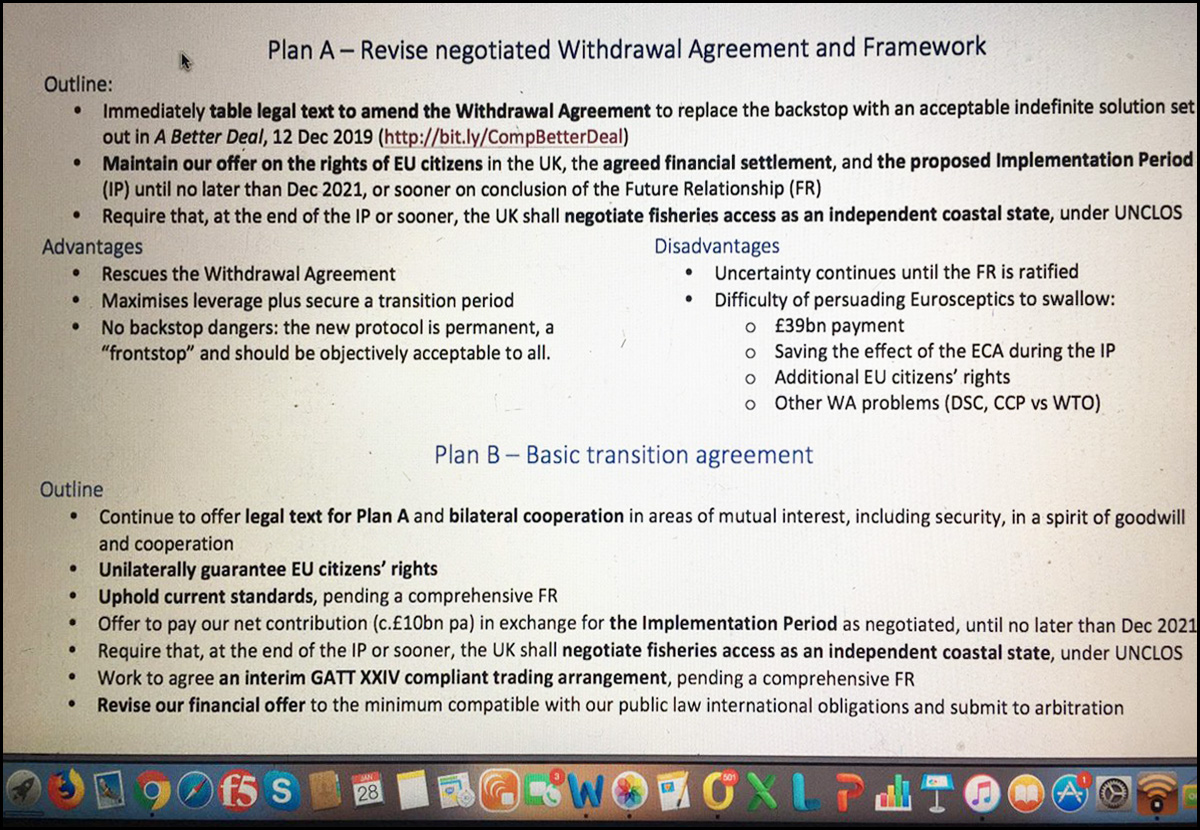
“The Malthouse Compromise,” which sounds like a new thriller from Robert Ludlum, is actually the latest hot topic among Brexiteers. Here it is:
Got that? No? Don’t worry. You can also vote for the Cooper Amendment or the Brady Plan. As I understand things, the Cooper Amendment would simply extend the negotiation period with the EU for a few months if no deal is in place by the end of February. The Brady Plan involves “alternative arrangements to avoid a hard border,” whatever that means. Meanwhile, the Malthouse Compromise is a way to finesse the Irish border problem with a bunch of high-tech gee gaws nicknamed “max fac,” something that the EU has already laughed at.
There are about a dozen other amendments under consideration, but only the Cooper and Brady amendments are getting votes right now. It’s hard to see that any of it matters, though. Northern Ireland insists on an open border with Ireland, while Europe insists on a hard border under the current circumstances.¹ There have been an endless series of proposals to get around this, and not a single one has gotten very much support from even one side, let alone both. It’s hard to see how any progress ever gets made under these circumstances.
But deadlines do a lot to concentrate the mind, so maybe we just have to wait until March 28 or something.
¹The “circumstances” are that Prime Minister Theresa May has declared there will be no border between Northern Ireland and Britain. That being the case, there has to be some kind of border between Ireland and Northern Ireland. If there isn’t, then there’s effectively no border between Britain and the EU, which is unacceptable to the EU.
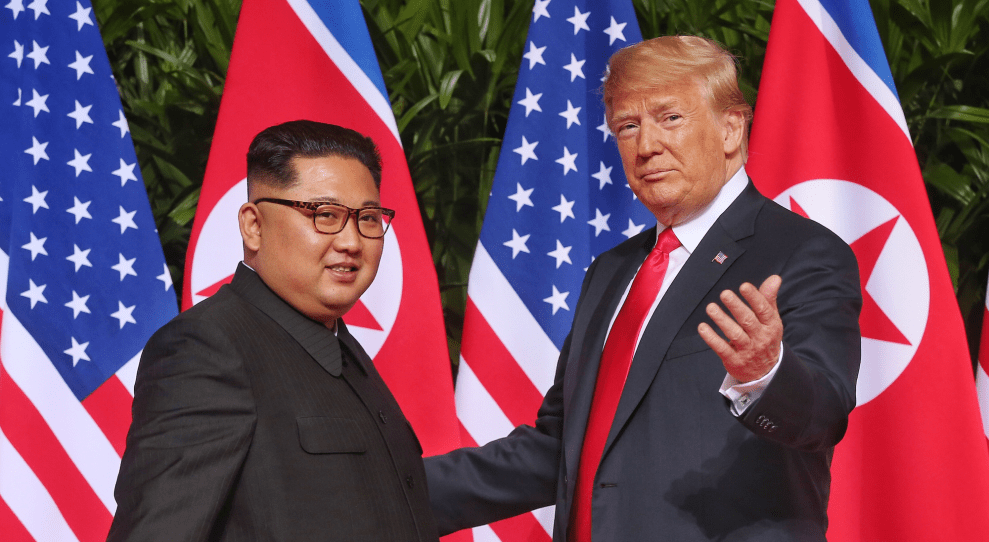
A new American intelligence assessment of global threats has concluded that North Korea is “unlikely to give up” all of its nuclear stockpiles, and that Iran is not “currently undertaking the key nuclear weapons-development activity” needed to make a bomb, directly contradicting two top tenets of President Trump’s foreign policy. Daniel R. Coats, the director of national intelligence, also challenged Mr. Trump’s insistence that the Islamic State had been defeated, a key rationale for his decision to exit from Syria.
….Mr. Coats told the Senate Intelligence Committee on Tuesday that “we currently assess North Korea will seek to retain its W.M.D. capability and is unlikely to completely give up its nuclear weapons and production capability….Its leaders ultimately view nuclear weapons as critical to regime survival,” Mr. Coats said.
OK, OK, Coats didn’t call Trump a moron. And intelligence agencies are often more hawkish than civilians in the White House or the State Department. Still, it’s a little unusual for the intelligence community to publicly say the president is mistaken on not one, not two, but three separate major issues. But wait, there’s more:
Perhaps the strongest rebuke of Mr. Trump’s security priorities comes in what is missing from the report: Any rationale for building a wall along the southwest border, which Mr. Trump has advertised as among the most critical security threats facing the United States. The first mention of Mexico and drug cartels comes on page 18 of the 42-page assessment, well after a range of other, more pressing threats are reviewed. Most pressing, as it has been for the past five years, are cybersecurity threats to the United States. For the first time, the report concluded that China is now positioned to conduct effective cyberattacks against American infrastructure, and specifically cited Beijing’s ability to cut off natural gas pipelines, at least briefly.
Keep in mind that the heads of the intelligence agencies are all Trump appointees. And apparently they all agree that he’s an idiot.
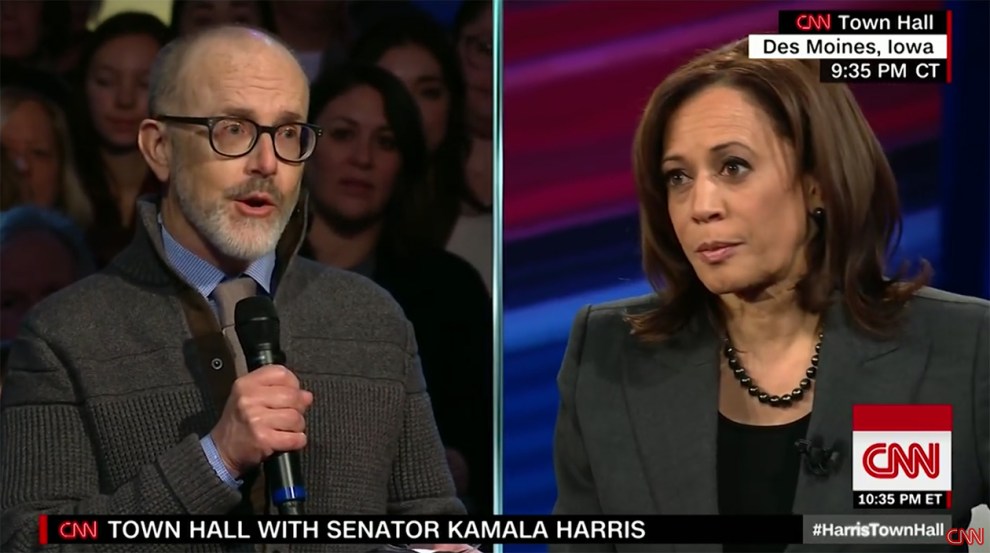
I watched bits and pieces of Kamala Harris’s townhall meeting on CNN, and the audience certainly seemed to like her. I like her too! She’s a good speaker and she knows how to work a room. Still, I wish more Democrats would learn the lesson of 2016: both Bernie Sanders and Donald Trump earned big followings by talking like ordinary human beings rather than politicians. Audiences will stay more engaged—and cable news will put you on air a lot more—if you talk as if you weren’t reading off cue cards.
On the policy front, there’s an interesting choice to be made between our two frontrunners, Harris and Elizabeth Warren. Harris wants a big tax cut for the poor and middle class. Warren wants a big tax hike on the rich. Which would you prefer? For my money, I’d prefer the tax hike as a way of paying for universal health care. This combination would more effectively redistribute income, if that’s your goal, and would certainly do more for the poor and working class than yet another expansion of the EITC. If we ever truly want universal health care, I think we have to finally acknowledge that we can’t keep promising more tax cuts for the middle class.
And as long as we’re on the subject, I see that former Starbucks CEO Howard Schultz engaged in one of my pet peeves today: saying that we have to stop promising people “free health care.” Bah. Universal health care is no more “free health care” than Social Security is “free retirement.” We pay taxes, we get health care. Nobody calls it “free” except for the folks who don’t like it.
This is the Carniceria Latina on the corner of Wilmington Avenue and 112th Street in Watts. I was attracted by the sharp, contrasty colors of the early morning light and took a whole series of storefront photos on this stretch of Wilmington. In the end, though, I decided to use only this one. The shadows catch the eye but aren’t overwhelming; the bright yellow is a great complement to the deep, clear blue above it; and the blue lettering on the building ties it neatly into the sky. It’s my favorite of the bunch.
On the benefits side, we do not detect significant improvements in patient health, although the expansion led to substantially greater hospital and emergency room use, and a reallocation of care from public to private and better-quality hospitals.
(Emphasis mine.) This paper joins an illustrious list of studies that find no benefit to Medicaid because they define “health” as “not dying.” That’s it. You feel better? You got a cavity filled? You got a prescription for an antidepressant? A new hip? Sorry, that doesn’t count. The only thing that counts is mortality. If that cavity wasn’t going to kill you, then this study doesn’t care about it.
And while we’re on the subject, why California? This has got to be one of the worst possible states to study since we already have relatively good indigent health care. Switching to Medicaid may have some advantages, but in California it probably has only a modest effect on health.
Anyway, I’ll make my usual offer to the folks who enjoy highlighting studies like this: If you’re really convinced that insurance has no particular effect on health, then put your money where your mouth is and ditch your own coverage. Any takers?
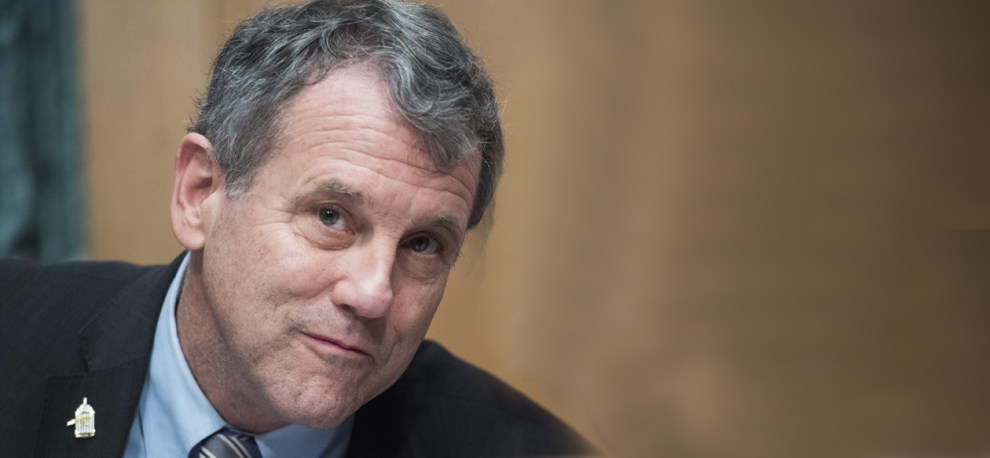
Brown spent many Fridays at the local steel and autoworkers unions, where he learned about the financial squeeze that workers endured. “I heard some talk about their kids and grandkids and making enough and working overtime so they could send their kids to Ohio State,” he says….“Members of the Senate don’t have a lot of time to sit around a union hall for two hours on a Friday, but we’ve got to make those forays into that part of America,” Brown explains as we sit in the conference room of his Senate office.
….Donna West, the chair of Nevada’s Clark County Democrats—home to one of the most politically active unions with overwhelmingly Latino membership—thinks a campaign centered on workers still might be the ticket. “We’re looking for someone who’s pro-union—they want to see a raise in the minimum wage, workplace protections, and paid family leave,” she explained. “It doesn’t matter who you are.”
If you’re curious about Brown and whether he might run, the whole piece is worth a read. The one thing I wish it had focused on more is Brown’s deep-in-the-bones support of labor unions. All Democrats in the progressive wing of the party support universal health care, a $15 minimum wage, child care, and so forth. And of course they support unions. But unions usually just get name checked along with all the other stuff. Brown really believes in unions, and that’s what sets him apart from other progressives.
It’s also what attracts me to him. When it comes to domestic policy, most progressive candidates are pretty interchangeable. When the time comes to choose one, I’ll probably make my choice on other grounds. But unions are about more than just a set of progressive policies. They’re about countervailing power, and they’re the only national institution that’s historically been able to take on corporate America and consistently win.
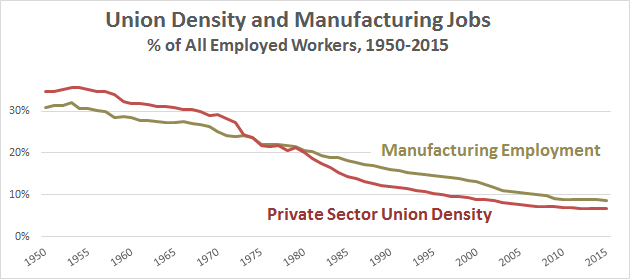
If Sherrod Brown runs on a platform of not just progressive policies, but of support for the kind of labor power that can make possible an era of progressive policies, that would set him apart from the field. Here’s what I wrote in 2011 about the decline of labor in the second half of the 20th century:
If unions had been as strong in the ’80s and ’90s as they were in the ’50s and ’60s, it’s almost inconceivable that they would have sat by and accepted tax cuts and financial deregulation on the scale that we got. They would have demanded economic policies friendlier to middle-class interests, they would have pressed for the appointment of regulators less captured by the financial industry, and they would have had the muscle to get both.
And that means things would have been different during the first two years of the Obama era, too. Aside from the question of whether the crisis would have been so acute in the first place, a labor-oriented Democratic Party almost certainly would have demanded a bigger stimulus in 2009. It would have fought hard for “cramdown” legislation to help distressed homeowners, instead of caving in to the banks that wanted it killed. It would have resisted the reappointment of Ben Bernanke as Fed chairman. These and other choices would have helped the economic recovery and produced a surge of electoral energy far beyond Obama’s first few months. And since elections are won and lost on economic performance, voter turnout, and legislative accomplishments, Democrats probably would have lost something like 10 or 20 seats last November, not 63. Instead of petering out after 18 months, the Obama era might still have several years to run.
This is something Sherrod Brown might be able to turn around if he got elected on a mandate to revive union power. He’s probably the only one who could.
Another frustration with manufacturing in Texas: American workers won’t work around the clock. Chinese factories have shifts working at all hours, if necessary, and workers are sometimes even roused from their sleep to meet production goals. That was not an option in Texas.
“China is not just cheap. It’s a place where, because it’s an authoritarian government, you can marshal 100,000 people to work all night for you,” said Susan Helper, an economics professor at Case Western Reserve University in Cleveland and the former chief economist at the Commerce Department. “That has become an essential part of the product-rollout strategy.”
Sounds great! I sure hope my iPhone is assembled by someone who’s been working for 72 hours straight.
From Kevin Powell, activist and dance producer, after unleashing an enormous smear campaign which turned out to be targeted at the wrong person:
Regardless if we had proof or not, what we do have proof of is the historical reality of being a person of color in America and having people talk to you in any kind of foul way and thinking it’s okay, even in the state of Minnesota that’s supposed to be liberal and progressive.
City Pages has the whole dismal story, which is worth a read. The obvious lesson here is that you should take at least minimal care before you wreak havoc on someone’s career. The other lesson is that it’s really not that hard to apologize when you make a mistake. Really.
Customs and Border Protection allocated $60.7 million to Accenture Federal Services, a management consulting firm, as part of a $297-million contract to recruit, vet and hire 7,500 border officers over five years, but the company has produced only 33 new hires so far.
Apparently no one wants to patrol the border even though starting salaries for border patrol officers are more than $50,000:
On Jan. 25, 2017, five days after Trump was inaugurated, he signed executive orders to hire 5,000 new Border Patrol agents and 10,000 more Immigration and Customs Enforcement officers, vowing to beef up border security and crack down on illegal immigration….Today, Customs and Border Protection — the Border Patrol’s parent agency — has more than 3,000 job vacancies, according to House Speaker Nancy Pelosi’s office. That’s about 2,000 more than when Trump signed the orders, according to a Government Accountability Office report on CBP’s hiring challenges.
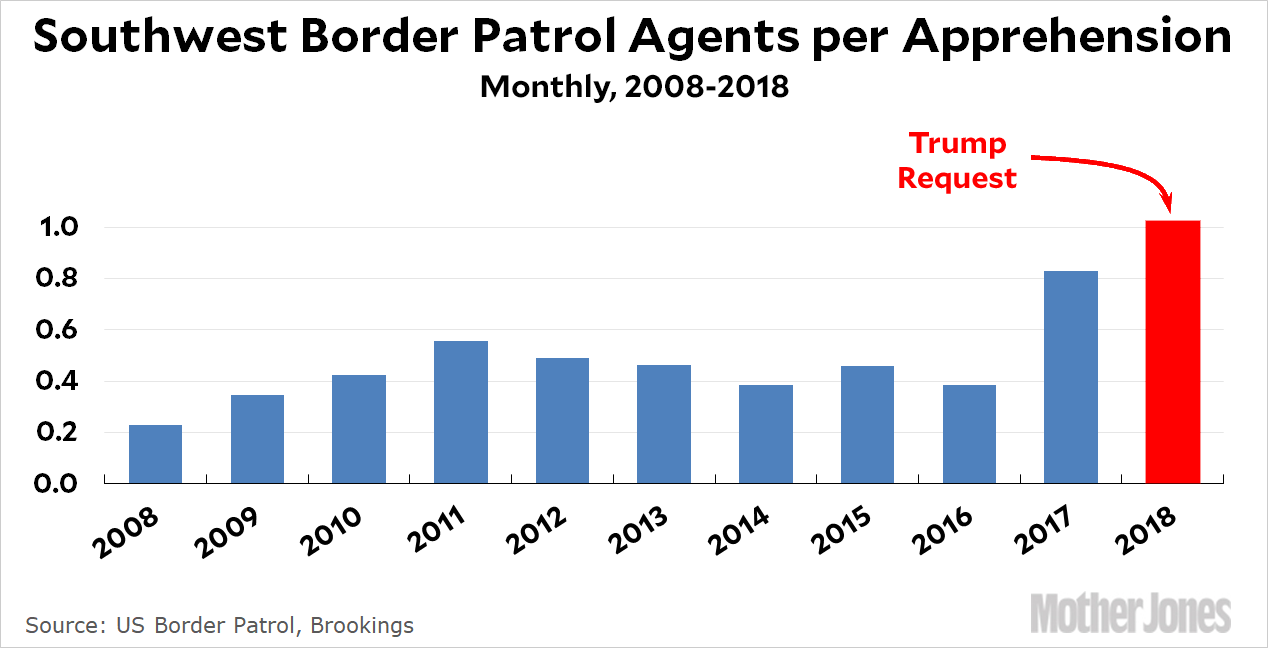
The whole thing is ridiculous. CBP has about 6,000 more agents on the southern border than they did ten years ago despite the fact that apprehensions are down by a third over the same period. As a result, there are about one-third as many apprehensions per agent as there were a decade ago.
There is no crisis on the southern border aside from the ones that we ourselves have created. Border crossings are low, net illegal immigration is zero, and we aren’t importing crime. If we took all the money earmarked for expanding CBP and instead spent it on more immigration judges, that would do far more to the reduce the number of unauthorized workers in the US. But I guess it’s not manly enough for Trump.
And we respect that! But maybe you’re of a mind to support our work directly instead? We have until December 31 to raise the last $400,000 we need to keep our nonprofit newsroom running at full strength into 2026. Will you make a gift today?
We noticed you have an ad blocker on. Can you pitch in a few bucks to help fund Mother Jones' investigative journalism?
Billionaires own the media,
but they don’t own us.
At Mother Jones we know these aren’t conventional times, and they require unconventional coverage. That’s what deliver every day: fierce, independent journalism you can’t find elsewhere. Perhaps never in the history of our country has that been more necessary than now. But we can’t do it without reader support—your support. Please chip in today.
Billionaires own the media,
but they don’t own us.
At Mother Jones we know these aren’t conventional times, and they require unconventional coverage. That’s what deliver every day: fierce, independent journalism you can’t find elsewhere. Perhaps never in the history of our country has that been more necessary than now. But we can’t do it without reader support—your support. Please chip in today.