• Here’s How to Enact a Wealth Tax That the Supreme Court Won’t Kill

    I know that my posts about Elizabeth Warren’s proposed wealth tax have left you mesmerized and waiting for more. I’m here to help.

    Let’s suppose that a wealth tax is unconstitutional. Or more to the point, let’s say that we don’t want to risk a showdown with a conservative Supreme Court that would probably find some way to strike down a wealth tax regardless of what legal scholars say about it. How can we enact the equivalent of a wealth tax but do it in a way that’s constitutionally unassailable?

    Ari Glogower of Ohio State has released a draft paper with a set of options that he calls Wealth Integration. The basic idea is fairly simple: in the same way that income taxes can be based on, say, your marriage status, they can also be based on other things unrelated to income. For example, they can be based on your net worth. Glogower’s three options are to vary either deductions, credits, or the tax rate based on your total wealth.

    These are all conceptually similar, and there’s no reason you couldn’t do all three at once if that’s what worked best. But the simplest is to vary the tax rate, so let’s take a look at that. Suppose Mr. Rich has $1 billion in wealth and we want to tax the amount over $50 million at 2 percent. That’s $19 million. If Mr. Rich also has $100 million in income, we could get the same amount by taxing the income above $5 million at a rate 20 percent higher than normal. Simple.

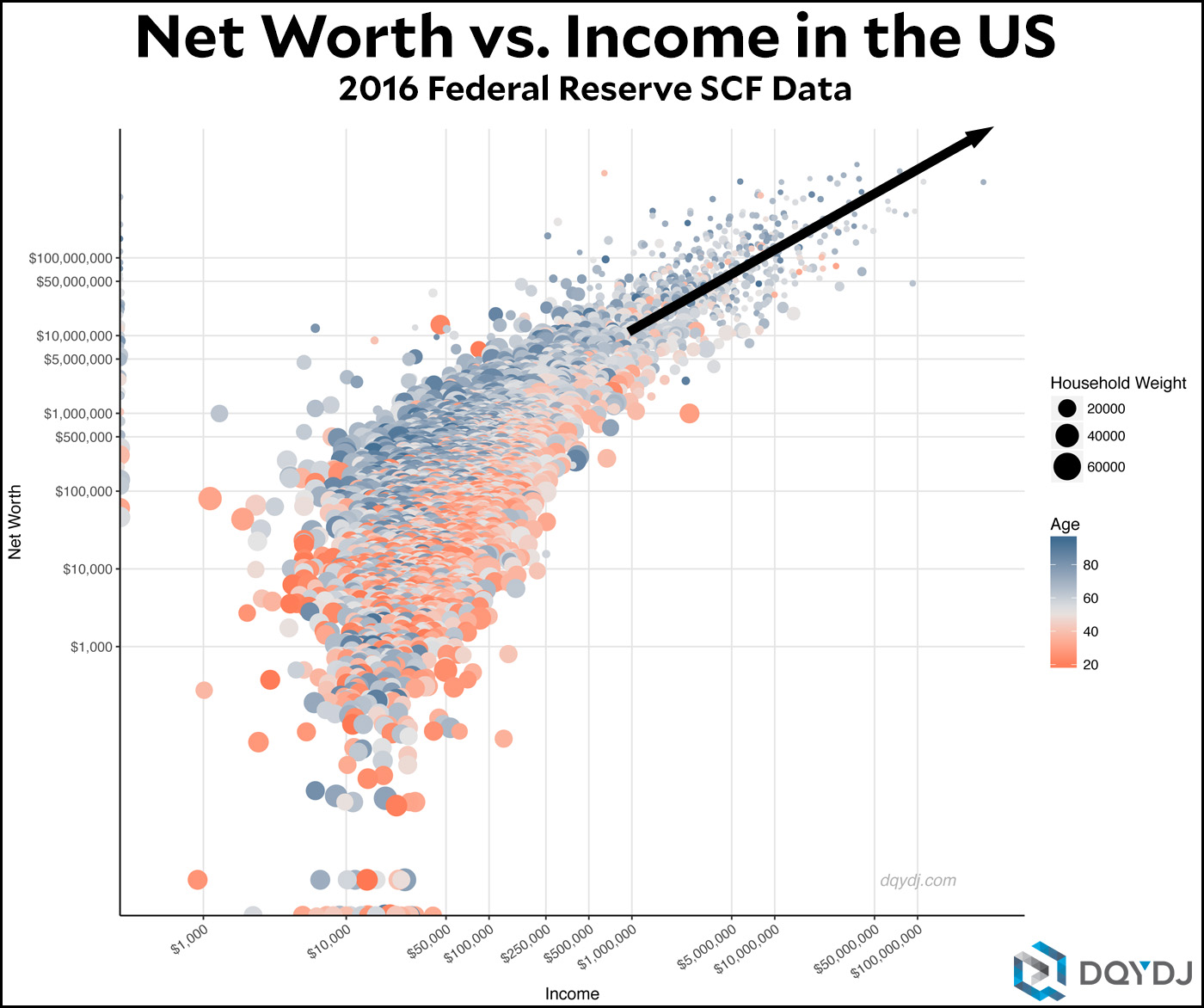
    But this only works if there’s a pretty good correlation between income and wealth—and it turns out there is. Check out this chart from DQYDJ:

    As you can see, the overall correlation between income and wealth isn’t very tight if you look at the entire range of incomes. However, if you look only at the very wealthy, the plot is fairly scattered but pretty linear at around 10:1. Very roughly speaking, someone with a wealth of $100 million probably has an income of about $10 million. Someone with a wealth of $500 million probably has an income around $50 million. Etc.

    Basically, to effectively tax wealth all you need to do is implement a surtax on income that rises as total wealth rises. Given the 10:1 correlation between wealth and income, the surtax on income would need to be in the range of 20 percent if your goal is a 2 percent tax on wealth. Alternatively, you could ignore actual wealth and simply implement a surtax of 20 percent on all income over $5 million. That would—again, very roughly—be equivalent to a 2 percent tax on all wealth above $50 million.

    Obviously there are lots of gotchas here, and no substitute for a wealth tax will ever have exactly the same incidence as a wealth tax itself. There would also be loads of deductions and credits to think about, but a straight wealth tax would probably have those too. The point here isn’t to present a well-thought-out proposal for a presidential white paper, it’s just to show that there are ways to indirectly tax wealth in ways that wouldn’t run afoul of the Supreme Court.¹ This is one way, and there are plenty of others.

    Whether a wealth tax is a good idea is a whole different discussion. There are all sorts of issues related to tax avoidance, capital accumulation, and so forth that need some serious thought. But it can be done if we want to do it.

    ¹Glogower spends a fair amount of time making a case that the Supreme Court, even if it desperately wanted to, simply couldn’t overturn a tax like the one he proposes. The short explanation is that it would blow up too many settled areas of tax law. The long version is in the paper if you’re interested.

  • Texas Is Looking for Fraudulent Immigrant Voters

    Our boys in Texas are busy on the voter fraud front:

    The Texas secretary of state’s office announced Friday it would send local election officials a list of 95,000 registered voters who the state says counties should consider checking to see whether they are U.S. citizens and, therefore, eligible to vote….Among the individuals flagged, about 58,000 individuals cast ballots in one or more elections from 1996 to 2018.

    Texas seems to produce about 6 million votes per national election (average of presidential and nonpresidential cycles), so that’s about 70 million votes. Add in local elections and you’re probably at around 100 million. So if every single one of those 58,000 votes was fraudulent, that would be…

    …about 0.06% of all votes cast.

    That doesn’t seem so bad. But of course, the true number won’t be 58,000. Nor will it be 5,800 or 580 or even 58. It will be about zero. And how many of the 95,000 people on the list will turn out to be noncitizens? There will be a few. I’m going to take a guess and say that Texas will verify noncitizen status for, oh, 500 people. Who wants to take the over?

    POSTSCRIPT: Actually, I suppose that before we bet on a number, we have to bet on whether Texas will ever even release the results of their cunning little dragnet. Probably not. My guess is that they’ll find a few people, make a big deal out of it, and then quietly shut down the whole thing.

  • Did Donald Trump Ever Really Fire Roger Stone?

    Amy Beth Bennett/Sun Sentinel/TNS via ZUMA

    How many of your remember this story from three years ago?

    Donald Trump’s campaign said Saturday it has fired top political adviser Roger Stone — who promptly denied being let go and insisted he had quit.

    ….“Mr. Trump fired Roger Stone last night. We have a tremendously successful campaign and Roger wanted to use the campaign for his own personal publicity. He has had a number of articles about him recently and Mr. Trump wants to keep the focus of the campaign on how to Make America Great Again,” a campaign spokesperson said in a statement.

    Stone, however, told CNN that he “categorically denies” being fired, and provided what he said was his resignation letter.

    Allegedly, Stone quit because he was unhappy about Trump’s “food fight with @megynkelly” taking attention away from “core issue messages.” Please raise your hand if you ever believed this. Roger Stone lives for televised food fights and has less than zero interest in policy messaging. I know that Trump and Stone had supposedly been bickering for weeks, but even if that were true, it’s hardly credible that the Megyn Kelly affair would have been the thing to finally tip him over the edge.

    Anyway, that’s what I remember thinking at the time: that this whole thing was a prearranged sham. Stone was more comfortable and more effective doing his thing while being able to claim that he had no connection to the Trump campaign, so he and Trump arranged a loud parting of the ways that no one could ignore. From that point on, Trump could disclaim any knowledge or connection to anything Stone did.

    In the end, that didn’t help Stone, who was arrested and indicted yesterday over charges of lying to Congress about WikiLeaks, tampering with witnesses, and obstructing a House investigation into possible Trump campaign coordination with Russia to tip the election. But will it protect Trump? Stay tuned!

  • Nancy Pelosi Ended the Shutdown, Not the Air Traffic Controllers

    Tom Williams/Congressional Quarterly/Newscom via ZUMA

    I didn’t have much to say about yesterday’s drama surrounding the end of the government shutdown. Are you wondering why? It’s because at 10 am I was getting so sleepy that I almost hit my head on the keyboard. I dragged myself five feet over to the couch, and was fast asleep within minutes. I woke up around 3 pm.

    What the hell? you’re wondering. That sounds like crash day from the Evil Dex. But didn’t Kevin quit the dex? What’s going on?

    Beats me. If anyone has an answer, please let me know. I suppose it’s possible that there are some longer-term withdrawal symptoms from the dex, but no one’s ever told me about them. Of course, no one ever tells me about anything, so that doesn’t really mean much. For now, it’s a mystery.

    But it’s a bright new day and surely I’ve kept you waiting long enough for my brilliant insights into yesterday’s events. I have two:

    INSIGHT THE FIRST: The conventional wisdom is that air traffic controllers at LaGuardia called in sick, and that was what finally did it. A few hours later President Trump announced an end to the shutdown. But with all due kudos to the controllers, I doubt this narrative. On Thursday, the Senate killed two shutdown bills. McConnell and Schumer started seriously talking about a bipartisan solution after that, and Trump announced that he would support whatever they came up with. All along, their talks revolved around a three-week continuing resolution, and news reports say they hammered out the final details by phone on Friday morning. I imagine it was a done deal by 9 am, when the LaGuardia ground stop began.

    The timing is close enough that there’s obviously some guesswork involved here. But it really seems as if a deal was mostly in place by Thursday night, and most, if not all, of the details were agreed to before the LaGuardia action. The air traffic controllers may have added a final kick to get it over the finish line, but the real credit belongs, as it always has, to Nancy Pelosi, who kept her cool for 35 days and never allowed Trump to see even a glimmer of hope for a victory.

    INSIGHT THE SECOND: Let’s assume that the sickout by the air traffic controllers, followed by the threat of a strike by the flight attendants, really did play a big role in ending the shutdown. How happy are we about that? Plenty of observers have noted that we can cause endless pain to ordinary workers and no one really cares, but produce a minor bit of chaos in our airports and suddenly it gets a ton of attention from reporters, CEOs, lobbyists, and other white-collar types who fly a lot. And once you have their attention, a solution must be found. Pronto.

    I dunno. Is this what we want? Do we really want the folks who run our air travel system to have this kind of power? I’m not so sure that would be a great thing. Luckily, I don’t think it’s what really caused the compromise measure to pass, so I don’t have to worry about it too much. But for those of you who think the air traffic controllers were a key part of ending the shutdown, this might be worth a bit of thought.

  • Here’s a Longer Look at Wealth Taxes and the Constitution

    Thais Llorca/EFE via ZUMA

    Is a wealth tax constitutional? I’ve now read two law review articles about it. The first one is a recent article by Dawn Johnsen and Walter Dellinger, which I didn’t find especially convincing. So, perhaps unfairly, I’m going to skip it entirely and focus instead on a 1999 article by Bruce Ackerman.

    First, though, a brief recap. As you’ll recall, the issue is not that Congress can’t enact a wealth tax. It clearly can. However, if a wealth tax is a “direct” tax, then it has to be levied in proportion to the population of each state. This is wildly impractical and effectively makes such a tax impossible. So the constitutional question is simple: is a tax on personal property a direct tax? Here’s a very brief summary of Ackerman’s historical exposition:

    1. The original definition of “direct tax” was deliberately vague, and was included as part of the same compromise that counted slaves as 3/5 of a person for purposes of representation in Congress.
    2. Throughout the 19th century, the Supreme Court generally agreed that only head taxes and land taxes counted as direct taxes.
    3. In the 1895 Pollock decision, the Court changed course. In addition to head taxes and property taxes, it ruled that income taxes and taxes on personal property were both direct taxes.
    4. The 16th Amendment made income taxes of any kind legal, but was silent about taxes on personal property.
    5. Since then, Pollock has never been explicitly overturned.

    No matter what you think of Pollock—and Ackerman doesn’t think much of it—it’s obvious that the key issues here are items #4 and #5. Let’s take them in order.

    When Congress first debated the 16th Amendment, Republicans introduced text that referred to “direct taxes on incomes.” This would have explicitly accepted the Pollock formulation that income taxes were direct taxes, even as it made them constitutional. But if you accept the Pollock formulation, then you’re also implicitly accepting that taxes on personal property are direct taxes. Progressives understood the trap and insisted on removing the word “direct.” In the end, the 16th Amendment was deliberately limited to income taxes, saying nothing one way or the other about wealth taxes.

    Ackerman is critical of later Supreme Court decisions which rely on the fact that the 16th Amendment says nothing about wealth taxes, and he may be right about that as a matter of legislative history. But even if one or two early decisions used faulty reasoning, it remains the case that the Supreme Court has never overturned Pollock even as it’s vastly expanded the taxing power of Congress. Why?

    Ackerman provides two reasons. The first is that the New Deal Court swept aside the old constitutional order so swiftly in the late 30s and early 40s that even New Deal opponents gave up on opposing it:

    By 1941 or so, the New Deal precedents were so overwhelming that all lawyers—regardless of their personal political opinions—had come to recognize that more bitter-end lawsuits were pointless. As a consequence, the Supreme Court reports from the 1940s and 1950s do not contain an endless series of cases tediously overruling each and every doctrinal detail of the old constitutional order. Indeed, we do not even have a square New Deal holding expressly overruling so famous a case as Lochner.

    This is not very convincing. You can’t simply note the absence of cases about Pollock and immediately conclude that this was because everyone agreed it was a dead historical artifact. This is especially unconvincing since Ackerman acknowleges that the Court had an easy opportunity to overturn both Pollock and a related case in 1943 and declined to do so.

    What’s more, if Ackerman is correct that Pollock remained good law in the postwar era only because no good test cases came before the Court, what happened when a test case finally did come before the Court? This brings us to Ackerman’s second reason that the Supreme Court has never overturned Pollock: he says they have, sort of.

    But this argument is even more treacherous than the first one. In 1988 the Court considered a case having to do with taxation of bearer bonds, which happens to be a lesser-known part of the Pollock decision. Although the Court reversed Pollock on this narrow issue and upheld the federal government’s power to tax the income from state bonds, it once again failed to simply overturn Pollock. Ackerman excuses this by suggesting that the Court’s description of Pollock as “premodern” meant they considered it a “relic whose constitutional premises have long since been repudiated.” This seems faintly ridiculous. Why bother with this kind of circuitous language if what they really wanted to do was overturn Pollock? As Ackerman concedes:

    To be sure, the Court’s opinion in Baker does not explicitly cover the precise terms of our problem—technically speaking, it overruled Pollock only insofar as it granted blanket protection to the tax exemption for state and local bonds, and did not address Pollock’s teachings on the scope of the “direct tax” clauses.

    So even given the opportunity, the Court refused to flatly overturn the main holding of Pollock. This fact looms above all others, and all the reasoning from absence in the world doesn’t change it. The Court had opportunities to overturn Pollock in the early 20th century, when it was intensely unpopular. It didn’t. It had another chance in 1943, at the height of the New Deal’s constitutional reordering. It still didn’t. And it had another chance in 1988, which is very much part of the current era of the Court. But it still didn’t. So Pollock sits there, possibly a relic, but nevertheless still on the books and still good law until it’s explicitly overturned.

    Now, given all that, do I think a wealth tax is clearly unconstitutional? Not necessarily! After all, the original understanding of “direct taxes” didn’t include wealth taxes, and Ackerman makes a colorable case that the course of Supreme Court opinion since the New Deal has undermined nearly all of the pillars of Pollock. However, I think the arguments supporting its constitutionality are fairly weak—and this is important, since a wealth tax would inevitably end up before the Supreme Court. As we learned with Obamacare, the current Court is willing to cling to nearly any argument if it advances a conservative program, and they wouldn’t even have to try very hard to uphold Pollock and declare a wealth tax unconstitutional. This is something to keep closely in mind, especially since it’s likely that there are plenty of other taxes that would accomplish much the same purpose and have no constitutional problems.

    UPDATE: Here’s another recent Supreme Court take on Pollock that I didn’t know about when I first wrote this post. As you know, Obamacare was upheld in 2012 when Chief Justice John Roberts decided that the individual mandate should be viewed as a tax. Since Congress’s tax authority is nearly unlimited, that made the mandate legal.

    But of course, that tax authority isn’t completely unlimited. It’s limited by Pollock, so Roberts had to consider whether the tax penalty in Obamacare counted as a direct tax. Roberts wrote that during most of the 19th century, the Court narrowly interpreted the meaning of “direct”:

    In 1895, we expanded our interpretation to include taxes on personal property and income from personal property, in the course of striking down aspects of the federal income tax. Pollock v. Farmers’ Loan & Trust Co., 158 U. S. 601, 618 (1895). That result was overturned by the Sixteenth Amendment, although we continued to consider taxes on personal property to be direct taxes. See Eisner v. Macomber, 252 U. S. 189, 218–219 (1920).

    A tax on going without health insurance does not fall within any recognized category of direct tax. It is not a capitation….The payment is also plainly not a tax on the ownership of land or personal property.

    This is not any kind of precedent, and a ruling on Obamacare is obviously not an appropriate vehicle for overturning Pollock. Nevertheless, the fact that Roberts accepts Pollock’s interpretation without comment suggests that he—and the other conservatives on the Court—might very well be willing to accept Pollock in the future. In his dissent, Justice Scalia draws no conclusion one way or the other, but he does call it a “difficult constitutional question of first impression.” In other words, none of the Court’s conservatives, as recently as 2012, appear to consider Pollock merely a dead letter.

  • Bloomberg: It Costs $4,000 to Mine a Bitcoin Worth $3,600

    Bloomberg provides the latest on Bitcoin:

    The production-weighted cash cost to create one Bitcoin averaged around $4,060 globally in the fourth quarter, according to analysts with JPMorgan Chase & Co. With Bitcoin itself currently trading below $3,600, that doesn’t look like such a good deal.

    The exception, apparently, is Chinese Bitcoin miners, who are able to make use of super-cheap hydro electricity and are still making a profit. Everyone else is just wasting time and power.

    And what happens when Bitcoin falls below $1,000 and it’s unprofitable for everyone? Then the game is up, I suppose. In fact, the game is already up, since it doesn’t appear to me that there’s any kind of broad market for Bitcoin. If there’s anyone out there who’s consistently been able to sell Bitcoin in return for US$ or something similar, I’d like to hear from them.

  • Mueller Indicts Trump Pal Roger Stone

    Jeff Malet/Newscom via ZUMA

    Robert Mueller has indicted yet another Trump confidant:

    Roger J. Stone Jr., a longtime informal adviser to President Trump, was arrested Friday by the FBI in Florida on charges that he lied and tried to tamper with a witness to hide his efforts to learn about releases of Democrats’ hacked emails during the 2016 presidential campaign.

    ….“After the July 22, 2016 release of stolen DNC emails . . . a senior Trump campaign official was directed to contact Stone about any additional releases and what other damaging information Organization 1 had regarding the Clinton campaign. Stone thereafter told the Trump campaign about potential future releases of damaging material by Organization 1,” the indictment states.

    Organization 1 is apparently WikiLeaks. Stone’s problem, it seems, is not that he was in contact with WikiLeaks, but that he lied to Congress about it and suggested to another witness that he lie to Congress as well. There sure seem to be a lot of folks in Trump’s orbit who don’t understand that you aren’t allowed to lie to Congress.

    And now for our next game: who is the “senior Trump campaign official” who was directed to contact Stone? And who is high enough in the campaign organization to boss around a “senior” campaign official? Presumably we’ll learn about that and more the next time Mueller indicts someone.

  • Is Elizabeth Warren’s Wealth Tax Constitutional?

    Brian Cahn/ZUMA

    The contest to propose the most progressive tax plan possible got kicked up a notch today:

    Sen. Elizabeth Warren (D-Mass.) will propose a new annual “wealth tax” on Americans with more than $50 million in assets, according to an economist advising her on the plan, as Democratic leaders vie for increasingly aggressive solutions to the nation’s soaring wealth inequality.

    Emmanuel Saez and Gabriel Zucman, two left-leaning economists at the University of California, Berkeley, have been advising Warren on a proposal to levy a 2 percent wealth tax on Americans with assets above $50 million, as well as a 3 percent wealth tax on those who have more than $1 billion, according to Saez.

    On a substantive basis, I don’t know if I favor this or not. But before I spend any time thinking about it, can someone tell me if it’s even constitutional? The 16th Amendment allows the federal government to levy direct income taxes, even if the income is derived from real or personal property, but a direct federal tax on property itself is still forbidden by the Constitution unless it’s proportional to the population of each state—which I’m sure is something Warren doesn’t have in mind.

    But nobody seems to be mentioning this. Am I missing something?

  • Lunchtime Photo

    I got some good comments about yesterday’s photo, but unfortunately the crucial one was probably about composition: I needed less pond and more sky. As it happens, I sort of knew that, which is why I had already Photoshopped a bit of extra sky into the picture. (Now that you know, can you see where it was done?) But that’s all there is. I went back to the original set, and all of them are composed roughly the same way.

    So how about a picture of Silverton itself, instead of just a pond near Silverton? This one is a crowd-pleaser with plenty of big, billowy clouds set against an azure sky—although nothing much more to recommend it, since Silverton itself is just a little blob of houses at this distance. This was taken a few hours after the pond picture.

    August 11, 2018 — Silverton, Colorado