• California’s New Governor Starts Off Day 1 With Health Care

    Paul Kitagaki Jr/Sacramento Bee via ZUMA

    Gavin Newsom is officially the governor of California now, and he started off his first day by proposing what the LA Times calls a “sweeping” set of health care proposals. Fortunately, this isn’t really a good description. They’re actually fairly modest proposals that move California in the right direction without reopening the single-payer debacle of a couple of years ago. Here’s a quick summary:

    • Restores the individual mandate. This is fine, and it’s something a few other states have done too. It costs nothing, and should make Obamacare’s funding in California more stable.
    • Expands Medicaid to cover undocumented residents up to age 26. We already cover them up to age 19, so this is not a budget buster.
    • Consolidates all prescription drug purchasing into a single agency. In theory this should give the state more leverage to negotiate lower drug prices, but I’m a little skeptical that it will work. In any case, whether it saves money or not, it certainly won’t cost anything.
    • Sent a letter to the Trump administration asking for waivers that would allow California to adopt a single-payer plan in the future. This will accomplish nothing since there’s no chance the waivers will be granted as long as Trump is in office.

    And finally the single most important proposal:

    • Extends Obamacare’s subsidies to include more middle-class families. Currently, subsidies phase out at $48,000 for individuals, $83,000 for a family of three, and $100,000 for a family of four. Newsom would extend these limits to $73,000, $125,000, and $150,000.
       
      Newsom has proposed a budget of $500 million to cover these increased subsidies, which amounts to roughly a 7 percent increase from current levels. That’s not enough to fund a very big subsidy for middle-class workers, but it’s a start.

    Newsom tags his entire proposal at $760 million, nearly all of which is for the increased subsidies and the additional coverage for undocumented residents. It’s a sizeable sum, but not a huge one by California standards. The big question, of course, is what else Newsom has on his plate and how much it will add up to. We’ll probably find out pretty soon.

  • US Carbon Emissions Soared in 2018

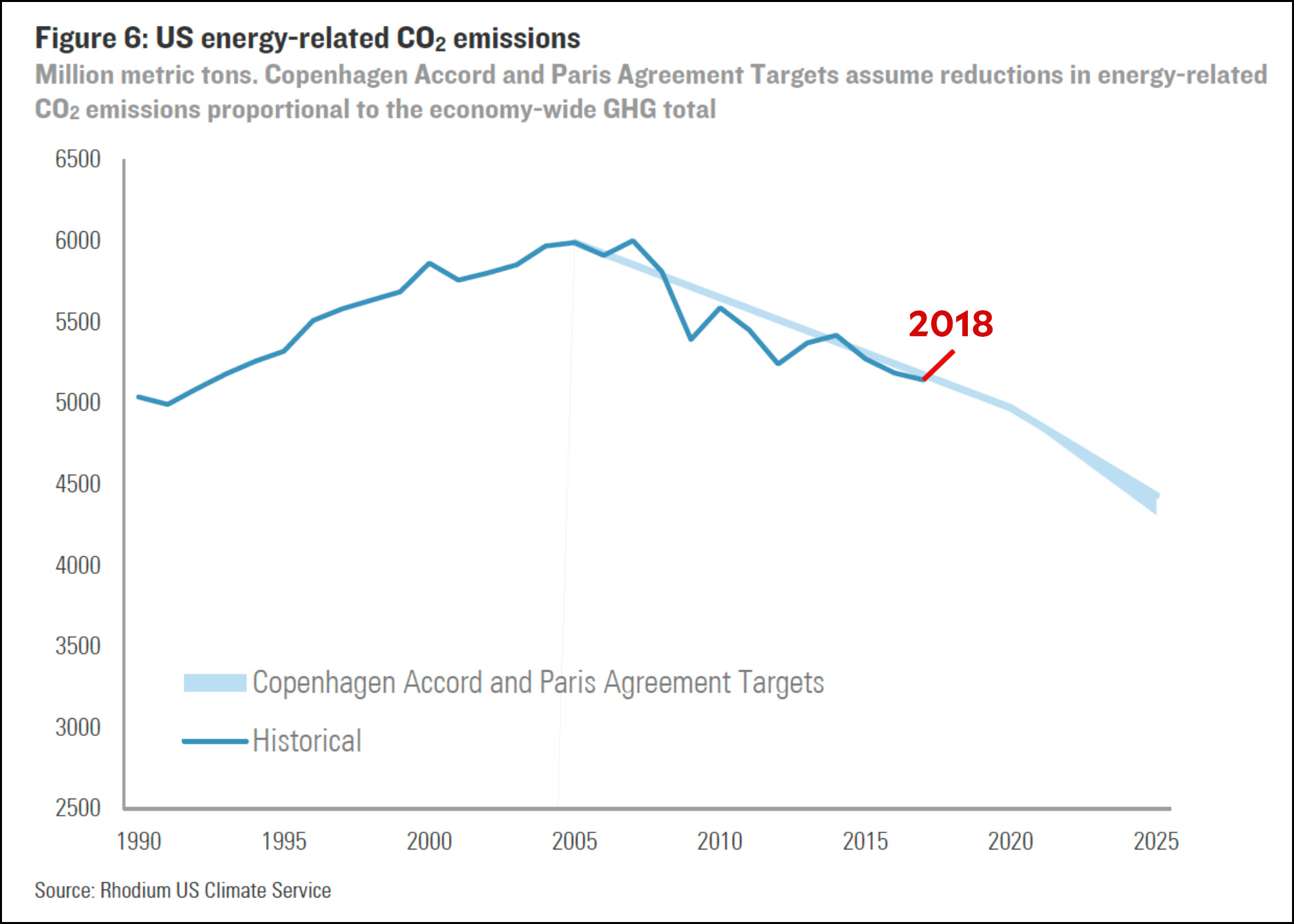
    Via the Washington Post, here’s our first estimate of the change in CO2 emissions in the United States in 2018:

    This comes from the Rhodium Group, which adds the following comments:

    • “We estimate that energy-related CO2 emissions increased by 3.4% in 2018. That’s the second largest annual gain since 1996.”
    • “The largest emissions growth in 2018 occurred in the two sectors most often ignored in clean energy and climate policymaking: buildings and industry. We estimate that direct emissions from residential and commercial buildings (from sources such as fuel oil, diesel and natural gas combusted on site for heating and cooking) increased by 10% in 2018 to their highest level since 2004.”
    • “At the state and federal level few good strategies have been implemented to begin decoupling production from emissions. Our preliminary estimates suggest the industrial sector posted the largest emissions gains in 2018 at 55 million metric tons.”

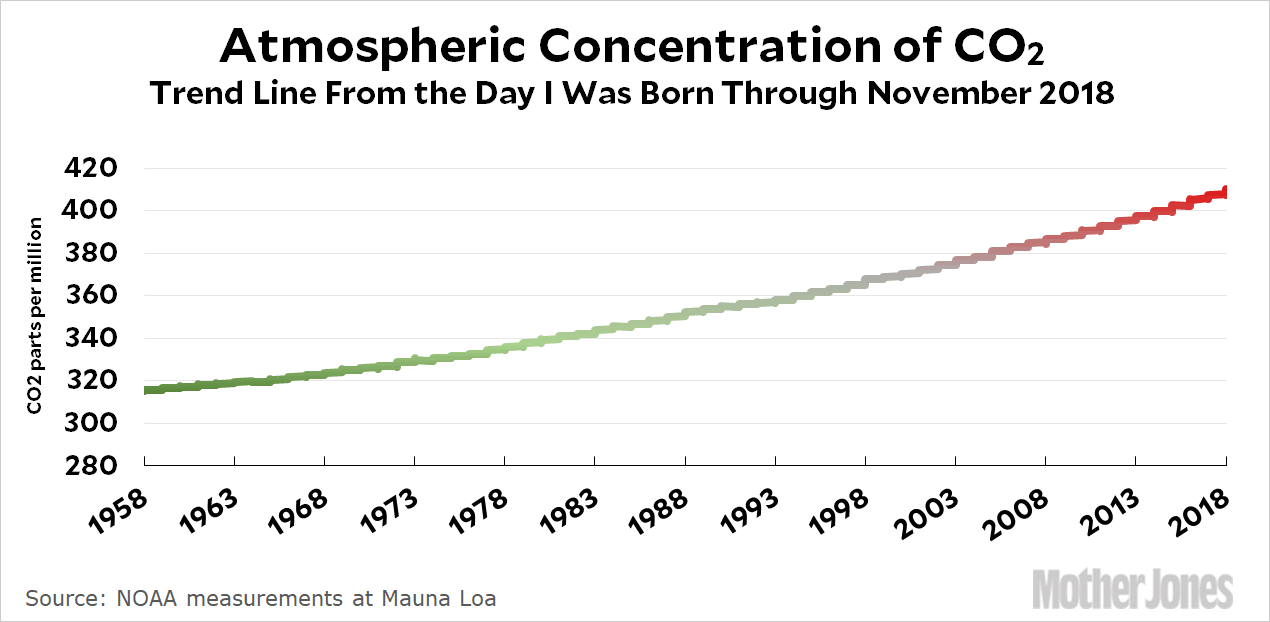
    Meeting the Paris Accord levels for CO2 emissions is all but impossible now, which is no surprise since Republicans in Congress won’t allow any policy changes to address climate change. And as we dither, the global concentration of CO2 continues to accelerate. The pre-industrial average was about 280 ppm and increased by only 40 ppm in the thousand years before 1958. Then, over the past 60 years, it increased by 95 ppm. In 2018 alone it increased by 3.43 ppm through November, which is a record since measurements began. And still we dither.

  • Probably No Terrorists Were Stopped at the Southern Border Last Year, and Trump Knows It

    President Trump five days ago:

    [In 2017] over 3,700 known or suspected terrorists tried to enter into this country…at the southern border because there’s no wall, there’s no physical barrier. There’s no way to actually control ports of entry…..It’s a problem of national security. It’s a problem of terrorists….We have terrorists coming through the southern border because they find that’s probably the easiest place to come through. They drive right in and they make a left.


    And here is NBC News reporting information that the Trump administration submitted to Congress last summer:

    U.S. Customs and Border Protection encountered only six immigrants at ports of entry on the U.S-Mexico border in the first half of fiscal year 2018 whose names were on a federal government list of known or suspected terrorists, according to CBP data provided to Congress in May 2018 and obtained by NBC News.

    ….Overall, 41 people on the Terrorist Screening Database were encountered at the southern border from Oct. 1, 2017, to March 31, 2018, but 35 of them were U.S. citizens or lawful permanent residents. Six were classified as non-U.S. persons. On the northern border, CBP stopped 91 people listed in the database, including 41 who were not American citizens or residents.

    Six. And this is merely people who were on a watchlist. Given what we know about the terrorist watchlist, this means the most likely number of real threats stopped at the southern border was zero or one.

    But it gets worse. These were people stopped at legal ports of entry, so a wall obviously wouldn’t have affected them anyway. Apparently the Border Patrol stopped five people between ports of entry, but we don’t know how many of them were trying to sneak across the southern border vs. the northern border. One or two? Of which, probably none were genuine threats.

    In other words, a wall most likely would have stopped no terrorists at all. Maybe a couple if we’re being generous.

    Eventually Sarah Sanders is going to have to fess up to this instead of droning on about “three thousand” terrorists, nearly all of whom were stopped at airports. But I’m not sure I even care. At this point, anything officially released by the White House should simply be considered a lie unless it’s confirmed with someone reliable.

  • What’s Going On With AOC?

    Tom Williams/Congressional Quarterly/Newscom via ZUMA

    Alexandria Ocasio-Cortez sure does know how to attract attention. I guess that’s no surprise: she’s photogenic, she’s young, she’s the leader of the #Resistance, and she defends herself pretty well on camera without constantly resorting to tedious talking points. She’s made for our era.

    But sometimes she screws up. Today Chris Cillizza—joined by the media’s entire universe of professional fact checkers—dinged her for a past mistake that she defended last night on 60 Minutes:

    Progressive Twitter went nuts, saying that Cillizza took the quote out of context. Cillizza replied that his tweet was limited by a character count, and then AOC chimed in:

    So what is the full quote? Here you go:

    Anderson Cooper: One of the criticisms of you is that— that your math is fuzzy. The Washington Post recently awarded you four Pinocchios…for misstating some statistics about Pentagon spending?

    Rep. Alexandria Ocasio-Cortez: If people want to really blow up one figure here or one word there, I would argue that they’re missing the forest for the trees. I think that there’s a lot of people more concerned about being precisely, factually, and semantically correct than about being morally right.

    Anderson Cooper: But being factually correct is important—

    Rep. Alexandria Ocasio-Cortez: It’s absolutely important. And whenever I make a mistake. I say, “Okay, this was clumsy.” and then I restate what my point was. But it’s— it’s not the same thing as— as the president lying about immigrants. It’s not the same thing, at all.

    I’m puzzled. AOC had said that a recent study documented $21 trillion in accounting errors at the Pentagon. Use this for health care instead, she said, and it would practically pay for Medicare For All.

    Now, for the record, this is not even close to correct. That’s $21 trillion unaccounted for, not $21 trillion that wasn’t used. It comes from a recent article in The Nation, which in turn was based on an estimate last year from Mark Skidmore of Michigan State University, who in turn based his estimate on an extrapolation from recent Pentagon audits along with other government sources. He says there have been $21 trillion in “unsupported journal voucher adjustments” for the years 1998-2015, which—and this is important!—includes adjustments both up and down.¹ The net value of the adjustments is not given, and Skidmore makes no allegation that any of this money literally went down a black hole. It’s certainly possible that some of it might have disappeared, or been the product of fraud, but the vast bulk is almost certainly due to incompetent accounting systems that produced a ton of positive and negative errors that mostly canceled each other out. In other words, this is not “in the ballpark” but not quite right. It’s just wrong. It would be a great idea to fix the Pentagon’s accounting systems, but doing so would produce only a tiny fraction of what Medicare For all would cost.

    So here’s my question: after the Post fact check was published did AOC correct herself? After all, that’s the missing part of the quote everyone is complaining about. As near as I can tell, she didn’t, really. Here’s how she responded to the Post last month:

    “To clarify, this is to say that we only demand fiscal details [with health and education], rarely elsewhere,” Ocasio-Cortez said in a follow-up tweet. “The point, I think, was more about how we care so little about the ‘how do you pay for it’ when we are talking about war and military spending,” her spokesman wrote in an email. “It’s only when we are talking about investing in the physical and economic well-being of our citizenry that we become concerned with the price tags.”

    I suppose this counts as “restating her point,” but it doesn’t count as admitting an error and owning up to it. Nor does it help her cause to complain that she’s being fact-checked too much and other people should be fact checked instead. Nor to suggest that she’s being picked on because she’s a woman of color. Nor that fact checkers don’t check enough of her true statements.

    Finally, this afternoon, AOC tweeted, “I think the check is a very fair one to masked, and that the coverage illuminated the issue far more than my tweet did.” But she’s still referring to her tweet as “confusing,” not wrong. That’s too bad.

    Personally, I really, really like AOC. She’s the kind of photogenic spokesman that progressives need, plus she knows how to drive conservatives crazy. Nor do I even mind occasional fuzziness in an effort to communicate broad points—something she does well. Still, her inexperience excuses only so much. If she gets a reputation for spouting nonsense without bothering to understand it—and she seems to be heading in that direction—her star is going to dim. I think she’d be well advised to slow down and study up just a little bit.

    ¹A Pentagon spokesperson drolly notes that “DoD hasn’t received $21 trillion in (nominal) appropriated funding across the entirety of American history.”

  • Chart of the Day: Never Believe Corporations. Never.

    Matt Yglesias points me today to an elegant recent study of the job market. As you know, the business community has been grousing for years that they simply can’t find people who are qualified for all the complex new jobs they have on offer. This is known as a “skills gap,” sometimes referred to as “structural unemployment.” The response of liberal economists has typically been to tell employers that they just need to raise wages: if they pay more, then people with stronger skills will apply for their jobs. Employers moan that this is just unpossible.

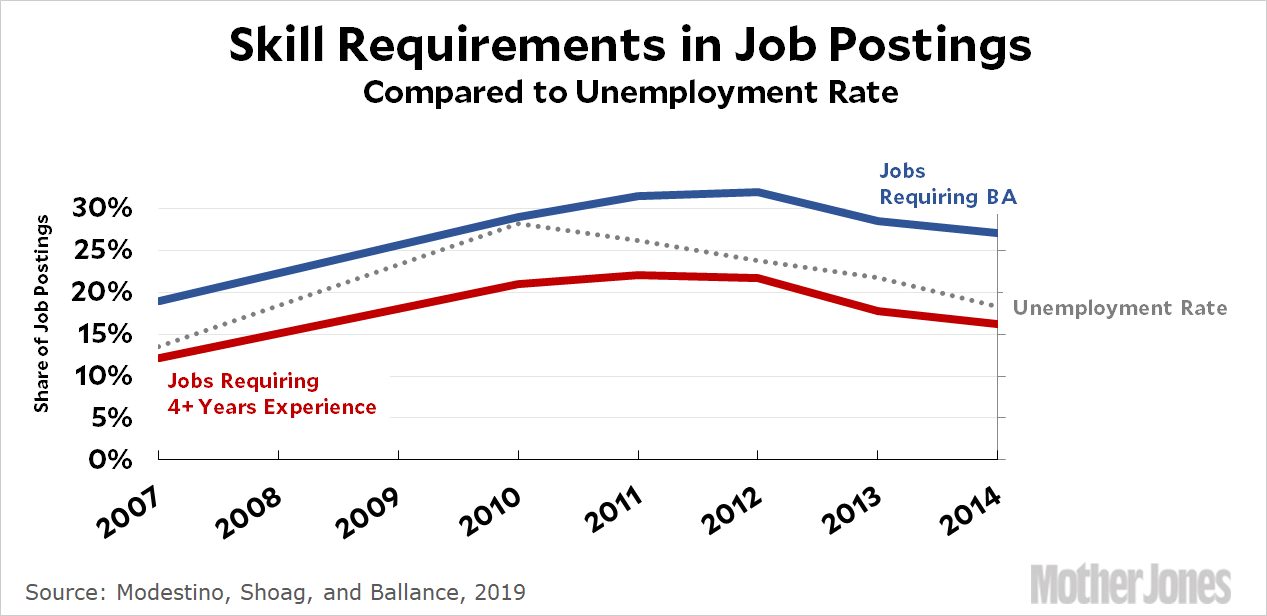
    Now along come Alicia Modestino, Daniel Shoag, and Joshua Ballance to look at things a different way. Their approach is so simple I’m surprised they’re the first, but apparently they are. All they did was analyze an online database of job offerings to find out whether employers made their hiring requirements stricter when unemployment was high and they could be more selective about who they hired. Do I even have to tell you the answer?

    As unemployment went up during the Great Recession, businesses began requiring more experience and more education. The share of job offerings requiring a college degree nearly doubled and the share requiring more than four years of experience increased by two-thirds. Only when the unemployment rate went back down to 7 percent did employers finally start relaxing their requirements a bit.

    The bottom line is that employers had a hard time finding qualified workers because they had consciously decided to get pickier about who they were willing to hire. With lots of college grads out of work and getting desperate, they figured they might as well try to pluck a few them out of the job pool, a phenomenon the authors call “opportunistic upskilling.” And note that they weren’t paying any more than they did with old job requirements, either.

    Now, if you’re a sophisticated consumer of time-series data like this, your first question is whether the whole thing is just a coincidence. It’s not a whole lot of data points, after all. However, the answer appears to be no. The authors also did a state-by-state analysis, and they found that states with higher unemployment rates reliably produced more selective job requirements. They also found that when large numbers of veterans re-entered the job market after serving in Iraq and Afghanistan, it produced the same effect even though the troop drawdown was unrelated to the broader job market. Overall, they find that deliberately tightening job requirements probably accounted for about a quarter of the alleged skills gap.

    And what accounts for the rest? We don’t know. Some if it is simply that employers weren’t willing to pay enough to get the people they wanted. And some of it is real. There are certain industries that really do require substantially higher skills than in the past, and they have a hard time finding workers because the educational system hasn’t yet caught up to them.

    My take on all this is to repeat something I’ve said before: Never believe corporations. Period.¹ Don’t believe them when they say the “jury is still out” about the danger of the chemicals they produce. Don’t believe them when they say environmental regulations will put them out of business. Don’t believe them when they claim that they’ll hire more people and boost their fixed investment if Congress will pass tax cuts. And don’t believe them when they say they just can’t find people to take their jobs. Most of them just need to stop goosing their hiring requirements and increase their pay rate a bit. Problem solved.

    ¹I should add that you shouldn’t automatically believe the opposite of what corporations say, either. Simply treat their pronouncements as null data, sort of like the pleas of a coke addict who you know will say anything to get a few bucks from you. Just ignore the chatter and make up your mind based on all the other evidence available.

  • Lunchtime Photo

    As you know, a few weeks ago I visited the LA Arboretum. During the day, it’s just the usual collection of plants from around the world. But in December and January it’s transformed each night into the “Moonlight Forest,” which is….

    …a bunch of lighted-up things. I’m not even sure what to call them. But they’re all based on Chinese culture and they’re quite pretty. The display below is typical, a collection of lilies of some kind. There were also lotus blossoms, peacocks, jellyfish, dragons, crescent moons, all the yearly animals, and so forth. It was not quite what I was expecting when I bought a ticket, and I still haven’t decided if it was worth seeing. Either way, though, I’ve got half a dozen more pictures like this one, and I’ll probably put them up eventually. Or maybe I’ll do them all at once. My photo queue is really, really backed up these days and I need to start clearing it out.

    December 9, 2018 — Los Angeles Arboretum, Arcadia, California
  • The Gig Economy Is a Big Nothingburger

    As you know if you’re a faithful reader of this blog, the “gig economy” is largely a myth. So how did two prominent researchers, Alan Krueger of Princeton University and Lawrence Katz of Harvard, manage to screw up so badly, predicting in 2015 that gig employment was rising rapidly and was poised to change the American economy permanently? To their credit, they have now published a working paper that digs into where they went wrong:

    First, the gig economy appeared swollen largely because the labor market earlier this decade was so weak for so long in the aftermath of the recession. Rather than heralding a permanent shift in the relationship of Americans to employers, a lot of gig-economy activity was odd jobs that people took up to make ends meet. As the economy returned to normal, they returned to more familiar work arrangements.

    Second, Messrs. Krueger and Katz conclude, the surveys used to measure alternative work arrangements remain riddled with flaws, and the Labor Department does a poor job of accounting for people with multiple jobs.

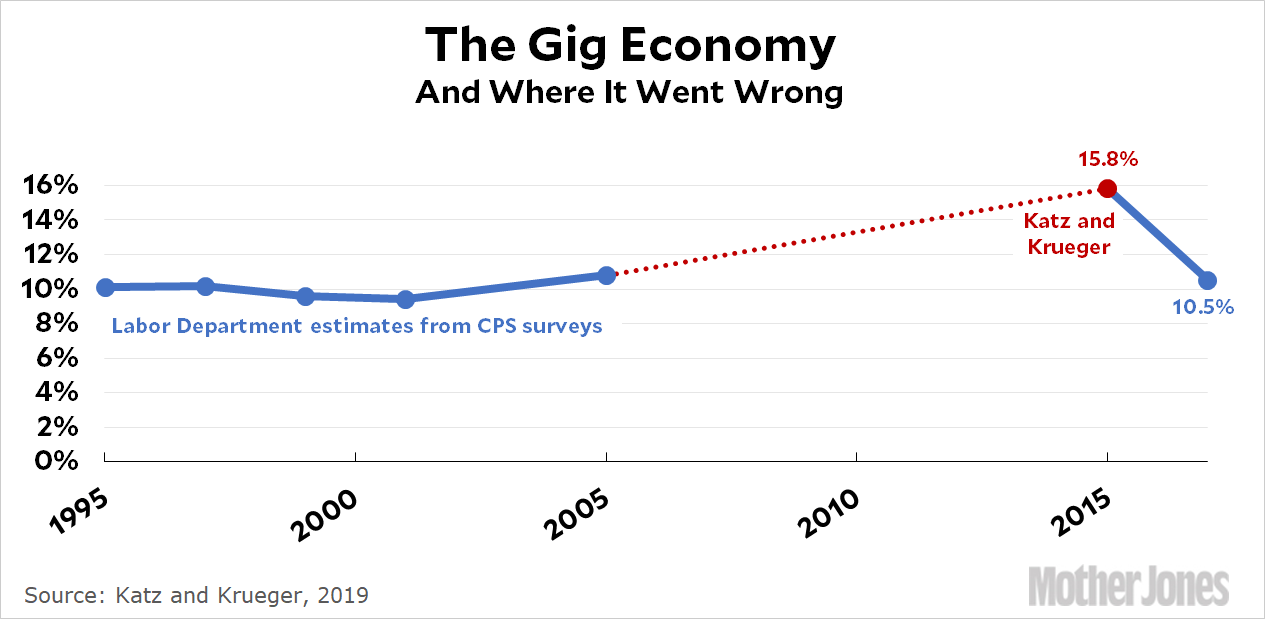
    Here’s the explanation in chart format:

    Roughly speaking, the Current Population Survey stopped asking about contingent work arrangements in 2005, so in 2015 Katz and Krueger teamed up with RAND to produce a more current estimate. They tried to weight their results similarly to the CPS surveys, but that’s hard to do and they ended up overestimating things. When the Labor Department itself produced a new figure for 2017, they found that contingent work was about the same as it had been in all the previous surveys going back to 1995.

    These things happen. Just as a personal observation, though, I think the enthusiasm about the gig economy sprang from two sources:

    • A disconnect between elites and the working class. A sizeable portion of the working class has been engaged in contingent labor forever, but somehow a lot of smart people have never really understood just how common this is in their lives.
    • A belief that if your contingent job is based on notification from an app rather than a phone call from a supervisor, it’s somehow fundamentally different. It’s not.

    Plus there’s the very slow recovery from the Great Recession, which caused a lot of otherwise sensible people to look at things like work arrangements and conclude that they were permanently worse than they had been. Time will tell about that, but in the short term we just needed to complete the normal recovery process. We mostly have by now, and sure enough, the nature of work is now back to about where it was ten years ago.

  • Does Weed Cause Schizophrenia?

    Over the weekend you might have noticed a MoJo piece about a new book by Alex Berenson called Tell Your Children: The Truth About Marijuana, Mental Illness, and Violence. Stephanie Mencimer says the book “takes a sledgehammer to the promised benefits of marijuana legalization, and cannabis enthusiasts are not going to like it one bit.”

    Probably not. But it’s worth noting that although I didn’t notice anything flatly incorrect in Berenson’s claims, there’s nothing all that new about them. And he does overstate the risks, I think. Here’s a very quick roundup of what we know:

    • About 10-15 percent of teens who try marijuana become dependent. This is roughly similar to the rate for alcohol dependency.
    • If you have schizophrenia, marijuana use will make it worse. Anyone with persistent psychotic symptoms should be kept far away from cannabis of any kind.

    However:

    • It is far less clear whether regular marijuana use causes schizophrenia. Drug researchers have been studying this for decades, and have concluded that there’s some evidence of a causal effect—but not a strong one. That’s the consensus so far, anyway.
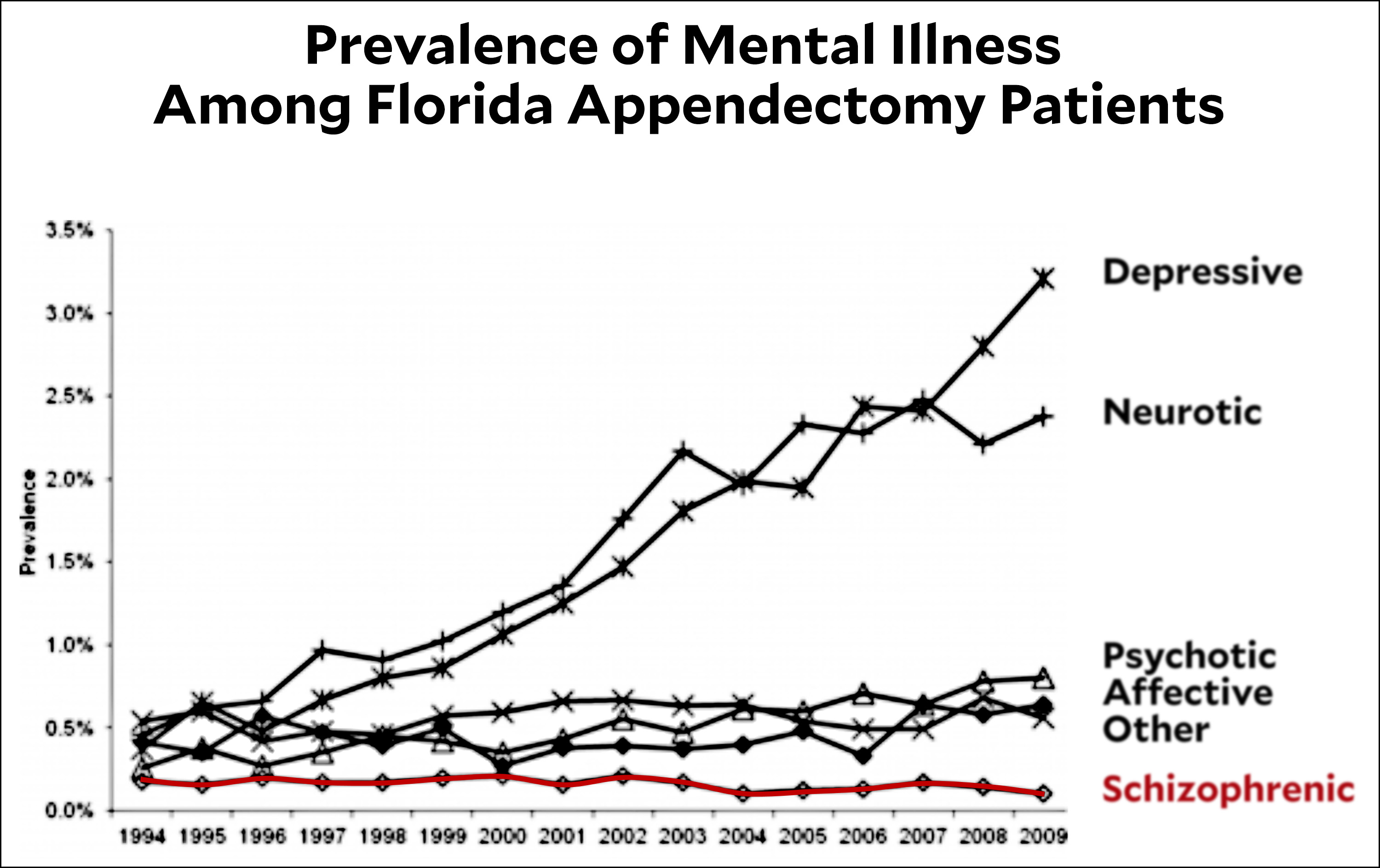
    • For example, marijuana use has increased considerably over the past 20 years, and so has the potency of marijuana. And yet, on a nationwide basis, there’s been no increase in diagnoses of schizophrenia. It affects less than 1 percent of the population, and that’s stayed steady for a long time.

    • Even if marijuana affects the onset of schizophrenia, the real-world effect is probably small. If the risk increases by as much as 40 percent, for example, that’s an increase from perhaps 0.5 percent to 0.7 percent.

    Nothing is perfect, and there’s no question that marijuana isn’t harmless. Among other things, no one with schizophrenia should get near the stuff, and if you have a family history of severe mental illness you might want to think twice about using it. That said, the notion that smoking marijuana significantly increases the risk of schizophrenia in the future is not really supported by the literature. There’s probably some risk, but it’s fairly small and the evidence for it is fairly weak.

    As with so many other things, though, daily use by teens is generally not a good idea—especially given the extremely high potency of modern pot. Anything that affects brain development even modestly should be used sparingly by teens whose brains are still in the process of maturing. There’s no need to panic, but it’s unquestionable that allowing your teen to become a serious stoner is a bad idea on a whole bunch of levels.

  • Quote of the Day: “Let the Damn Oil Flow!”

    Ralf Hirschberger/DPA via ZUMA

    President Trump in a cabinet meeting last week:

    And I make calls. I said, “You better let that oil and that gasoline flow.” And they did. And now it’s down to $44. And I put out a social media statement yesterday; I said, “Do you think it’s luck that that happens?” It’s not luck. It’s not luck. I called up certain people, and I said, “Let that damn oil and gasoline — you let it flow — the oil.”

    Tough! Good work, Mr. Pres—

    Saudi Arabia is seeking a return to $80-a-barrel oil to cover a massive government spending boost—and plans to cut crude exports to 7.1 million barrels a day by the end of January, according to OPEC officials….To cover proposed expenditures, Riyadh is set to reduce its crude exports by as much as 800,000 barrels a day from November levels.

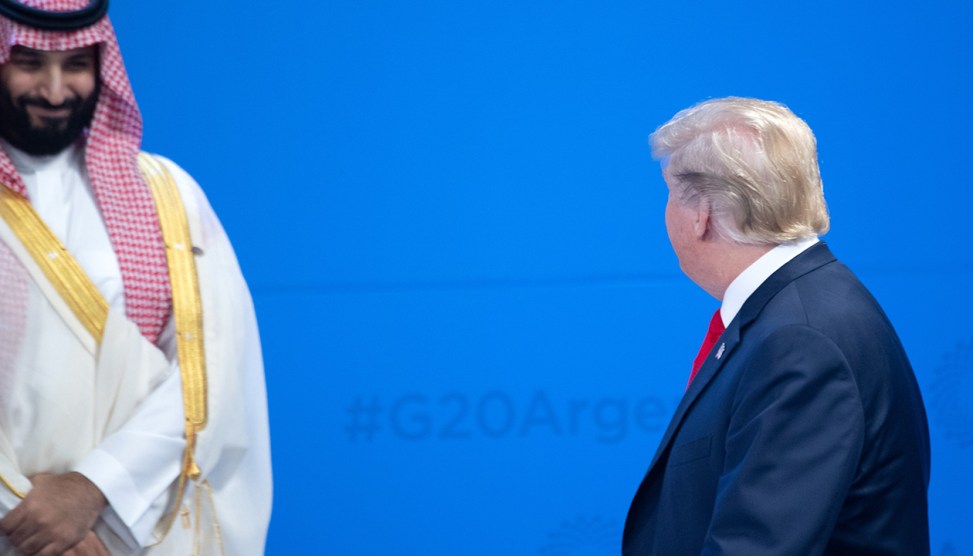
    After all we’ve done to ignore the murder of Jamal Khashoggi, you’d think they’d be more grateful. But I guess it’s all fine. We don’t need the Saudis, after all. We’re the biggest oil producer in the world now, thanks to fracking. We can open our own taps and produce as much oil as we—

    Thousands of shale wells drilled in the last five years are pumping less oil and gas than their owners forecast to investors….Collectively, the companies that made projections are on track to pump nearly 10% less oil and gas than they forecast for those areas….Some companies are off track by more than 50% in certain regions.

    Oh. Well, I guess there’s always the Iranians. Maybe we could call a do-over and try to make friends with them again. Or maybe Russia. Or Venezuela. Or Canada. Or…oh crap. We’ve really pissed off a lot of big oil producers, haven’t we? But it should all work out. With a recession coming, we won’t need as much oil anyway.

  • Cuban Sonic Attack Was … Crickets

    One down, 700 million to go.Zoologische Staatssamlung München

    You all remember the “sonic attack” on the US Embassy in Havana? It was weird as hell. People who worked there complained of a high-pitched sound and became sick in startling numbers. The effects, which doctors said were similar to a concussion, lingered long after the victims had returned home. But no one could figure out what happened. Even after an exhaustive investigation, no one found any evidence of a Cuban attack, or even any good theory of what it could have been. And why would the Cubans attack American embassy personnel anyway? They were eager for the diplomatic recognition that President Obama had given them.

    Well, now the story is even weirder. An audio recording of the high-pitched sound was released to the AP, and from there it made its way into scientists’ laboratories:

    A fresh analysis of the audio recording has revealed what scientists in the UK and the US now believe is the true source of the piercing din: it is the song of the Indies short-tailed cricket, known formally as Anurogryllus celerinictus….“The call of this Caribbean species is about 7 kHz, and is delivered at an unusually high rate, which gives humans the sensation of a continuous sharp trill.”

    …..But the cricket’s mating call and the Cuban recording did not match up perfectly. The sound recorded in Havana had an uneven pulse structure which is not seen in calling insects. Stubbs and Montealegre-Zapata realised that the discrepancy might be down to the environments in which the recordings were made….The researchers tested the idea by playing the call of the Indies short-tailed cricket in a room through a single loudspeaker. Recordings from the room show that the sound gained the same uneven pulse structure seen in the Cuban recording. The two sounds matched even more closely.

    So it was crickets. This still leaves a bunch of unanswered question, chief among them why American diplomatic personnel in Havana seem to be so sensitive to the 7 kHz call of an Indies short-tailed cricket. But I suppose that’s a question for another day. For now, it appears the Cubans are off the hook.