• Walking Your Cat

    On the way to lunch today, we saw a couple walking a pair of dogs and a cat. A cat? We had to check this out. So I made a U-turn and headed back in their direction.

    False alarm. They were walking two dogs, but the cat just happened to be in a nearby yard and they had stopped to say hello. So I went on by and made another U-turn to get us back in the direction of lunch.

    As I approached them again, I saw that the cat was still following them. So I stopped and asked. Sure enough, it turned out they were walking their cat. “He loves to be walked,” one of them told us, “but he hates being on a leash.” So he just prances around and follows them as the dogs obediently stay on their leashes and do what they’re told.

    And me without my camera. Damn.

  • Syrian Troop Withdrawal Halted Forever

    Here’s the latest on our Syrian troop withdrawal:

    President Trump’s national security adviser sought to reassure allies Sunday that the United States would be methodical about withdrawing troops from Syria, promising that the pullout would not occur until the Islamic State was fully eradicated from the country and Turkey could guarantee the safety of Kurdish fighters….“There are objectives that we want to accomplish that condition the withdrawal,” Bolton said while speaking to reporters in Jerusalem, on a trip intended to allay Israeli leaders’ concerns about Trump’s announcement. “The timetable flows from the policy decisions that we need to implement.”

    In other words, we’re not withdrawing any troops from Syria. Good to know.

  • Soaking the Rich

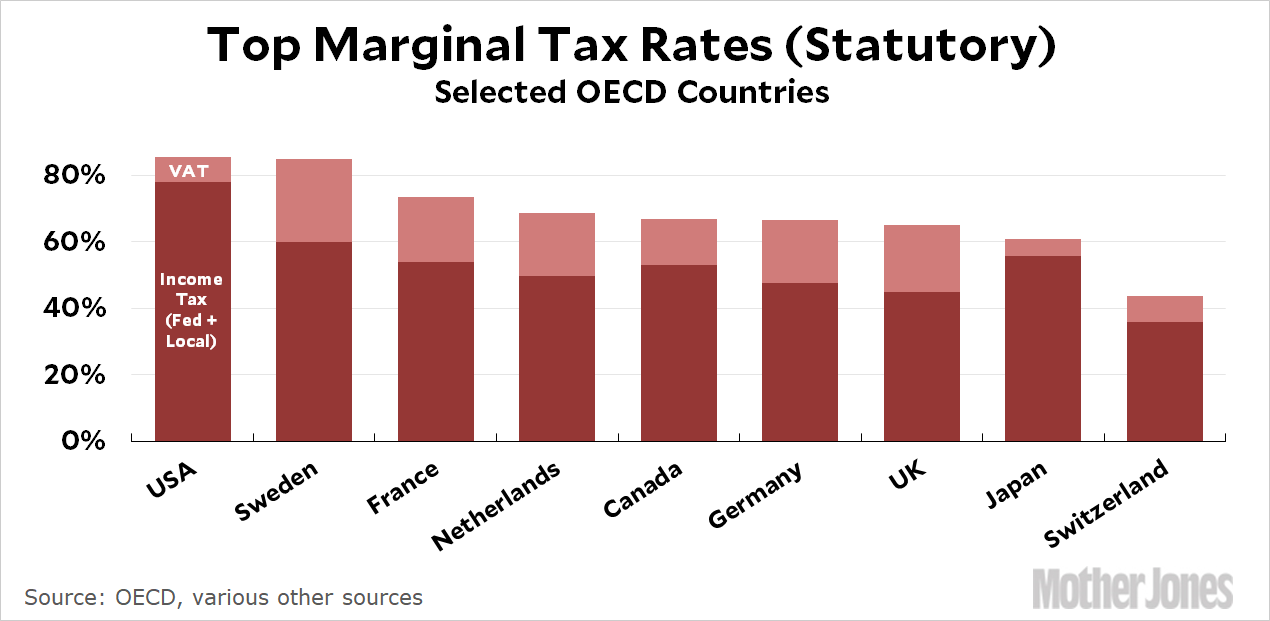
    Since we’re all pretending to care that a freshman member of Congress has proposed a top federal income tax rate of 70 percent, I thought you might be interested in where this would place us in the world league tables. Keeping in mind that international rates include both federal and state taxes, and that VATs play a big role in personal taxation, here you go:

    For the United States, I’ve included a 70 percent top federal rate, an 8 percent average state income tax rate, and a sales tax rate of about 7.5 percent. This would represent the statutory top tax rate for someone living in a high-tax state like California, New York, or New Jersey. Under Alexandria Ocasio-Cortez’s proposal, we would have the highest top rate in the world.

    Now, the actual effective top tax rate depends a lot on the details of exemptions, deductions, loopholes, income limits, and so on. In real life, that makes all these rates substantially lower than the statutory rate. Without details and more sophisticated analysis, it’s impossible to say where the US would fit in.

    So do I support a 70 percent top rate? Of course not. I support certain programs that require certain spending levels. Once we’ve figured that out, then I support a tax system that can fund our spending. This might end up including a top marginal rate of 70 percent or it might not. Until I know what the money is going to be spent on, I’m agnostic on the details of tax rates.¹

    ¹Although I’ll confess to a personal reluctance to support an all-in tax rate greater than 50 percent. That’s real-life taxation, not statutory rates, and it’s total taxation, not top marginal rates. I don’t base this on anything to do with economic efficiency, just that it seems unfair to have to turn over more than half your income to Uncle Sam. But I might make exceptions at the very highest income levels.

  • There Is No Crisis on the Southern Border. None.

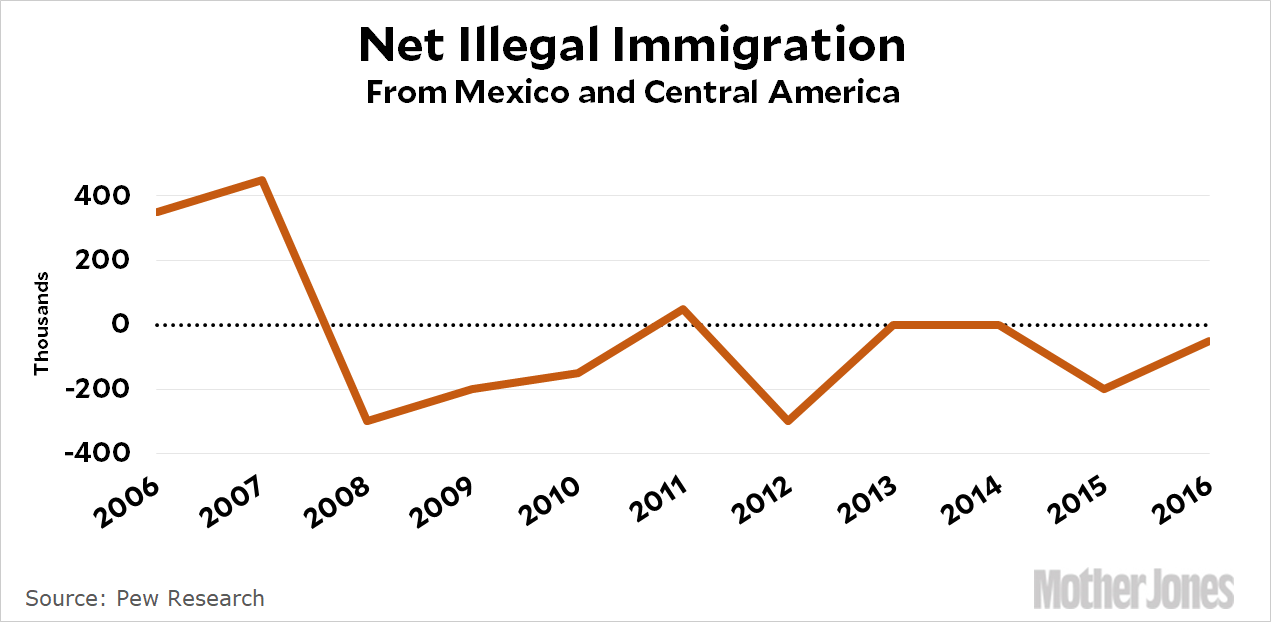
    Mike Pence was burbling a few minutes ago about the “crisis” on our southern border, so I’d like to share that crisis with you. Here it is:

    Yes, there is traffic across our southern border. However, the net traffic entering the US is zero or lower. To put it plainly: more people are leaving than are coming in. This is not a crisis. It is not anything close to a crisis.

    The number of undocumented workers in the United States has been declining steadily for a decade. It’s obviously not something to panic over. What’s more, anyone who’s truly concerned about the undocumented population anyway should be obsessed with E-Verify, not a wall. This is because a properly functioning E-Verify system would (a) be more effective than a wall, (b) stop illegal immigration from everywhere, not just the south, and (c) reduce all forms of illegal immigration, including visa overstays, which a wall can’t stop.

    Trump’s obsession with a wall is a sign of unseriousness. The big businesses that run the Republican Party encourage it because they know it won’t work—and something that works is the last thing they want.

    This whole thing is just a kabuki show. It’s ridiculous.

  • Is There Any Way to Clean Up Facebook and Twitter?

    Frankhoermann/Sven Simon/DPA via ZUMA

    Tyler Cowen proposes today that there is no form of internet speech moderation that will satisfy everyone:

    I’d like to suggest a simple trilemma. When it comes to private platforms and speech regulation, you can choose two of three: scalability, effectiveness and consistency. You cannot have all three. Furthermore, this trilemma suggests that we — whether as users, citizens or indeed managers of the platforms themselves — won’t ever be happy with how speech is regulated on the internet.

    Note that Cowen uses “effective” to mean “doesn’t require so much time that the platform company can’t do its core job anymore.” Back when blogs were new and comment moderation was the big issue we were all trying to resolve, I ran into the same trilemma:

    • If the blog was small, I could easily moderate comments and do it consistently.
    • If I was willing to spend lots of time on moderation, I could manage a large blog with consistent comment policies.
    • If I decided not to worry about consistency, I could manage a large blog without putting a lot of time into comment moderation.

    I never came anywhere close to finding a solution to this, and I generally chose option #3. I’d do a bit of moderation here and there, and it would necessarily be pretty inconsistent. However, that left me enough time to actually write a blog even as my audience grew. There’s just no way to spend hours moderating comments and still have hours left over to write a blog of decent quality. The same trilemma affects huge social media platforms:

    • A system that’s big and effective (i.e., lightly moderated by the platform company) will inherently be inconsistent.
    • A system that’s big and consistent will inherently require huge resources from the platform company and therefore won’t be effective.
    • A system that that’s effective and consistent requires too much human intervention to ever become very big.

    Most people don’t get this, and therefore expect too much from platform companies like Twitter and Facebook. These companies can use automation to do a lot of the job, but automation isn’t even close to perfect yet. So what do you do? If the automation is too tight, it will eliminate innocent comments and everyone will scream. If the automation is too loose, it will let lots of hate speech through and everyone will scream. If you ditch the automation and use humans, you’ll go bankrupt—and anyway, human moderation is far from perfect too.

    I didn’t have an answer to this back when I was a lone blogger (these days I get help from MoJo moderators), and I don’t have one today. However, my own personal view is that we should think of internet moderation about the same as we think of real-life moderation. This leads me in the direction of (a) light moderation that lets people say whatever they want, even if it’s gruesome, and (b) giving users the tools to do their own moderation. I’m far more in favor of the latter than I am with Twitter or Facebook making centralized decisions about what to allow and what to ban.

    This is not a perfect solution, but that’s because there are no perfect solutions. And there’s no question that different people benefit from different levels of moderation. It’s one thing for a white man like me to prefer light moderation, but quite another for a black woman who gets far more abuse. Nonetheless, I don’t really see a good solution other than giving us all more and more tools to set our own preferred moderation levels while we wait for automated systems to get better. That’s going to be a while.

  • Chart of the Day: Net New Jobs in December

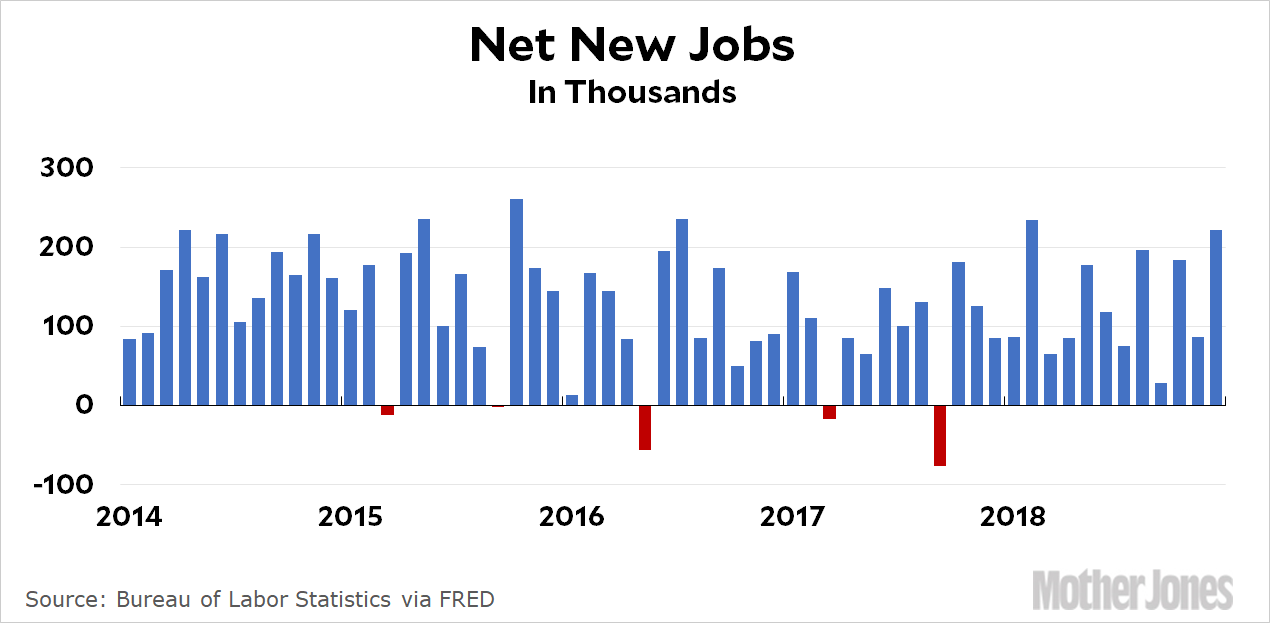
    The American economy gained 312,000 jobs last month. We need 90,000 new jobs just to keep up with population growth, which means that net job growth clocked in at a healthy 222,000 jobs. The unemployment rate rose to 3.9 percent.

    December’s numbers are a little hard to make sense of. The labor force increased by 412,000, and about half of this was due to people coming in off the sidelines and starting to look for jobs. However, they’re counted as unemployed until they find work, so the number of unemployed increased in December, while the number of employed went up by only 142,000.

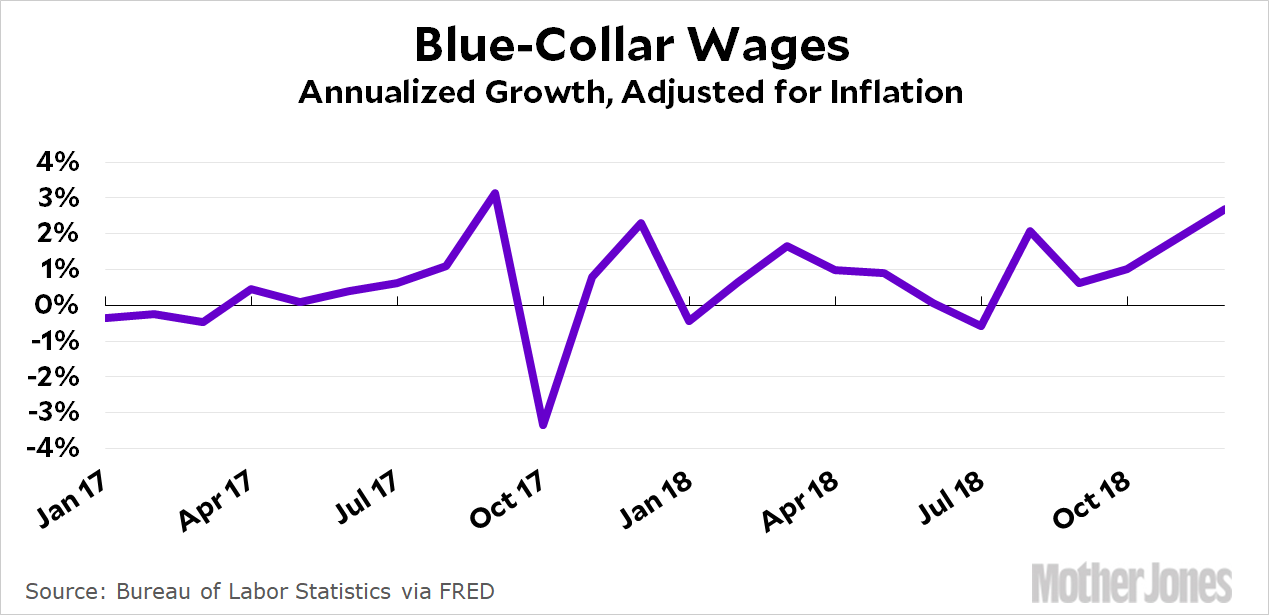
    Earnings of production and nonsupervisory workers increased at a startling annualized rate of 4.9 percent in the month of December. For the full year, the increase was 3.3 percent. With inflation running at about 2.2 percent both recently and for the full year, this means blue collar workers saw a full-year increase of about 1.1 percent and a December increase of about 2.7 percent at an annualized rate. Not bad.

  • If It Bleeds It … Gets Ignored?

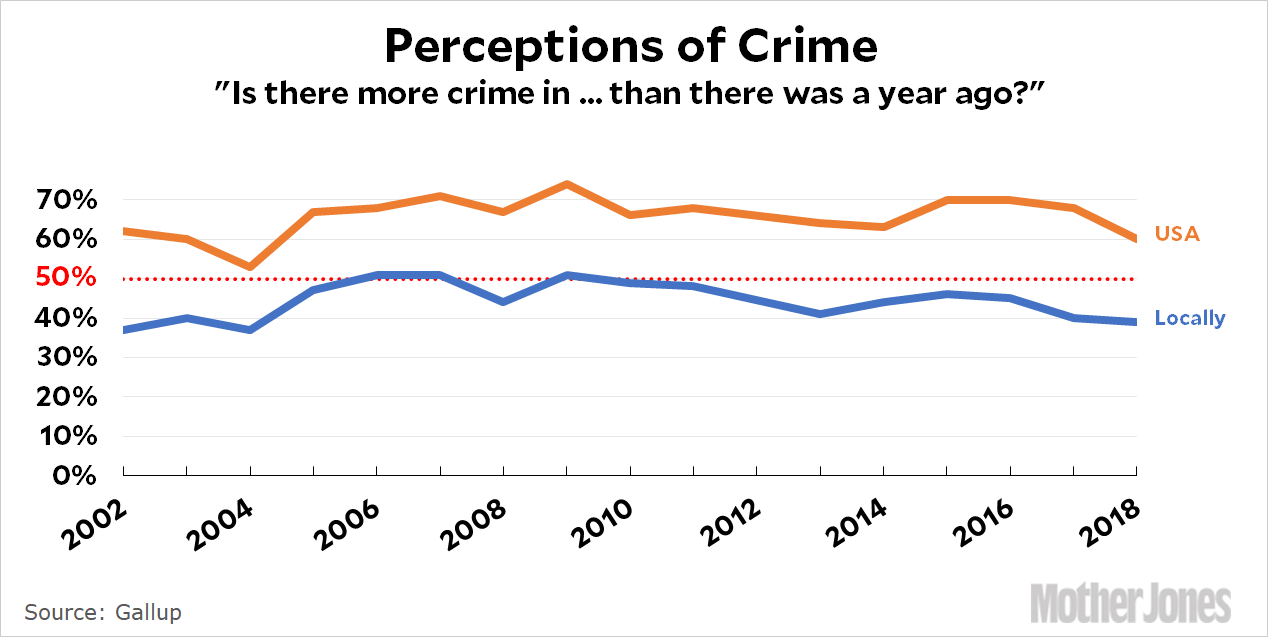
    Pew Research released a note today about perceptions of crime in the US, most of it based on Gallup poll numbers. The main takeaway is well known: crime is way down over the past couple of decades but people still think crime is going up. As I was looking at the raw data, though, something else struck me that I hadn’t noticed before:

    These two trendlines track each other quite closely, but the USA line is consistently about 25 percentage points higher. In other words, if you ask people about crime in their own neighborhoods, fewer than half think it’s going up. But if you ask them about crime in the whole country, 60-70 percent think it’s going up.

    In one way, this is simply another example of a well-known phenomenon: people almost always think conditions in the country are worse than conditions in their own neighborhoods. Schools are failing, but our schools are pretty good. Congress is horrible, but our rep does a good job. Drugs are rampant, but our town doesn’t have a big problem. Etc.

    But I wouldn’t have expected the same result here. Why? Because every time I turn on the local news, it’s wall-to-wall crime for the first ten or fifteen minutes. It’s a wonder there’s anyone alive to still report it. Conversely, national news really doesn’t focus much on crime. Obviously they report on mass shootings and similar things, but it’s a small share of their total reporting compared to local news.

    Or is it? And has it changed over the years? Does routine overexposure to local crime news actually make it seem less dangerous? I demand a PhD thesis on this topic.

  • Lunchtime Photo

    Yesterday we said goodbye to autumn, so today we’ll say hello to winter. I took this picture up at Big Bear a couple of months ago, and I have a question about it: is this sign placement a deliberate little joke or is it just a coincidence? The latter hardly seems likely, but what do I know?

    October 19, 2018 — Big Bear Lake, California
  • Looking for a Gender Neutral Workplace? Try a Call Center!

    From Wonkblog:

    Men dominate Google image searches for most jobs — even for bartender, probation officer and medical scientist, roles in which women outnumber men. In 57 percent of occupations, image searches indicate the jobs are more male-dominated than they actually are.

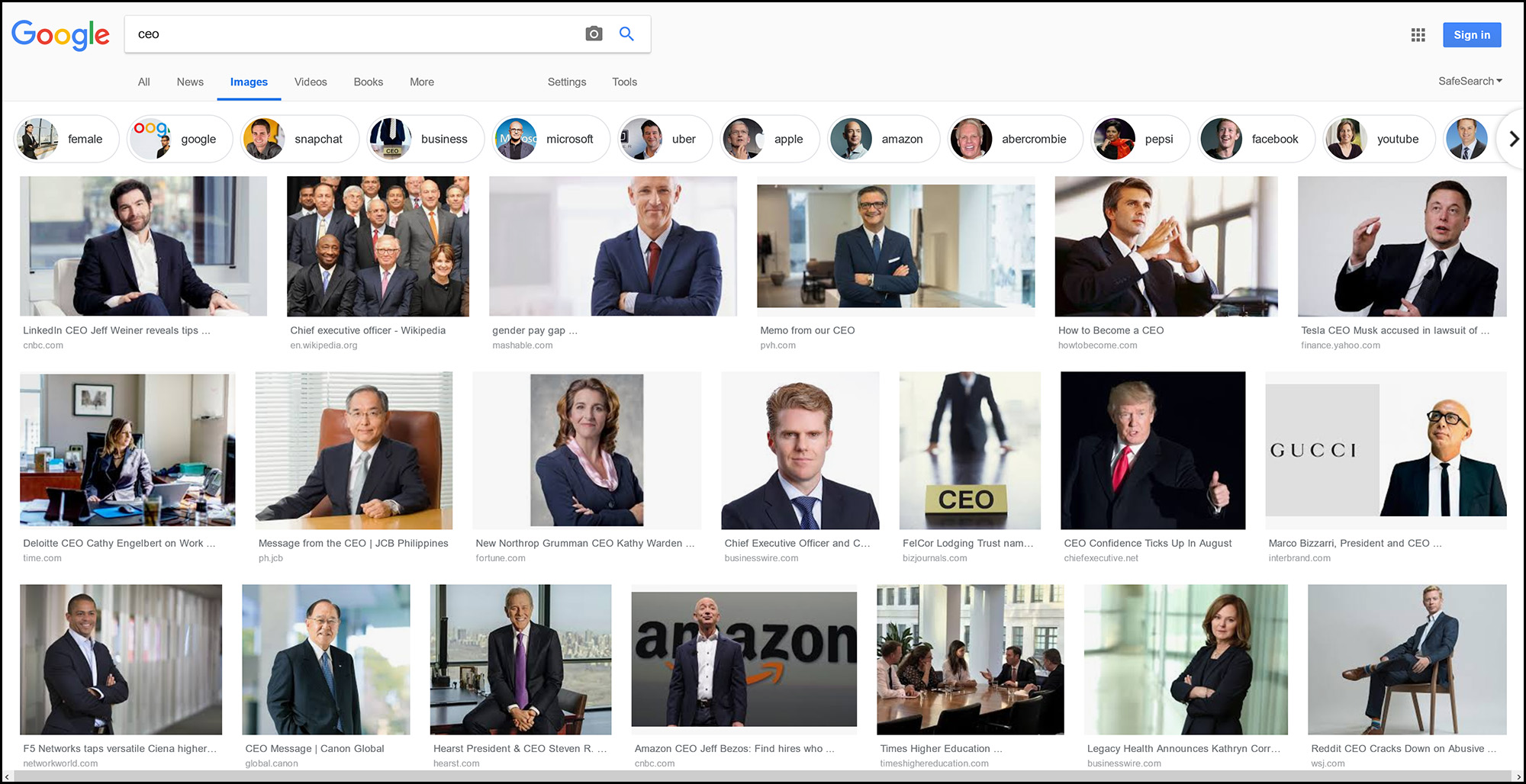
    Let’s check this out. I opened a fresh private browser window and googled CEO:

    Result: 16 men, 3 women, one unclear. Now let’s check out teachers:

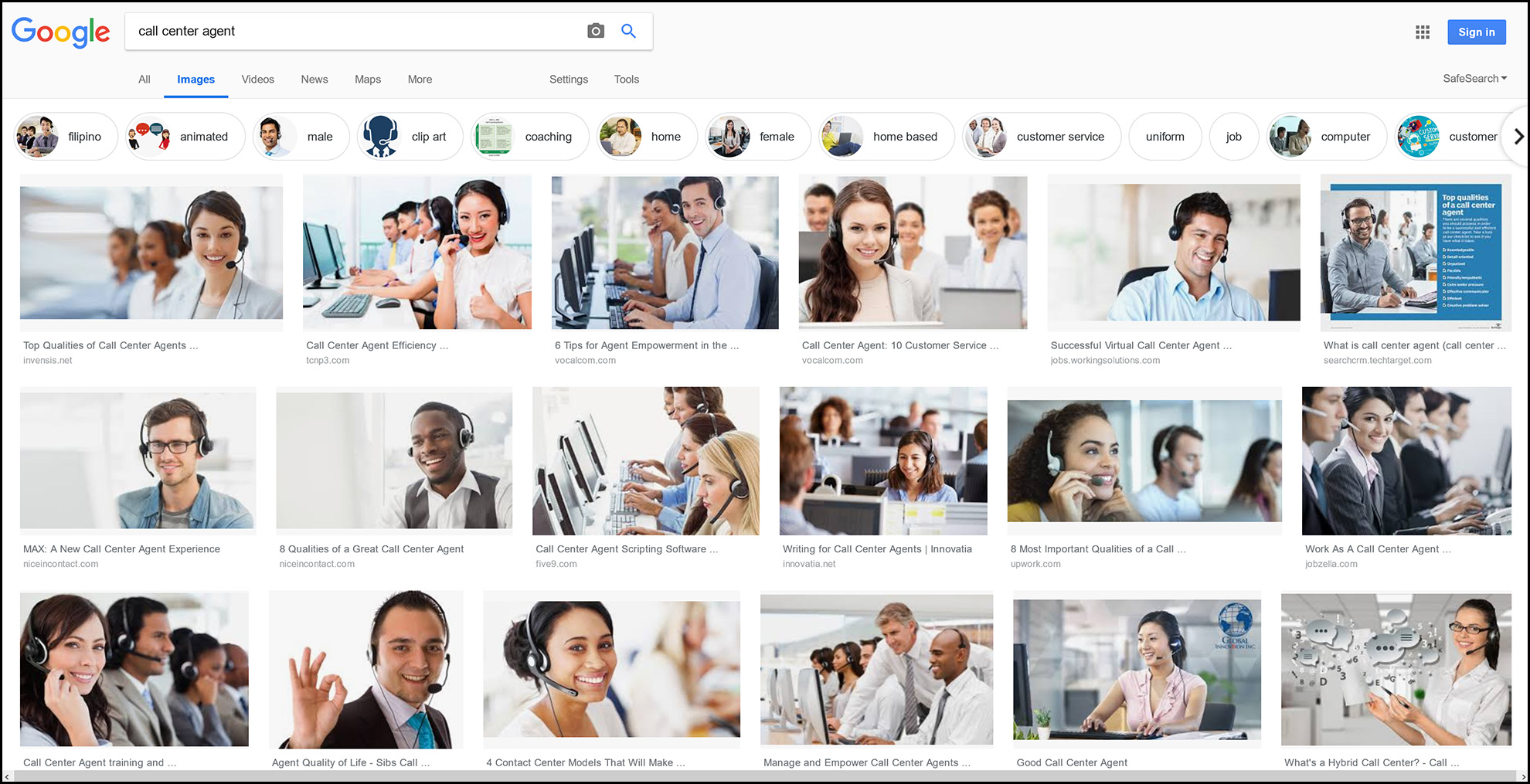
    Result: 15 women, 3 men. Hmmm. What occupation does Google think is roughly gender neutral? I noodled on this for a while and I finally got it: Call center agent.

    Result: 10 women, 7 men, 1 mixed. Not bad! Plus nearly all of them have mixed gender backgrounds and they all look really happy in their jobs. So I guess that’s our answer: if you want to work in a truly gender neutral workplace, Google says you should become a call center agent.

    For the record, the Pew study that kicked this off tags “interviewer” as the occupation that appears most gender neutral in a Google search, with physicians close behind at 52-48.