• For Only $1,000 You’ll Never Get Lost Again

    I’ve never gotten excited about the wearables trend, probably because I don’t like wearing things and I don’t even use my ordinary, non-wearable smartphone very much. And yet, Kaitlyn Tiffany’s piece about the latest attempt at making smart eyeglasses is intriguing. They cost a fortune and have to be personally fitted—and they’re currently available only in two cities in North America—but they seem oddly friendly and perhaps genuinely useful:

    North Focals

    I get lost really easily and even Google Maps on my phone doesn’t always save me—which makes a heads-up display like this sort of appealing. The strange thing is that although the glasses themselves seem OK to me, I’m less excited at the idea that you control them via a “loop” that you wear on your finger:

    So you have to wear a joystick on your hand all the time? Half of me hates this idea and half of me thinks it’s actually very clever, almost James Bondish. Unfortunately, it would cost me a thousand dollars plus a plane ticket to New York to try it out, so I suppose I’ll let other people be the guinea pigs. In any case, the company that makes these glasses, North, is funded by Amazon, so if they’re as useful as they look I’m sure they’ll be available in a city near me soon.

    The future is here. Or in Brooklyn, anyway.

  • The Opportunity Costs of Capitalism

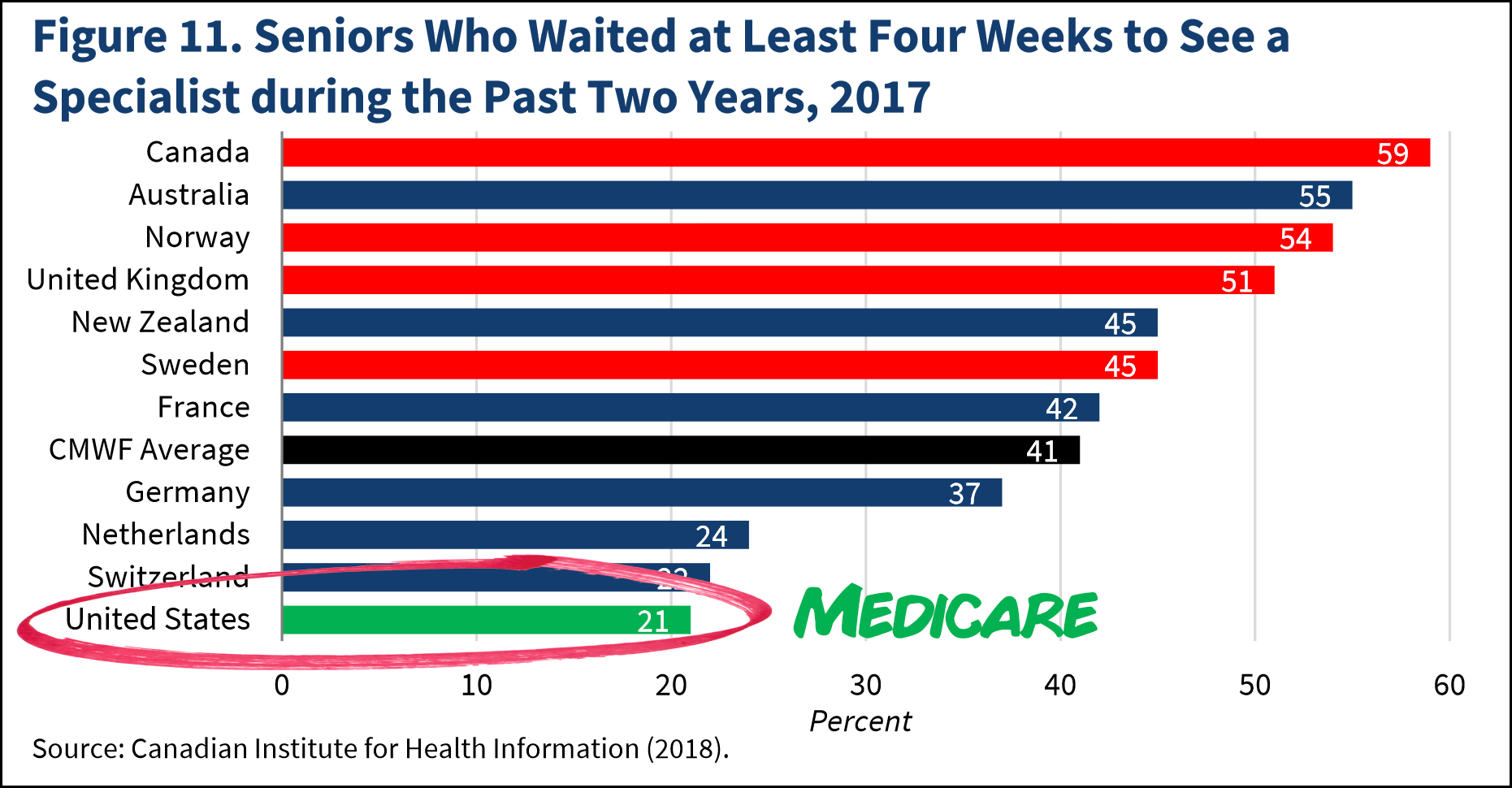
    The White House has released a booklet called “The Opportunity Costs of Socialism,” and it purports to show that wait times under socialist health care systems are far higher than they are in the good ol’ capitalist USA. However, as Sarah Kliff hilariously points out, the folks who put this together used data for senior citizens, all of whom are part of Medicare in the United States. And as we all know, Medicare is a socialist health care system:

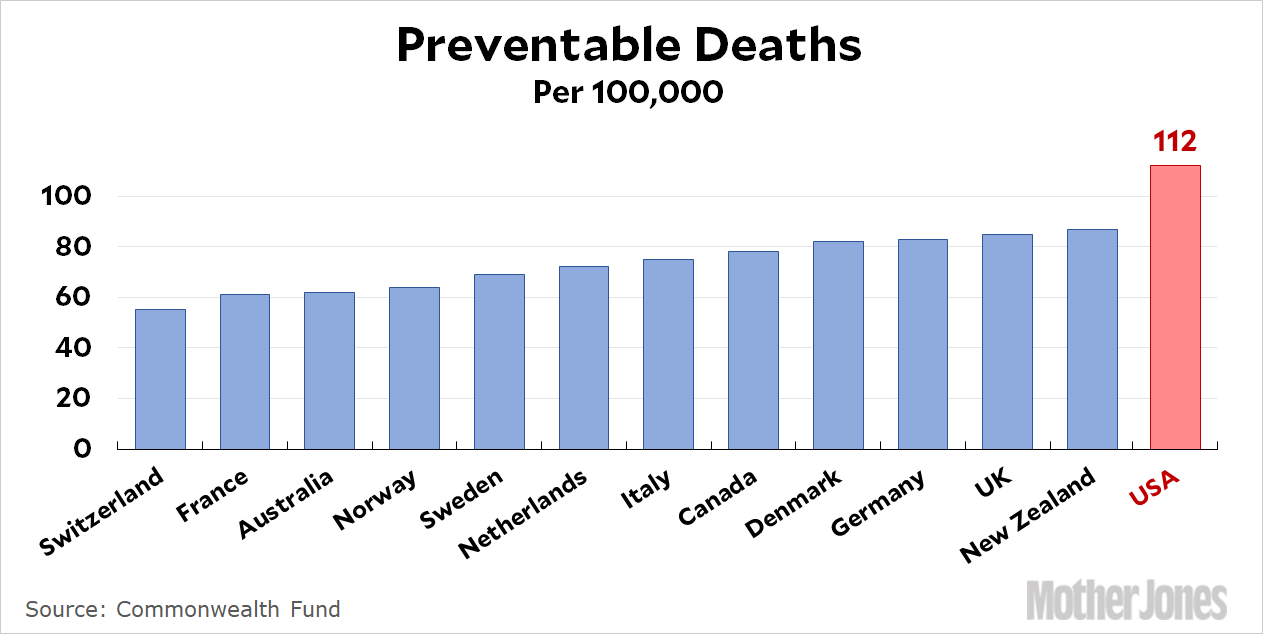
    This looks like a great case for Medicare for All! And while we’re on the subject, here are a couple of charts to show the opportunity costs of capitalism as well. First, our health care system kills an awful lot of people:

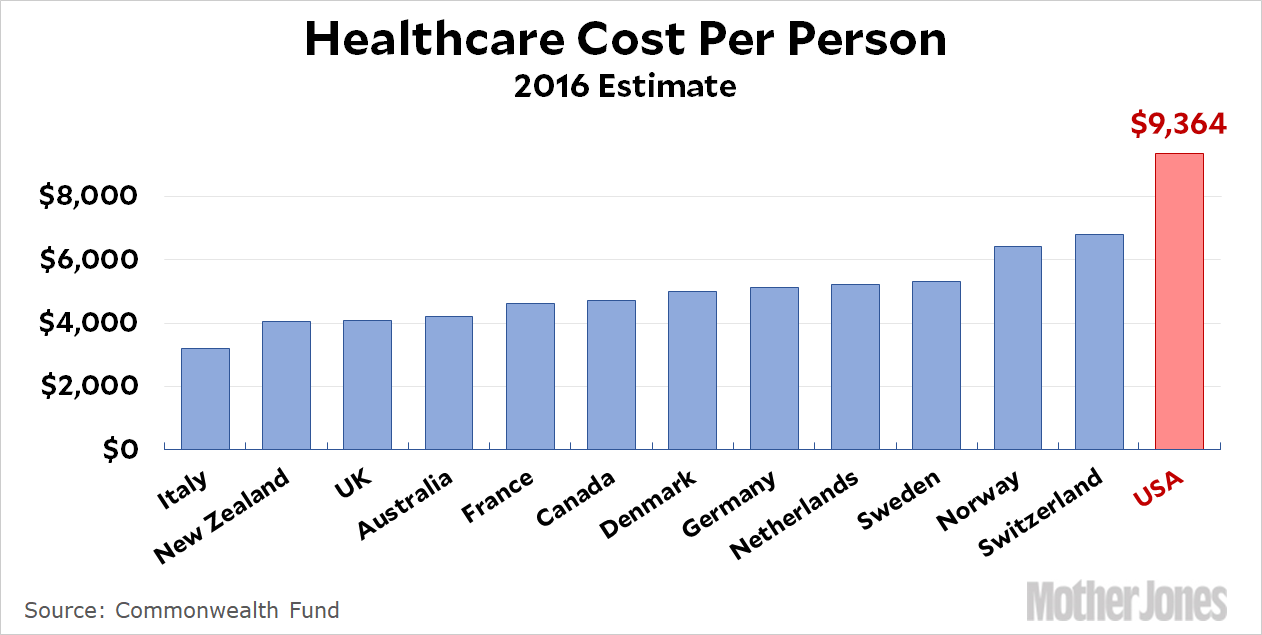
    And we spend a helluva lot of money to kill them:

    Since I am neither Donald Trump nor a Republican, I will add that there are lots of other measures of health care effectiveness, and the United States does very well on some of them. The truth is that all the health care systems in advanced countries have both good and bad points, and it’s actually pretty difficult to judge them on an overall basis. If you do, the US is usually in the top third or so, but not at the very top.

    But there’s one thing we can say for sure: we really do spend a ton of money to maintain a health care system that’s (a) good but not great, (b) fantastically complicated, error-prone, and likely to overcharge, and (c) covers only about 90 percent of the country. I’m a capitalist, not a socialist, but like it or not, capitalism has its opportunity costs too.

  • Some Questions About That McKinsey Report

    While I was larking about this weekend, the New York Times published a story about how Saudi Arabia uses an army of Twitter trolls to control its public image. At the tail end of the story—because it apparently wasn’t considered very important—the Times revealed that in 2015, after Saudi Arabia introduced some domestic austerity measures, the consulting firm McKinsey & Company analyzed how effective the Saudi leadership’s overall PR strategy was:

    In a nine-page report, a copy of which was obtained by The Times, McKinsey found that the measures received twice as much coverage on Twitter as in the country’s traditional news media or blogs, and that negative sentiment far outweighed positive reactions on social media. Three people were driving the conversation on Twitter, the firm found: the writer Khalid al-Alkami; Mr. Abdulaziz, the young dissident living in Canada; and an anonymous user who went by Ahmad.

    After the report was issued, Mr. Alkami was arrested, the human rights group ALQST said. Mr. Abdulaziz said that Saudi government officials imprisoned two of his brothers and hacked his cellphone, an account supported by a researcher at Citizen Lab. Ahmad, the anonymous account, was shut down.

    Here in America, the overall view on Twitter was that McKinsey had essentially signed death warrants on three people. McKinsey, however, issued a statement saying the report was nothing more than “a brief overview of publicly available information,” and “It was not prepared for any government entity. Its intended primary audience was internal.” I have two questions:

    For the New York Times: What does “issued” mean? How was the report issued? And to whom? And why can’t you simply post the report on your website so that all the rest of us can assess it?

    For McKinsey: What does “intended primary audience” mean? And if the “primary” audience was internal, who was the rest of the intended audience? Also: If it was primarily for internal use, what prompted it to be written in the first place?

  • Lunchtime Photo

    Marian and I were up at Big Bear this weekend for a little birthday getaway. Naturally there are pictures. First, though, since we’re getting close to Halloween, here’s a seasonal picture of some pumpkins.

    On our way home we stopped at Oak Glen, famous for its apple orchards. Specifically, we stopped at the Parrish Pioneer Apple Ranch. Mainly this was because we wanted to find a restroom, but the place was packed and we could barely find a parking space. When we did, we discovered that there really weren’t many apples there—although the bakery did have a $22 apple pie for sale. In fact, the biggest display out front was this bunch of pumpkins, so I took a picture for the blog. Also, they had a nice llama.

    But the real reason for putting this up is to make sure I don’t get obsessed with finding the perfect pumpkin picture. It’s entirely possible. Once I’ve put up a pumpkin picture on the blog, however, I know that I’ll lose all interest, which is just what I want. So here you go.

    October 21, 2018 — Oak Glen, California
  • A Quick Correction of Donald Trump’s Standard Stump Speech

    So what is Donald Trump lying about lately? I don’t feel like repeating his lies, so here’s a quick and non-comprehensive correction of what he’s been telling his fans at his rallies:

    • There are no riots here in California.
    • Democrats do not want to give Cadillacs to undocumented immigrants.
    • Republicans do not have any kind of plan to lower middle-class taxes next year.
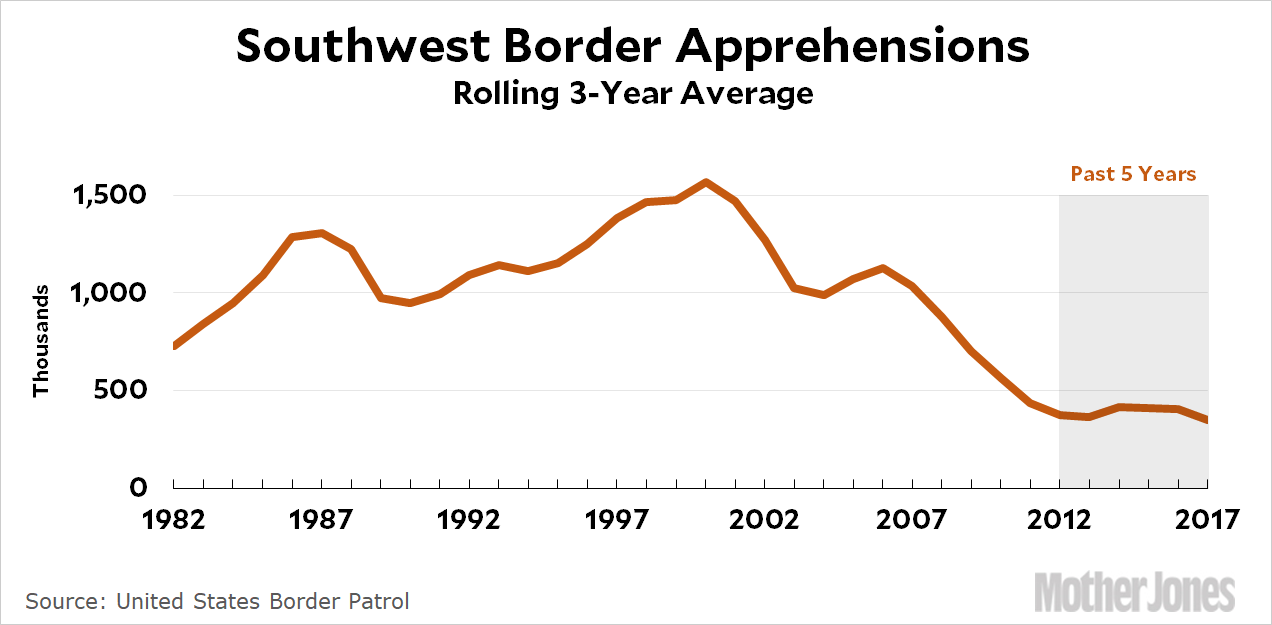
    • Illegal immigration is not increasing.
    • We do not have a $110 billion deal to supply arms to Saudi Arabia. We don’t really have any kind of deal at all, let alone one of that size.
    • Selling arms to Saudi Arabia, in whatever quantities, will not generate 500,000 jobs. Or 600,000 jobs. Or 1 million jobs. The entire defense industry only employs about 300,000 people in the first place, and Saudi Arabia is not that big a customer.
    • There’s no evidence that the caravan of migrants walking north from Guatemala includes any Middle Eastern terrorists.
    • Crime is not increasing.
    • Trump has not started building his wall. Nor is Mexico paying for his nonexistent wall.
    • Trump’s various health care plans did not protect people with pre-existing conditions.
    • The Veterans Choice Act was signed into law by President Obama in 2014, not by Trump. In 2017 Trump signed a bill approving a new version of the act that he likes better, but without bothering to fund it.
    • US Steel is not opening eight new plants. Or seven. Or six. Or even one.
    • Democrats will not destroy Medicare or Social Security.
    • Democrats do not advocate open borders. Democrats have placed a number of immigration proposals on the table over the past decade or so, and they’re all easy to find and read.

    These are just the recent highlights. The list will undoubtedly expand substantially the next time Trump opens his mouth.

  • LAT Poll: Democrats Still Far Ahead in Congressional Races

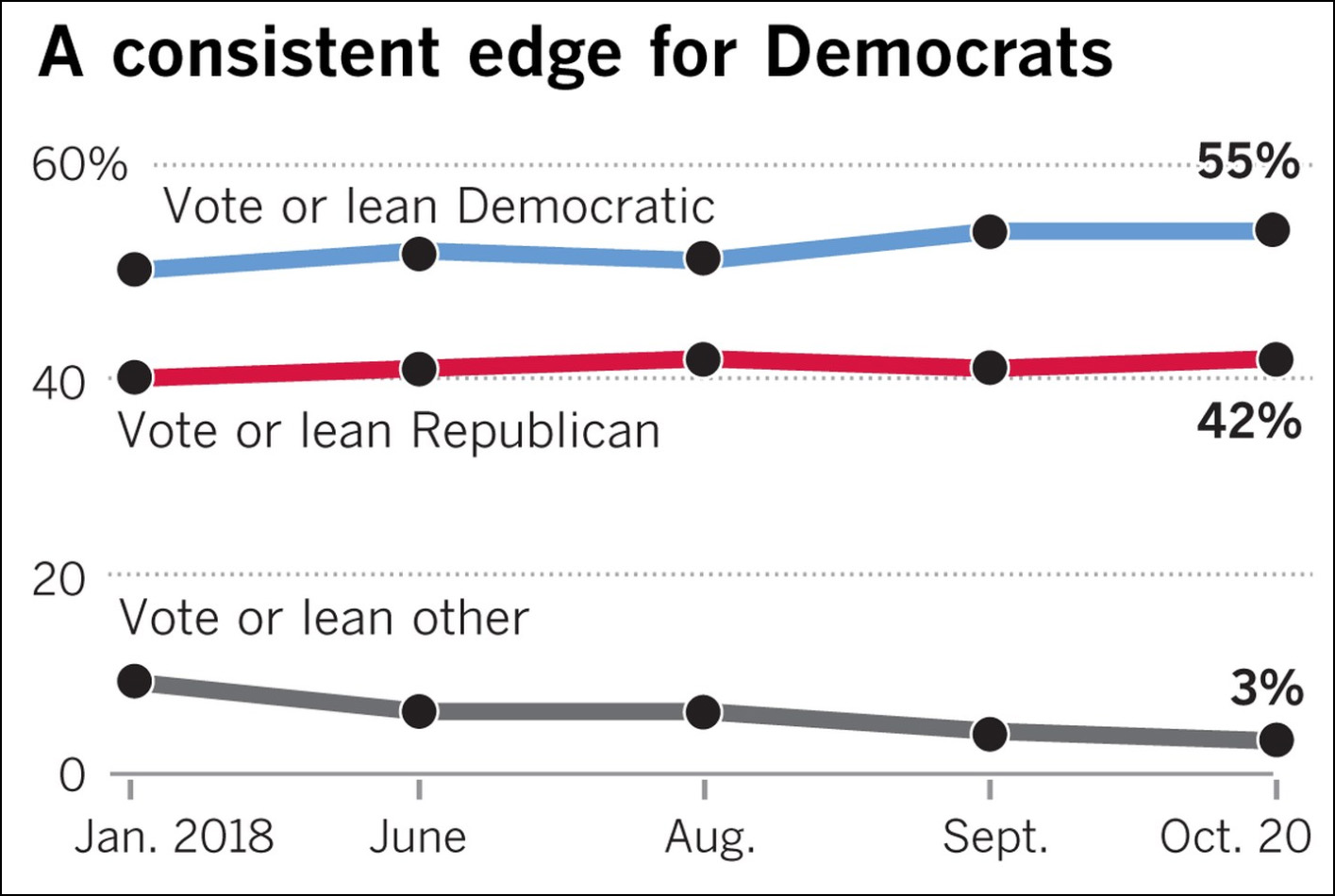
    The latest LA Times generic congressional poll of likely voters shows that apparently nothing—not Brett Kavanaugh, not Jamal Khashoggi, not North Korea, not NAFTA—has changed how we’re planning to vote this year:

    Back in January, Democrats led in the LAT poll by about 12 points. Now it’s 13 points. That’s a little higher than other polls show, and if it holds up it’s great news for Democrats since it suggests a pretty heavy sweep of House races. Unfortunately, the Senate still looks like Republican territory, which means that Trump and Mitch McConnell are probably going to be able to continue their scorched-earth campaign of confirming corporate-friendly judges.

    Progressives look like they’re going to do pretty well in the House and in governor’s races this year, so that makes the Senate the big battleground. If you’re planning to put time or money into something, that’s probably the place to do it.

  • Hey Doctors, Stick to Medicine

    Sure, she looks happy now because her blood pressure is OK. But will she still be happy when this smiling man of medicine urges her to vote No on Proposition 8?Cultura/ZUMAPRESS

    Dr. Danielle Ofri thinks physicians should bring a little more politics into the exam room:

    Like many doctors and nurses, I became politically active for the first time during the summer of 2017, when Congress tried to repeal the Affordable Care Act. I could see the direct risk to my patients — all of whom, inconveniently, had pre-existing conditions — and realized that protecting health care coverage was as critical as prescribing insulin.

    ….So is it time for doctors to pull out our prescription pads and, like Dr. Virchow, start prescribing democracy? This may seem like a radical extension of the medical mandate, but the poorer and the sicker our patients are, the more likely they are to be disenfranchised. Those with the most to lose are least likely to have their voices heard.

    Of course no one should be advocating political viewpoints in the exam room — patients need a neutral, nonjudgmental atmosphere to feel secure. But civic engagement is nonpartisan. When patients say they can’t afford their medicine, fear being bankrupted by medical bills or struggle to find treatment for an addiction, we typically offer sympathy for these heartbreaking and seemingly intractable issues. But might it be our responsibility to point out that these problems are not just bad luck but also the result of political decisions? Instead of giving a kindly pat on the shoulder, perhaps we should inform our patients that they can call their elected officials to get answers. In addition to our medical counsel, perhaps we should also encourage them to vote.

    Wesley J. Smith disagrees:

    They want to politicize everything! Now, in the name of promoting “health,” doctors are urged to engage their patients about politics…. Considering the repeated examples she gives of the political issues doctors should address with patients—and the apparent approach she believes they should promote—does anyone believe her disclaimer that “viewpoints” would not be advocated in the exam room? I don’t. And frankly, neither does she.

    ….No. I don’t want to be harangued by my doctor about politics during a physical. I don’t want my doctor asking me if I have guns or preaching to me about firearms policy (as some have urged they do). I don’t want to hear my doctor pontificating about the Affordable Care Act or what our public policy should be about the opioid epidemic–all of which would happen inevitably once politics entered the exam or treatment room.

    I’m pretty sure this is a lifetime first for me, but I agree with Smith. There’s already pressure on doctors to discuss “dangerous” lifestyle choices that aren’t actually medical in nature, and haranguing patients to get out and vote is just one more step along this slippery slope. It’s a bad idea. But the reason it’s a bad idea is not because it annoys Kevin Drum or Wesley Smith. The reason is twofold:

    • If doctors are increasingly viewed as political actors, it will affect their authority on genuinely medical issues. If your doctor insists that you should get out and vote to save Obamacare, for example, what are you going to think when she also insists that you should get the full course of vaccines for your new baby?
    • Even bartenders are smart enough not to engage customers who are ritually complaining about whatever they’re annoyed about. You’re not going to agree with everyone, so a substantive response just risks pissing a lot of people off. That’s dangerous for folks who are drowning their sorrows in alcohol, and probably also dangerous in the inevitably stressful environment of an exam room. Starting fights is a bad thing.

    Plus, I suppose that annoying Kevin Drum and Wesley Smith really is also a good reason to avoid this. I’m never all that thrilled to see a doctor, and if I knew I was going to have to put up with even more than just the usual crap about eating better and losing weight (thanks for the tip, doc!), I’d probably be even less likely to see my doctor. That could end up badly. Alternatively, I could make inquiries and choose my doctor on the basis of her political views, but I’m going to guess that this would end badly too.

    Bottom line: think about how this plays out over the long term. It might seem like the right answer for an individual patient, but for the profession as a whole it isn’t.

  • Raising the Aspirations of the Young: Is It Always a Good Thing?

    Sandy Huffaker/ZUMA

    Tyler Cowen tells a story from back when he was Graduate Director of Admisstions at George Mason University:

    One of my favorite strategies was to take strong candidates who applied for Masters and also offer them Ph.D admissions, suggesting they might to do the latter. My lunch partner was a beneficiary of this de facto policy. At least two of our very best students went down this route. Ex ante, neither realized that it was common simply to apply straight to a Ph.D program, skipping over the Masters. I believe this is now better known, but the point is this.

    At critical moments in time, you can raise the aspirations of other people significantly, especially when they are relatively young, simply by suggesting they do something better or more ambitious than what they might have in mind.

    I have two questions. First, did many students a couple of decades ago really not know that it’s common to apply straight to PhD programs? That seems like such common knowledge. How did it happen?

    Second, Cowen says that at least two great students went straight to PhD studies after he suggested it. That’s wonderful. But he must know what I’m going to ask next: how many of them bombed out and would have been happier and better served if they had ignored his advice and stuck with just a masters? Raising aspirations can be a wonderful thing, but not always.

  • Don’t Forget: MBS Approved the Preposterous New Khashoggi Story

    Just a quick note. Donald Trump and others have been suggesting that Saudi Crown Prince Mohammed bin Salman wasn’t personally responsible for ordering the death of dissident activist Jamal Khashoggi. The odds of this being the case are minuscule, but they aren’t zero. There is a tiny chance that MBS wasn’t involved, and this is what keeps Trump going.

    But it hardly matters anymore. MBS did authorize the public release of the latest explanation of what happened. It’s a plainly preposterous story, and MBS knows it. But he approved it anyway.

    In other words, regardless of his initial personal involvement, he knows that the true story is so appalling that it has to be suppressed at all costs. If that means making his complicity in a coverup obvious to everyone, so be it. It’s worth even that.