I have a question. If you’re a young person of good will who is concerned about racial division in this nation, longs to understand how race has played a role in American history, and seeks racial reconciliation — which is to say, one of millions of politically and culturally engaged young people in America — how many thoughtful conservative voices will you encounter compared to thoughtful progressive voices?
….It strikes me that an enormous amount of conservative or right-leaning commentary on race is dedicated mainly to debunking the excesses and hypocrisy of the identity-politics Left….Less is dedicated to seriously grappling with the consequences of racism in American life and culture….In fact, at least in my experience, showing particular concern for issues of race is often seen as evidence by itself that you’re thinking like a progressive or that you’re somehow not sufficiently conservative.
Time and again I see concerned young people ask probing questions about stubborn racial gaps in a host of areas of American life, their elders ask them not to follow the siren song of the so-called social gospel, and then drop the ball on providing any meaningful alternative answer….Honestly, it’s amazing how much Sharpton or Louis Farrakhan come up, as if they represent the sum total of progressive thinking on race.
So the question hangs out there. If I care about bridging racial divides, what should I do? The identity-politics Left has an answer, one that provides millions of people with religious-level meaning and purpose. The conservative response is far harder to find.
French doesn’t mention Donald Trump, but it’s obvious that Trump has made this an existential issue for the right. Trump’s campaign and his presidency have been predicated almost entirely on appealing to white racial animus, and it’s this—not his populism or his ignorance or his braggadocio—that sets him apart from Republicans past. If conservatives are afraid to forthrightly address this—and so far they are—the Republican Party will be tied to a political legacy of wholesale racism forever. Regrettably, the first response to French’s piece came from Roger Clegg:
Thanks for your post, David. I’d offer a few thoughts.
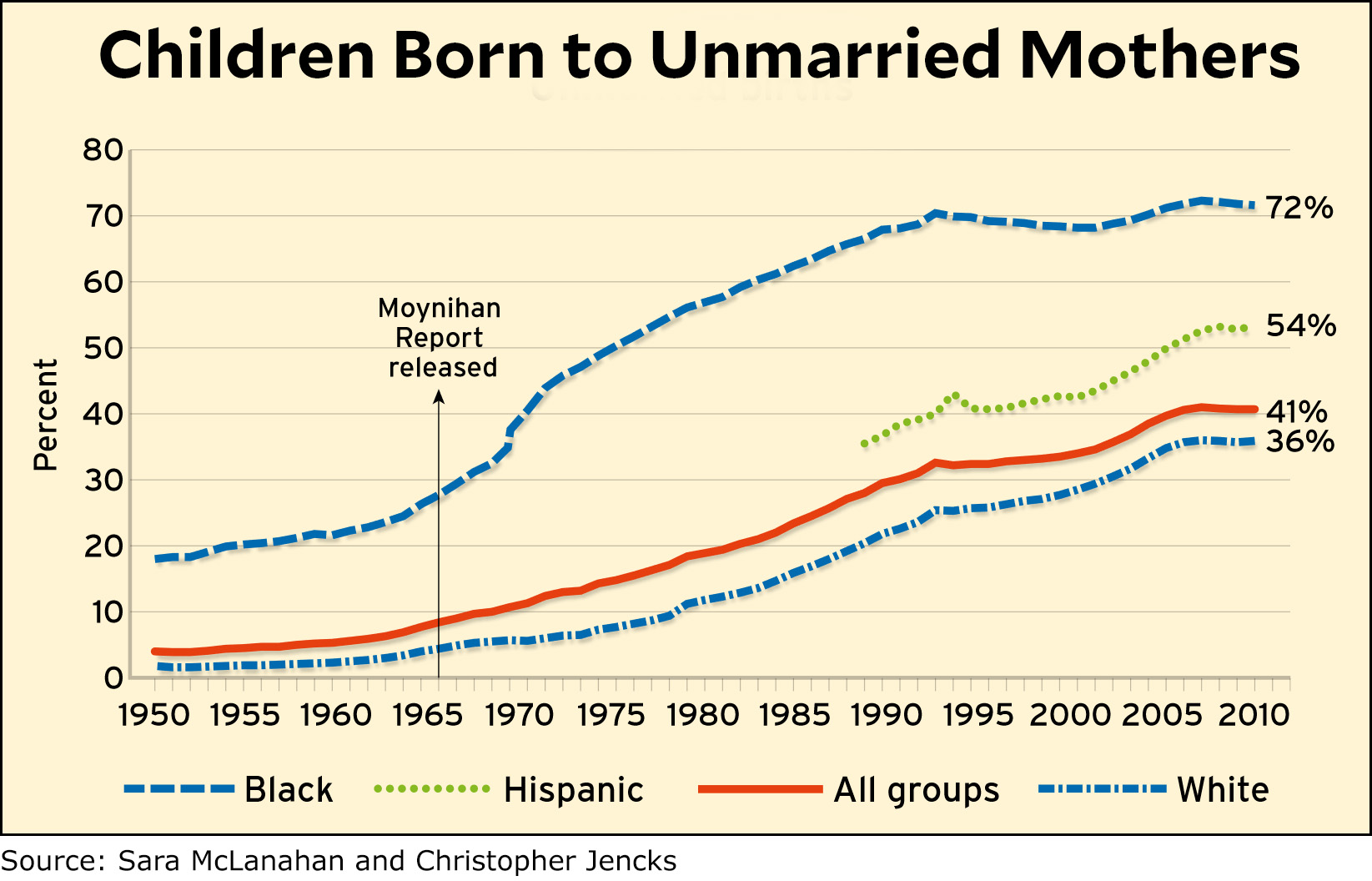
First, the principal reason for the stubbornness of racial disparities in this country is family structure — i.e., out-of-wedlock birthrates….Second, I would note that the problem of race relations in this country is really a problem about African-American racial disparities, and again it is no coincidence that they have the highest out-of-wedlock birthrates….Third, this is not to deny that racism still exists and that the effects of past racism are still with us. But the persistence of the racial disparities cannot, I do not think, be blamed on present or past racism.
….Here’s my answer to what I think is your core question, David, and which as a fellow Christian I also think you may welcome: This is basically a moral problem, and moral problems are religious problems. More people need to believe in God and follow His rules….Our laws, after all, prohibit racial discrimination in just about any public transaction (except, by the way, politically correct racial discrimination, namely affirmative action) and are widely supported. Racism is socially unacceptable except on the fringes. Americans are increasingly multiracial, which ought to tell us something; indeed, as I recall, we just had a multiracial president. What’s really needed is a period of benign neglect, but alas that’s unlikely because, to echo the end of your post, the grievance industry is too large and too entrenched in the intelligentsia and in one of our political parties.
This, unfortunately, is what French’s young person of good will is all too likely to hear from fellow conservatives: African-Americans live immoral lives and are too stupid to do well in school—and there’s nothing much we can do about it. So we should just ignore it except for fighting back against the liberal racial grievance industry. How inspiring. But then we get Reihan Salam:
I disagree with Roger. Before turning to racism in the present, consider the role of past racism….Past discrimination created significant obstacles to labor-market success and wealth accumulation, which in turn have made life more difficult for those in subsequent generations. It contributed to the rise to ghetto communities defined by high levels of concentrated poverty, which in turn have had lingering negative effects on those residing in them — I found Patrick Sharkey’s Stuck in Place particularly convincing on this point. That growing up in a high-poverty neighborhood has a negative impact on a child’s ability to learn is not especially controversial….One can argue that dwelling on the present-day effects of cumulative disadvantage is counterproductive, and that self-help is always the best and most reliable way for those burdened by it to better their lives and those of their loved ones. Fair enough. But that’s different from the claim that the persistence of racial disparities (in marriage rates, rates of nonmarital childbearing, and much else) is not rooted, at least in part, in past racism.
….And while racism has greatly diminished in recent decades, there is evidence that anti-black discrimination in hiring persists….If I can’t secure entry-level employment, how will I gain the experience and training I need to succeed? Roger believes that while statistical discrimination exists, “we should not pretend that this is a bigger problem than it is.” Again, I’m inclined to disagree. I believe that statistical discrimination isn’t just a problem for its victims — it’s a problem for society as a whole, as Tyler Cowen recently suggested: It deprives us of talent that we can’t afford to waste.
….More broadly, there is the question of social networks….These networks tend to be highly segregated by race and class….Does this pattern reflect racial animus on the part of whites toward blacks? I don’t believe so. But is it the case that blacks and whites are less likely to cross paths and form friendships due to the legacy of past discrimination and (perhaps to a lesser extent) the interaction of subtler forms of color and class prejudice in the present, and does this kind of social segregation contribute to persistent racial disparities? Yes, I believe that’s a big part of the story. And that’s why I greatly appreciated David’s call for a more constructive conversation about race on the right. Like David, I believe that conservatives can make an important contribution to racial reconciliation. To do that, however, it is important to acknowledge that past discrimination has ongoing ill effects.
When it comes to race, liberals and conservatives have a similar problem: it’s a lot easier—and frankly, a lot more fun—to slam the obvious idiocies of the other side than it is to seriously engage with their best arguments. This is especially true when there’s usually a political and social price to be paid for being perceived as “soft” on racial issues. Unfortunately, this is almost inevitable when declining to adopt the most extreme views of your own side is all it takes to be dismissed as “not getting it.”
If there’s any silver lining to Donald Trump’s presidency, this could be it. Perhaps more conservatives will wake up to the fact that plain old racism is far more pervasive in their party than they believed, and they’d better take it seriously if they don’t want to end up with yet another Trump in the next election. On the flip side, liberals might realize that there’s a price to be paid for playing endless rounds of woker-than-thou that accomplish little except to trigger fragile whites into voting for guys like Trump.
The truth is that real, steady progress on race probably requires both sides to take political risks: liberals might occasionally lose black support on certain issues while conservatives run the risk of losing older white votes. Nothing comes easy. But thoroughly rejecting Trump and Trumpism is a good start, and with even a little bit of goodwill it’s possible that we can go further.
Silent Sam is finally silent forever.Left: SGM/ZUMAPRESS; Right: Julia Wall/Raleigh News & Observer/TNS via ZUMA
Students are coming back to school, and at some schools this means grappling once again with all those statues of Confederate generals:
Tim Huebner, a history professor at Rhodes College in Memphis, Tenn., who has studied the legacy of Confederate memorials, recommends contextualizing Confederate markers with signs or new courses rather than removing them. “I don’t think you take all of these remnants of the past, take all these artifacts, and grind them into dust,” he said.
Allow me to politely disagree. I think that grinding them into dust is precisely what ought to be done. In fact, I’m surprised that kids at these universities haven’t torn down and pulverized a whole lot more of these statues than they have. It shouldn’t take much. Fill some frat boys with plenty of Bud Light and mint juleps, get ’em to drive a couple of F-350s out to the quad (or whatever) with plenty of rope, and then hit the accelerator. When the statue is down, everyone gets out their sledge hammers and starts pounding away until the campus cops arrive. Then they run away. Mission accomplished.
All it would take is a tacit understanding between the students and the administration that puts a few reasonable safety precautions in place but basically promises not to make trouble for any 2 am Confederate statue bashing parties. How hard is that?
Jeez, I go out to lunch, and when I get back everyone in the Republican Party is going to jail. Paul Manafort is going to jail. Michael Cohen is going to jail. Rep. Duncan Hunter might be going to jail. And of course, we already know that Michael Flynn and George Papadopoulos and Rick Gates are going to jail. Rep. Chris Collins might be going to jail too. Eric Greitens might be going to jail. I suppose Reps. Pat Meehan and Blake Farenthold probably aren’t going to jail, but they both had to resign from Congress after getting caught in some minor peccadilloes.
Any way you add it up, that’s a lot of corruption. You’d almost think it was a trend or something.
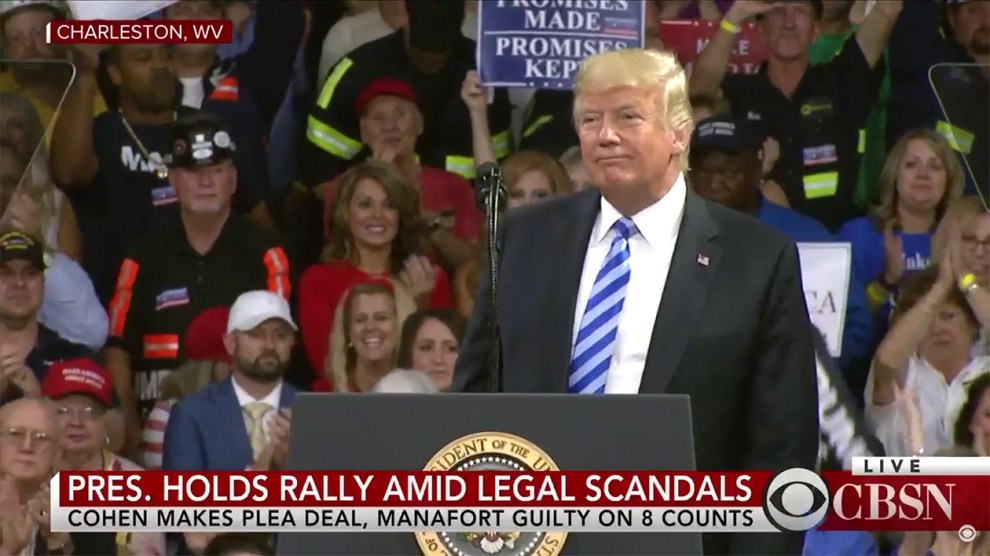
I guess Donald Trump is holding a rally in West Virginia right about now. That should be a helluva barn burner, don’t you think? Maybe I’ll go watch.
This is it! My very last velvety, long-exposure photo of a creek or waterfall from Ireland. This one is in Caherdaniel, right outside the Blind Piper pub.
For those of you who find this kind of picture annoying, you’ll be glad to hear that I don’t have anymore in the queue. I took a few in Durango a week ago, but none of them were any good. This means you’re safe for now—though you never know when I might come across another waterfall somewhere, do you? However, the only trip I have planned for the rest of the year is to New York City, which is not exactly crawling with waterfalls as far as I know. So you should all be in good shape for a while.
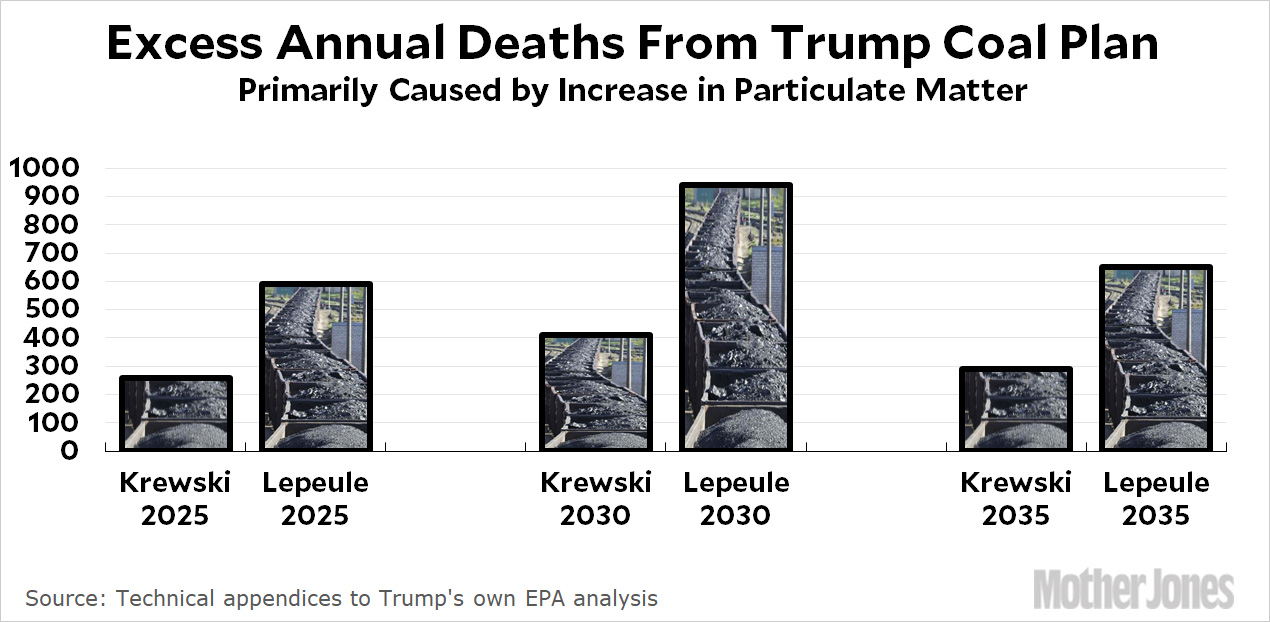
Depending on whose estimate you trust and how far out you’re willing to look, the Trump plan will kill somewhere between 200-1,400 extra people per year compared to the Obama Clean Power Plan, with the averages shown in the chart above.
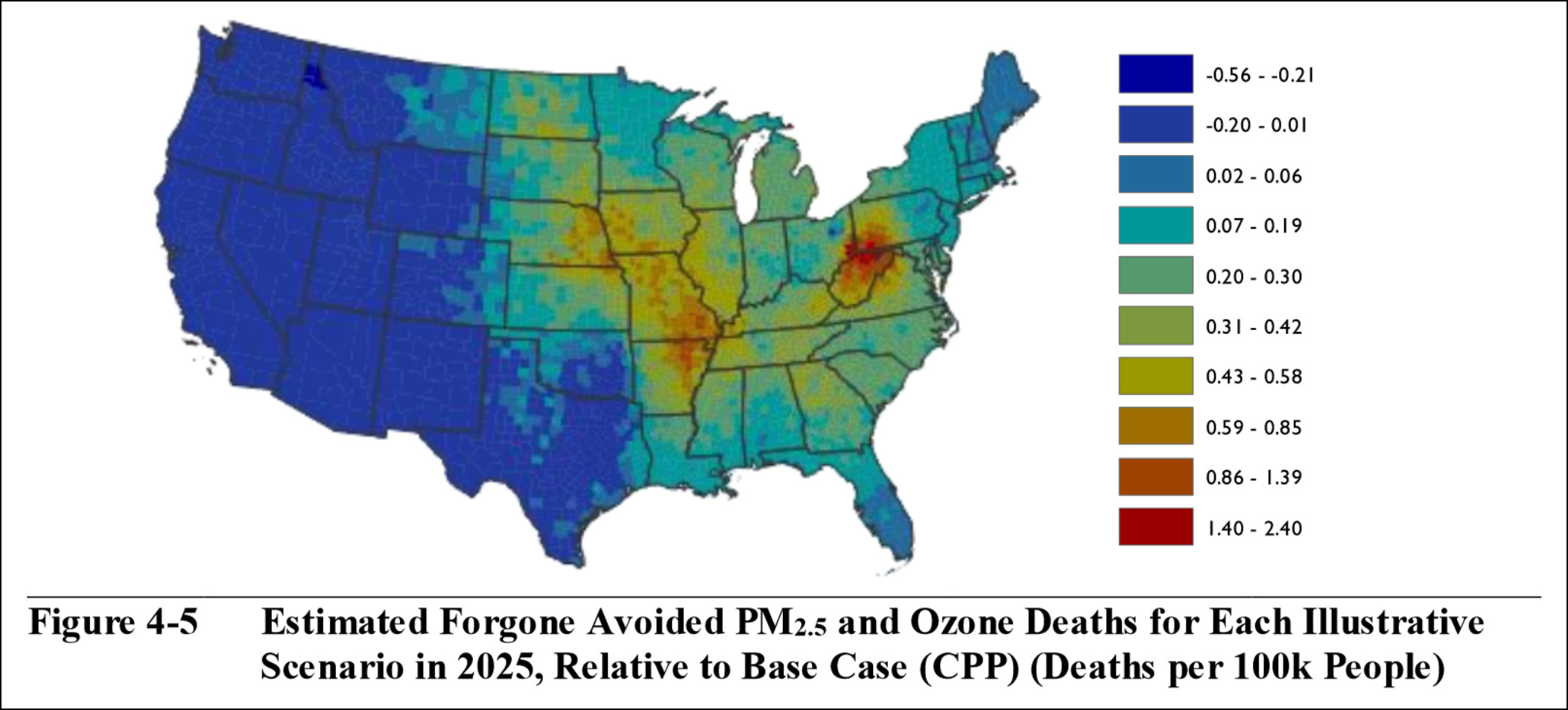
Of course, there’s good news and bad news in all this. Out West, where we don’t use much coal, the effect will be negligible. On the other hand, if you live in Missouri, Arkansas, West Virginia, or western Pennsylvania, things don’t look so rosy. In those places, EPA estimates an extra 10-20 deaths per million people each year:
All this for a power source that’s not competitive anymore and employs hardly anyone. Trump is planning to kill, oh, about 5-10,000 people over the next decade to support an industry that employs fewer than 200,000 people total in mining, transportation, and power generation. That’s right: 200,000. The coal industry is smaller than the marijuana industry—which is at least growing and basically harmless. But Trump is happy to kill off Americans by the thousands just so he can say he overturned an Obama coal plan and replaced it with his own. I hope Don Jr. opens up a coffin business especially for all the people who die because of this. It’s one time when I think that splashing a big gold TRUMP on his products would be totally appropriate.
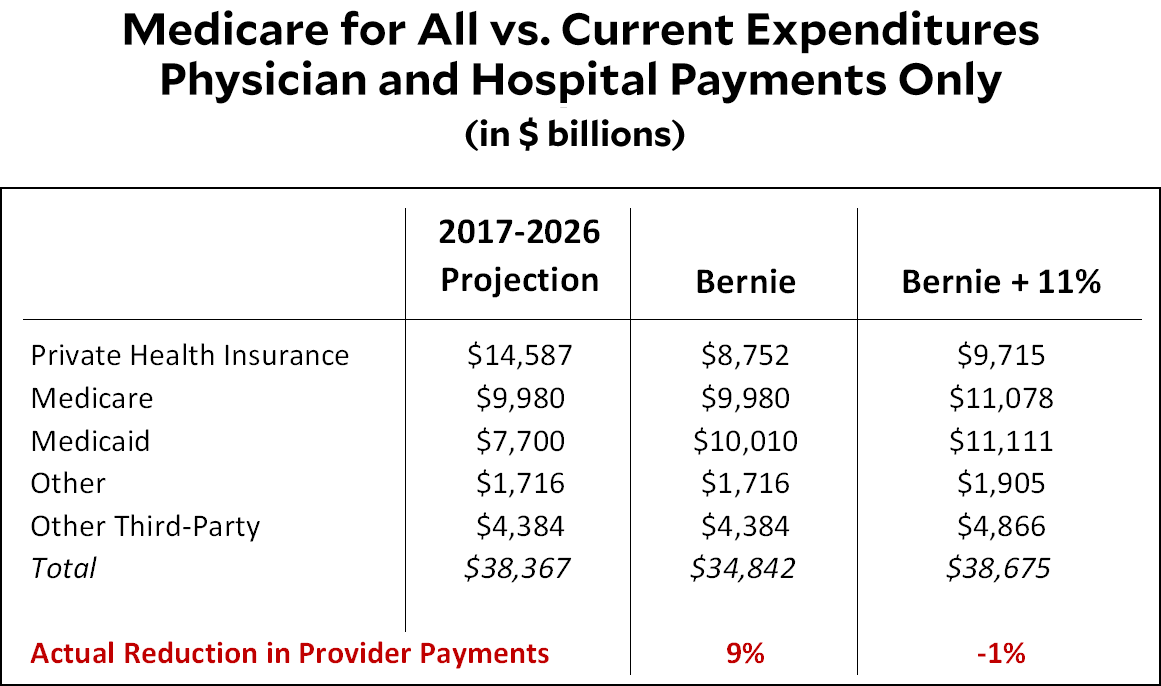
Charles Blahous of the Mercatus Center recently produced an analysis of Bernie Sanders’ Medicare For All Plan that’s generated an awful lot of confusion about how much it would affect payment rates to physicians and hospitals. In this post, I’m going to do my best to get the numbers right in order to get everyone on the same page about this.
First of all, the Sanders plan assumes that private physicians and hospitals would all be paid at Medicare rates in the future. This would be a cut of about 40 percent for all services currently covered by private insurance. However, Medicaid payments, which are lower than Medicare rates, would increase. Second, Blahous assumes that because the Sanders plan covers everyone, people will use more health care. He figures an increase in health care utilitization of about 11 percent.
Note 1: The top line changes to show that private payments to doctors and hospitals go down 40 percent to $8.7 trillion. If the Sanders plan really does result in an 11 percent increase in patients, then total payments will be 11 percent higher than that.
Note 2: The Medicaid line goes up because Medicaid payments will be increased to match Medicare rates.
Note 3: All the other lines stay the same since they’re already paid for using Medicare rates or something similar.
Note 4: Add everything up and you get the total line. Total payments under the Sanders plan are about 9 percent less than under the current system. If you assume an increase in patients, then payments are higher and the change is close to zero. But keep in mind that this number is a little fuzzy since we don’t know if those extra patient visits would be handled by an increase in doctors or by current doctors seeing more patients. (Or maybe by additional nurse practitioners.)
In any case, I think you can fairly estimate that the Sanders plan would result in a roughly 5-10 percent cut in payments to physicians and hospitals. It’s quite possible, of course, that any legislation to implement Medicare for All would increase Medicare payment rates enough that physicians would take either no cut or only a small cut. It all depends on the details.
BOTTOM LINE: It’s not correct to say that the Sanders plan reduces physician payments 40 percent. It reduces some physician payments by 40 percent and leaves others the same. Overall, the best estimate is probably that physician payments would decline about 5-10 percent under the Sanders plan.
As for total national health care spending over the next decade, Blahous estimates that it would go down about $2 trillion if Sanders successfully cut payments to Medicare levels, but would go up about $3-5 trillion if he didn’t. For what it’s worth, my guess is that it’s politically impossible to slash physician rates, which means that Medicare for All would cost more in its first few years than our current system. However, it would be easier to rein in future spending increases with M4A, so in the long run it would cost less. That’s just my guess, though. The truth is that no one knows for sure.
UPDATE: I forgot to account for Medicaid payment rates going up to match Medicare rates. That’s now been corrected.
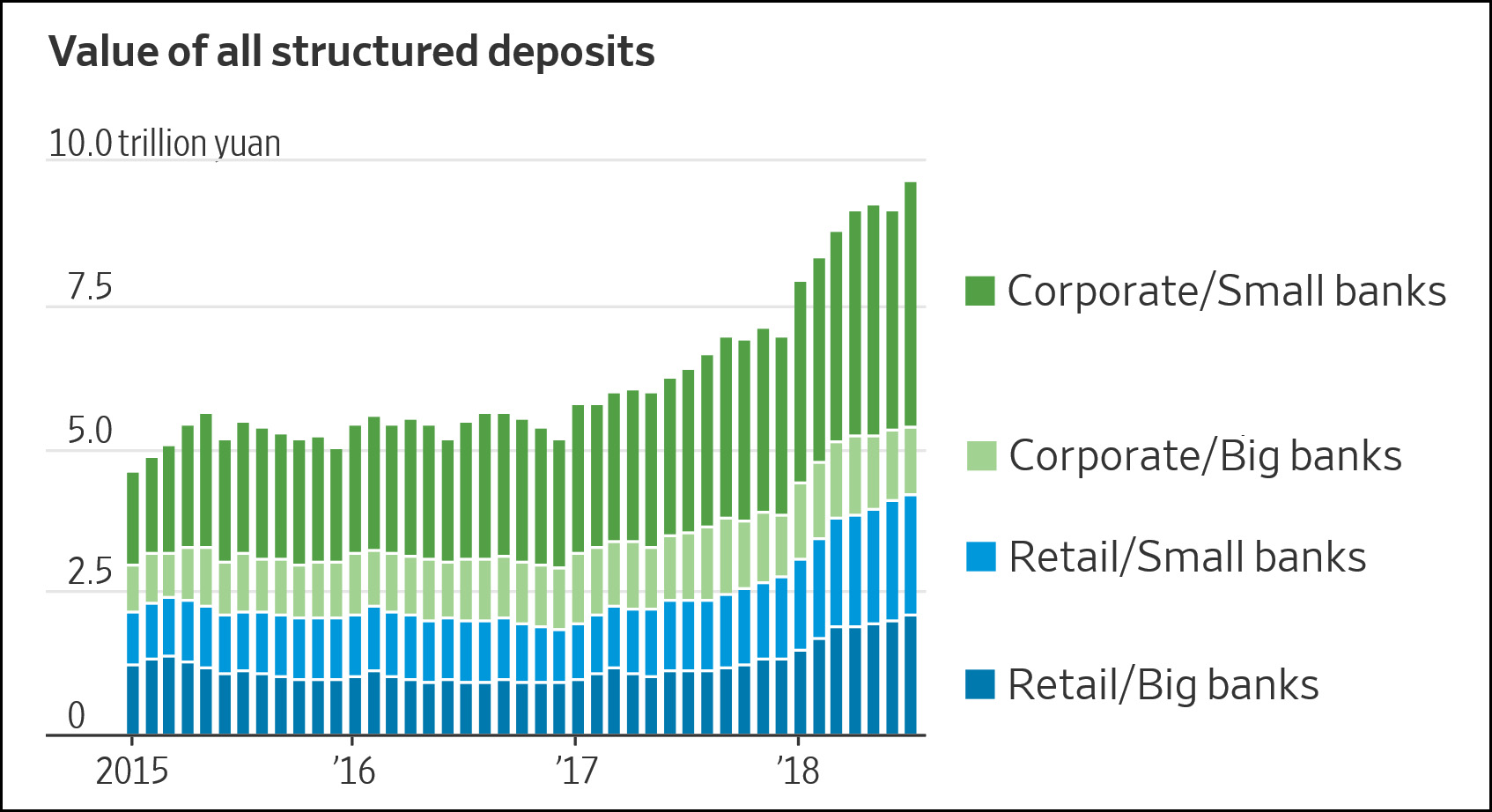
Structured deposits offer higher returns than regular savings accounts and are tied to bets on assets from currencies to gold. They have been around for years, but the sums outstanding have soared recently. In July they stood at a record 9.71 trillion yuan ($1.42 trillion), up 52% in a year, according to data provider Wind.
….The investments are a form of structured product. In the U.S., this broader asset class enjoyed solid growth until the global financial crisis, when products issued by Lehman Brothers suffered steep losses. In 2013, the Securities and Exchange Commission introduced stricter disclosure requirements for structured notes, bonds that contain a derivative component.
….However, many of these structured deposits in China have structures where the terms are “set so far off that investors can almost always get the advertised maximum return,” says Ms. Wan at Moody’s. In a 91-day product recently marketed by Weihai Blue Ocean Bank, the small lender from eastern Shandong province offered the equivalent of 5.28% a year if gold prices in London, now around $1,183 per ounce, stay between $300 and $2,200. If not, customers will receive 1.65%.
A turning point for Brennan was a tweet from the President on March 4, 2017, in which Trump falsely claimed, “How low has President Obama gone to tapp my phones during the very sacred election process. This is Nixon/Watergate. Bad (or sick) guy!”
At the time, some of Trump’s most fervent supporters in the White House saw former Obama Administration officials as powerful enemies who threatened the new President’s rule, and they agitated for punishing them by revoking their security clearances. The idea was rebuffed by the national-security adviser at the time, H. R. McMaster, who signed a memo extending the clearances of his predecessors at the N.S.C., Republicans and Democrats alike. As Trump stepped up his public and private attacks on Obama, some of the new President’s advisers thought that he should take the extraordinary step of denying Obama himself access to intelligence briefings that were made available to all of his living predecessors. Trump was told about the importance of keeping former Presidents, who frequently met with foreign leaders, informed. In the end, Trump decided not to exclude Obama, at the urging of McMaster.
How is it that no matter how much a lowlife I think Trump is, somehow he always manages to find a way to surprise me anyway?
I know this will never happen, but man, what I wouldn’t give for Obama to decide the hell with it and just start whaling away on Trump every day. You want rallies? Obama will have bigger ones. You want insults? Obama will have sharper ones. You want golf? Maybe Obama should buy his own chain of golf courses.
What’s the deal, Kevin? One stupid Yeezy post in the morning and then a crappy astronomy picture for lunch? Are you feeling well?
As it happens, no, I’m not. This whole evil dex thing is turning into a real pain in the ass. Really, I ought to be fine by today, but instead I wrote one stupid Yeezy post and then…fell asleep. I woke up around lunchtime. What’s up with that? Probably nothing: just like last time, the effects of the chemo get steadily more pronounced every month, and that goes for the dex too. I’m in my 13th week of dex, which is nearly the entire length of my first round of chemo (16 weeks), so it’s not surprising that it’s now hitting harder than it did back in June. And there’s 16 more weeks to go! Exciting!
On the bright side, sleepiness is the only really serious side effect so far, and that’s pretty far from the biggest deal in the world. What’s more, my M-protein level almost set a new record low last week, and I expect to plummet past my all-time record of 0.30 this week. So at least this regimen is having a vigorous effect on the cancer.
But that’s not all. Is it just me, or has the news been unusually tedious lately? The Catholic Church is corrupt. Donald Trump is corrupt. Trump’s lawyers are idiots. We still haven’t won the war in Afghanistan. Etc etc. Meh.
What to do? For the moment, I’ll highlight a trivial story that will nonetheless probably piss off a whole bunch of you:
The California Senate on Monday approved legislation barring dine-in restaurants from offering plastic straws to customers unless they are requested….The measure exempts fast-food restaurants and other businesses.
“This bill is the last straw,” Sen. Jim Nielsen (R-Gerber) said. “This is a first step to the total banning of plastic straws. To me it almost looks silly. I think the negative consequences [of straws] are a bit overstated.”…But Sen. Bill Monning (D-Carmel) said the proposal will help educate the public about the environmental hazard of plastics that are not biodegradable. “Let the consumer request it if they want it,” he said.
Here’s what’s going to piss you off: I agree with the Republicans about this. California is too full of performative legislation that’s designed to make some point or other but is almost certain to have no actual effect. I’d prefer that folks pick a career and stick to it. If you want to be a performer, go to Hollywood. If you want to be a politician, propose legislation that actually accomplishes something. How about a plastic packaging tax, similar to what France is doing? If that’s not enough, go bigger. But whatever you do, make it something that delivers real results, not just a pat-on-the-back for getting on board with the fad of the week.
FOR THE RECORD: In case you’re curious, I don’t care one way or the other about straws. I’m perfectly content to drink my sugary swill with or without straws, so this legislation has no personal effect on me at all.
This picture is a lousy example of night-sky photography. There’s a ton of haze still in the skies around here from the fires, and it was enough to ruin even a 10-second exposure. I never bothered mounting the equatorial drive for a longer exposure, since it would have been pointless.
But! This picture does have something that none of my others have: a cat keeping careful watch over the Milky Way. As it should. And that’s why this is today’s lunchtime photo.
And we respect that! But maybe you’re of a mind to support our work directly instead? We have until December 31 to raise the last $400,000 we need to keep our nonprofit newsroom running at full strength into 2026. Will you make a gift today?
We noticed you have an ad blocker on. Can you pitch in a few bucks to help fund Mother Jones' investigative journalism?
Billionaires own the media,
but they don’t own us.
At Mother Jones we know these aren’t conventional times, and they require unconventional coverage. That’s what deliver every day: fierce, independent journalism you can’t find elsewhere. Perhaps never in the history of our country has that been more necessary than now. But we can’t do it without reader support—your support. Please chip in today.
Billionaires own the media,
but they don’t own us.
At Mother Jones we know these aren’t conventional times, and they require unconventional coverage. That’s what deliver every day: fierce, independent journalism you can’t find elsewhere. Perhaps never in the history of our country has that been more necessary than now. But we can’t do it without reader support—your support. Please chip in today.