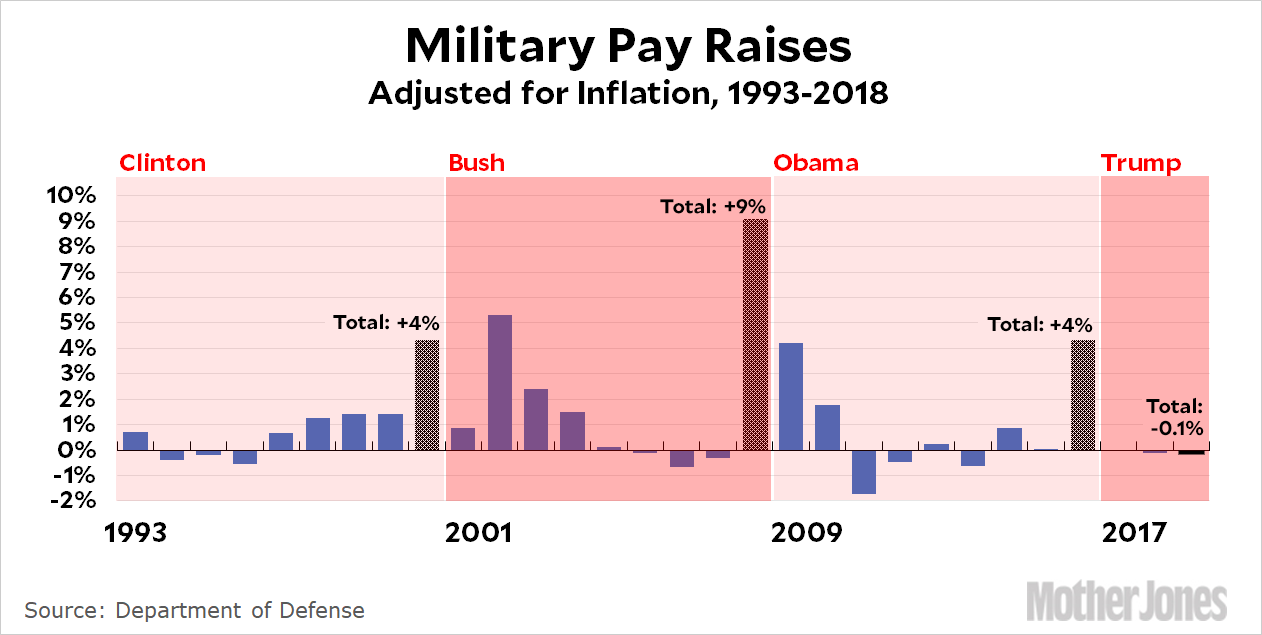
Every year the military gets a standard across-the-board pay raise. Sometimes it’s enough to keep up with inflation, sometimes it’s not. In the 26 years since 1993, the pay raise has been positive 16 times and negative 10 times after accounting for inflation. Over time, however, it tends to outpace inflation by a bit. Adjusted for inflation, military pay rose about 4 percent during the Clinton presidency; 9 percent during the Bush presidency; and 4 percent during the Obama presidency. During the Trump presidency, it’s been negative both years so far, and the cumulative pay raise has been about -0.1 percent.
This is the G&S Market in Gridley, taken early in the morning. I wouldn’t normally put up another picture from Gridley so soon after the last one, but when I mentioned to Marian that this guy was flipping me off she immediately declared it her new favorite.
I don’t know precisely why he was giving me the finger, but I suppose he must have thought I was a private eye or something? Or maybe a member of the Temperance League taking pictures of people hauling out 12-packs of Bud at 6:30 in the morning? In any case, he felt strongly enough about it to show how he felt even though he already had something in his hand. I suppose I deserved it.
The Europeans come to Washington with potential auto tariffs weighing heavily on their minds. Last week, Mr. Trump threatened “tremendous retribution” if his meeting with the EU officials doesn’t lead to what he considers to be a fair auto-trade deal. On Tuesday night, Mr. Trump suggested he was willing to make concessions if Europe would. He wrote on Twitter, “Both the U.S. and the E.U. drop all Tariffs, Barriers and Subsidies! That would finally be called Free Market and Fair Trade!”
I’m willing to bet that Trump has no clue what he’s talking about when he says he wants to drop “all” tariffs, barriers, and subsidies, but I guess that’s his problem. In any case, this got me curious about how high the overall tariff barriers really are between the US and the EU, but I had a hard time finding this. The best I could come up with was something from the World Bank called WITS: “The World Integrated Trade Solution (WITS) software provides access to international merchandise trade, tariff and non-tariff measures (NTM) data. Browse the Country profile section to obtain countries exports, imports and tariff statistics along with relevant development data.”
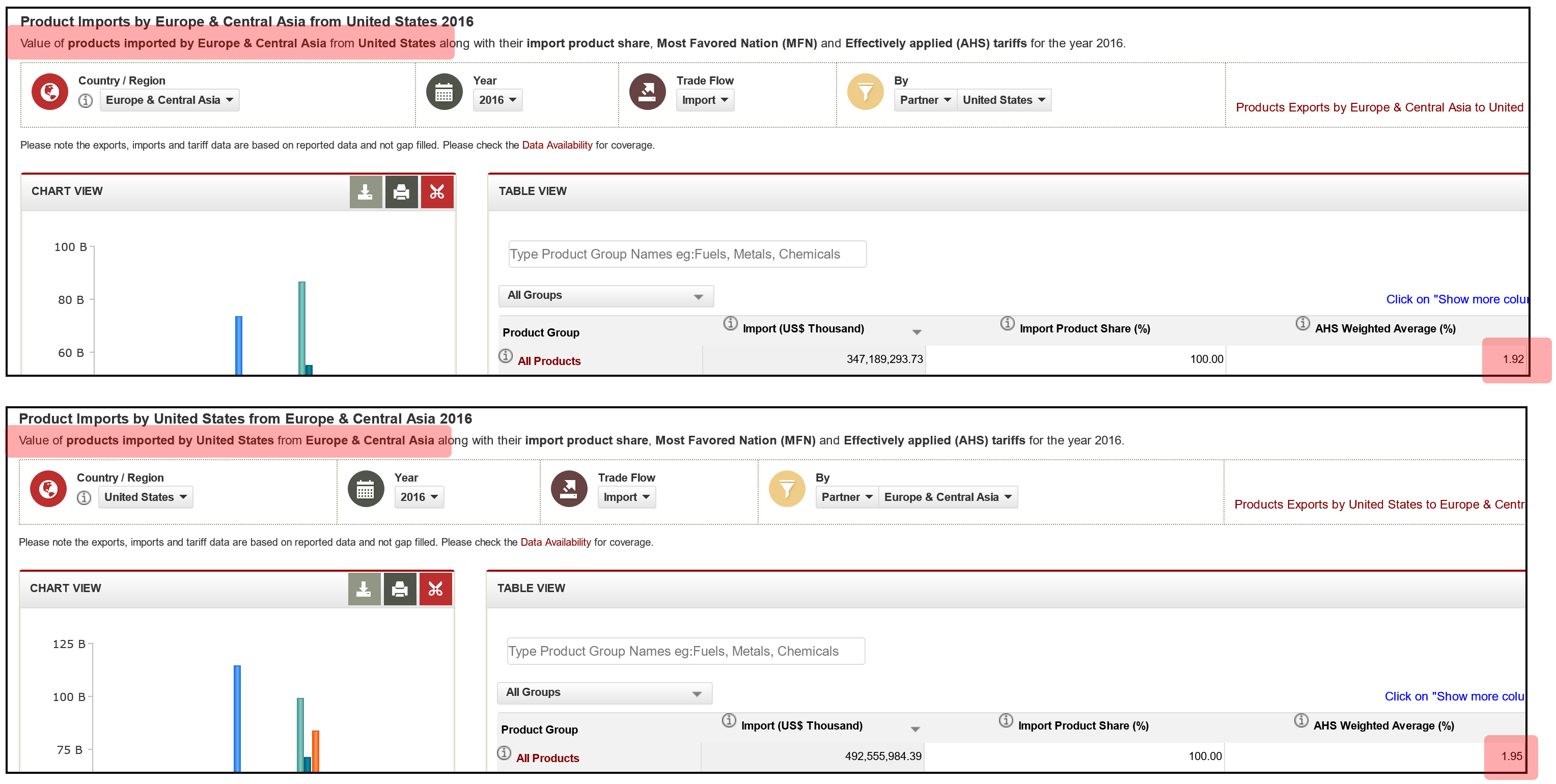
OK, fine. So I checked the US and Europe going in both directions and came up with this:
That’s a little hard to read, but it suggests that tariffs levied by the EU on imports from the US amount to 1.92 percent. Likewise, tariffs levied by the US on imports from the EU amount to 1.95 percent. For all practical purposes, they’re the same.
Of course, I’m not sure I have this right. Plus there are all sorts of non-tariff barriers that you ought to count, though you first have to figure out a way to express them in dollars.
Can anyone help out further with this? At first glance, the WITS data suggests that tariffs between the US and Europe are small and nearly identical. But I’m sure there are details I’m totally missing here. Who wants to help me out here?
Having read several hundred books on this topic, I used to write a fair amount about it. But then I stopped. It wasn’t worth it because most people haven’t read several hundred books on the topic and are more interested in the political implications of genes and upbringing than the actual scientific facts.
But it’s not going to be avoidable for much longer. I haven’t kept up with the latest research in detail, but there’s no question that geneticists are plugging right along regardless of what political activists think of them. And they’re discovering gene complexes for all sorts of interesting things, right along with genetic codes that control how and when and if various personality traits get expressed by those gene complexes. We’re still a long way away from understanding how all this stuff interacts, but by “long way” I mean maybe a decade or so. That’s not really so long.
So prepare yourself for a few things:
We will discover the genetic wellsprings of things like memory, artistic talent, mathematical ability, extroversion, laziness, aggression, ability to swot up foreign languages, and a hundred other things. And that’s not even counting fast-twitch muscles, balance, speed, stamina, and other traits that make great athletes.
Thanks to CRISPR (or perhaps CRISPR+) we’ll be able to fine-tune these abilities in babies. Maybe in adults too. The era in which we argued about the ethical implications of this stuff will be over. We’ll just do it and see the results.
How much does parental upbringing affect any of this? I’m going to put my money on “not much,” but it’s hardly worth making guesses anymore. In a decade or two we’ll know.
How much effect does the entire environment outside the womb have starting with the day a baby is delivered? I’m going to put my money on “some,” but that’s as far as I’ll go.
The effects on social justice will be profound. Once it becomes irrefutable that certain people just flatly have more talent than others, and furthermore, that they can probably buy even greater talents, the philosophical justification for paying the talented more than the untalented disappears. In what way do the talented deserve any more money if we can literally draw a map showing where their talents are located on their genomes and where their ambition, focus, and zeal for hard work comes from?
Anyway, get ready for all this, is all I’m saying. It’s not so far away. And shortly after that, the robots are going to take over and nobody will care about jobs anyway. And while we’re on the subject, we’ll all be disease free and able to live more or less forever, if we want to.
This is all about 30 years away if we can manage to avoid killing ourselves or frying the globe. That’s not too much longer to wait, is it?
OK, I'll buy one. But please, not a minivan. Anything but a minivan.Andrej Sokolow/DPA via ZUMA
Here’s some genuinely interesting news about self-driving cars:
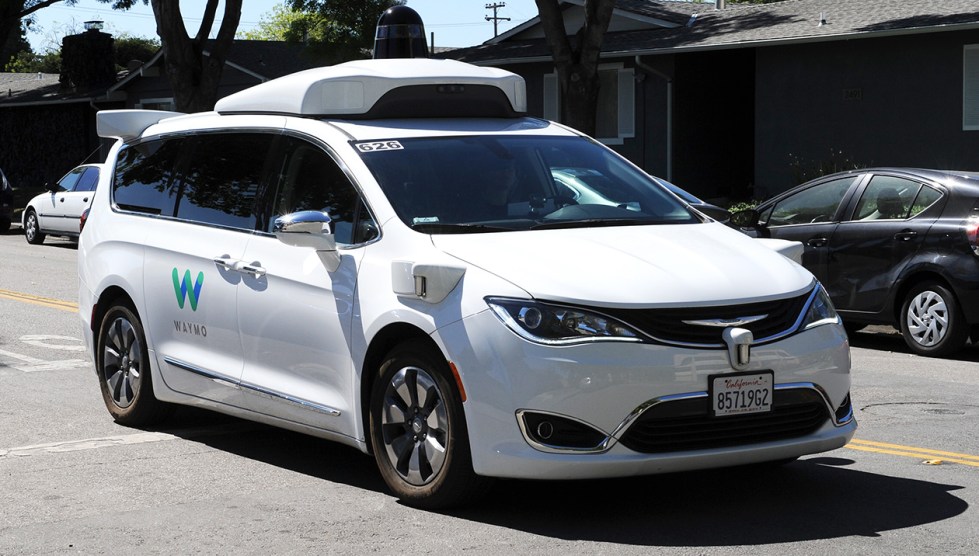
Alphabet’s Waymo announced Wednesday that it will begin a pilot program with Walmart to shuttle customers to and from stores to pick up their groceries. The new initiative is part of a series of partnerships with companies to offer customers self-driving cars to run errands and shop. Customers in Phoenix who order groceries on Walmart.com, will receive savings on their goods, and as their orders are put together at the store, autonomous Waymo vehicles will take customers to and from Walmart.
This is interesting for a few reasons:
It’s Waymo, not Tesla or Uber or Apple. As near as I can tell, Waymo is leagues ahead of any other company in this field.
It’s a nice, easy pilot program. Waymo isn’t creating a driverless taxi program or anything like that. Their cars need to know how to go from a suburban address to the nearest Walmart store, and that’s it.
Right now, the only autonomous car company I care about is Waymo. Their testing seems to be far, far beyond any other company. Their technology is far more advanced than any other company. And yet they keep a low profile, continuing their testing in the real world and not killing anyone in the process. This grocery app is a perfect small-scale app for them that’s easy to set up and easy to debug, but that provides a genuine service for seniors or teens or the disabled. If it works, it will slowly expand into other applications.
Ignore everyone else. Waymo is the leading edge of driverless cars no matter how loud and brassy the other guys are. Once they start doing real-world stuff like this, it means they’re truly not far from honest-to-god driverless cars that can do anything.
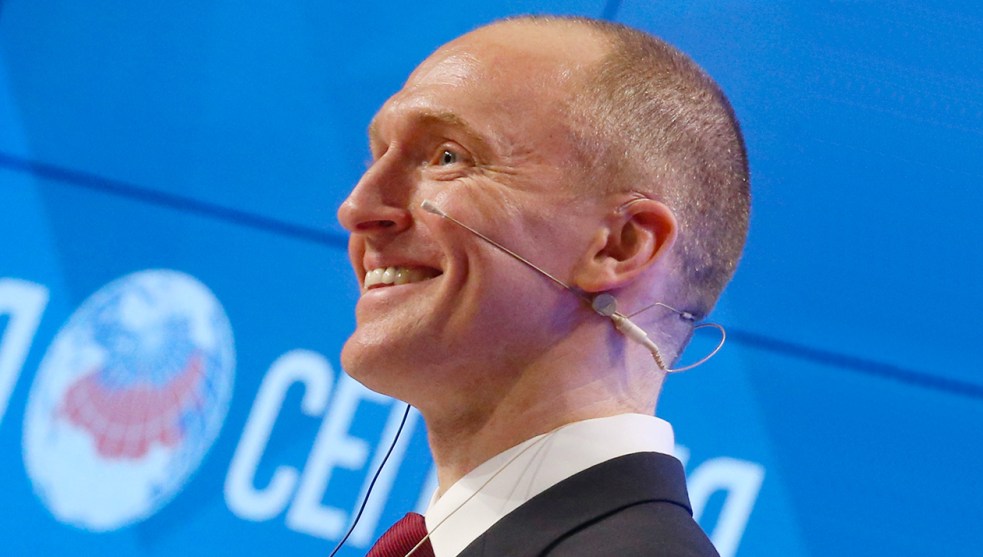
I was busy/sleepy all weekend (they’re sort of the same thing these days) and I didn’t get a chance to dig into the just released FISA surveillance application that the FBI filed in 2016 against Carter Page, the goofball “energy analyst” who worked on the Donald Trump campaign in 2016 and was suspected by the FBI of being a target of Russian recruitment. As you’ll recall, Rep. Devin Nunes theatrically released a memo last February explaining why Republicans were so disturbed about this FISA application—but declined to release the text of the application so that the rest of us could see if Nunes was telling the truth about it. Democrats tried to respond to the Nunes memo, but the White House allowed them to release only a heavily redacted response, and as a result the whole affair was fuzzy enough that lots of people concluded that something funny was probably going on.
Well, thanks to a FOIA request, we can now see the entire FISA application submitted by the FBI. Much of it is redacted, but that turns out not to matter very much. We can fairly easily match up the criticisms in the Nunes memo with the various sections of the application, and make some pretty good guesses about the rest of it. So let’s do that.
The first excerpt is unrelated to the Nunes memo. It’s merely the starting point of the FISA application, stating that the FBI believes Russia is trying to recruit Page in order to influence the outcome of the 2016 election:
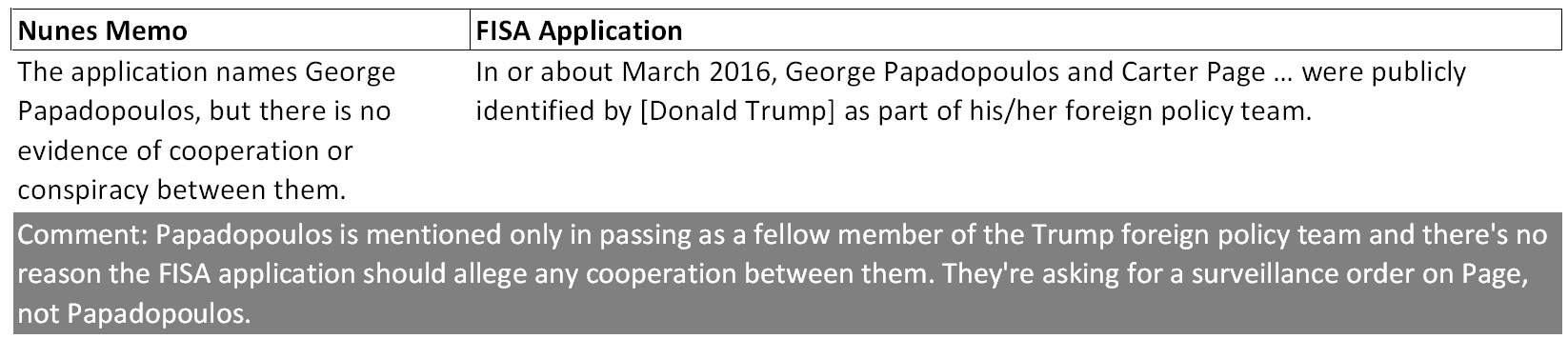
Next, Nunes complains that the FISA application mentions George Papadopoulos:
Papadopoulos is yet another sketchy member of Trump’s original foreign policy team, and it was his drunken conversation with the Australian ambassador to Britain in May 2016 that kicked off the FBI investigation in the first place. It’s true that there was apparently no cooperation between Page and Papadopoulos, but so what? He was mentioned solely as another member of the Trump foreign policy team—perhaps to draw the court’s attention to the fact that cooperating with Russia wasn’t unusual for Trump team members—and that was that. There’s no reason there should have been more since the FISA application was for surveillance of Page, not anyone else.
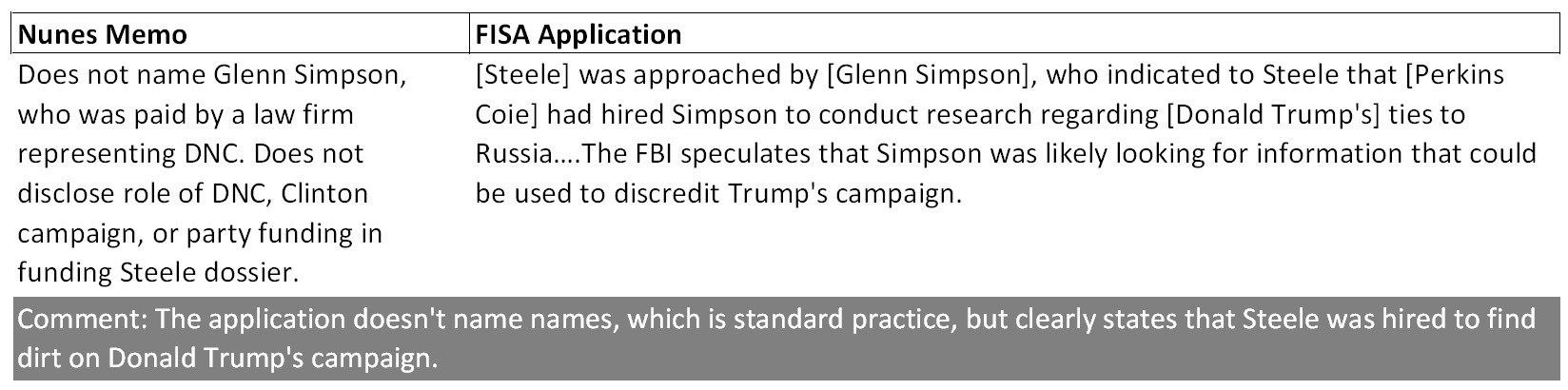
Generally speaking, Nunes is obsessed with the idea that the entire surveillance operation against Page was justified solely by information in the “Steele dossier,” a collection of tittle tattle that he claims was partisan, untrustworthy, and unreliable. What’s more, he claims the court was never advised that the FISA application was largely based on evidence from the Steele dossier:
This is flatly not true. Generally speaking, FISA applications use identifiers (“Source #1,” “Candidate #1,” etc.), and in this application there’s an entire page-long footnote spelling out the details of the information provided by Christopher Steele. A law firm hired Simpson, who hired Steele specifically to perform oppo research on Trump. The FISA court was very much aware of this, and was aware that it was most likely oppo research paid for by Hillary Clinton’s campaign.
Steele had been a reliable source in the past, and here the FBI is explicitly saying that even though this is a partisan investigation, they believe Steele’s reporting to be credible.
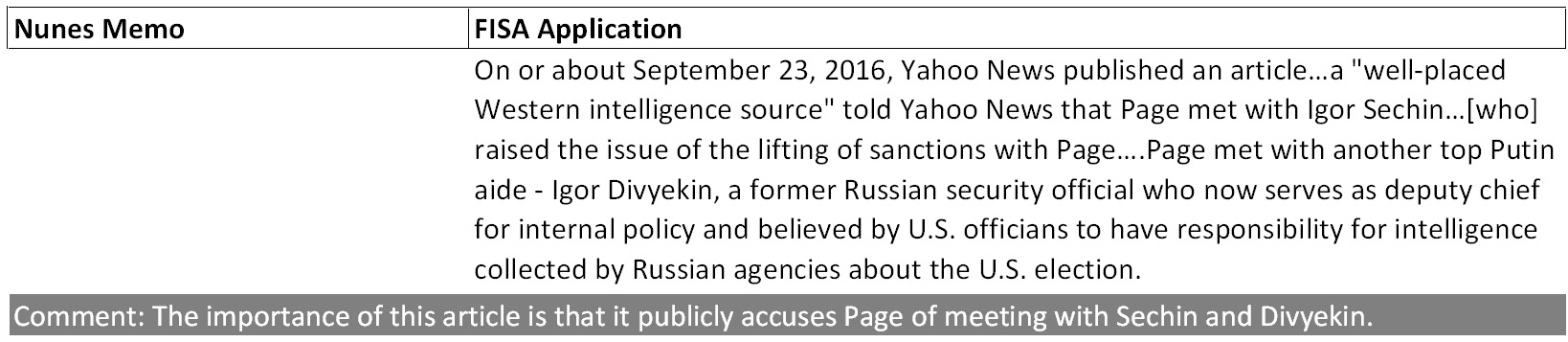
This is a reference to an article by Michael Isikoff about Page’s meetings with Russian officials.
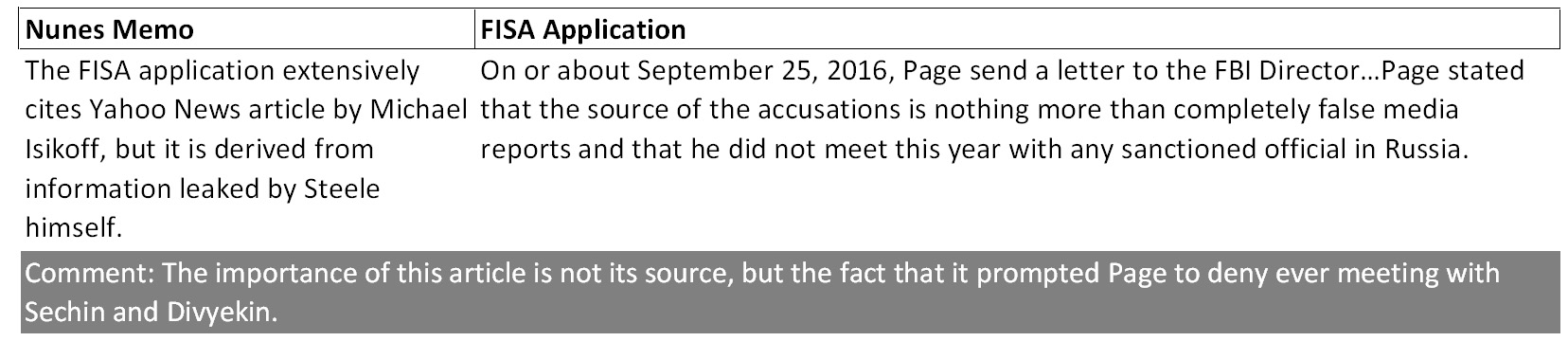
Nunes is outraged that the FBI doesn’t mention that Isikoff’s article isn’t independent verification of Page’s activities, but merely the same information recycled by Steele through a different outlet. However, that’s not why the FBI included this information. They included it because it was the Isikoff article that prompted Page to deny that he had met with any Russian officials.
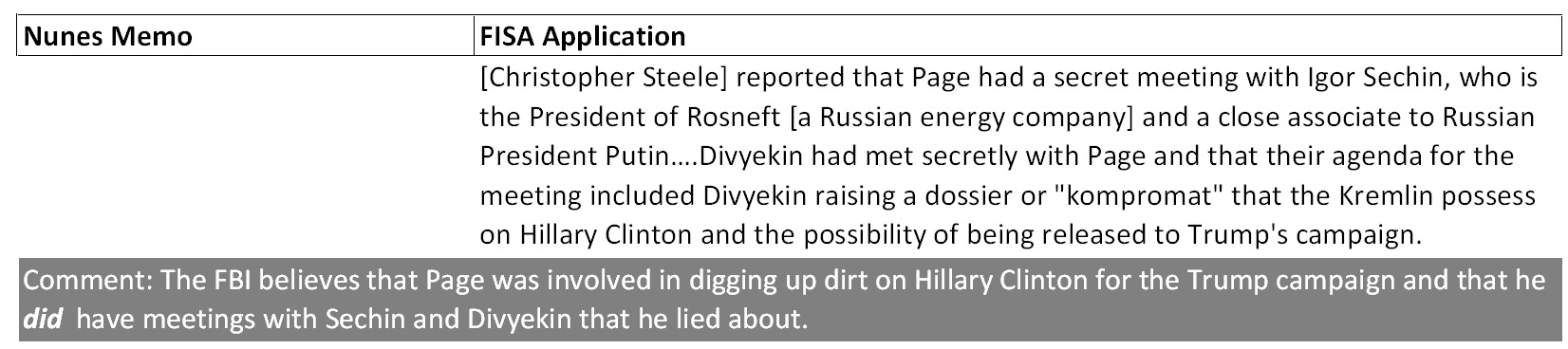
This is key information. Page denied the meetings with Sechin and Divyekin that were part of the Steele dossier. Quite possibly there’s other confirmation in the redacted portions of the FISA application. The fact that Page apparently lied about this is central to the FBI’s desire to surveil him further.
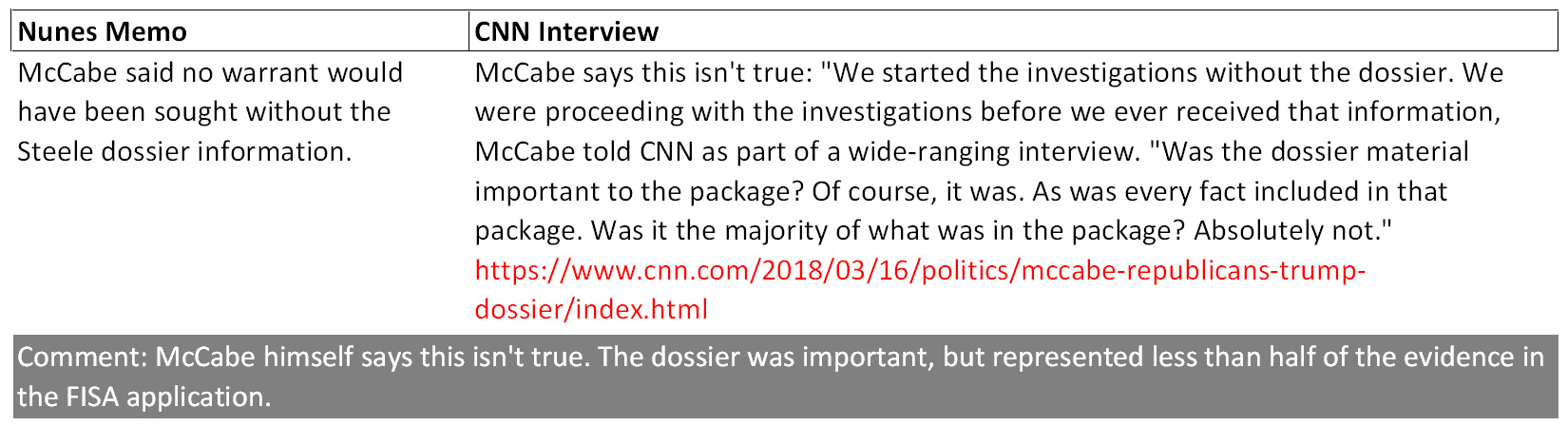
This appears to be a lie. The Steele dossier was important, but McCabe makes it clear that it was less than half the evidence contained in the FISA application. Given the number of redactions in the released FISA application, this is pretty plausible. After all, since the Steele dossier has already been made fully public, there’s little reason to redact anything related to it. The fact that there are so many other redactions suggests that the FISA application contains quite a bit of non-Steele information.
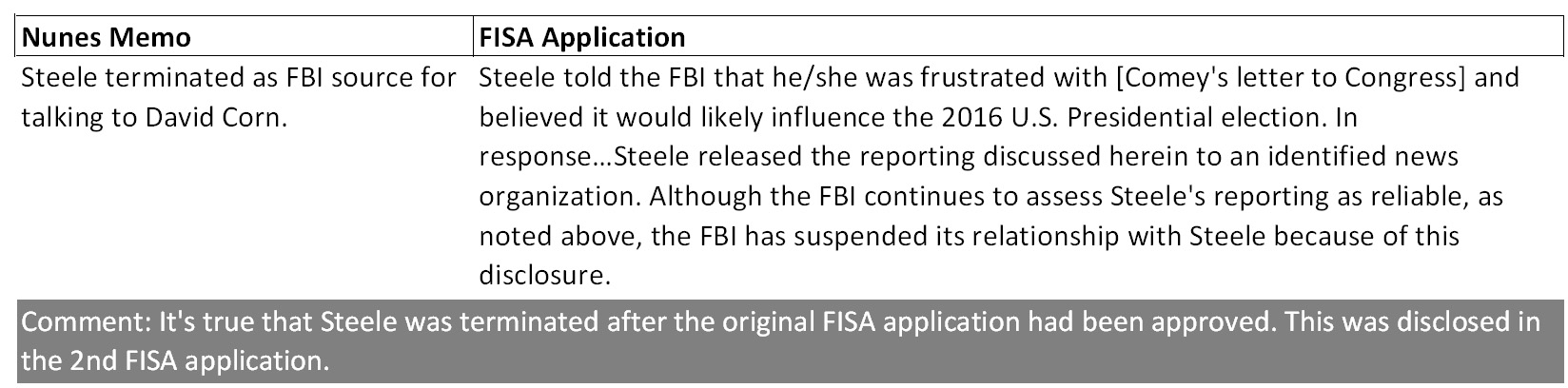
This is true, though the FBI continued to believe Steele’s reporting was basically reliable.
This is also true, though it’s not clear why it’s important. Ohr was an FBI official, and I suppose the implication here is that Fusion GPS, the firm at the center of the Steele dossier, was somehow worming its way into the FBI via Ohr’s wife. Nunes has nothing more to say about this, though. It’s just a petty smear tossed out for no reason.
Generally speaking, Nunes’ contention is that (a) the entire FISA application is based on the Steele dossier, (b) the Steele dossier is a partisan pile of lies, and (c) this goes to show that the FBI had it in for the Trump campaign.
But as we can now see, virtually everything Nunes said is untrue. The FBI investigation originally started in summer 2016, when the Australian ambassador to Britain reported a conversation he had with George Papadopoulos in which Papadopoulos implied that he had Russian dirt on Hillary Clinton. They were further alarmed by the very public attitude of the Trump campaign toward Russia. They had been keeping an eye on Carter Page for years at that point, and the Steele dossier’s claim that Page had spoken with Russian officials alarmed them yet further. Finally, after Page lied about those meetings, the FBI asked the FISA court for a warrant to surveil him.
The warrant was approved by a Republican judge. Not then, and at no time since, has she suggested she was duped. Ditto for the judges who signed the subsequent extensions, all of them Republicans. Finally, the sheer volume of redacted material—which grew larger in each application for extension—strongly suggests that the FBI had quite a bit of material well beyond just the Steele dossier.
Finally, it’s worth keeping in mind that the standard for a FISA warrant is “probable cause” that the target is an “agent of a foreign power.” This is not a negligible standard, but neither does it require bulletproof evidence. In this case we have Page’s known travels; his meetings with Russian officials; his own admission that he was an “informal adviser” to the Kremlin; his lie about his meetings with Sechin and Divyekin; and the contents of the Steele dossier. Plus, of course, whatever else is hiding under all those redactions. In the real world, that’s way more than enough to get approval for a surveillance warrant.
Bottom line: Devin Nunes, unsurprisingly, has lied about virtually everything he said. The Carter Page warrant was perfectly ordinary and the FBI showed no particular bias in applying for it. Nor did the judge show any bias in approving it. It was all pretty routine, and the only unusual thing about it is that presidential candidates usually don’t hire multiple advisers with unexplained connections to Russian officialdom. But Donald Trump did.
L-a-a-a-a-dies and gentlemen, your attention please. I am about to attempt a death-defying stunt THE LIKES OF WHICH FEW THROUGHOUT HISTORY HAVE EVER ATTEMPTED BEFORE. I am going to defend Donald Trump’s tariff policy.
Are you ready? (Cracks knuckles.) As you know, tariffs are bad. All the finest economists say so. BUT. There’s one generally tolerated exception to this rule: If another country has indefensibly high tariffs, and the sole purpose of your tariff is to cause them enough pain to force them to reduce their tariffs, then it’s OK. If you’re successful, then everyone’s tariffs go down and the world is better off.
But this can take a while, and in the meantime your own people can suffer. So today President Trump announced a plan to help our farmers who are hurt by the tariffs we imposed on China. The general reaction to this was mockery:
“Tariffs are so great that the federal government has to create new spending programs to compensate the tariffs’ victims.” https://t.co/p1S0fxFv9n
But if the purpose of the tariffs is to force China to reduce its tariffs; and if we know this will take a while; and if we know that domestic resistance to sustained economic pain is our biggest obstacle to seeing this through—then it makes sense to stand tough on the tariffs but assuage domestic resistance with random payouts here and there. And that’s what Trump is doing.
If you think the tariff war is dumb in the first place, then the payoff to farmers is dumb on top of dumb. But if you support the tariff war as a way of getting China to open its economy more, than the payoff to American farmers makes perfect sense. It’s just a way of bribing people to allow a good but painful policy to run its course.
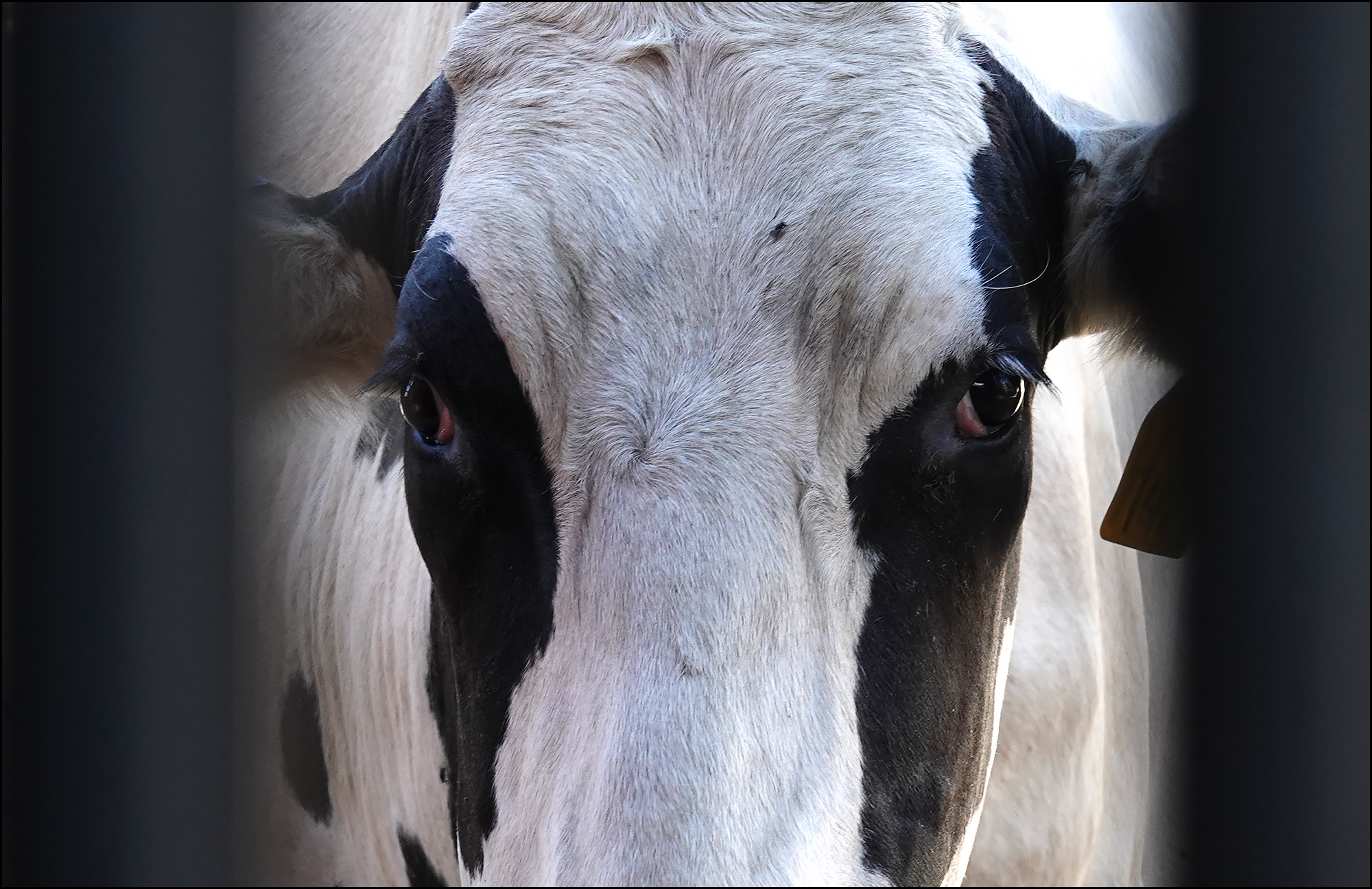
My sister and I went to the county fair a couple of weeks ago, and guess what we saw? Cows! This particular breed of cow is, um, the black and white kind. Hey, give me a break. I’m a city kid. All I know is that they say “moo.” And the brown ones produce chocolate milk, right?
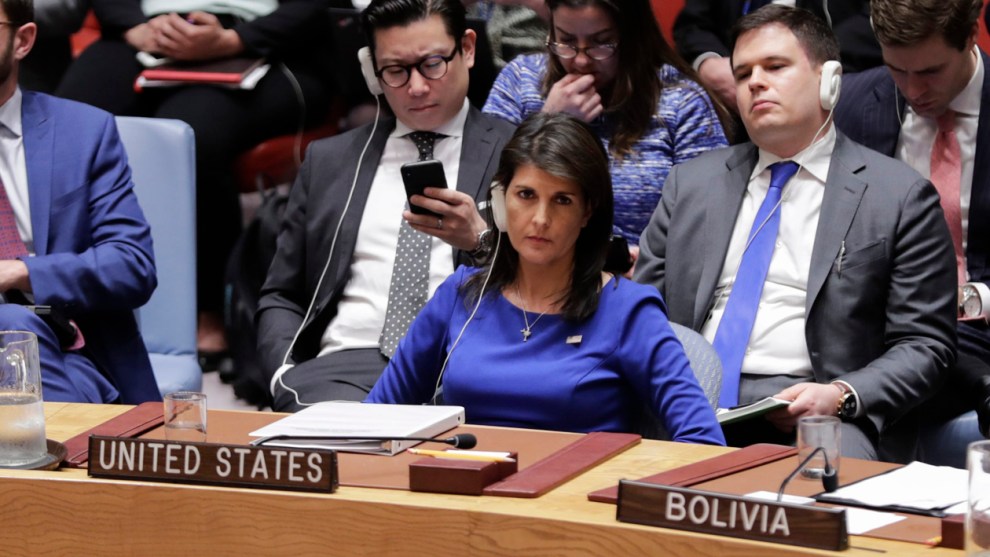
Haley asked high-schoolers attending a Turning Point USA summit at George Washington University whether they had “posted anything online to quote-unquote ‘own the libs,’ ” according to the Hill….The students reportedly raised their hands en masse and roared. But then Haley went a different direction. “I know that it’s fun and that it can feel good, but step back and think about what you’re accomplishing when you do this — are you persuading anyone? Who are you persuading?”
“Too many schools are coddling our young people and actively preventing them from scrutinizing the validity of their beliefs and the issues of the day,” he said. “That is the exact opposite of what we expect from universities in our country.”…“I can tell this group isn’t going to have to have Play-Doh when you get attacked in college and you get involved in a debate,” Sessions said. “You’re going to stand up and defend yourselves and the values that you believe in. I like this bunch, I can tell you. You’re not going to be backing down. Go get ’em! Go get ’em!”
The crowd, which had erupted into a “lock her up” chant earlier, began the chant again. “Lock her up,” Sessions chuckled. The chants continued, and he added, “I heard that a long time over the last campaign.”
House Speaker Paul D. Ryan on Tuesday played down President Trump’s threat to revoke security clearances of former top officials who have criticized him….“I think he’s trolling people, honestly,” Ryan said at a news conference with other House Republican leaders. Ryan said the issue falls under “the purview of the executive branch,” not Congress, before saying again: “I think he’s just trolling people.”
It looks like “owning the libs” wins the morning, 2-1. But who knows? Maybe Haley will have a little talk with her fellow cabinet members and see if she can bring back civility to Washington DC.
I wonder how long Haley can keep this up? Almost uniquely, she’s acquitted herself well as part of Trump’s cabinet, and has avoided even a hint of criticism from Trump himself. I’m not sure how. But it seems like she needs to quit while she’s ahead. Unless she’s discovered a magic beanstalk or something, there’s no way she can avoid being humiliated by Trump forever, can she?
The White House plans to announce on Tuesday a plan to extend $12 billion in emergency aid to farmers caught in the midst of President Trump’s escalating trade war, two people briefed on the plan said, the latest sign that growing tensions between the United States and other countries will not end soon.
….The White House has searched for months for a way to provide emergency assistance to farmers without backing down on Trump’s trade agenda, and the new program will extend roughly $12 billion through three different mechanisms run by the Department of Agriculture….It will rely in part on a Depression-era program called the Commodity Credit Corporation, a division of the Agriculture Department that was created in 1933 to offer a financial backstop for farmers.
Wow! After 85 years, the New Deal comes roaring back to life! And if the CCC doesn’t work, there’s always the Agricultural Adjustment Act. Or the Farm Security Administration to help small farmers sell out to giant agribusinesses. Those are likely to be the only “farmers” who benefit anyway.
Anyway, it’s a good thing that remnants of all those New Deal programs are still floating around out there. Trump can now latch on to them as a reminder of what the federal government did back when it actually believed its primary mission was to help people.
And we respect that! But maybe you’re of a mind to support our work directly instead? We have until December 31 to raise the last $400,000 we need to keep our nonprofit newsroom running at full strength into 2026. Will you make a gift today?
We noticed you have an ad blocker on. Can you pitch in a few bucks to help fund Mother Jones' investigative journalism?
Billionaires own the media,
but they don’t own us.
At Mother Jones we know these aren’t conventional times, and they require unconventional coverage. That’s what deliver every day: fierce, independent journalism you can’t find elsewhere. Perhaps never in the history of our country has that been more necessary than now. But we can’t do it without reader support—your support. Please chip in today.
Billionaires own the media,
but they don’t own us.
At Mother Jones we know these aren’t conventional times, and they require unconventional coverage. That’s what deliver every day: fierce, independent journalism you can’t find elsewhere. Perhaps never in the history of our country has that been more necessary than now. But we can’t do it without reader support—your support. Please chip in today.