• Lunchtime Photo

    I have good news and bad news. I’ve spent the last two Thursdays up in Los Angeles taking pictures of iconic LA sights at night, and I’m pretty happy with the results. That’s the good news. The bad news—maybe—is that I got hooked on a particular style: deliberately overexposing my shots so the nighttime city looks almost overpoweringly bright.  I happen to like this, but you might not. Nevertheless, over the next few months you’re going to see a whole lot of pictures shot in this style.

    But I’m going to ease into it. Today, I’ve got a series of pictures of the LA skyline, each with its own particular appeal. To start us off, here’s a picture taken by my father in the early 40s. My best guess is that it was taken from somewhere around Bronson Canyon, and the brightly lit street is Western Avenue. Needless to say, the downtown skyline doesn’t exist yet:

    Early 1940s — Bronson Canyon (?), Los Angeles

    (The speckles in the black areas are there because my father printed the picture on matte paper and that produced little patterns when I scanned it. There’s probably a way to get a better scan, but I’m not sure what it is.)

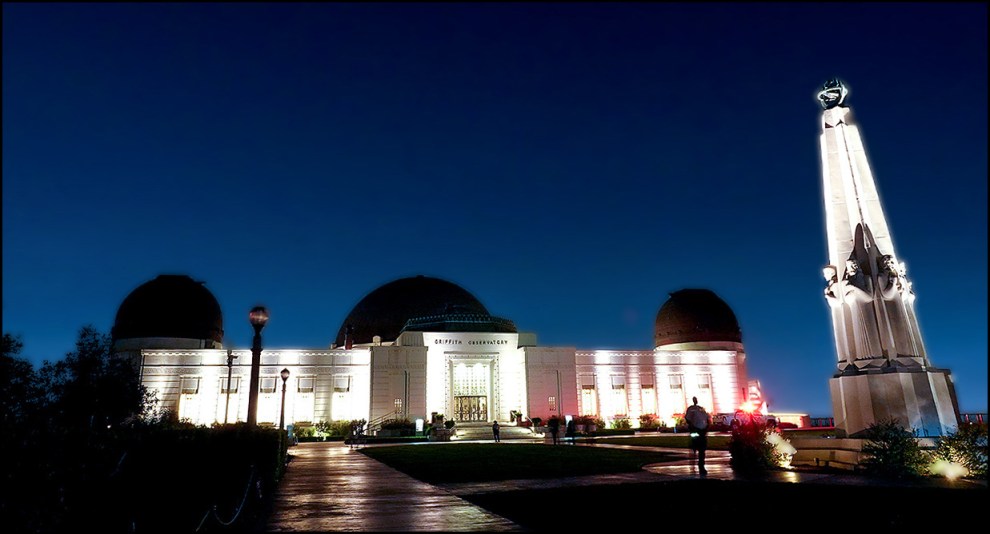
    Next up is the iconic LA skyline shot taken from Griffith Park Observatory. I’m delighted with how this turned out. The observatory itself is on the left with the moon rising right behind it, and then I stitched together a second shot to create a nice, wide panorama. The street looking dead ahead is Normandie. Vermont is to the left and Western is to the right. This is a really pretty picture:
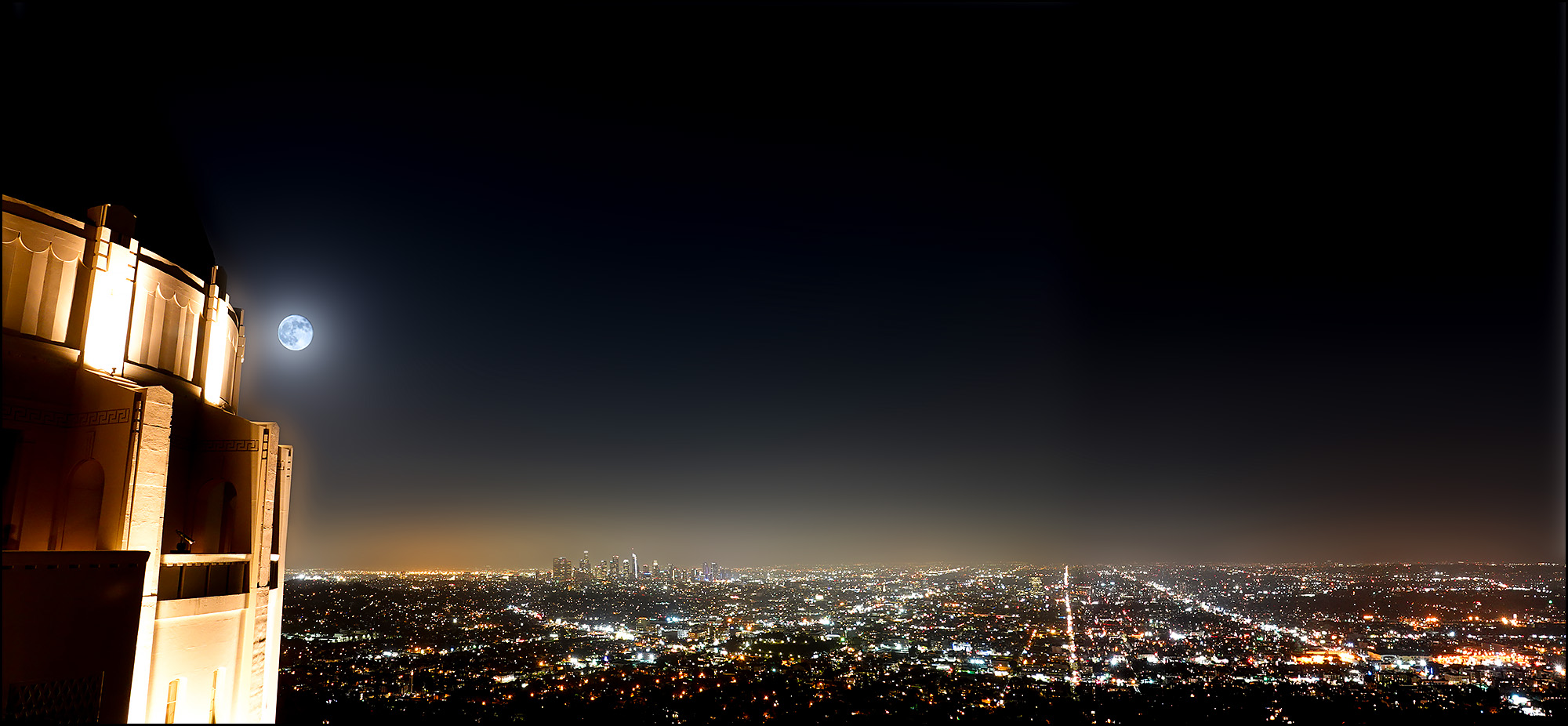
    June 28, 2018 — Griffith Park Observatory, Los Angeles

    Next is a picture taken from Radio Hill Gardens, a small park on a hill right next to Dodger Stadium. The park itself isn’t much, and not really someplace you want to be at night anyway. But it does have a terrific view of downtown. You can see City Hall off to the left:
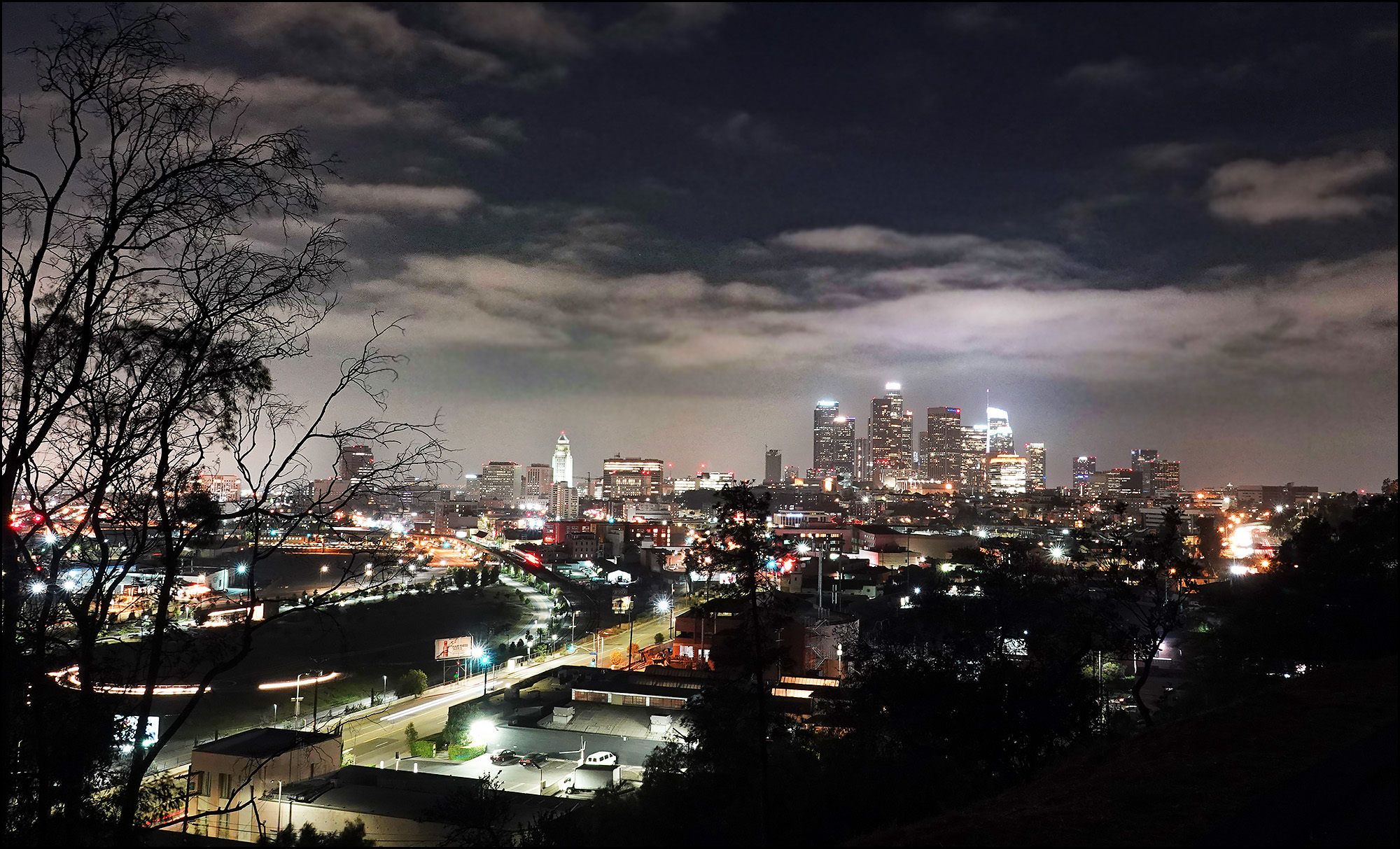
    June 28, 2018 — Radio Hill Gardens, Los Angeles

    Next is a view of LA that you won’t recognize even though you’ve probably seen it before. There’s a street in Boyle Heights that’s frequently used as a setting in car commercials because, surprisingly, it’s unique. It’s just about the only place in the city where you have a view of the skyline looking west from an ordinary, 1930s-era neighborhood. The commercials are typically shot near sunset with a very long lens and some bungalows on either side of the road. The effect of this very careful composition is a hazy, lazy small-town feel with skyscrapers in the far distance. I wasn’t trying to recreate that vibe, just to show what it looks like at night:
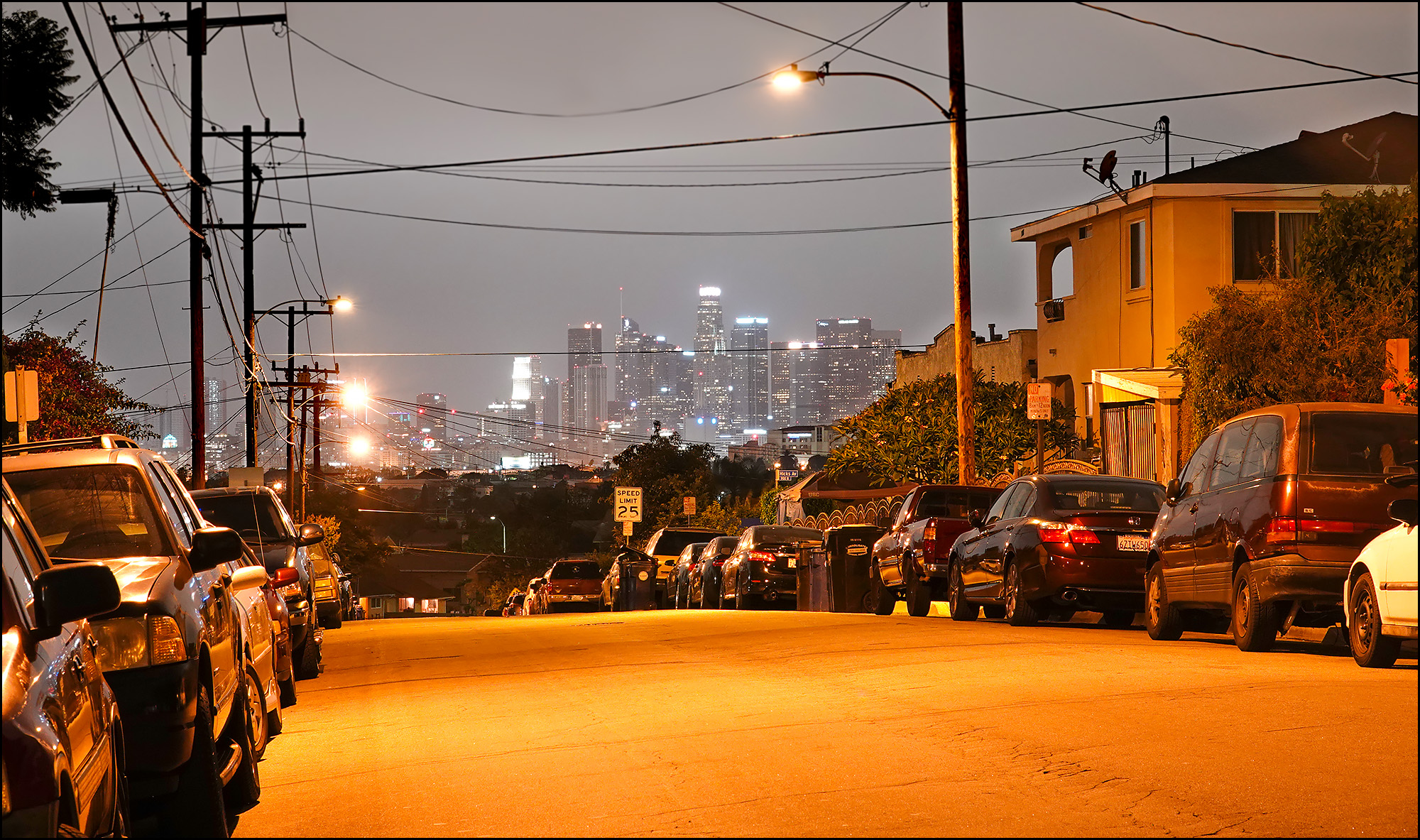
    June 28, 2018 — Blanchard and Ditman, Boyle Heights, Los Angeles

    Finally, here’s a closeup taken from a neighborhood just south of Dodger Stadium. There’s a spot called Spiders View (you can find it on Google Maps) that’s a well-known scenic spot, but I chose to take this picture from a couple of streets away because I liked the palm tree in the foreground. I didn’t especially like the power pole in the foreground, but that’s the big city for you. This picture was taken on a misty, almost foggy night, and I shopped out a whole bunch of power and phone lines:
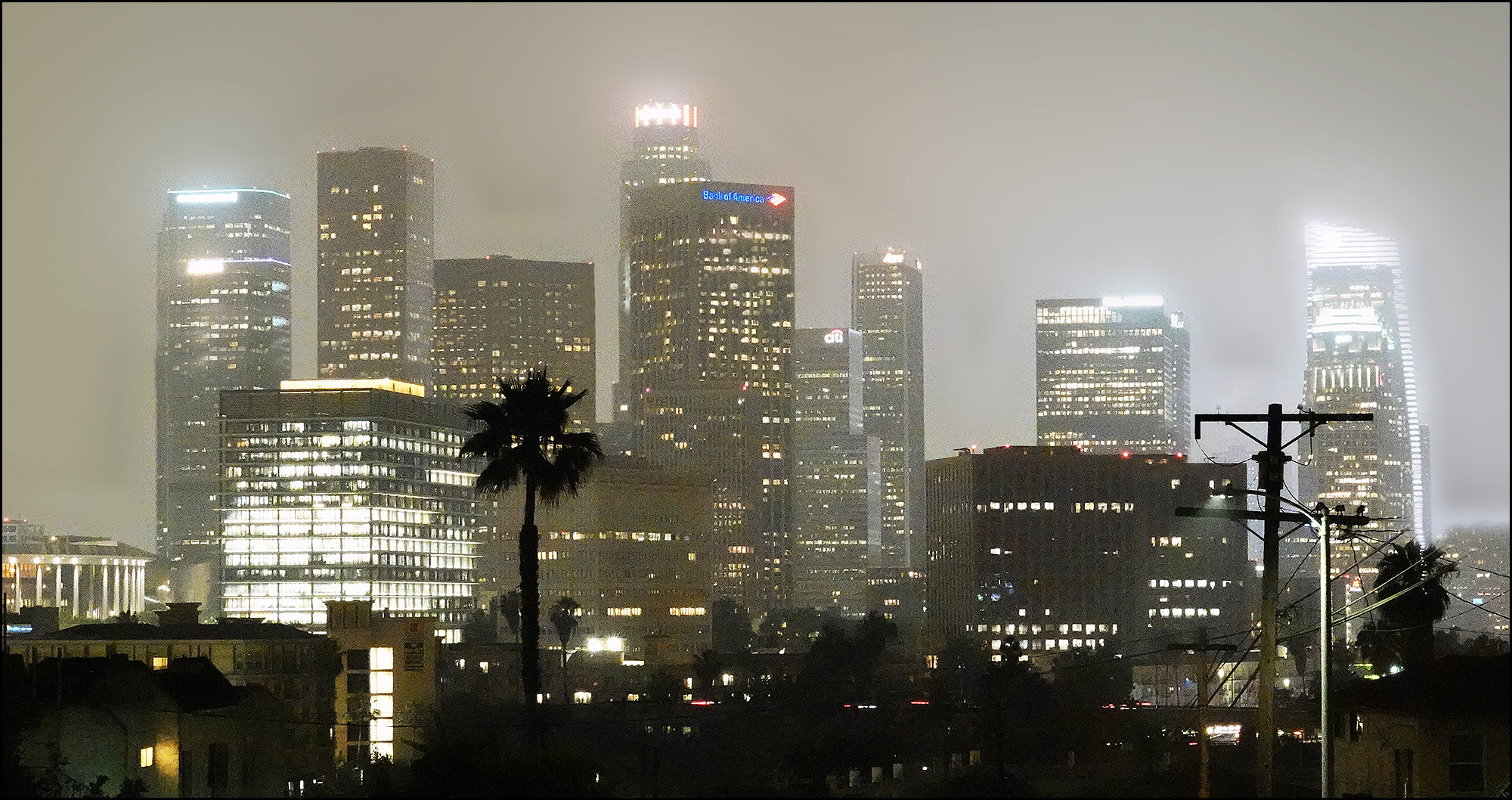
    June 21, 2018 — Centennial and College, Los Angeles

    So there you have it: the LA skyline at night. Someday I might go back and try to get a picture of the skyline from Wilshire looking east, but that’s a tougher nut. There are really no good places to take a photo in that direction except from the rooftops of tall buildings, and I don’t have access to any rooftops in Westlake or MacArthur Park—especially at 1 in the morning. So that’s a project for another time.
  • Kentucky Governor Is Going to Screw Medicaid Recipients Come Hell or High Water

    Jeff Malet/Newscom via ZUMA

    Last week, a federal court struck down a plan from Kentucky Gov. Matt Bevin to implement work requirements for Medicaid recipients. Today he got his revenge:

    Gov. Matt Bevin’s administration has abruptly cut Medicaid dental and vision benefits to nearly half a million Kentuckians.

    ….”This is an unfortunate consequence of the judge’s ruling,” said an email Sunday from Doug Hogan, communications director for the Cabinet for Health and Family Services….”When Kentucky HEALTH was struck down by the court, the ‘My Rewards Account’ program was invalidated, meaning there is no longer a legal mechanism in place to pay for dental and vision coverage for about 460,000 beneficiaries who have been placed in the Alternative Benefit Plan,” the email said. “As such, they no longer have access to dental and vision coverage as a result of the court’s ruling.”

    What a dick.

    In other Kentucky news, Rand Paul announced that “Capitol Police have issued an arrest warrant for a man who threatened to kill me and chop up my family with an axe.” So, um, that’s Kentucky today.

  • Most Illegal Border Crossers Are Turned Around and Sent Home Immediately

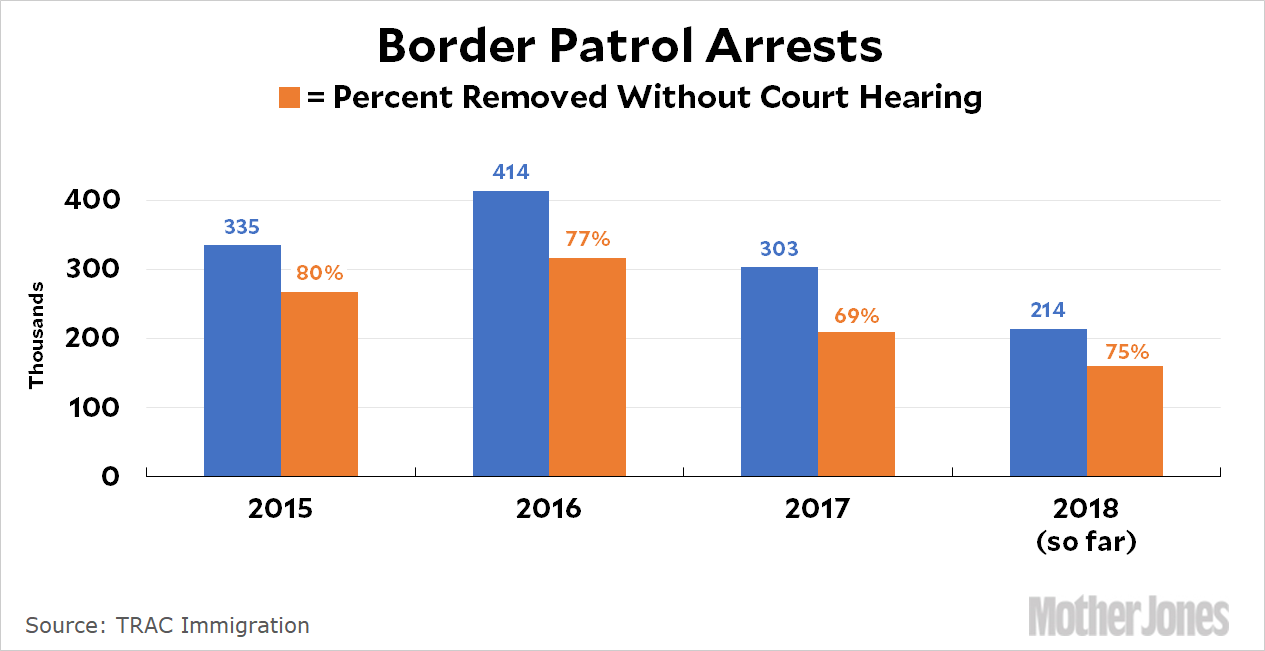
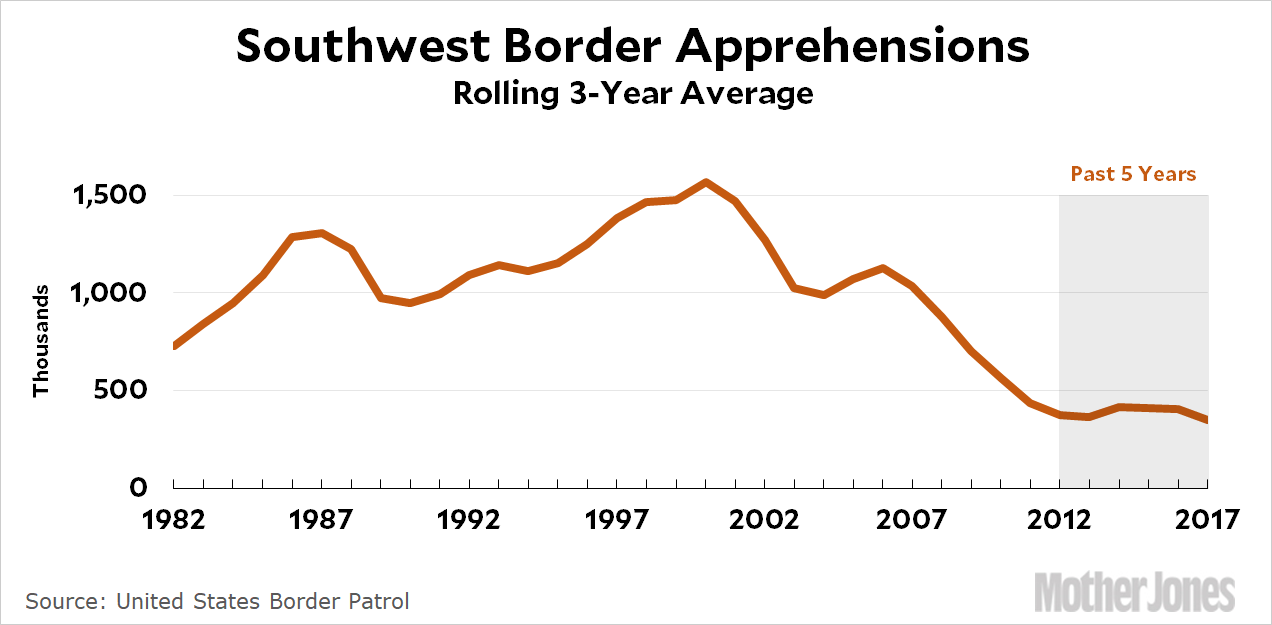
    Here’s a chart I put up a few days ago showing the total number of border apprehensions over the past several decades:

    As you can see, the number of illegal border crossings has plummeted dramatically in the past two decades. It’s less than a quarter of what it was in the year 2000. Now here’s a chart showing how many people crossing the border illegally were deported under some sort of expedited removal process:

    In 2000, about 1.6 million people entered the US illegally. Last year that number was about 300,000, and of that more than two-thirds were immediately deported without any kind of court hearing. This was done via expedited removals, reinstatement orders, voluntary returns, and administrative removals.

    Keep this in mind the next time Donald Trump blathers about how our “stupid” immigration system allows people to cross the border and then stay for years while we process them through courts instead of just turning them around at the border. He’s lying, as usual. The vast majority of illegal border crossers are turned around and deported immediately. Only a small number get court hearings, and many of those are asylum seekers. More here.

  • Susan Collins Will Vote to Kill Abortion Rights

    Tom Williams/Congressional Quarterly/Newscom via ZUMA

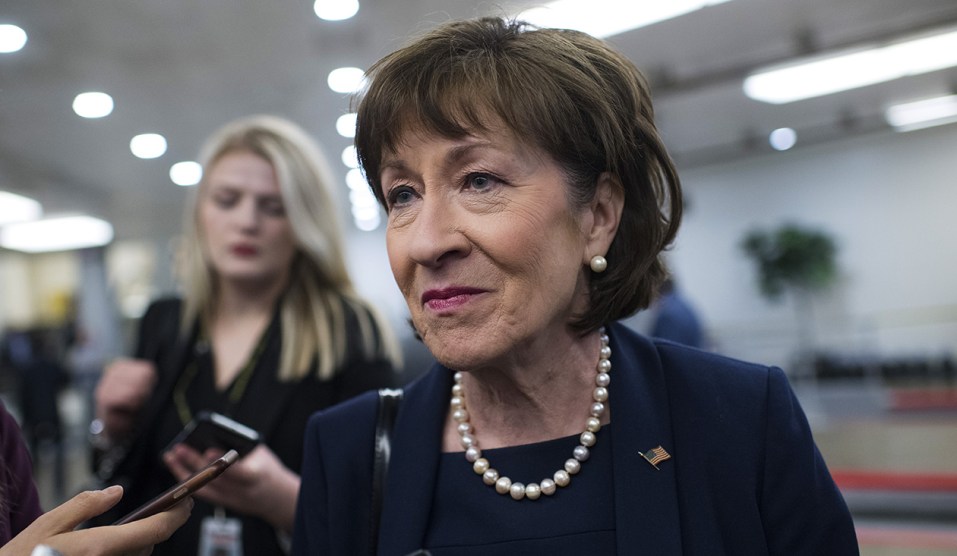
    Is Roe v. Wade effectively dead once President Trump nominates a conservative new justice to replace Anthony Kennedy? Maybe not! Republicans only have 51 votes in the Senate, and Susan Collins of Maine told Jake Tapper yesterday that she won’t support anyone who would overturn Roe:

    I would not support a nominee who demonstrated hostility to Roe v. Wade, because that would mean to me that their judicial philosophy did not include a respect for established decisions, established law.

    So, um, that’s great. But what about Neil Gorsuch? You voted for him.

    I had a very long discussion with Justice Gorsuch in my office, and he pointed out to me that he is a co-author of a whole book on precedent. So, someone who devotes that much time to writing a book on precedent, I think, understands how important a principle that is in our judicial system.

    So Roe is doomed. We already knew that, so this is hardly a big bombshell at this point. But you still have to wonder: is Susan Collins the most gullible person on the planet? It’s one thing to have a sunny, trusting disposition, but does she seriously think that Gorsuch wouldn’t vote to overturn Roe in a heartbeat? Hell, the guy joined the majority just last week in a ruling about public union agency fees that stated in its second paragraph, “Abood was poorly reasoned….Developments since Abood was handed down have shed new light on the issue of agency fees….Abood is therefore overruled.” For the record, Abood was decided in 1977. Unless Gorsuch believes that a 45-year-old precedent is somehow more sacred than a 41-year-old precedent, I think it’s safe to say that he might find that Roe was poorly reasoned too, and developments since it was handed down have shed new light on the issue of abortion.

    So I’m sticking with my prediction that Roe is dead. The only real question is how long the Supreme Court waits so the new guy can pretend that things have changed since he promised Collins with all his heart that he has tremendous respect for precedent.

  • Even ICE Agents Hate ICE

    Orit Ben-Ezzer via ZUMA

    Customs and Border Protection is in charge of apprehending undocumented immigrants within 100 miles of the border. ICE does the same thing for the interior of the country. But ICE is actually two agencies: the Enforcement and Removal Operations division, or ERO, and Homeland Security Investigations, or HSI. In a sign of just how widely hated ICE is these days, even HSI wants nothing to do with them:

    A majority of ICE’s top criminal investigation agents are asking Homeland Security Secretary Kirstjen Nielsen to spin their division off from the agency.

    ….In a letter sent last week, 19 special agents in charge at ICE’s Homeland Security Investigations unit said that ICE’s controversial detention and deportation policies have made it hard for them to conduct investigations into threats to national security, organized crime, narcotics smuggling and human trafficking….They also wrote that “the perception of HSI’s investigative independence is unnecessarily impacted by the political nature” of ICE’s immigration enforcement. “Many jurisdictions continue to refuse to work with HSI because of a perceived linkage to the politics of civil immigration.”

    More from the LA Times:

    On a recent morning, fugitive operations teams with ERO fanned throughout the Los Angeles area, searching for “criminal aliens, illegal re-entrants and immigration fugitives.” When the agents stopped for coffee at a Starbucks in Huntington Park, they noted that the negative opinion of the agency had recently intensified.

    “Even the cops don’t like us anymore because they’re listening to the news also,” said one agent, who did not want his name included. “ ‘Oh you guys are just separating families.’ ” As the agents prepared to leave, a Huntington Park police car pulled into the parking lot. Someone had probably seen the agents, Marin said, and called the police.

    Thanks Donald!

  • Just How Evil Is the Evil Dex?

    Griffith Park Observatory, where it all started.Photo credit: Kevin Drum/Evil Dex

    Bear with me here. This story has a long windup and an uncertain payoff. You have been warned.

    As you all know, I’m awake all night on Thursdays thanks to my weekly dose of the evil dex.¹ On moonless nights I’ve been playing around with night sky photography. But what about the other nights? For the past couple of weeks I’ve been driving up to Los Angeles to putter around and take pictures of things. Here’s how this week’s trip went.

    First, I headed for the Griffith Park Observatory to take a picture of the LA skyline. The observatory closes at ten, so I planned to get there around nine—and I would have made it if not for a minor wrong turn near the top of the hill. This got me distracted by a great view of the observatory with the moon rising just above it, so I spent some time taking pictures of that. I turned around just before ten and headed back up, but got stopped by a traffic control guy. They’d already closed the road to incoming traffic! But I cajoled the guy a bit, promised to do nothing more than a quick flyby, and he eventually agreed to let me in. It was a close call, but worth it since I ended up getting a truly spectacular picture out of it that I’ll show you on Monday.

    Then I drove back down into LA and happened to walk by the construction site for a new Metro station. The gate was open on one end, so I went in and set up my camera to take a few shots of the excavation. The security guard came over since I wasn’t really supposed to be there, but I chatted with him for a bit and asked some questions about the site. He relaxed and was fine with me taking my pictures.

    Next I headed to Spring Street, where I passed a homeless woman on the sidewalk who was ranting at everyone who passed by. (Her rant to me: Why is everyone walking around at midnight? How come no one goes to sleep anymore? Etc.) I set up the camera a little ways away and took some pictures of the old LA Times building and then walked back. As I did, the homeless woman was ranting at a nearby couple in a particularly unhinged way: she was white trash, her boyfriend was probably Mexican mafia, and when were Americans going to start standing up for what’s right blah blah blah. This went on, as these things do, and started to turn into an argument. I intervened gently and suggested we all just move along. The homeless woman was obviously seriously mentally ill and had no idea what she was saying. We all talked for a while as I headed back toward my car, and it turned out the couple was from Ohio and had never run into anything like this before. The woman hated being disrespected, but eventually calmed down and agreed that the homeless person had a badly broken brain and it was best to let everything be.

    Finally, I went to Union Station, but it was closed. As I was walking back to my car, one of the security guards saw my camera and asked about my picture taking. We talked for a while, and he regaled me with his theory that we needed to do away with money. If we did that, he explained, we wouldn’t argue about money anymore. But what about sex, I asked? We’d still argue about that. Sure, but we wouldn’t argue about money anymore. He had a point! We talked for a little while longer and then he had to move some barriers to let a bus out. I made my way back to my car and drove home.

    Here’s the punchline: to most of you, this all sounds very ordinary. It isn’t for me. Under normal circumstances I virtually never engage in conversation with strangers and I am very easily annoyed. That parking guy at Griffith Park? I probably would have gotten pissed, he would have told me rules were rules, and I would have huffed back down the hill. The security guy at the Metro site? I would have scurried off before he could even say anything. The couple getting mad at the homeless woman? I would have walked quickly by. The security guard at Union Station? I would have made some quick comment about the camera and kept moving.

    So what was going on? The answer is peculiar but true: the evil dex makes me into a better person. I’m more conversational and less annoyable. I’m friendlier and more interested in people. I start from a very low base on these virtues, so it’s not as if I suddenly become a hale and hearty guy. But I move noticeably in that direction.

    That’s very interesting. Just what is the dex doing? It’s a corticosteroid, so I suppose it’s not surprising that it might have some cognitive effects. But what exactly does it target and how does it work? More to the point, is there something out there that has the same effects but isn’t dangerous to take over long periods and doesn’t wreck my sleep? I’m thinking I need to make an appointment with a psychiatrist to ask about this. Every Thursday for a little while I’m a better version of myself, and I sure wish I could be like that all the time.

    ¹For those not yet in on the joke, I’m talking about dexamethasone, part of the three-drug chemotherapy cocktail I take weekly.

  • We Should Try to Understand Even the People Who Hate Us

    John Schultz/Quad-City Times via ZUMA

    Over at Vox, Sean Illing interviews Robert Wuthnow, author of The Left Behind: Decline and Rage in Rural America. The title makes it pretty clear what the book is about, and Illing is annoyed that we’re all once again being forced to engage with this stuff. “I know a lot of people who don’t live in rural America are tired of being told they need to understand all these resentments,” he says, pretty obviously referring to himself.

    Politically, of course, the answer is simple: these people vote, and if liberals want to win elections they need to figure out how to appeal to at least some of them. Morally, the answer is that rural communities have some real problems (“social fragmentation and drug addiction and wage stagnation and all the rest of it”) and we owe it to them to help out, the same as we do with any other community that’s having problems.

    But the interesting part is this:

    Sean Illing: I’m still struggling to understand what exactly these people mean when they complain about the “moral decline” of America. At one point, you interview a woman who complains about the country’s “moral decline” and then cites, as evidence, the fact that she can’t spank her children without “the government” intervening. Am I supposed to take this seriously?

    Robert Wuthnow: It’s an interesting question. What does it mean for us to take that seriously? I guess my point is that she takes it seriously, even if we don’t or shouldn’t. Does she still spank her children? Probably. Is she just using that as an example of how the country is changing and how Washington is driving that change? Probably. Now, I doubt she made this us up herself. She likely heard it at church or from her neighbors or from Fox News or talk radio. Again, what I kept hearing from people is a general fear that traditional moral rules were being wiped out by a government and a culture that doesn’t understand the people who still believe in these things.

    I don’t think this is so hard to figure out. Social mores around spanking have certainly changed over the past few decades, and it’s generally frowned upon these days in the middle class and above. Now think about an entire stew built around this:

    • Spanking used to be OK, now it’s not.
    • This change emanated more or less from elite liberal culture.
    • Most of us know about the gradual turn against corporal punishment from hearing about it on TV shows, Oprah, supermarket magazines, and so forth, where it’s generally attributed to “authorities” in child rearing or somesuch. That sounds vaguely government-ish.
    • Back in 1992, Bill or Hillary Clinton probably mentioned on the campaign trail that they had never spanked Chelsea and didn’t think it was a good idea. A few months later they were in the White House. That’s the government talking.
    • A couple of years ago, football player Adrian Peterson was charged with reckless injury to a child for spanking his son with a switch. That’s the government intervening.
    • This is mostly a nonissue for readers of the New York Times, but places like Fox News have kept it on the conservative radar for a long time. They treat it as a controversy, make it into a partisan issue because that’s what they do, and bring on various conservative family types to warn that kids need firm discipline and should be spanked from time to time.

    Mix all this together with a generous dash of insecurity, resentment, and ignorance, and you have a woman who thinks the “government” will come after her if she spanks her kid. This might not sound very sensible to you and me, but it’s perfectly understandable if you think for a few minutes about the community this woman lives in and how her beliefs are shaped by anecdotes, conservative media, friends, the local church, and so forth.

    Now, all that said, Illing’s real complaint seems to be that even if this stuff is explicable, there’s nothing much anyone can do about it. So why bother with all the hand-wringing?

    It’s a good question. There are plenty of people who are simply beyond reach for liberals. They’re either racist or sexist or they love guns or maybe they’re just plain mean. Whatever the reason, they aren’t going to vote for anyone even faintly liberal, and there’s virtually nothing that could persuade them otherwise. For myself, I’d say it’s still worthwhile understanding them for a couple of reasons:

    • It’s just generally a good idea to try to understand points of view that are held by a substantial number of people.
    • At the very least, it’s worth understanding the rural working class well enough that you can speak about them in ways that aren’t contemptuous or insulting. A lot of liberals have a real problem with this.

    Beyond that, there’s the fact that there are real problems underlying all these various resentments. Addressing those problems may not win any votes, but we lefties should be dedicated to at least trying to help anyone who needs it. If you’re only willing to help the people who will thank you for it, then you’re not really much of a liberal in my book.

    UPDATE: Just in case this isn’t obvious, let me add that although I think empathy and understanding are good and necessary, that doesn’t mean I want these folks to run things. On a political level, I just want to win, however we can. If that means hardball, then hardball it is—but afterward an Obama-like sense of fairness and a desire to make things better for everyone, even if it won’t help you in the next election.

  • Jared Kushner Is an Idiot

    Toya Sarno Jordan/CNP via ZUMA

    A comedian pretending to be Sen. Bob Menendez called President Trump on Wednesday and got a callback from Air Force One. They chatted and the comedian posted the conversation.

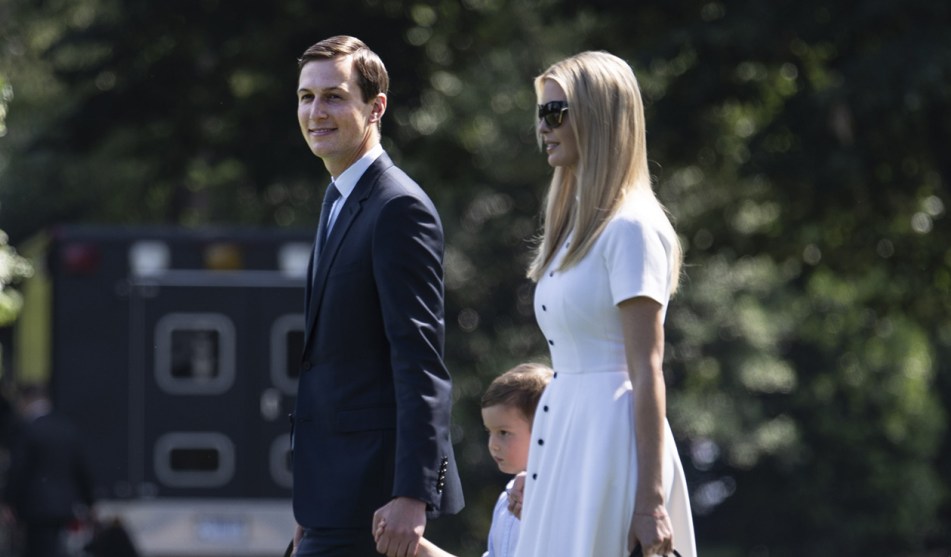
    But this is not the real story. The real story is that the competent people in the White House—and there are still a few left—called Menendez’s office and were told that the senator hadn’t tried to reach Trump. So they killed the call. But the comedian also managed to talk to Jared Kushner, who was fooled and sent the message along. That’s why Trump called back.

    Jared Kushner is an idiot. He knows nothing about politics; nothing about policy; nothing about proper security; and has no apparent skills aside from being married to Ivanka Trump. I guess that makes him a pretty good fit for the Trump White House.

  • Donald Trump Is Not Going to Withdraw From the WTO

    Axios reports that President Trump really, really wants to exit the World Trade Organization, the primary agreement that governs free trade throughout the world:

    What we’re hearing: “He’s [threatened to withdraw] 100 times. It would totally [screw] us as a country,” said a source who’s discussed the subject with Trump. The source added that Trump has frequently told advisers, “We always get fucked by them [the WTO]. I don’t know why we’re in it. The WTO is designed by the rest of the world to screw the United States.”

    There’s more about what the WTO is and how Trump’s advisors are passive-aggressively pushing back on his rants, but it’s not until the 17th paragraph that we get this:

    As head of state, Trump under international law could make the notification at the WTO. But the U.S. law implementing the WTO agreements states quite plainly that withdrawal from the WTO requires an act of Congress.

    Oh. So none of this matters even slightly since Congress is not going to withdraw from the WTO. It’s just another story about all the weird stuff Trump rants about in private. Someone should make a list.

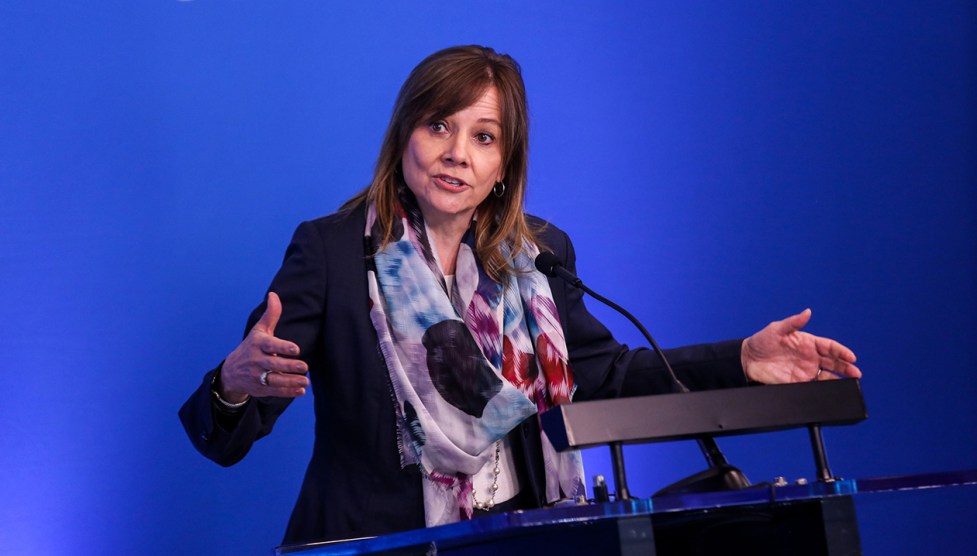
  • GM: Tariffs Are Bad for America and Bad for GM

    Come on, Mary, tell us what you really think of Donald Trump.Kimberly P. Mitchell/TNS via ZUMA

    I mentioned a couple of days ago that Donald Trump’s strategy of attacking his enemies with every tool at his disposal has been working pretty well. Corporate America in particular sees no upside in ever disagreeing with him. Who needs the grief, after all? So they mostly stay quiet, and this helps Trump to spread the idea that no one outside a small band of radical obstructionist Democrats really disagrees with him.

    But maybe that’s changing. Barely. Here is GM’s response to a request from the Commerce Department for comment on Trump’s proposed 25 percent tariff on foreign cars and car parts. After six paragraphs of throat clearing about the importance of national security and making cars in America, we get the following two paragraphs about the impact of tariffs on GM’s global supply chain:

    If import tariffs on automobiles are not tailored to specifically advance the objectives of the economic and national security goals of the United States, increased import tariffs could lead to a smaller GM, a reduced presence at home and abroad for this iconic American company, and risk less—not more—U.S. jobs.

    ….Combined with the other trade actions currently being pursued by the U.S. Government—namely the 232 Steel and Aluminum tariffs and the Section 301 tariffs against Chinese imports—the threat of additional tariffs on automobile imports could be detrimental to our company. At some point, this tariff impact will be felt by customers. Based on historical experience, if cost is passed on to the consumer via higher vehicle prices, demand for new vehicles could be impacted. Moreover, it is likely that some of the vehicles that will be hardest hit by tariff-driven price increases—in the thousands of dollars—are often purchased by customers who can least afford to absorb a higher vehicle price point. The correlation between a decline in vehicle sales in the United States and the negative impact on our workforce here, which, in turn threatens jobs in the supply base and surrounding communities, cannot be ignored. Alternatively, if prices are not increased and we opt to bear the burden of tariffs or plant moves, this could still lead to less investment, fewer jobs, and lower wages for our employees. The carry-on effect of less investment and a smaller workforce could delay breakthrough technologies and threaten U.S. leadership in the next generation of automotive technology.

    Now, it’s worth noting that GM said this in a regulatory comment, not on TV or in an interview with Fortune. It’s pretty low profile, and I wouldn’t even know about it if the New York Times hadn’t dug it up and highlighted it. It’s also worth noting that GM chose not to provide a comment to the Times except to say that they were “still assessing the impact” of the proposed tariffs. No need to poke the bear further! On the other hand, Harley-Davidson is already moving some production to its overseas plants, and the Times article points out that a Fiat Chrysler executive recently told Bloomberg that they’ve been doing “contingency planning on a massive scale” ever since Trump was elected.

    This is still low-key stuff, but the threat of massive tariffs obviously has the entire auto industry scared to death. It has the potential to wreck their supply chains and spur retaliation, which would make them globally less competitive and lead to lower sales, lower profits, higher car prices, and worker layoffs.

    Some context is also probably worthwhile here. With the exception of a few activist CEOs on both sides of the political spectrum—think Starbucks’ Howard Schultz on the left or Hobby Lobby’s David Green on the right—most modern CEOs don’t want to get in fights with presidents. They just want to be left alone to lobby for tax breaks and make a lot of money. In that respect, it’s not surprising that CEOs are reluctant to take on Trump, which means that Trump’s reputation for scorched-earth retaliation is only strengthening a tendency that already exists.

    But now they have their tax cut, and going forward it doesn’t look like Trump is really going to be all that helpful to big business. He’s got his pet industries, like coal and steel, and certainly the EPA is taking a chainsaw to environmental regulations. But the former doesn’t help many companies and the latter probably produces headaches everywhere outside the power industry, since most big companies at least maintain a facade of supporting strong environmental laws.¹ So it might not be surprising if Trump starts getting a little more criticism from the business community. There’s safety in numbers, after all.

    ¹Because among the ordinary consuming public, environmental regulation are very popular and no company wants to be viewed as insufficiently dedicated to cause of a cleaner planet.