• Lead and Crime in Eastern Europe: A Hopeless Case

    Tyler Cowen has an odd Drum-bait headline today:

    Why is there no lead-homicide connection in Eastern Europe?

    Children growing up in former communist CEE [Central and Eastern European] countries during the 1980s were subjected to horrific amounts of industrial pollution, including extreme levels of prolonged lead exposure. Since lead is theorized to be a primary culprit in exacerbating violent crime, you would assume there would be a sizeable discrepancy in the homicide rate between, say, former East Germany and West Germany, or Western Europe and Eastern Europe as a whole. But the difference in the homicide/violent crime rate is negligible, with many former communist CEE countries having a lower homicide rate than Western Europe. I suspect the same is true when comparing the rate of mental disorders, which is another malady that is supposedly influenced by exposure to high levels of industrial pollution.

    The text is from a commenter at Slate Star Codex, who references an ancient Cato study titled “Environmental Problems Under Socialism.” As near as I can tell, it references lead twice: first to note that children from the Upper Silesia area of Poland have “five times more lead in the blood than children from Western European cities,” and second to relate a brief anecdote about officials in the Bulgarian city of Kardszhali who were reluctant to shut down a lead smelter even though it was causing “massive health problems to area residents.”

    This doesn’t say anything at all about whether Eastern European lead levels during the 70s and 80s were higher than in Western Europe. How do we figure that out? Generally speaking the biggest source of lead poisoning during that era comes from auto exhaust, so the first thing you’d want to look at is per-capita lead emissions from gasoline combustion. Since Eastern Europe was relatively poor compared to Western Europe during this period, I’d expect lower lead emissions there, not higher, and that’s pretty much what the data shows. Here it is for five big Western and Eastern European countries:

    Aside from all the usual measurement issues, there’s also a problem here with different population densities. Lead has its biggest effects where auto density is high, which probably means that Western Europe not only had higher overall lead levels, but that its effects were more concentrated. This would make Eastern Europe’s lead emissions even lower relative to Western Europe than the raw numbers suggest.

    Ideally, of course, what you’d really like to see is measurements of blood lead levels, and for Western European countries these are often available. Eastern Europe, by contrast, is pretty much a black hole. However, here are some comparisons from a World Bank report that pulled together a very small number of studies of specific Eastern European locations:
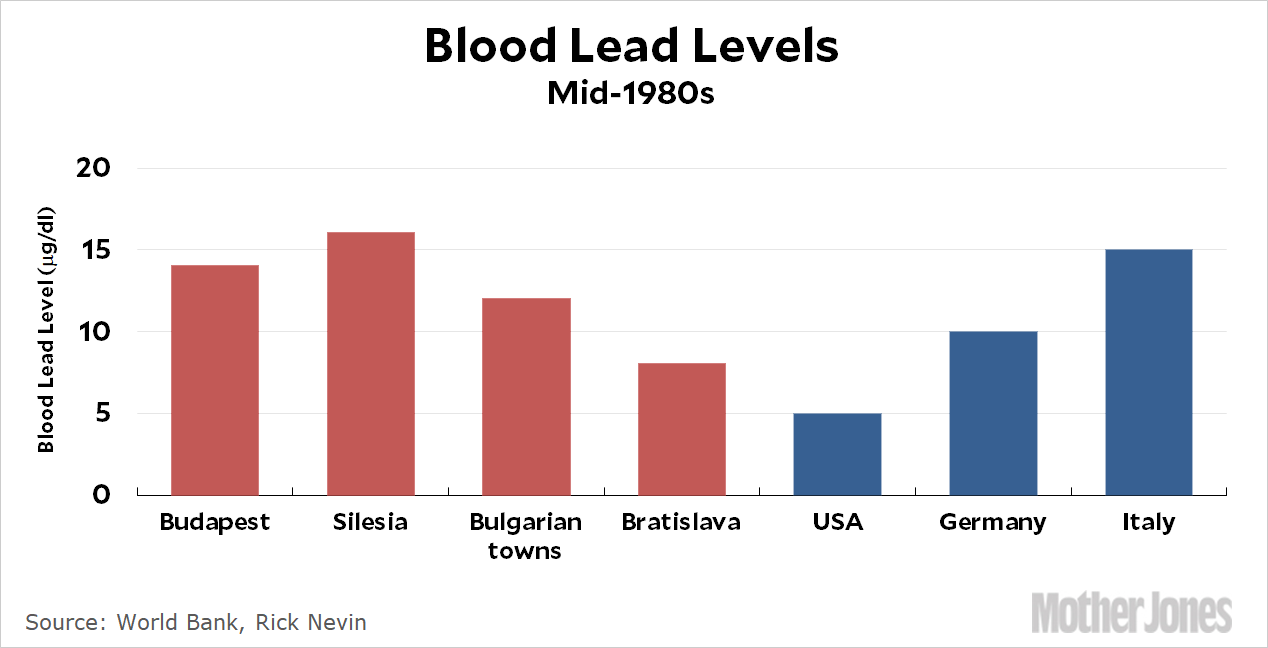
    These are very rough numbers. The studies themselves have tiny sample sizes, and all I could pull out of them was a sort of eyeball average of various bits and pieces. That said, there’s nothing special that catches my eye. By the mid-80s, Eastern Europe might have had slightly higher rates of lead poisoning than Western Europe, but not by a lot. And keep in mind that this is a period in which blood lead levels are changing very quickly everywhere thanks to the adoption of unleaded gasoline.

    Bottom line: there are specific places in Eastern Europe that had very high lead levels up through the 1980s—usually due to mining, smelting, or lead-based industry of some kind—but overall lead levels seem to have been in the same ballpark as Western Europe. At a guess, this is because of two forces that worked in opposing directions: the fact that Eastern Europe was poor cut down on the amount of lead they produced, but lousy environmental rules increased the amount they allowed into the atmosphere.

    Roughly speaking, then, lead levels appear to be about the same in Eastern and Western Europe, so there’s no special reason in the first place to think they should have noticeably different homicide or violent crime rates due to lead poisoning. And even if there were, I imagine that communist-era crime statistics in Eastern Europe are wildly unreliable if they even exist. And if good stats do exist, you still have the problem of trying to compare two very different kinds of policing cultures on opposite sides of the Iron Curtain. Given all this, it seems all but hopeless to seriously address the question originally posed about lead and homicide rates in Eastern Europe.
  • Gallup: Suicide Immoral Unless Doctor-Assisted

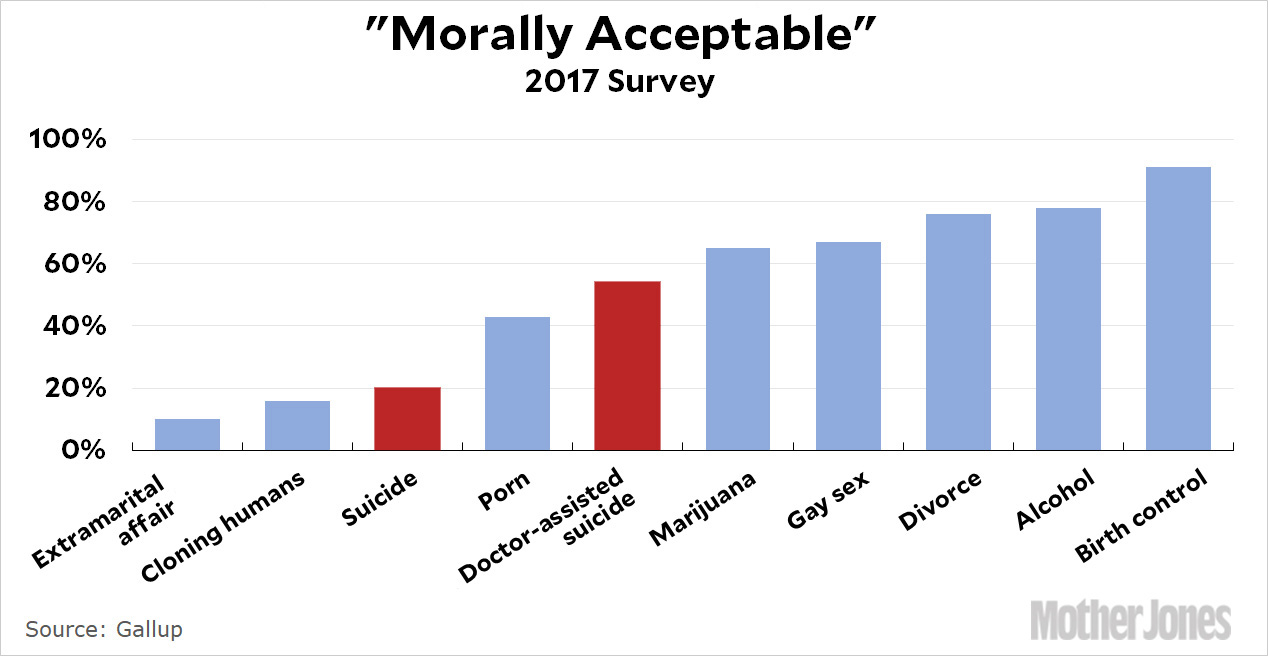
    The Washington Post has a piece about marijuana acceptance today (65 percent now say it’s morally acceptable), but something else caught my eye in the Gallup survey data they cited:

    I wonder if this is real, or just some odd polling artifact? Can it really be true that only 20 percent of Americans think suicide is morally acceptable, but 54 percent think it’s OK if a doctor helps out? Does “doctor-assisted” imply pain and incurable disease to most people, thus making it acceptable even though it wouldn’t be if you did it for other reasons? Or does it trigger some other framework entirely? Whatever it is, it makes an awfully big difference.

  • Spoofing Caller ID For Fun and Profit

    The Wall Street Journal has a piece today about how robocall scammers make money from Caller ID. I had to read it a couple of times before I got it, but apparently it works like this:

    • Scammer calls me.
    • My carrier automatically makes a Caller ID request, for which it pays a hundredth of a cent or so.
    • The caller gets a share of that hundredth of a cent.
    • Multiply by a gazillion.

    Why does the calling number get a piece of the Caller ID action? That part is unclear. “Regulators monitor such revenue-sharing deals,” the article says, but that’s all. I’m trying to think of what legitimate purpose this could have, but I’m coming up blank.

  • Lunchtime Photo

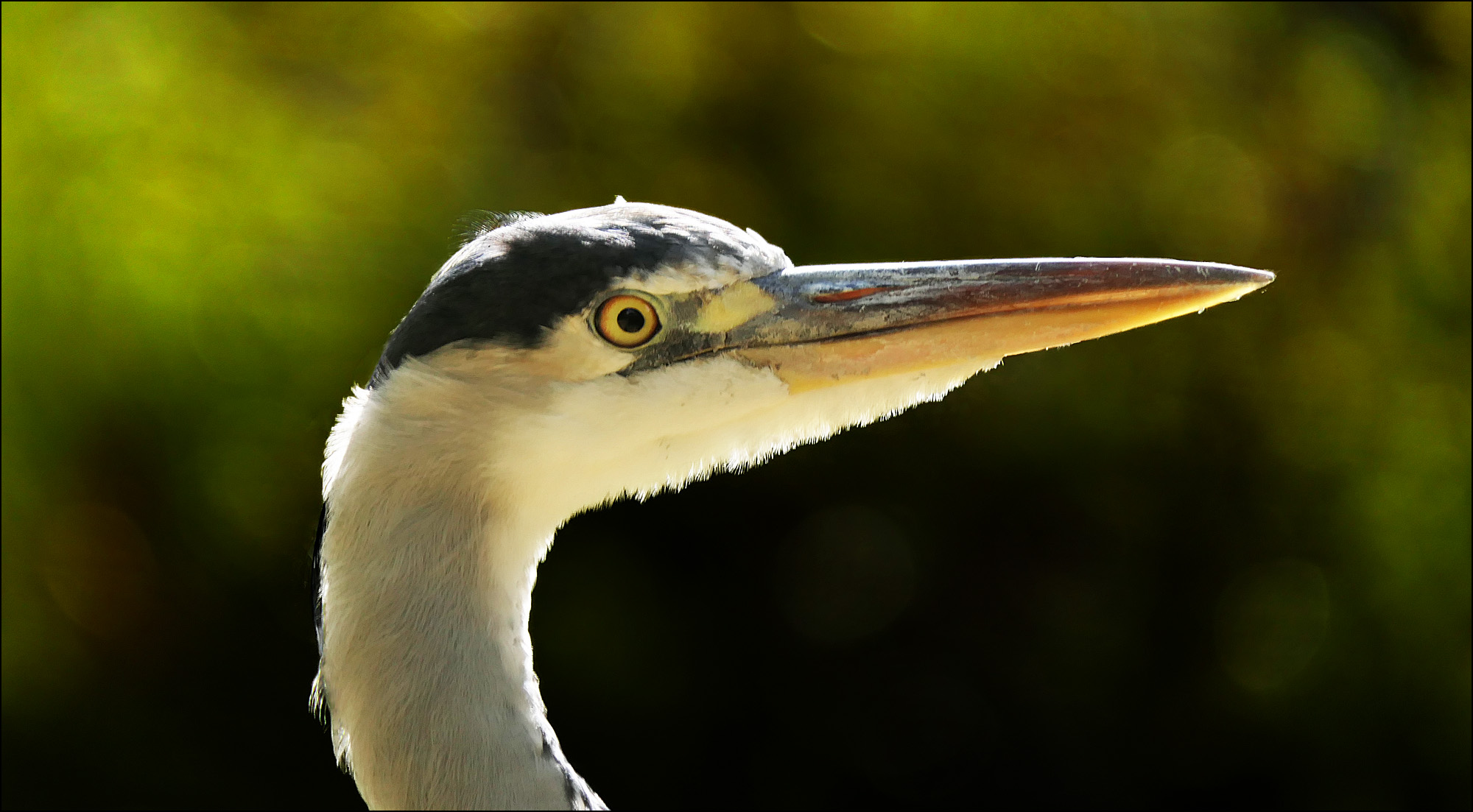
    This is a grey heron at St. James’s Park in London. How do I know it’s a grey heron, not a great blue heron? Because it’s in London. If it were in North America, it would be a great blue heron. There are undoubtedly other ways to tell them apart, but that’s probably the easiest.

    BY THE WAY: This picture is a good example of my old camera vs. the new one. I took this at full zoom, and it’s a little soft. With the new camera, it would have been pin sharp.

    September 25, 2017 — London
  • Donald Trump and the Double-Plus Imperial Presidency

    Remember this? Those were some good times, weren't they?Scott Stantis/Chicago Tribune

    It’s a slow Monday, so everybody is yakking about President Trump’s insistence that he can pardon himself and Rudy Giuliani’s insistence that Trump could gun down Robert Mueller at high noon and not be indicted for it. Whatever. But this is really the weird one:

    Huh. If I recall correctly, it was Trump’s own Department of Justice that appointed Mueller. Or, as Trump now likes to call it, the Department of “Justice.” In any case, I wonder who filled his brain with the notion that appointing a special prosecutor is unconstitutional? Ronald Reagan tried this wheeze and was batted down by the Supreme Court 8-1. Scooter Libby tried it a few years ago and was also batted down. Was Dinesh D’Souza on Fox & Friends this morning or something?

    Anyway, Trump and his surrogates have now variously claimed that:

    • He cannot be indicted for anything, even murder, while he’s in office.
    • Special prosecutors are unconstitutional.
    • The president can pardon himself.
    • The president, by definition, cannot obstruct justice because he is Justice.

    In other imperial presidency news, Trump has claimed that he has effectively unlimited power to socialize industry in the name of national defense, as well as unlimited power to levy tariffs on the same grounds. Isn’t that something? Do you remember the days when Republicans were outraged about President Obama’s wanton seizure of power just because he decided not to prosecute and deport kids who were brought across the border when they were infants? Seems like decades ago. Today, the rule is simpler: as long as the president keeps sending over conservative judges for confirmation, the Constitution allows him to do anything he wants.

  • Sad Astrophotography Update

    On Saturday I posted a picture of my first try at photographing the sky with a tracking mount that allows long exposures. It came out great! “I wonder if I had beginner’s luck with my celestial pole centering?” I mused.

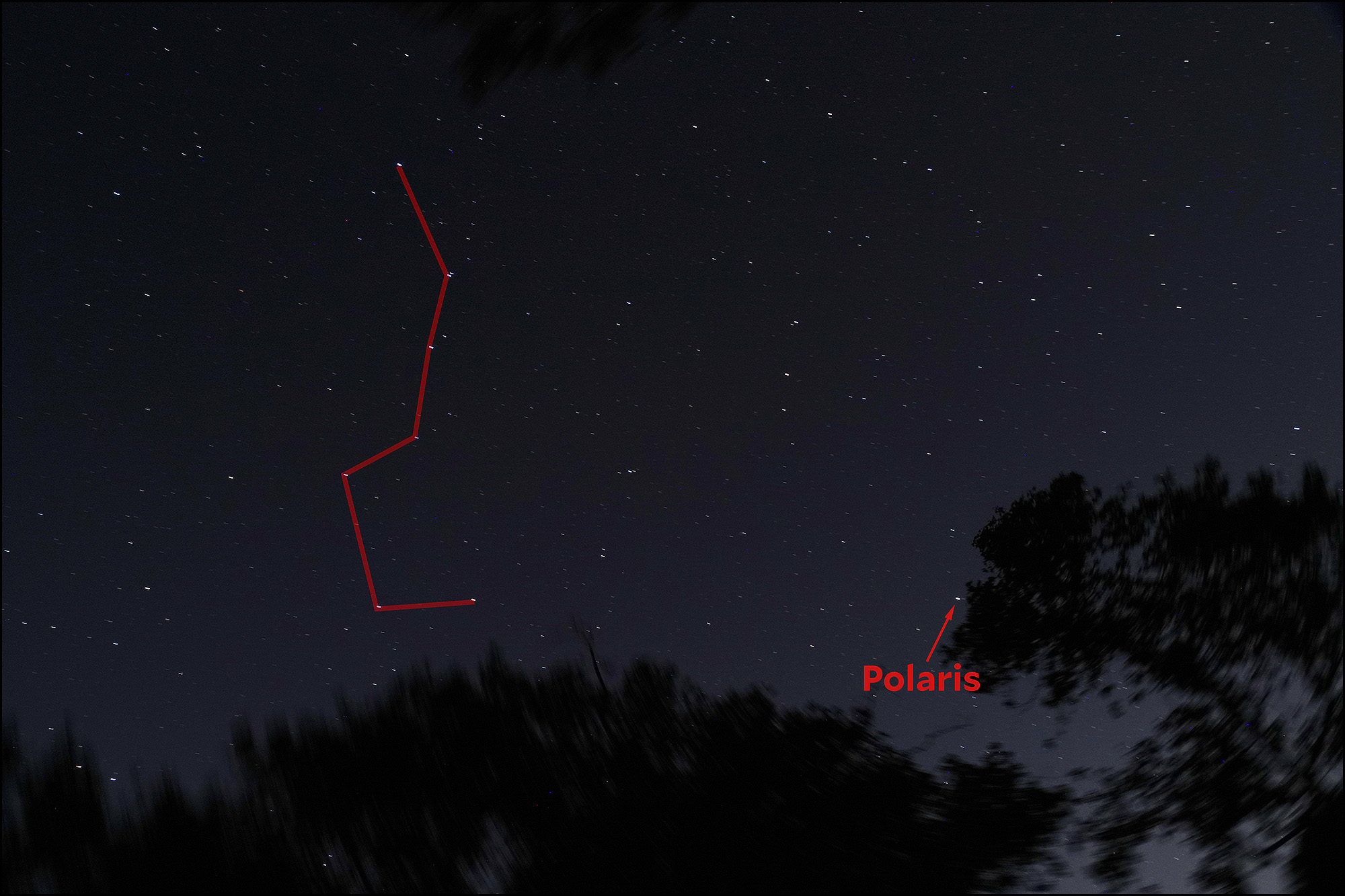
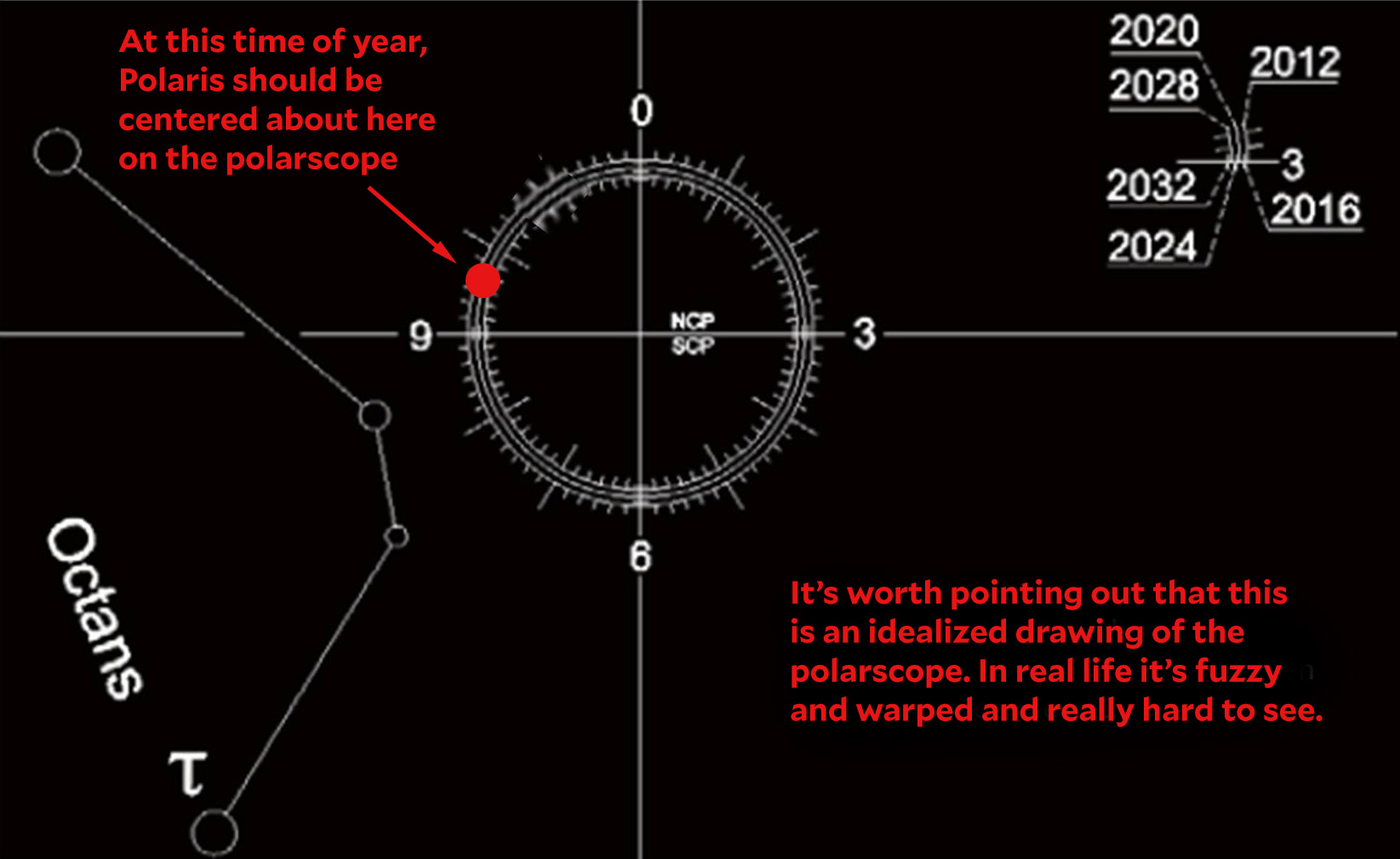
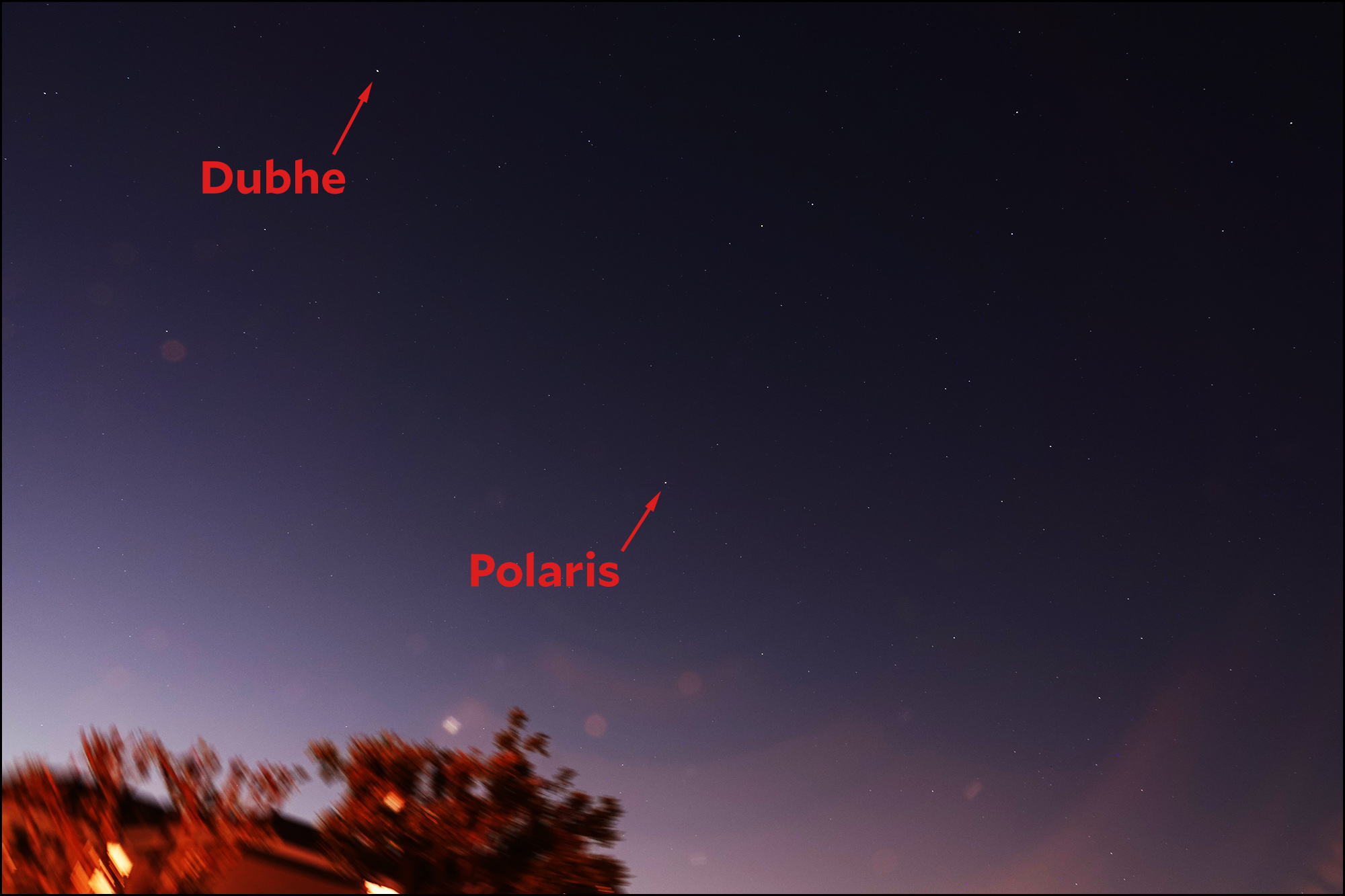
    Ahem. As I mentioned on Saturday, the tracker has to be aimed precisely at the north celestial pole, which is offset slightly from Polaris. I thought I knew the correct offset, but I didn’t realize that it changes with the hour. Nor did I realize that everything is upside-down and backward in the polarscope. In other words, I was basically throwing darts when I lined up the scope and I just got lucky. So last night I bravely left my front yard and went out to an area that’s mildly dark to try again under more realistic conditions. This time I used an app to tell me the proper offset, and everything seemed fine when I sighted Polaris. But here’s what I got:

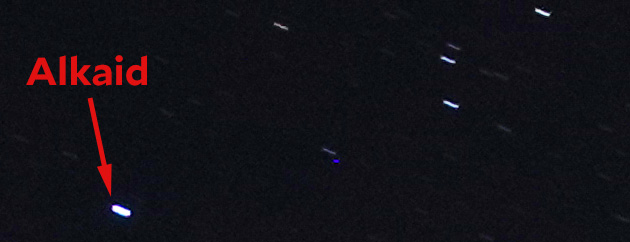
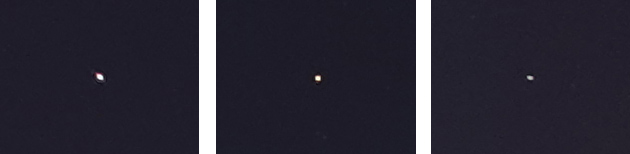
    I tried again and got the same results. You don’t really need a pixel crop to see how bad this is, but here’s one anyway:

    What happened? Did I miss Polaris completely? Maybe I mistakenly had the scope centered on that star just above Polaris (Delta in the Little Dipper?). That’s quite possible. More practice needed!

  • Scott Pruitt Is Sleeping Great These Days on a Trump Mattress

    For chrissake, Scott, it's just a relabeled Serta mattress. Try to contain yourself.Trump Home

    Here’s the latest on our nation’s hardworking EPA chief:

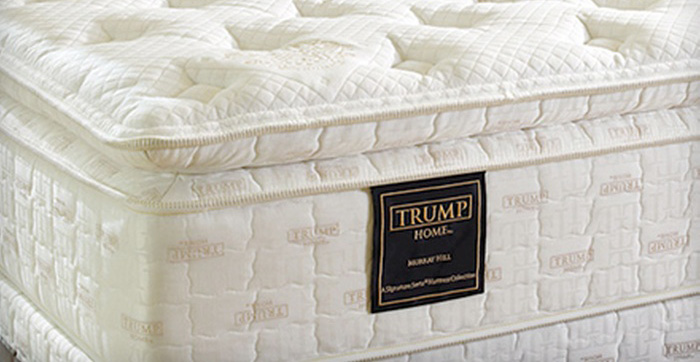
    In mid-September, the Environmental Protection Agency administrator’s director of scheduling and advance, Millan Hupp, contacted the Trump International Hotel in Washington with an unusual request. Hupp wanted to know how much the hotel would charge EPA chief Scott Pruitt for purchasing one of its used mattresses.

    Hupp’s search for a discount “Trump Home Luxury Plush Euro Pillow Top” mattress, which she detailed in a recent interview with congressional investigators, was one of several unusual tasks she performed for the administrator. The senior EPA official also scouted apartments for her boss in some of the District’s hippest neighborhoods and helped arrange his family vacation to California over the New Year’s holiday so that the Pruitts could watch the Oklahoma Sooners play in the Rose Bowl.

    What a brown-noser. How are things going, Scott? Great, Mr. President, thanks to you! Glad to hear it. Well, I got a Trump mattress and I’m sleeping like a baby these days. I chose those mattresses myself, you know. There’s nothing but quality in the Trump brand!

  • Apple May Not Be Quite as Outraged About Privacy as Tim Cook Pretends

    Christoph Dernbach/DPA via ZUMA

    Here is Apple CEO Tim Cook two months ago, slamming Facebook for its invasions of user privacy:

    We’ve never believed that these detailed profiles of people, that have incredibly deep personal information that is patched together from several sources, should exist,” Cook said. Later, he added that those detailed profiles of consumers “can be abused against our democracy. It can be abused by advertisers as well.” Apple has long touted privacy as one of the draws of being in the Apple ecosystem, and Cook underscored this again, claiming that Apple “could make a ton of money if we monetized our customers” but that the company has elected not to do it.

    Today the New York Times reveals that Facebook has long allowed device makers access to “vast amounts of its users’ personal information.” Apple’s response this time comes not from Tim Cook, but from a faceless spokesman:

    An Apple spokesman said the company relied on private access to Facebook data for features that enabled users to post photos to the social network without opening the Facebook app, among other things. Apple said its phones no longer had such access to Facebook as of last September.

    Here are a few more details:

    Some device partners can retrieve Facebook users’ relationship status, religion, political leaning and upcoming events, among other data….Facebook’s view that the device makers are not outsiders lets the partners go even further, The Times found: They can obtain data about a user’s Facebook friends, even those who have denied Facebook permission to share information with any third parties.

    In interviews, several former Facebook software engineers and security experts said they were surprised at the ability to override sharing restrictions. “It’s like having door locks installed, only to find out that the locksmith also gave keys to all of his friends so they can come in and rifle through your stuff without having to ask you for permission,” said Ashkan Soltani, a research and privacy consultant who formerly served as the F.T.C.’s chief technologist.

    ….Facebook acknowledged that some partners did store users’ data — including friends’ data — on their own servers. A Facebook official said that regardless of where the data was kept, it was governed by strict agreements between the companies.

    Apple says it doesn’t monetize its own customers, but apparently they’re happy to monetize Facebook’s. I wonder if Tim Cook’s righteous outrage about privacy violations is real, or if it’s because Apple doesn’t really have any good ways to monetize its limited customer information in the first place?

  • A Few Miscellaneous Charts About Development Aid

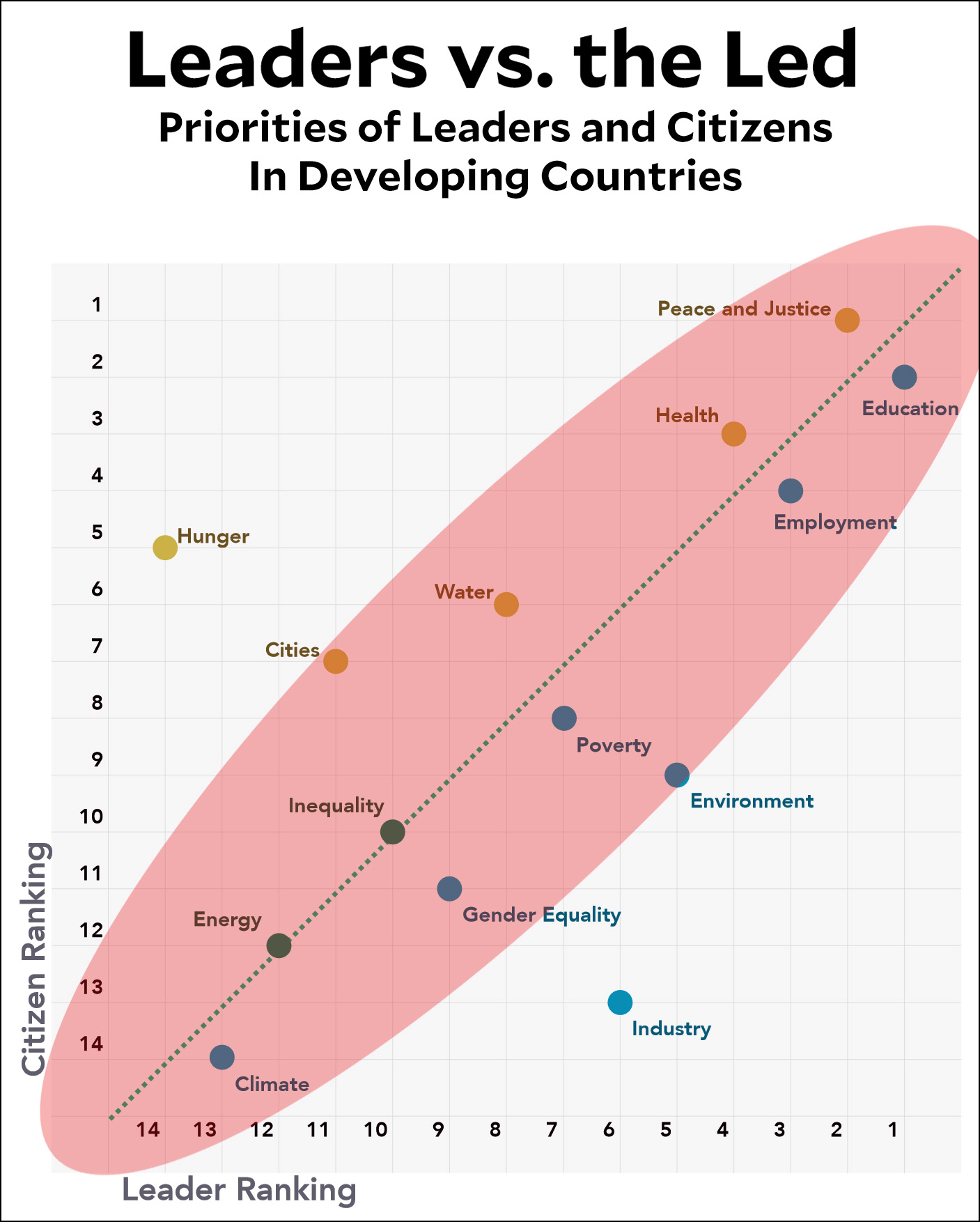
    Here’s a random selection of charts from a report on aid to developing countries that I ran across via Twitter yesterday. It comes from AidData, a research lab at William & Mary. This isn’t a broad summary, just a few interesting factlets I pulled out. For example, here’s a survey of priorities:

    It turns out that leaders and citizens of developing countries mostly have the same priorities. Peace and education are at the top, while climate is at the bottom. But there are two outliers. Citizens are pretty concerned about hunger while leaders couldn’t care less. Literally: it’s their lowest priority out of 14 topics. Conversely, leaders are pretty enamored with attracting industry to their country, while ordinary citizens rank that as practically frivolous.

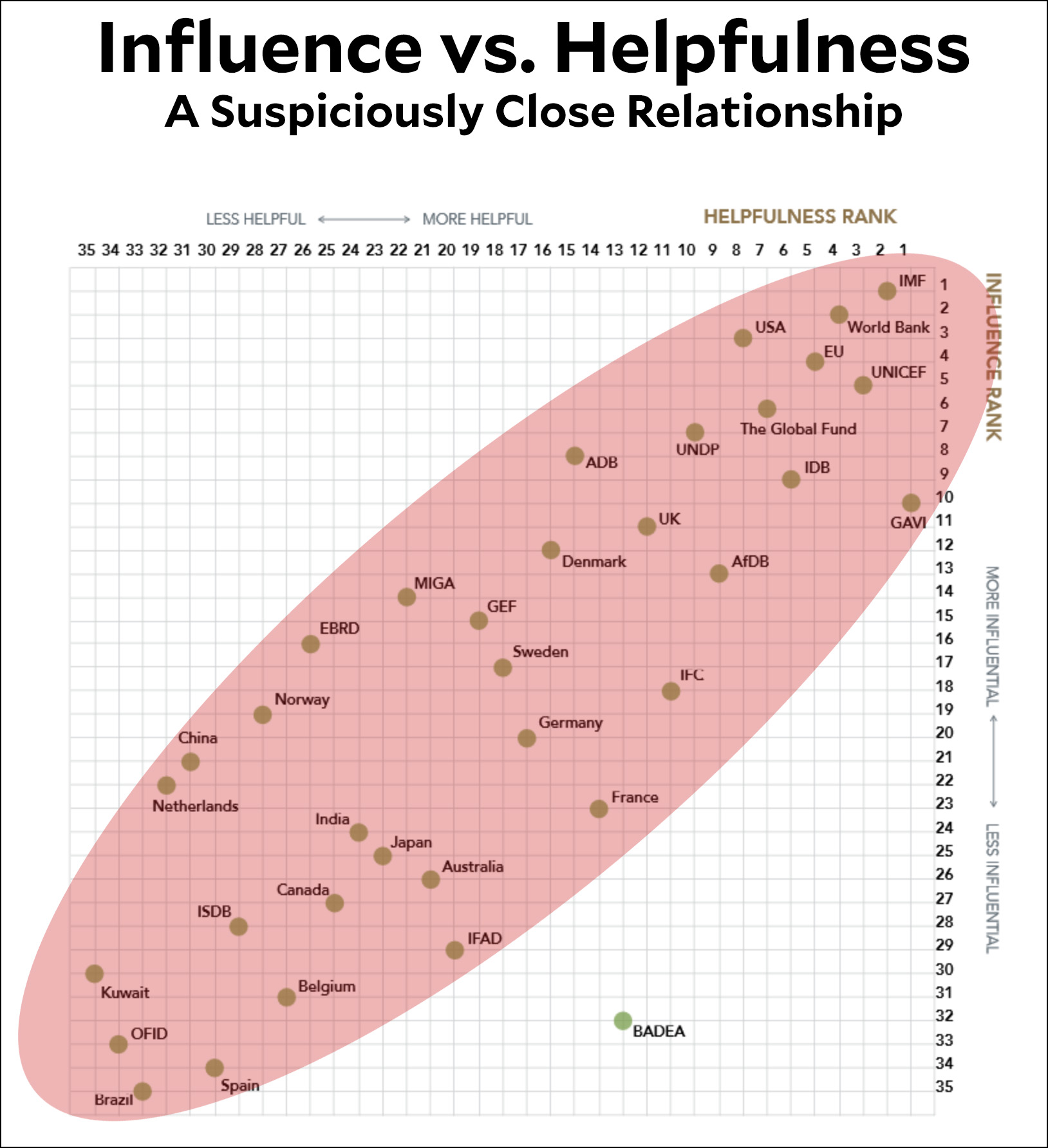
    Next up is a survey of leaders, who are asked to rank both the influence and helpfulness of aid from various countries and organizations:

    This is a suspiciously tight correlation, as if no one wants to insult the influential. If you’re big and powerful, then yes, we think you’re just the most helpful folks around! The only real outlier is Arab Bank for Economic Development in Africa (BADEA), which is viewed as pretty helpful even though apparently no one thinks they have any real influence at all. Bill Gates’ GAVI vaccine alliance also does pretty well on this: it’s viewed as the most helpful organization even though its budget is relatively small and its influence is viewed as modest.

    Finally, here’s a homemade chart that you can all critique. The blue bars show “development aid committed” by whatever metric the report writers have used. The US is on top with $190 billion, followed by Japan at $132 billion and going all the way down to Belgium at $3 billion.

    But I also wanted to invent a sort of Generosity Quotient, something that suggests how much a country can afford to give. Obviously that depends on both GDP and population, but not in a linear way. In particular, big populations suggest a lower GDP per capita, which means a country is relatively poor even if its total GDP is big. After some noodling, I decided on GDP² divided by population. It seemed intuitively about right, but feel free to provide your own ideas. So this explains the orange line, which shows aid as a percentage of each country’s GQ.

    By the GQ measure, the US is fairly stingy (16 percent) while Japan is very generous (73 percent). Other countries are in between. The average is a little above 40 percent, which might be taken as a benchmark of some kind. The anglosphere as a whole could stand to be a little more generous, though they often argue that they should get credit for their outsize military budgets, which help to protect shipping lines, keep the peace, and just generally make the world a more stable place. There’s something to this, though there are pretty obviously some issues with just how much stability the US military, for example, has been responsible for lately. But that’s a subject for another day.

  • Saturday Astrophotography Blogging

    A couple of weeks ago I was out at Anza Borrego and finally took some good pictures of the Milky Way. In fact, I was thrilled at how good they were compared to past attempts. A better camera, a better time of year, and a truly dark spot made all the difference.

    Anyway, I was so excited that I started wondering just how good a picture my camera could take. You can buy very cheap tracking mounts these days that allow you to take long exposures without motion blur from the rotating earth, and unfortunately I recently received a check I wasn’t really expecting. So even though this was a pretty serious waste of $300, I figured why not? Money’s no good if you don’t use it, amirite?

    I ended up buying a Skytracker Star Adventurer plus a few necessary accessories, which brought the bill to $400. The big question with these devices is their accuracy. To work well they need to track the sky smoothly and precisely, or else eventually you get blurred stars. The better they are, the longer they can track. Even though I’m using a wide-angle lens, I figured this one would be good for about two or three minutes max. So last night I went out on the front lawn and tested it. As a picture, this would produce only a horror, since my front lawn is about as light polluted as you can get without literally being in downtown Los Angeles. But as a test of tracking accuracy it would be fine, and being near the house would be handy for my first try.

    The first step is to align the tracker with the north celestial pole as accurately as you can. The pole is slightly offset from Polaris—denoted by an etched circle in the tracker’s polarscope—but the direction of the offset changes with the seasons. There were instructions for figuring out exactly where the pole is relative to Polaris depending on the time of year, but I didn’t understand them. Luckily, I happened to know already: it’s between nine and ten o’clock. So I pointed north, raised the tracker to 34 degrees, and within a couple of minutes I had Polaris centered on the etched circle at the right spot. Or so I thought. Without electronic guidance, this is as much art as science.

    Then I mounted the camera and pointed it in the general direction of the Big Dipper. The tracker comes in half a dozen pieces, which makes it sort of a tottering mess, and my tripod is just an ordinary tripod, not built for super-steadiness. In fact, everything swayed so much at the slightest touch that I began to wonder if it would work at all. But I turned on the motor, eventually got the lens focused, engaged the cable release, and took a picture.

    The first one was two minutes. It looked pretty good in the preview screen, so I took another at four minutes. Then one at nine minutes. Here’s the full frame of the last shot with only some slight exposure correction:

    That looks surprisingly sharp. You can see the blurred foreground due to the tracker motion, but the stars look like precise little dots. Here’s a pixel-by-pixel crop of three stars in the picture, with no retouching at all:

    That’s really good. The star on the left is Dubhe, the last star in the Big Dipper. It’s the one that points to Polaris. It shows some slight elongation, but not much. The middle star is perfectly round. The faint star on the right shows a slight elongation, but even less than Dubhe.

    I should note that I was using a light pollution filter, which actually works. It’s no panacea, but it produced a very noticeable improvement.

    All in all, this is far better than I expected. I wonder if I had beginner’s luck with my celestial pole centering? Next Thursday—evil dex night!—I’ll go back out to Anza to find out, weather permitting. What I’m mainly curious about is how good a job the camera can do using just a single exposure and internal noise reduction. I’m also going to take half a dozen shots in RAW mode and stack them in software to remove the noise. This is how serious skywatchers do it, and I want to see how much better it is than just a plain processed JPG file from the Sony. Stay tuned.