• Kevin Williamson Fired From the Atlantic

    Eric Vance/Planet Pix via ZUMA

    The curtain has rung down on the great Kevin Williamson affair. It turns out that Williamson didn’t propose the death penalty for women who get abortions in just a single angry tweet, but also in greater depth in a podcast:

    Of all the reasons to get fired, this is the craziest. Goldberg didn’t think Williamson was serious about his view of abortion? That’s nuts. Of course he was serious about it. How could Goldberg have somehow convinced himself otherwise?

    Do you remember during the 2016 campaign, when Donald Trump said that “there should be some form of punishment” for women who have abortions? It was obvious at the time that Trump was just freewheeling and had no idea what the pro-life community thought of this. He just figured (a) hey, if abortion is illegal this makes sense, right? and (b) taking the farthest right-wing stance had worked before, so it should work again.

    What he didn’t know was how hard the pro-life community works to not say this. They will talk about abortion being murder. They will talk about it being worse than the Holocaust. They will talk about punishing doctors who perform abortions. But they will never, never take the obvious next step of saying that women who get abortions should be punished. “We need to change the culture,” they’ll say. “Women are victims,” they’ll say. “This isn’t the most effective way to reduce abortions,” they’ll say. Trump was advised of this posthaste and he backed down within a few days.

    It goes without saying that nobody would take this kind of forgiving attitude if we were murdering, say, a million adult Hispanics every year. We would all agree that the murderers should, in fact, be punished, and not lightly. So if abortion really is murder, then punishing women who get abortions is obviously the right thing to do.

    But conservatives are firmly prohibited from saying this because they know perfectly well that everyone would find it heinous—and this prohibition is enforced with an iron fist. Williamson’s crime wasn’t believing that women who get abortions should be hanged, it was saying out loud that women who get abortions should be hanged.

    Personally, I wish Williamson had said this loudly and proudly in the pages of the Atlantic. That would help tear the mask off the duplicity of the anti-abortion movement and expose it for the barbarism that it is. It would be great to see them tearing each other apart over what they really think should happen to women who get abortions. I guess now that will never happen.
  • Kudlow: Calm Down, There Are No Tariffs Yet

    Jeff Malet/Newscom via ZUMA

    From the perspective of Economics 101, everybody hates tariffs.¹ But even among economists, there’s broad agreement that tariffs have one legitimate use: as a weapon to force another country to lower tariffs. Cue Larry Kudlow:

    It’s a funny thing. There are a couple of areas where Donald Trump’s habit of bluster and bullying can be genuinely effective. One of them is illegal immigration: by scaring the hell out of everyone, he probably really has reduced traffic across the border.² Another is trade: by threatening China, he might very well get concessions that others haven’t. But having done the blustering and bullying, I wonder if he can now switch gears and handle negotiations with China with the dexterity to get what he wants? Or does China know that he’s likely to cave as soon as he gets just enough to claim victory on Twitter?

    I suppose we’ll find out soon enough.

    ¹The contemporary liberal case against trade agreements goes beyond Econ 101. Liberals don’t generally favor tariffs, which are already low in any case, but they’re unhappy over things like patent protection and corporate control of the adjudication process. If modern trade agreements were solely about reducing tariffs on goods, there would hardly be anyone opposed to them.

    ²Whether this effect lasts more than a year or two is a whole different question.

  • When Trump Speaks, Wall Street Shrugs

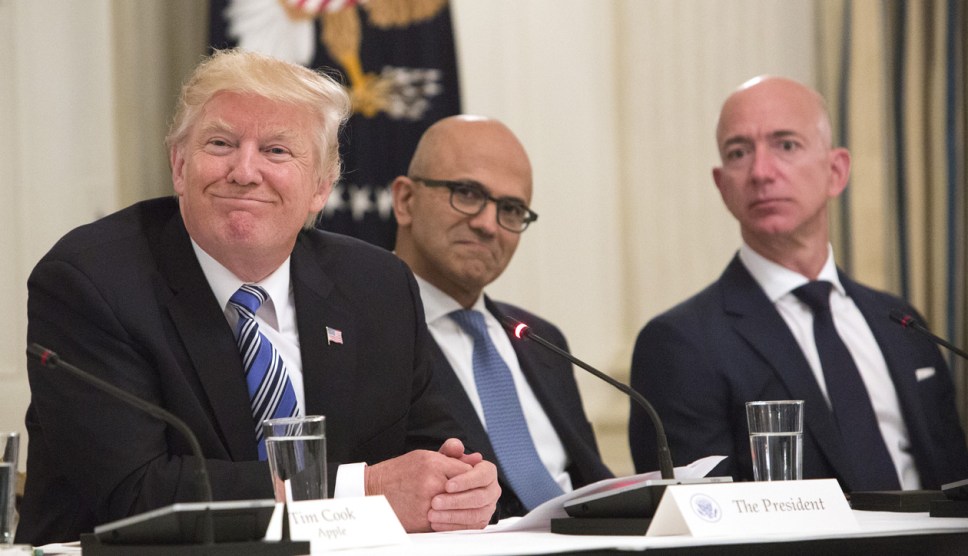
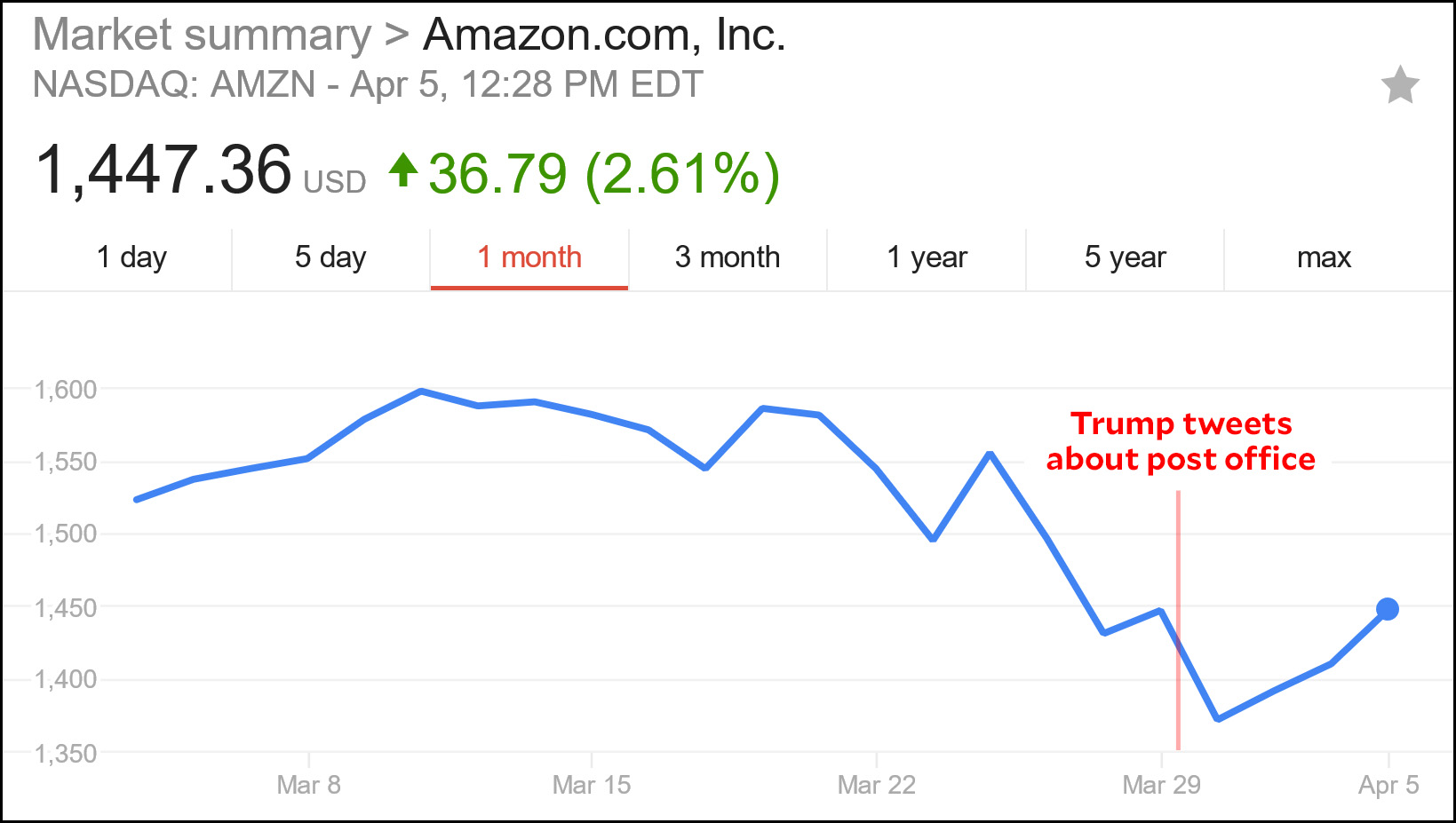
    For those of you who are worried about the president of the United States attacking a corporation out of personal pique—Amazon is the latest—you’re right to be worried. But as with every other time Trump has done this, you probably shouldn’t be too worried:

    We’ve seen this movie before: Trump says or tweets something about somebody, the target’s stock price briefly goes down, and then a couple of days later it goes back up. This happens so reliably you could probably make money from it if you invested regularly in companies that Trump attacks.

  • Pruitt Went Behind Trump’s Back to Give Aides Big Raises

    Mitchell Resnick/Planet Pix via ZUMA

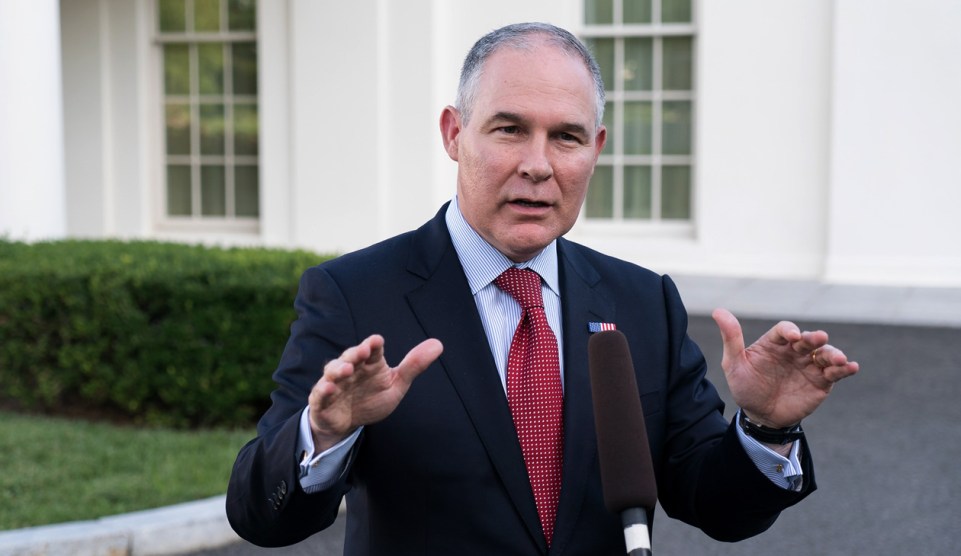
    EPA administrator Scott Pruitt is quite the operator. He hired a couple of his close aides from Oklahoma, and then asked the White House for permission to give them big pay raises. He was turned down. So he gave them big raises anyway:

    A provision of the Safe Drinking Water Act allows the EPA administrator to hire up to 30 people into the agency, without White House or congressional approval….After the White House rejected their request, Pruitt’s team studied the particulars of the Safe Drinking Water provision, according to the source with direct knowledge of these events. By reappointing Greenwalt and Hupp under this authority, they learned, Pruitt could exercise total control over their contracts and grant the raises on his own.

    Pruitt ordered it done. Though Hupp and Greenwalt’s duties did not change, the agency began processing them for raises of $28,130 and $56,765, respectively, compared with their 2017 salaries. Less than two weeks after Pruitt had approached the White House, according to time-stamped Human Resources documents shared with The Atlantic, the paperwork was finished.

    Pruitt may be one of Donald Trump’s favorites, but Trump does not like people going behind his back to do the kind of stuff that Trump himself does. Plus, this whole business with the $50/day apartment he scored from a lobbyist friend is looking worse and worse. Trump obviously doesn’t care that Pruitt is hellbent on wrecking the environment—it pisses off the liberals, so that’s fine—but one of these days Pruitt’s shenanigans are going end up on the cover of Time, and Trump will finally decide that he’s tired of being upstaged. That’s how you get fired in Trumpland.

  • Don’t Mistake the Fading Echoes of Boomer Culture for the Roar of the Crowd

    Sure, he's still alive, but it's hard to ignore the wrinkled mien, isn't it?Sven Hoppe/DPA via ZUMA

    Ross Douthat uses the big ratings debut of the Roseanne reboot to argue that baby boomers still utterly control our culture:

    The same week that “Roseanne” hit it big, the number one movie in America was Spielberg’s “Ready Player One” — an aging boomer director telling a story saturated in nostalgia for the pop culture that defined his peak artistic years. And the big Easter television event was the live performance of “Jesus Christ Superstar,” a musical that the baby boomer Andrew Lloyd Webber wrote at the tender age of 22….Now it’s just boomer culture all the way down. And since that culture is, for all its creaking repetitiousness, our only common culture at this point, it would not be surprising if we find ourselves still clinging to it even once its progenitors are gone.

    You can make practically any point you want if you cherry pick a few observations and ignore everything else. Sure, there’s nostalgia for boomer-era entertainment. Why wouldn’t there be since lots of boomers are still alive? But there’s also nostalgia for I Love Lucy, and the same week that Roseanne hit it big, The Ten Commandments was on TV as usual. A couple of years ago we were all agog over a sequel to To Kill a Mockingbird. Today we’re celebrating the life of Martin Luther King Jr.

    That’s all from the generation previous to boomers. Skipping forward, the most omnipresent aspect of modern pop culture is probably the Kardashian family. The number one movie in America for this entire year has been Black Panther, directed by a 31-year-old black man. Teen culture is saturated with Harry Potter, the Hunger Games, Twilight, and a truly astonishing mountain of decidedly non-boomer dystopian fiction. Contemporary feminist and racial discourse is driven almost entirely by Gen X and younger. What’s more, contemporary cultural discourse in general is driven largely by social media, which is very much a post-boomer phenomenon.

    And while we’re at it, let’s not forget the steady stream of nostalgia-based entertainment that sank into oblivion almost as soon as it was released. Remember Pan Am?

    Douthat claims that “boomers, for all the destruction trailing in their wake, might be the only thing holding American culture together at this point.” Please. Like all generations, boomers continue to keep the fading echoes of their youth alive. But this hardly means that boomer culture is hegemonic. It’s not even close.

  • Does Cell-Phone Radiation Help You Live Longer?

    A few days ago the Nation ran a cover story titled “How Big Wireless Made Us Think That Cell Phones Are Safe.” The authors say that their article “does not argue that cell phones and other wireless technologies are necessarily dangerous; that is a matter for scientists to decide.” Rather, it’s focused on the long campaign from the cell-phone industry to downplay and cover up studies that suggested any danger.

    I finally got around to reading the article this evening, and toward the end it mentioned that we were still waiting for the final report of the National Toxicology Program, a rigorous study of cancer in rats exposed to cell-phone radiation. That got me curious, so I found the final draft report, released a few weeks ago, and read through it. The study found that a very small number of male rats exposed to radiation developed malignant gliomas, though oddly, there was no dose-response effect: rats exposed to low levels of radiation developed gliomas at the same rate as those exposed to high levels. In any case, the overall effect was not statistically significant. Female rats showed no ill effects at all. The same was true for schwannoma tumors (which are often benign): male rats showed a small increase while female rats didn’t.

    The report concluded that there was “some evidence” of carcinogenic activity based on the increased number of schwannomas, though it was fairly low and restricted to males. However, there was also this:

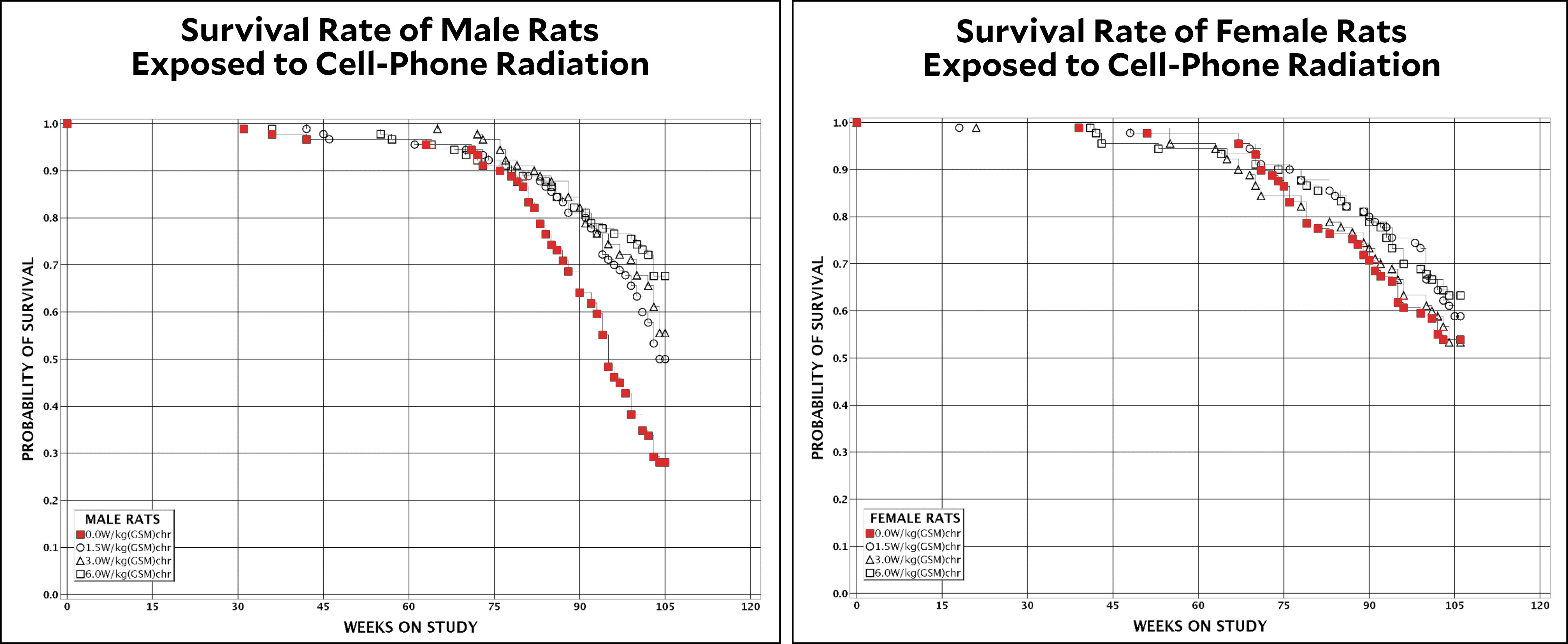
    In males, survival was greater in all exposed groups compared to sham controls, though it was statistically significant only in the 1.5 and 3 W/kg groups. Survival in the sham control group was 28% compared to 48%, 62%, and 48% in the 1.5, 3, and 6 W/kg groups, respectively.

    Wait. The male rats exposed to radiation lived longer? Yep. Here’s Figure 8:

    By the 105th week, males exposed to the highest levels of radiation had a survival rate of about 70 percent. Those exposed to no radiation (the red dots) had a survival rate of 30 percent. Among female rats, survival rates were similar for all groups. (The chart above is for GSM phones, but the results were pretty much the same for CDMA phones.)

    The authors attribute the lower survival rate of the control group to “higher severity of chronic progressive nephropathy in the kidney,” a common disease in the strain of rats used in the test. But there’s more: not only did the exposed rats have a lower severity of nephropathy, but the higher the exposure the less the nephropathy. In the discussion section, the authors say this suggests “that the decrease in chronic progressive nephropathy may have been related to cell phone RFR exposure,” possibly via “suppression of inflammatory processes through stimulation of stress response pathways.”

    I’m not sure what we should make of this. The peer review of the report was held last week, and the review panels voted to accept the conclusions of the study. However, there doesn’t seem to have been any discussion of the higher survival rates of male rats exposed to radiation. How peculiar.

  • Trump Wants Do-Over on Spending Bill

    ABC News reports that President Trump may ask Congress to use its recission authority to slash some of the programs in the $1.3 trillion spending bill it passed a couple of weeks ago:

    Trump has been talking with House Majority Leader Kevin McCarthy, R-Calif., about the plan over the past couple of days, according to an aide to the House leader who spoke on condition of anonymity to discuss the private talks….The idea emerged as lawmakers get hammered back home for the $1.3 trillion spending package that, while beefing up funds for the military, also increases spending on transportation, child care and other domestic programs in a compromise with Democrats that Trump derided as a “waste” and “giveaways.”

    ….[McCarthy’s spokesman] didn’t specify how much spending could be rescinded or in what categories. But Trump would likely seek to focus on domestic spending he has attacked in recent tweets.

    If Trump actually goes through with this, I have no doubt that his request will be focused primarily on poor people. A recission bill requires a majority vote in the Senate, which means that Republicans have to stay united to pass it. Aside from spending on poor people, I’m not sure there’s anything else that they hate almost unanimously.

    The big problem, of course, is that plenty of people in the Senate made commitments to Democrats on the spending bill. If they break those commitments, how will they ever get agreement on a budget in the future? For this reason, I think that passage in the Senate is pretty unlikely.

  • Lunchtime Photo

    Family week reaches hump day with this pick from my mother. It’s a picture of a Dublin streetlight at dusk. However, the pinkish cast to the light is solely the result of Photoshop.¹ Please don’t visit Dublin and then get mad when night falls and the streetlights are just plain old white, like they are everywhere else.

    ¹Why did I do this? Because I felt like it. What other excuse do great artists need?

    October 23, 2017 — Dublin
  • Trump vs. Amazon In Exactly 100 Words

    Chris Kleponis/CNP via ZUMA

    I think I’ve now read upwards of a dozen articles about whether Amazon pays a fair rate for shipping its packages via the post office. It’s insane. The journalists of America are apparently required to write detailed explainers about every single stupid thing that Donald Trump tweets. They do this even when they know that Trump is motivated solely by personal animus, not by any serious policy preference.

    Here is everything you need to know in 100 words. In every business, there are centralized departments—factories, billing, computer services, etc.—that are used by lots of different product lines. The cost of these common services has to be allocated across different products, and the post office is no different. It has lots of costs—trucks, planes, distribution centers—that are used by all their product lines: first class mail, priority mail, packages, etc. The question is: are they allocating these costs properly to their package business? If their allocation is low, they can charge less for package delivery while still making it look like they’re turning a profit.

    That’s it. It’s a technical question of cost accounting, and as I can tell you from personal experience, every product manager lobbies creatively to get their allocations as low as possible. The Postal Regulatory Commission believes the current allocations are OK, but if you put your mind to it you can come up with nearly any allocation formula you want. As it turns out, some guys from Citigroup did exactly that and came up with a higher allocation formula for packages. This allowed them to predict that USPS package charges would eventually have to go up and therefore FedEx would get more business, which made FedEx a great buying opportunity. Given the history of Wall Street firms finding creative ways to hype their stock picks, you may decide for yourself whether to believe this.

    As for Trump, who cares? He saw this on Fox News and tossed off a tweet because he hates Jeff Bezos. Why does he hate Bezos? Because Bezos (a) really is a self-made billionaire, and (b) he owns the Washington Post. Everybody knows this. Can we all stop pretending that cost accounting for the USPS package delivery business is a genuine story that we should all be concerned about?