The Washington Post puts some numbers to a story that we’ve known for a while: EPA director Scott Pruitt flies first class a lot. He also has a much bigger security detail than most heads of cabinet-level agencies:
On Monday, June 5, accompanied by his personal security detail, Pruitt settled into his $1,641.43 first-class seat for a short flight from the District to New York City….Raced to New York on a military jet, at a cost of $36,068.50, to catch a plane to Rome….Met with papal officials, business executives and legal experts…cost at least $90,000….That figure does not account for the costs of Pruitt’s round-the-clock security detail, which have not been disclosed.
….In an interview Friday, Bowman said the agency doesn’t release Pruitt’s schedule in advance “due to security concerns” and because it could be a “distraction” from the trips….The agency records show that wherever Pruitt’s schedule takes him, he often flies first or business class, citing unspecified security concerns. The EPA’s assistant inspector general for investigations told The Post in September that Pruitt has gotten a higher number of threats than his recent predecessors.
….“It is acutely paranoid,” Schaeffer said of the EPA’s refusal to disclose Pruitt’s whereabouts on any given day….Last week, for instance, Pruitt surfaced in Florida, to the surprise of reporters who cover the EPA and even media outlets in the state. An official said the agency notified some local and national outlets. The EPA has also declined at times to confirm in advance Pruitt’s speaking engagements to various industry and political groups.
Personally, I wouldn’t really have a problem if cabinet-level officials were allowed to travel business or first class. Rank hath its privileges and all that. But the security stuff is crackers. Does Pruitt just like the status of having a bunch of security guys around at all times? Is he truly paranoid that someone might want to assassinate the head of the EPA? Does he keep his trips secret because he doesn’t want the press around, or to reduce the chances of being assassinated? Did he insist on all this stuff back when he was just a minor state official in Oklahoma?
A week ago I posted a picture of some contrails that seemed like they were rising at a surprisingly steep angle. I got convinced pretty quickly that, in fact, this is just an optical illusion created by a plane coming around the curve of the earth from south of here. And of course, that’s what it is. Here’s a pair of pictures I took from my backyard this morning:
So, fine, they’re just airplanes. But I do still have a question. Unless I’ve completely lost my mind, I don’t recall seeing contrails like this until recently. Then, starting a couple of months ago, I started seeing them all the time. What’s up with that? I assume that they only show up when the sun is nice and bright and shining from the right spot in the sky, but surely it’s been doing that for the past 50 years? Even if it’s a seasonal thing, it’s been doing it for the past 50 winters. So why have I only recently noticed this? Is it really just a case of me being completely oblivious for the past few decades?
A whole bunch of people have emailed to ask what I think of Adam Gopnik’s latest piece in the New Yorker, “The Great Crime Decline.” It’s a review of Patrick Sharkey’s new book, “Uneasy Peace: The Great Crime Decline, the Renewal of City Life, and the Next War on Violence.” Sharkey’s basic point is that crime is bad, a view that I hardly need to be convinced of, but he seems to have an unfortunately conventional view of why it declined so much in the 90s and aughts:
What made the crime wave happen and what made it halt?…[Sharkey] is an enthusiast of the hypothesis that local community organizing was a key factor in the crime drop….He also finds that incarceration accounted for some of the crime decline, and so did more aggressive policing.
….Sharkey, as good as he is at explaining what happened—whom it helped, what it permitted—isn’t as good at explaining why it happened. The curious truth is that the decline in crime happened across the entire Western world, in East London just as it did in the South Bronx. At the same time, the relative decline in New York was significantly bigger than elsewhere. Sharkey’s guess that the crime decline can be attributed to the uncomfortable but potent intersection of community action and coercive policing seems about as good as any….With the crime wave, it would seem, small measures that pushed the numbers down by some noticeable amount engendered a virtuous circle that brought the numbers further and further down.
….We cured the crime wave without fixing “the broken black family,” that neocon bugaboo. For that matter, we cured it without greater income equality or even remotely solving the gun problem. The story of the crime decline is about the wisdom of single steps and small sanities.
In some sense I don’t blame Gopnik for this. He’s primarily an essayist and critic, not a social scientist or a reporter who specializes in urban policing. At the same time, reviewing a book in an unfamiliar field and then shrugging his shoulders and saying the book’s guess about crime “seems about as good as any”—well, even an essayist might think about spending an hour or two googling to get up to speed on alternate theories.
Sharkey, of course, is a different matter. For some reason he doesn’t explain, he dismisses the effect of lead as “vastly overstated” and says he finds it “difficult to believe” that the crime decline was caused by either lead or any other exogenous shock. Ten years ago that would have been fine. Today it’s journalistic malpractice. And the weird thing is that if Sharkey had spent any time with the lead-crime hypothesis, he would have found that it was practically made to order for him. Check this out:
A real problem, going forward, is the one identified by Black Lives Matter and associated groups: police violence. As the social cost of stop-and-frisk and mass incarceration has become, rightly, intolerable, we ask if the crime decline, with its unprecedented benefits for the marginalized populations, can survive. Sharkey emphatically thinks it can, and so far there’s no evidence to counter his view.
….Effects that we don’t normally track are surely related to the crime decline, not least the rise of the Black Lives Matter movement itself. Without a general understanding that crime was no longer the real problem but that the response to crime might be, the movement could not have caught a surprisingly large, sympathetic audience….Ironically, though the urban crime wave is over, it still persists as a kind of zombified general terror, particularly in places where it was never particularly acute.
Sharkey very much wants to persuade us that the crime decline is permanent, and that we should change our policing and incarceration strategies to recognize this. He’s absolutely right, but the best evidence for this is the lead-crime connection. It was lead that poisoned young brains and produced a generation of criminals. With the lead mostly gone, young people today are back to normal. They just aren’t as dangerous as they used to be, and that change is permanent. It’s really peculiar that Sharkey dismisses this, given how strongly it reinforces his point. It’s also peculiar since it explains otherwise mysterious things like the fact that crime declined throughout the world, not just in the United States.
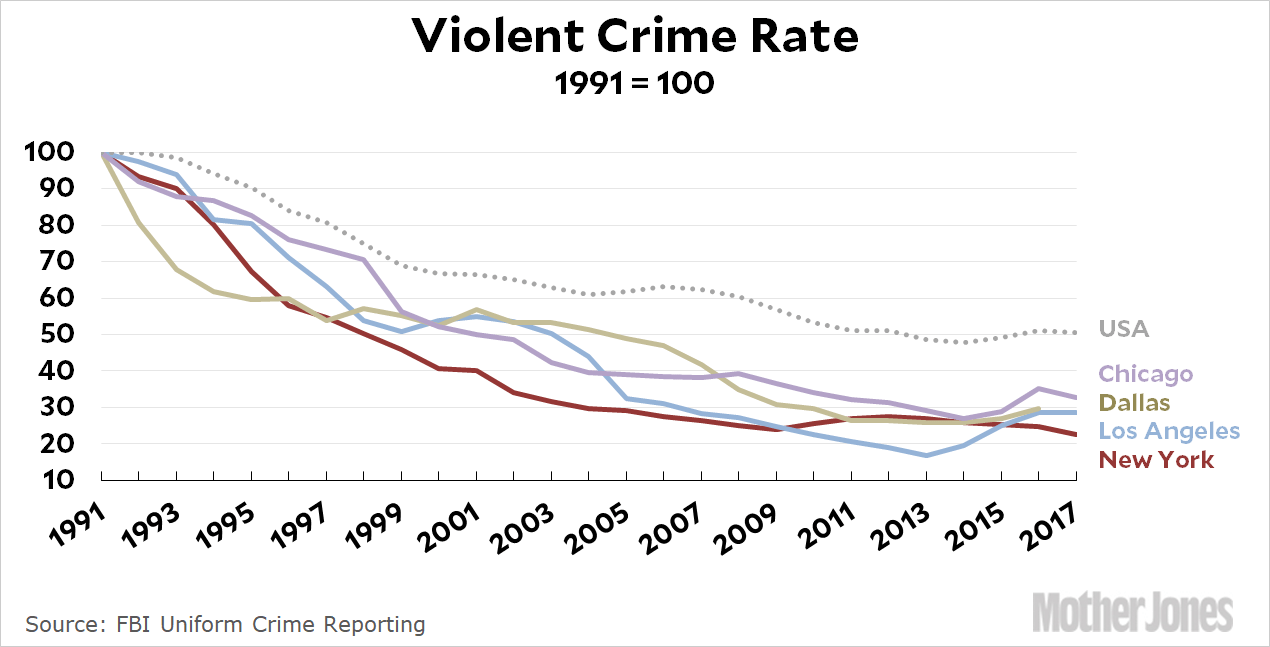
But in another way, this isn’t surprising. I don’t understand why this is so, but for some reason New Yorkers seem to be especially resistant to recognizing lead as a prime cause of crime. Part of this, I suppose, is that New York was ground zero of the great crime wave and New Yorkers have been bombarded with theories about crime for decades now: Bill Bratton, CompStat, Rudy Giuliani, broken windows, community policing, stop-and-frisk, the breakdown of the black family, etc. etc. More than any other city, they’ve been told over and over and over that the great crime decline is due to various interventions by the great and good. But the truth is that although New York’s crime rate fell faster than the national average, it didn’t fall any faster than it did in other big cities, all of which have seen violent crime rates drop by 70-80 percent since 1991:
I don’t know why Sharkey so casually dismisses the effect of lead, since it explains so much: the overall decline in crime; the decline in different cities with different policing strategies; the international decline in crime; the fact that crime rose and fell more in big cities than in rural areas; and the fact that crime rose and fell more among blacks. No other theory comes close to explaining all this, or to explaining why crime rose in the first place. In the end, it’s hard not to conclude that Sharkey, like so many people, simply doesn’t want to believe in an exogenous explanation. He wants the answer to reside in the actions of human beings, and so that’s the explanation he chooses even though it doesn’t even come close to fitting the available evidence.
POSTSCRIPT: I do want to add a caveat to this. The lead era ended around 2010. By that time, every age cohort from 0-30 had been born in a low-lead environment, and further lead reductions had little role to play in crime rates. What that means is that for the past decade or so, human interventions really have been key to whatever declines or increases we see. Ironically, when the great crime wave was at its peak, we paid a ton of attention to the sociological determinants of crime even though it turns out they didn’t matter much. Now that it’s over, though, they do matter. All the stuff Sharkey talks about probably had little to do with the great crime decline, but they have plenty to do with the rate of crime going forward.
In my lead-crime roundup a few days ago, I mentioned that one of the only open critiques of the theory comes from cohort studies. This requires a little bit of explanation, so bear with me.
After the end of World War II, we started spewing lead into the atmosphere at increasing rates as more and more people drove cars. As a result, lead poisoning of infants got worse and worse up until around 1970. What this means is that if you look at crime statistics, you should see that the cohort of children born in 1970 are more crime prone than those born in 1950. Unfortunately, we don’t have crime figures by age for that era, so there’s no way to test this.
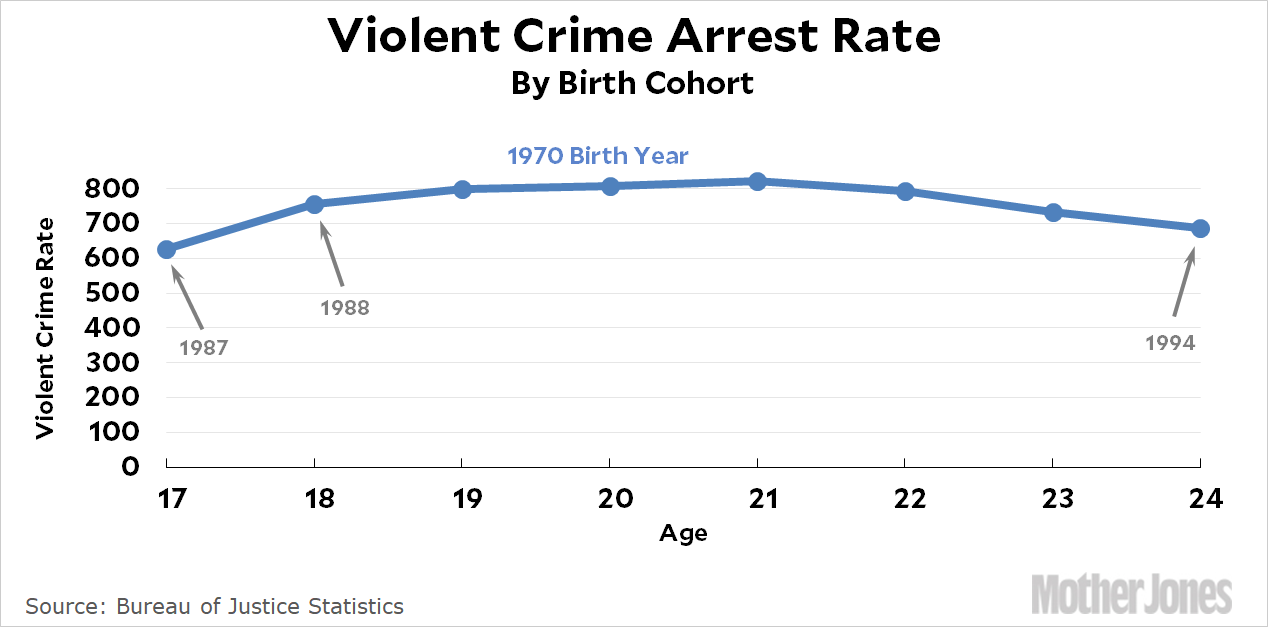
However, we do have that data starting in 1980. This is data for crimes committed in 1980 by teenagers, so it includes the cohort born in 1970, the peak lead year. We can then follow that cohort over time. Here’s what it looks like:
Basically, we’re looking at violent crime rates for 17-year-olds in 1987, 18-year-olds in 1988, and so forth. We can also do the same for other cohorts and then compare them. Before I do that, however, there are some caveats:
You can’t compare cohorts that are close together. Crime data is noisy, and lead is only a part of the explanation for crime. The difference between, say, kids born in 1970 and kids born in 1973 is just too small to compare. Other things will drown out the differences.
Increases in lead poisoning aren’t the main reason crime rates kept going up through the early 90s. That played a role, but the main driver of the big crime wave is the fact that we accumulated more and more cohorts that were lead poisoned. By 1985, for example, pretty much every age group from 15 to 25 was heavily lead poisoned. The same was true in 1980 and 1990, so you wouldn’t expect to see big differences in crime rates between those years. Once every age cohort is lead poisoned, crime is going to be really high, and it will get only modestly higher each year as the amount of lead poisoning slowly increases.
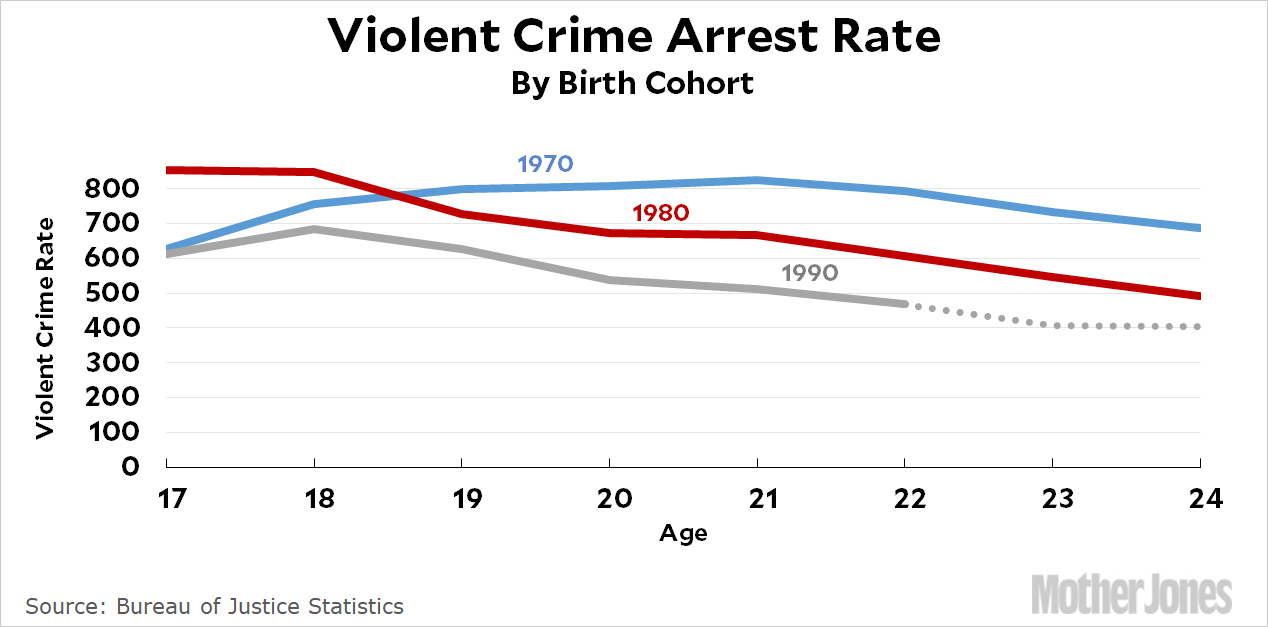
I hope this all makes sense. I’ve never seen the arrest data by age before, so this was genuinely new territory for me and I was pretty interested to see what it would look like. Here it is for the 1970, 1980, and 1990 birth cohorts:
I chose cohorts that were a decade apart in order to see real differences. And sure enough, this fits with the lead-crime hypothesis. Compared to the kids born in 1970, children born in 1980 were a little less lead poisoned and had generally lower crime rates. Children born in 1990 had even lower crime rates. I don’t show it in the chart above, but the earliest cohort we have records of, 1963, also has lower crime rates than the 1970 cohort, just as the theory predicts.
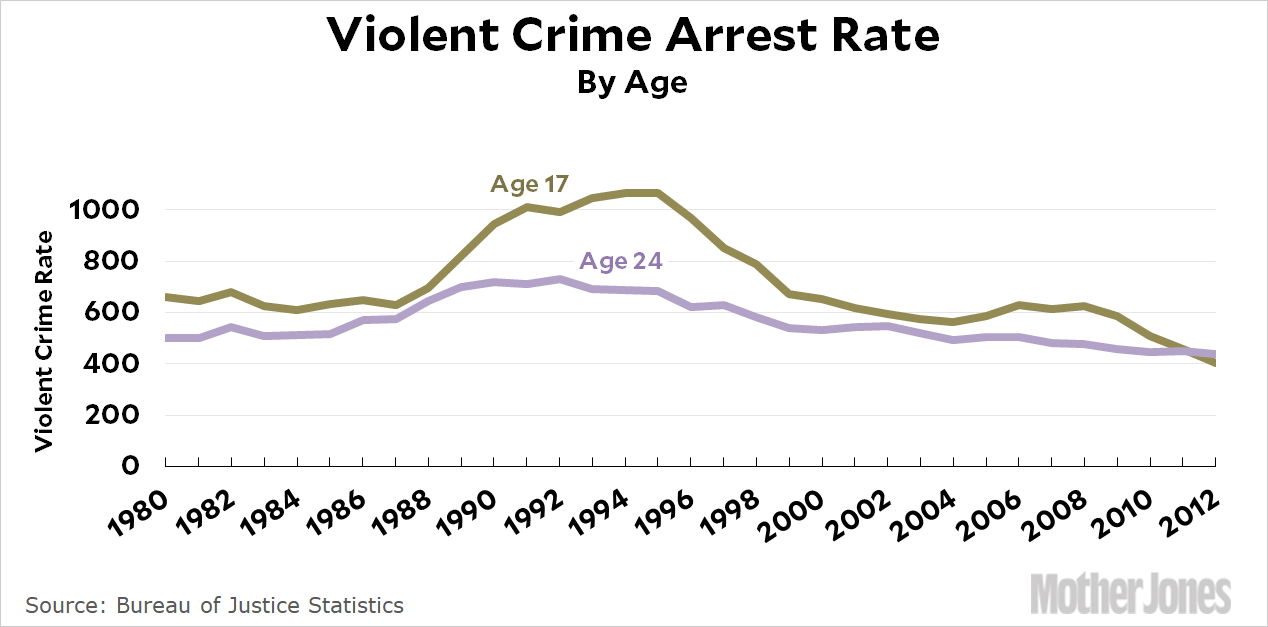
So far, so good. However, there’s another way to look at this data: by age. That is, we can look at 17-year-olds over time and compare them to 24-year-olds over time. Here’s what this looks like:
If 1970 is the peak lead year, theory predicts that the peak crime year for 17-year-olds should be 1987. For 24-year-olds it should be 1994. That’s obviously not what this chart shows. This might be because the data is noisy and it just can’t resolve differences of only seven years. But unless I’ve done something wrong, it doesn’t support the lead-crime hypothesis.
On the other hand, it’s widely known that the crack epidemic of the late 80s drove higher crime rates independently of lead. Starting around 1987, crime rates among 17-year-olds (born in 1970) went up far more than crime rates among 24-year-olds (born in 1963). That is what the lead-crime hypothesis predicts. Once you account for crack, perhaps the age chart does support the lead-crime hypothesis after all. Needless to say, this is the kind of thing that makes crime analysis so difficult.
Anyway, this is just a quick, amateur look at the data. There’s probably more sophisticated analysis that could tease out the cohort effect a little better. For now, though, I’d say that basic cohort analysis supports the lead-crime hypothesis, while age analysis might not.
The age analysis results are especially peculiar given that incarceration data shows a very clear, very strong cohort effect. Incarceration has been declining for years, and the decline is much bigger for younger ages, which were the first ones to be born in a less lead-poisoned environment. Since incarceration is obviously closely linked to arrests, this means arrest data should also show a decline first for younger age groups and only later for older age groups. More research, please!
My camera does many wonderful things, but it’s just not good enough to capture good quality photos of hummingbirds. It’s one of life’s little compromises. However, I did get a nice pair of photos the other day. This is a very handsome little hummingbird, and I happened to get lucky and catch a frame of it flying away. It’s amazing how fast those wings beat, and amazing how fast they accelerate from a standing stop. These photos were taken at a shutter speed of 1/1600th of a second, and the wings are still a blur!
TGIF, am I right? Time to relax from the craziness of the week, put up my feet, and maybe watch a little—
What’s that? I should look at the news first? Well…OK. Let’s see what we have.
Another White House aide has been fired/resigned due to reports of domestic violence. This time it’s David Sorensen, a speechwriter who worked under Stephen Miller. According to his ex-wife, “he ran a car over her foot, put out a cigarette on her hand, threw her into a wall and grasped her menacingly by her hair while they were alone on their boat in remote waters off Maine’s coast, an incident she said left her fearing for her life.” Sorenson denies it all.
Donald Trump is reportedly so pissed off at chief-of-staff John Kelly that he’s thinking of firing him. Kelly has reportedly said he’s willing to step down if Trump asks him to. Possible replacements include Mick Mulvaney and Gary Cohn.
The #3 official in the Justice Department, Rachel Brand, is leaving to go work for Walmart. Apparently she figured her career might end up in ruins if she stayed. I wonder what could have given her that idea?
After releasing the Nunes memo without so much as a single redaction, Donald Trump has refused to release the Democratic rebuttal. It’s just too sensitive, you see. Surely someone is going to leak it before long?
I guess that’s it. Even the Friday news dump is bigger and better under Trump. Now can I start my weekend?
Here’s a break from the same old cats. This is Tillamook, one of my mother’s cats. He was snoozing under one of his favorite drought-tolerant plants in the front yard when I came by to disturb him with my clicky-clacky camera. He deigned to pose for a few seconds, and then turned back around and curled up.
Mother Jones illustration; Photo by Cheriss May/NurPhoto via ZUMA
Rob Porter may be gone thanks to his history of domestic violence, but the White House continues to slip on its own banana peels. Today the Washington Post adds another tidbit to the “John Kelly is a liar” file:
During a staff meeting [this morning], Kelly told those in attendance to say he took action to remove Porter within 40 minutes of learning abuse allegations from two ex-wives were credible, according to the officials….“He told the staff he took immediate and direct action,” one of the officials said, adding that people after the meeting expressed disbelief with one another and felt his latest account was not true….At Friday’s meeting, Kelly also told subordinates to convey to other White House aides he cares about domestic violence, according to the officials.
I think it’s safe to say that (a) Kelly lied to his own staff about how quickly he took action, and (b) he lied about giving a shit about domestic violence.
Meanwhile, President Trump says it’s a sad time for Rob Porter and a sad time for the White House. Is it a sad time for the abused women too? Not so much. After all, Trump said, Porter claims he’s innocent. So, you know, maybe nothing happened.
While we’re on the subject, isn’t it odd that the White House never tried to defend Porter after news of his abuse became public? In cases of sexual harassment, you’re dealing with professional misconduct. It makes sense to fire someone who acts badly with subordinates. But you can make a case that (a) Porter’s actions were entirely private, (b) his second wife enthusiastically recommended that the White House keep him, (c) the actions were in the past and Porter regrets them, and (d) he deserves a second chance. Maybe you could even claim that Porter has gone through counseling¹ and then trot out Hope Hicks to say he’s been nothing but a total gentleman with her. I don’t know that this is a great case, but it seems like something you might at least try. Why didn’t they?
¹I assume this isn’t true, but that’s obviously never made a difference in the Trump White House.
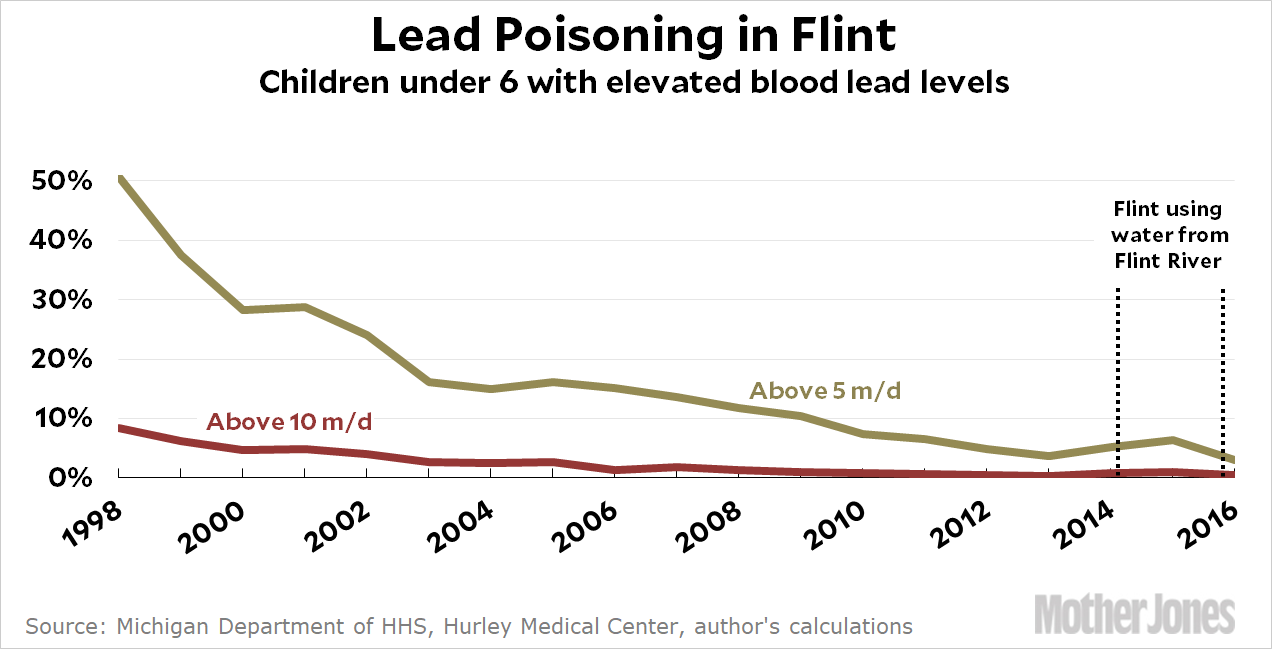
Another Outrage in Flint: Third-Grade Reading Levels Plummet by 75% After City’s Water Poisoned by Lead
The article goes on to say that grade-level reading proficiency dropped from 41.8 percent in 2014 to 10.7 percent in 2017. Sure enough, that’s a 75 percent drop. Case closed?
Nope. All by itself that figure should make you suspicious: a modest increase in lead ingestion simply shouldn’t have that big an effect. And sure enough, it turns out that proficiency for the entire state of Michigan dropped from 70 percent to 50 percent in the single year between 2014 and 2015. Why? Because Michigan put in place a new, more difficult test in 2015. Test scores dropped all over the state after the new test was introduced.
But scores dropped even more in Flint. Is that because of lead? Probably not. Reading proficiency in Flint dropped from 41.8 percent to 18.7 percent between 2014 and 2015, but it makes no sense to blame lead for this. Lead primarily affects 1-5 year-olds. These are 8-year-olds. A smallish increase in lead levels simply wouldn’t have that big or that immediate an effect on 8-year-olds. It would be more informative to track, say, children who were three years old in 2015 to find out how they did five years later. But we can’t do that yet because those kids are barely out of kindergarten. We’ll have to wait.
There’s also this: if lead was the cause of the decline, then reading proficiency should have increased after 2016, when the lead was removed. It didn’t. It kept dropping, and so did scores throughout Michigan. Lead just doesn’t fit except as possibly a very small contributor to this decline.
Why do I care about this? For the same reason as always: warning people about the dangers of lead is great, but producing panic isn’t. Children know what’s going on around them. If they hear that kids are being made stupider by the water in Flint, they’ll do worse on tests. This is common knowledge: expectations of success affect test scores in both directions.
I understand that it takes yelling and screaming to get anything done. But it has other consequences too, and one of them is panicking children into thinking they’ve been turned into idiots. Stop it.
Tom Williams/Congressional Quarterly/Newscom via ZUMA
Peter Baker and Maggie Haberman have a piece in the New York Times today about the travails of White House chief-of-staff John Kelly, who has been at the center of a surprising amount of unwelcome drama during his tenure:
He engaged in a heated back-and-forth with an African-American Democratic congresswoman, distorting statements she had made at a ceremony they both attended. He opined that the Civil War resulted from “the lack of an ability to compromise.” He said that Mr. Trump had not been “fully informed” about border issues as a candidate and had since “evolved,” drawing a public retort from the president. Mr. Kelly generated further heat this week when he dismissed many of the more than one million immigrants who were brought to the country illegally as children but who did not apply for the protection of an Obama-era program that Mr. Trump ordered ended next month. Some of them “were the people that some would say were too afraid to sign up, others would say were too lazy to get off their asses, but they didn’t sign up,” he told reporters.
Now, of course, there’s Kelly’s flip-flop on Rob Porter, who he initially defended but then turned against. Kelly’s defenders claim this is because he learned new details about Porter’s spousal abuse, but Haberman takes to Twitter to suggest this probably isn’t so:
As Kelly allies insist he didn’t know details, which he has repeatedly said, it is worth noting he claimed he hadn’t repeatedly threatened to quit (he had), he claimed he wasn’t trying to disappear Kushner and Ivanka (he was) and he insisted a WaPo story on Trump and the Nunes memo was false (it wasn’t). As folks attack journalists, it’s worth bearing in mind the degree to which this White House often uses standard journalistic practices as weapons against journalists.
Translation: like everyone else in the White House, Kelly lies routinely, so there’s really no good reason to believe his latest CYA story. I guess you’re not allowed to say that in the news pages of the Times, but you can imply it on Twitter.
And we respect that! But maybe you’re of a mind to support our work directly instead? We have until December 31 to raise the last $400,000 we need to keep our nonprofit newsroom running at full strength into 2026. Will you make a gift today?
We noticed you have an ad blocker on. Can you pitch in a few bucks to help fund Mother Jones' investigative journalism?
Billionaires own the media,
but they don’t own us.
At Mother Jones we know these aren’t conventional times, and they require unconventional coverage. That’s what deliver every day: fierce, independent journalism you can’t find elsewhere. Perhaps never in the history of our country has that been more necessary than now. But we can’t do it without reader support—your support. Please chip in today.
Billionaires own the media,
but they don’t own us.
At Mother Jones we know these aren’t conventional times, and they require unconventional coverage. That’s what deliver every day: fierce, independent journalism you can’t find elsewhere. Perhaps never in the history of our country has that been more necessary than now. But we can’t do it without reader support—your support. Please chip in today.