• ERP Blogstorm Part 2: Education


    Part two of our series of charts from the Economic Report of the President is all about higher education. First off, here’s the college premium over time:
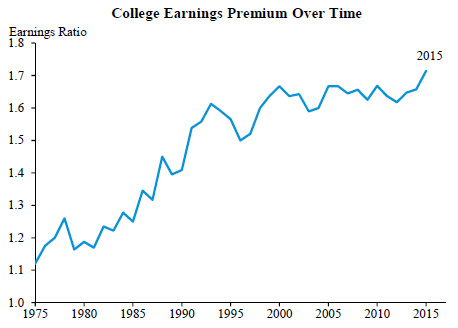
    When I graduated from my local state university in 1981, I had no debt because attending public universities was practically free. On the other hand, my earning prospects were only about 20 percent higher than a non-college grad. Today, college grads often have tens of thousands of dollars in debt, but their earning prospects are 70 percent higher than non-college grads. So who got the better deal? That’s not entirely obvious.

    Next up is a different measure of the value of a college education:
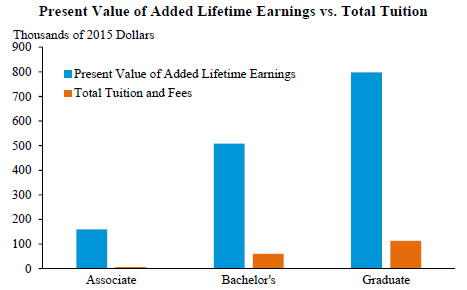
    This helps answer the question, “How high can university costs go?” The answer is, “Pretty high.” Even with higher tuition, college is still a great deal. A bachelor’s degree, on average, pays off nearly 10:1. That means there’s a lot of room to raise tuition and still provide enough of a bargain that anyone who’s qualified will be willing to pay. Treating higher education this way may be a bad idea, but nevertheless, this chart suggests that states can continue to raise prices if they want to.

    The first two charts have been all about nonprofit schools: community colleges, state universities, and private universities like Harvard and Morehouse. But for-profit institutions—which are typically trade schools—have exploded over the past three decades:
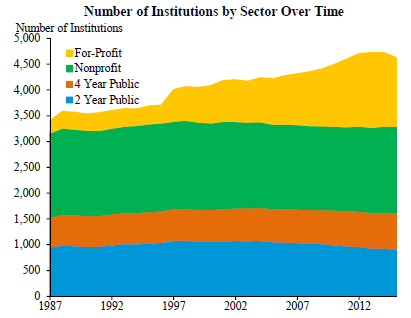
    The number of trade schools has skyrocketed since 1987, from about 300 to well over a thousand. And that brings us to our final chart:
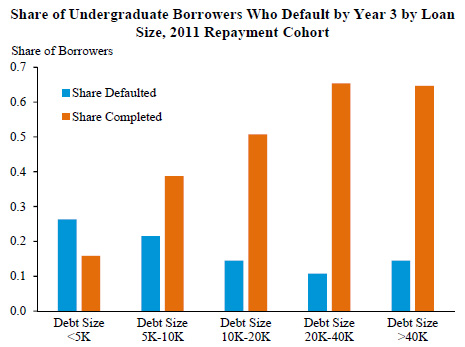
    At first glance, this chart seems odd: the students with the smallest debt have the highest chance of defaulting. There are multiple things going on here, but the biggest one is that a lot of these students attended trade schools for a semester or a year and then dropped out. Their debts aren’t the biggest, but with not even a trade school certificate they can only get low-paying jobs that make it very hard to pay back their loans.

    Too often, for-profit schools cajole people into signing up with promises that the government will pay for everything. Unfortunately, a lot of their students just aren’t suited for further schooling, so they drop out and end up with less than nothing: no certificate, and a big chunk of debt. The trade schools themselves don’t care much, since they get paid whether anyone graduates or not, but it’s a helluva bad deal for the students who end up broke. This is why President Obama’s recent crackdown on the worst offenders among for-profit trade schools is so welcome.
  • ERP Blogstorm Part 1: Income Inequality


    ERP? Yes indeed. That’s what the cool kids call the Economic Report of the President. The 2017 edition is out, so this weekend I’m going to highlight a few of the charts that caught my eye. These are not necessarily the most important topics in the report. They just happened to strike me as interesting and worth sharing more widely. I’m mostly going to present them without much commentary.

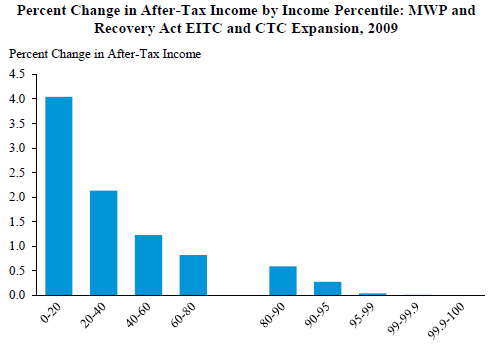
    In previous times, I would have called this a series of blog posts. Today I suppose I should call it a blogstorm. Gotta keep up with the lingo, after all. Our first topic is income inequality. Here’s the impact of the 2009 stimulus bill and the Making Work Pay tax credit:

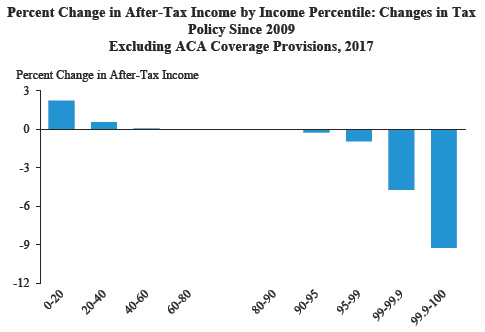
    And here’s the impact of changes in tax policy (primarily the effects of the “fiscal cliff” negotiations, which renewed the Bush tax cuts for all but high-income taxpayers):

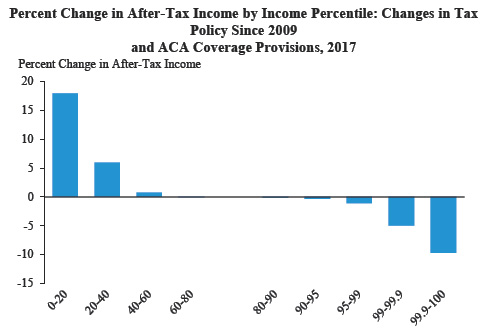
    And finally, here it is all put together: stimulus, tax changes, and Obamacare:

    The lowest-income folks saw their after-tax income increase by about 18 percent. The after-tax income of the top 1 percent declined by about 5 percent and the top 0.1 percent declined by about 10 percent.

    Not bad. Sadly, nothing infuriates Republicans more than reducing income inequality, and they will do everything they can to reverse this and then some over the next four years. The rich can never be too rich and the poor can never be too poor in GOP land.

  • Swamp Watch – 17 December 2016


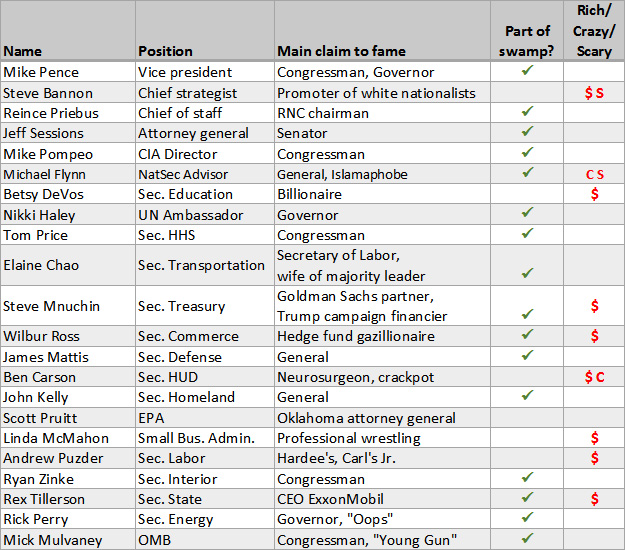
    Mick Mulvaney, a lunatic budget hawk who entered Congress in the great tea party wave of 2010, will be our new director of the Office of Management and Budget. Most people probably think this is bad because he’s a lunatic budget hawk, but I’m not sure how much that matters. After all, Paul Ryan is already a budget hawk—except for budget-busting tax cuts, of course—and defense spending—and anything else that conservatives happen to like. But anyway, he’s a budget hawk as that term is currently abused. So Mulvaney probably doesn’t add an awful lot to the total weight of budget hawkery that will rule Washington, DC, next year.

    But OMB is important for an entirely different reason: It plays a huge role in the regulatory process. Allow me to quote from the OMB website:

    The Office of Information and Regulatory Affairs (OIRA) is a statutory part of the Office of Management and Budget within the Executive Office of the President. OIRA is the United States Government’s central authority for the review of Executive Branch regulations, approval of Government information collections, establishment of Government statistical practices, and coordination of federal privacy policy. The office is comprised of five subject matter branches and is led by the OIRA Administrator, who is appointed by the President and confirmed by the United States Senate.

    Mulvaney will be the patron saint of “cost-benefit” analysis of federal regulations—which, in Republican hands, normally means totting up the costs and ignoring the benefits. In particular, it means that environmental regulations, even those with immense benefits, will be scored into oblivion and never see the light of day. Lucky us.

    Anyway, we’re almost finished. We have two Cabinet positions left—Agriculture and Veterans Affair—and two Cabinet-level posts—CEA and trade representative. Tick tick tick.

  • Health Update


    The short version: nothing has changed. The long version: nothing has changed.

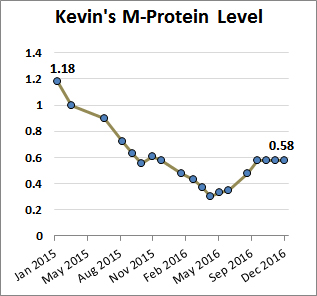
    Literally. The M-protein level that we track so assiduously has stayed at the exact same level for four months running. The exact same level down to the hundredth of a gram. I’m beginning to wonder if I’m just being humored and they’re only pretending to do the lab work. The guy is nuts about his M-protein level. Just mark down 0.58 and forget about it.

    Everything else is stable and relatively normal too. My immune system is, of course, compromised by the chemo meds, but it remains in tolerably good condition. My red blood cells are fine. My platelet count is sometimes a little low, but not enough to be worried about. I go through weird cycles of fatigue (Friday was unusually bad, for example), but nothing close to what happened during the initial rounds of chemo. Mostly I just have to take naps more often than I used to. My neuropathy is annoying but seemingly fairly stable. And now that I’m off the evil dex, I’m no longer gaining weight. Sadly, I’m not losing it either. Even cancer can’t kill off my weakness for chocolate.

  • Now Even Conservatives Are Calling Them “Tax Cuts For the Rich”


    National Review editor Rich Lowry thinks that although Donald Trump’s fans love his populist blather, they might start to lose patience with some of the big programs that Congress tries to pass. For example:

    Obamacare “repeal” without a replacement, a deficit-increasing traditional Republican “tax cut for the rich,” and even — although this is much less likely — Medicare reform. Trump may find his political capital depleting rapidly in the cause of passing conventional Republican legislation that isn’t as important to him as his populist calling cards.

    I don’t want to make too much of this, but when was the last time you heard a conservative, let alone the editor of NR, refer to tax reform as a “traditional Republican” “tax cut for the rich”? That’s the way liberals jeer at supply-side voodoo. Conservatives insist that tax cuts like Trump’s (or Paul Ryan’s) are “broad based,” “capital deepening,” and “job creating.” They are most definitely not “tax cuts for the rich.”

    But now they are. What does this mean?

  • Friday Cat Blogging – 16 December 2016


    It’s that time of year again—when we beg our readers for tax-deductible donations to support our work.

    But we’ve never been too much into doing things the way they’ve always been done. Case in point: Clara and Monika’s new piece that argues for investigating Donald Trump—and supporting MoJo—includes this appraisal of the media:

    “Why was it only now, well past the election, that Trump is being pushed to address how we would deal with banks to which he is in debt, or foreign leaders who have a say over his company’s projects? Simply put: Math. Advertising pays fractions of a penny per click, which means that publishers have to pump out buckets of fast, cheap content to make ends meet, and that leaves little opportunity for serious investigation.

    ….In normal times, right now we’d be in the middle of the kind of routine end-of-year fundraising drive many nonprofits do in December (“We need to raise $250,000 by December 31!”). But these aren’t normal times. So enough with the marketing pitches. None of us needs to be motivated by some arbitrary fundraising goal. Covering Trump, and what he represents, will take everything we’ve got.”

    Yep. Here’s a small sample of my headlines (from this week alone!). If you think pieces like this matter, I hope you’ll pitch in a few bucks to help us do it.

    • NBC NEWS: Putin Personally Directed Anti-Clicking Hacking
    • No, the Senate Will Not “Heavily Vet” Trump’s Cabinet Nominees
    • Chart of the Day: Republicans Sure Are Warming Up to Vladimir Putin
    • Working Class Hero Donald Trump Sure Has Been Good For Wall Street
    • Russia Ran the Most Epic Ratfucking Operation in History This Year
    • How Putin Got His Pet Game Show Host Elected President
    • Here is Rex Tillerson’s Awesome Record at ExxonMobil

    And now, as your reward for reading this far (and donating to MoJo), here is Hopper enjoying herself in the garden earlier this week. And don’t forget: today is also Beethoven’s birthday. Let’s all listen to the 7th Symphony.

  • Note From a Conservative: Republicans Can’t Repeal Obamacare on Their Own


    Conservative Ramesh Ponnuru considers what would happen if Republicans “repealed” Obamacare but left in place the preexisting conditions ban:

    This course could cause the insurance exchanges, already in trouble, to collapse entirely. That’s because the Republican bill would scrap the individual mandate while keeping Obamacare’s requirement that insurers treat sick and healthy people alike.

    ….The Republicans to whom [Philip] Klein talked are blasé about this possibility. If millions of people lose their coverage, these Republicans plan to say that the exchanges were already collapsing before they touched the law. It seems unlikely that the press will go along with this narrative, in part because many health-care experts, liberal and conservative, will tell reporters that it’s false.

    What Republicans have not faced is that they don’t have the votes to repeal Obamacare. Calling a bill that doesn’t repeal Obamacare’s central provisions “repeal” is no escape from that dilemma.

    It’s a sign of the times that Ponnuru has to warn Republicans that the press won’t go along with their preferred narrative because it’s a lie. It’s also a bit starry-eyed, unfortunately. The fact that it’s a lie certainly wouldn’t stop the right-wing press; wouldn’t stop Trump; and would quite likely affect the rest of the press at least to the extent of calling it “controversial” and declining to take sides.

    That said, Ponnuru is right. If you repeal some of Obamacare but leave the rest in place, it would cause the entire program to collapse. It might even go further, and cause the entire individual insurance market to collapse. Republicans better think hard about whether they want to be on the business end of something like that happening.

  • Am I Still Bitter Over Republican Perfidy in 2009? Oh Yes.


    The Economic Report of the President is out, and we should probably take a look at it, if only for old time’s sake. The rumor mill says that the next chairman of the CEA will be supply-side TV blatherer Larry Kudlow, and God knows what we can expect from him. Probably a ten-minute YouTube video. Or maybe a tweetstorm. Who knows?

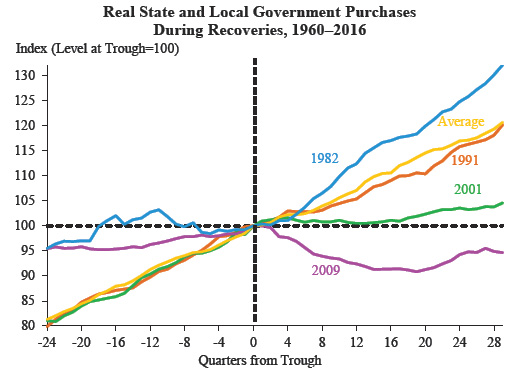
    Anyway, this year’s report is stocked full of the usual number of interesting charts, but I’m going to highlight their version of my favorite chart. This one shows state and local spending following the Great Recession:

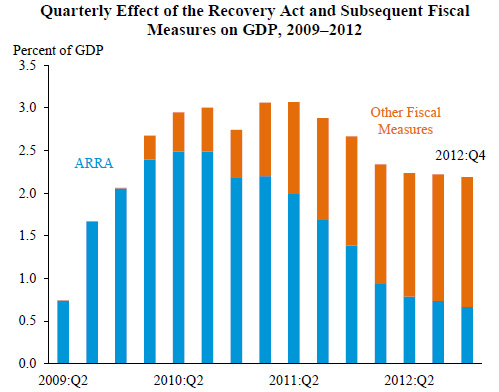
    Normally, spending increases after a recession, and this is one of the things that powers the recovery. This time that didn’t happen. Thankfully, we at least had a bit of help at the federal level:

    Needless to say, Republicans feverishly opposed all attempts at economic stimulus because they didn’t want the economy to get too much better. That might have helped Obama’s reelection chances, you see.

    Oh well. Bygones. I’m sure Trump will fix everything.

  • We Still Have 1,496 More Days of Trump to Go


    Donald Trump was eager this morning to fight back against the news that Vladimir Putin worked hard to get him elected:

    Greg Sargent comments:

    By referring to this episode, what Trump is inadvertently revealing here is that, yes, the complaint about Russian hacking to hurt Clinton did in fact precede the election, and this was widely and publicly known. Of course, there is ample other evidence that Trump is fully aware of this. The intel community had publicly declared it weeks before the election. Trump had reportedly been privately briefed on it by U.S. officials. Trump was confronted with evidence of the hack at a debate with Clinton that was watched by tens of millions of people. At the debate, he cast doubt on the notion that Russia had hacked the materials to hurt Clinton. And yet, as Mark Murray points out, Trump himself widely referenced the material dug up in the hacks at rallies, where he used that material to — wait for it — try to damage Clinton.

    Yeah, Trump knows all this. He just doesn’t care. He knows that most people have poor memories for this kind of stuff and are likely to believe him if he says nobody talked about the Russian hacking during the campaign. Give him a few months and he’ll be tweeting about how no one brought up health care during the election, so why are they all so upset about it now?

  • Bernie Sanders Would Have Lost the Election in a Landslide


    Could Bernie Sanders have beaten Donald Trump? I think there’s almost no chance of that, but since the topic keeps coming up, I feel like I ought to explain why. I know this won’t persuade anyone, but the reason is simple: He’s just too liberal.

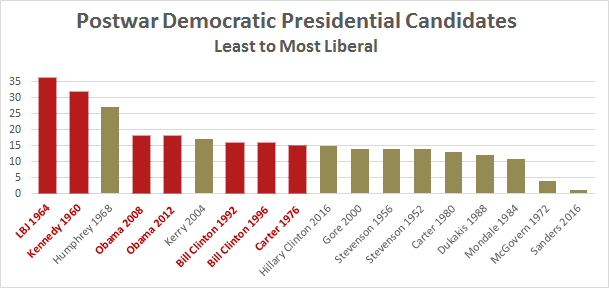
    Here’s a chart of every Democratic presidential candidate in the postwar era—plus Bernie Sanders. It shows them from least liberal to most liberal. I used NOMINATE to gauge how liberal senators were; this paper to fill in the governors; and a bit of personal judgment to shift a few candidates around. I’m not pretending I got this perfect, but I think it’s in the ballpark. Feel free to move folks around if you like.

    Very roughly, the scores show how the candidates compare to all of Congress: LBJ was more liberal than two-thirds of Congress, while Bernie Sanders is more liberal than 99 percent of Congress. Winning candidates are in red.

    No Democratic candidate with a score below 15 has ever won the presidency. Bernie Sanders, needless to say, is way below 15. There’s not a snowball’s chance that he could have won the presidency.

    Like I said, I don’t expect this to persuade anyone. You can always make up a dozen reasons why this time would have been different. But it wouldn’t have been. In the end, Trump was treated like an ordinary Republican. Hillary Clinton, after being forced a bit to the left during the primaries, was treated like an ordinary Democrat who was right on the bubble of being too liberal for the country. Both candidates had plenty of personal flaws that they used against each other, but Sanders did too. They were just different than Clinton’s. Republicans would have twisted him up like a wet rag and tossed him down the drain.