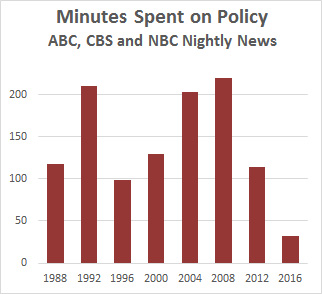
• Chart of the Day: Net New Jobs in October


    I guess we all know that government “statistics” are totally phony, but just for laughs let’s take a look at the latest jobs report. The American economy added 161,000 new jobs last month, 90,000 of which were needed to keep up with population growth. This means that net job growth clocked in at a modest 71,000 jobs—not great, but OK. Job estimates for August and September were revised upward by 44,000. The headline unemployment rate improved slightly to 4.9 percent and the labor force participation rate ticked down slightly to 62.8 percent.

    Hourly earnings of production and nonsupervisory employees were up at an annual rate of about 2.3 percent compared to last month. This continues a streak of decent increases. A genuinely tight labor market would push that up even more, but with the rest of the world in the doldrums that’s probably not likely to happen anytime soon.

  • Where Are All the Fake Docs Coming From?!?


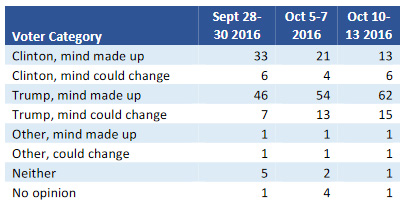
    Longtime creep Roger Stone has been occupying himself lately by tweeting golden oldies about the “Clinton Body Count” and how Hillary had Vince Foster killed because he knew too much. Charming as always. But a couple of weeks ago he was busy tweeting this:

    OMG indeed. You will be unsurprised to learn that the document in question wasn’t real. Sadly, it contained a telltale clue common to autocrats around the world. Can you spot it?

    In the same way that megalomaniacs love to claim that they won re-election with 99 percent of the votes, this fake poll claims that Trump leads Clinton 77-19 percent. The pranksters might have fooled a few people if they’d stuck to something a little less obvious, but I suppose 77 percent must have seemed pretty modest to them. Perhaps this gives a clue about where it came from? Here is Reuters:

    The FBI and U.S. intelligence agencies are examining faked documents aimed at discrediting the Hillary Clinton campaign as part of a broader investigation into what U.S. officials believe has been an attempt by Russia to disrupt the presidential election, people with knowledge of the matter said.

    Russian officials deny any such effort.

    In addition to the Carper letter, the FBI has also reviewed a seven-page electronic document that carries the logos of Democratic pollster Joel Benenson’s firm….The document, identified as a fake by the Clinton campaign, claims poll ratings had plunged for Clinton and called for “severe strategy changes for November” that could include “staged civil unrest” and “radiological attack” with dirty bombs to disrupt the vote.

    Nice try, Russia, but you really need to up your game.

  • Are Democrats In a “Fearful Frenzy”?


    Every day I get an email newsletter from Bloomberg. I’m not sure why, but I suppose it’s for the same reason I get email newsletters from everyone else on the planet. Normally I just delete them en masse each morning, but today I read Bloomberg’s. It turns out they’re doing their best to keep everyone on the edge of their seats and waiting for their next Bloomberg newsletter:

    In five days, America will make history, one way or another. We will either select our first female president, pick a true mold-breaking non-politician, or face a 2000-esque stand-off that paralyzes courts, fuels a media maelstrom and inflames passions around the country. No big deal. So where does the race actually stand as we dive headlong into Tuesday?

    There are several new polls that double down on the narrative that the race has tightened….These numbers, the ongoing hum of controversy from the FBI and WikiLeaks, and the positive tone and spin coming from the Trump camp has some Democrats in a fearful frenzy.

    Oh settle down. Sure, there’s a rogue cabal at the FBI determined to take down Hillary Clinton. Sure, there’s a lunatic cooped up in the Ecuadorian embassy in London determined to take down Hillary Clinton. Sure, there’s a despot in Russia determined to take down Hillary Clinton. Sure, there’s an entire media edifice determined to take down Hillary Clinton.

    But she’s still around, isn’t she? And the polls really aren’t tightening all that much. So relax and read instead about Donald Trump’s illusory wealth:

    On the financial disclosure forms that Donald J. Trump has pointed to as proof of his tremendous success, no venture looks more gold-plated than his golf resort in Doral, Fla., where he reported revenues of $50 million in 2014….But this summer, a considerably different picture emerged in an austere government hearing room in Miami, where Mr. Trump’s company was challenging the resort’s property tax bill.

    Mr. Trump’s lawyer handed the magistrate an income and expense statement showing that the gross revenue had indeed been $50 million. But after paying operating costs, the resort had actually lost $2.4 million.

    Well, really, what’s the difference between +50 million and -2.4 million? According to Trump, nothing much. But it goes a long way toward explaining why he filed for bankruptcy so many times, doesn’t it?

  • High Court Throws a Spanner in the Brexit Works


    A high court judge has ruled that Brexit cannot go forward without a vote of Parliament. In a nutshell, the court ruled that since Parliament passed the 1972 law joining the EU, only Parliament can make the decision to leave the EU:

    The most fundamental rule of the UK’s constitution is that Parliament is sovereign and can make and unmake any law it chooses….The Government of the day cannot by exercise of prerogative powers override legislation enacted by Parliament.

    ….In the present case, however, the Government accepts, and indeed positively contends, that if notice is given under Article 50 it will inevitably have the effect of changing domestic law…The Court does not accept the argument put forward by the Government. There is nothing in the text of the 1972 Act to support it.

    Prime Minister Teresa May said this ruling would be appealed to the Supreme Court, which will hear the case in early December. If the Supreme Court upholds the decision—which seems likely—it could lead to further court cases that end up giving the Scottish Parliament a veto over withdrawal. That would kill Brexit completely.

    But even if only a vote of Parliament in London is needed, it’s not clear what will happen. The New York Times passes along the conventional wisdom that the court decision may delay things but not derail them: “Few observers believe that Parliament would go so far as to block a departure from the bloc, as lawmakers themselves voted overwhelmingly to hold the referendum and pledged to abide by the results.”

    I guess. Maybe. But once Parliament plunges into this, and the government is forced to unveil its negotiating stance, I could see public opinion changing fairly dramatically. I also can’t help but think that there are a lot of MPs who say they’re for Brexit but would welcome an excuse to kill it. Remember: the referendum passed by only 52-48 percent. It wasn’t exactly a landslide.

    If I had to lay a bet, I’d guess that one way or another, Brexit will somehow not happen. Stay tuned.

  • Rogue FBI Agents Are Latest Victims of CDS


    The Wall Street Journal’s Devlin Barrett has the latest from his disgruntled sources at the FBI who are hell-bent on proving that the Clinton Foundation is corrupt:

    Much of the skepticism toward the case came from how it started—with the publication of a book suggesting possible financial misconduct and self-dealing surrounding the Clinton charity. The author of that book, Peter Schweizer—a former speechwriting consultant for President George W. Bush—was interviewed multiple times by FBI agents, people familiar with the matter said.

    …In February, a meeting was held in Washington among FBI officials, public-integrity prosecutors and Leslie Caldwell, the head of the Justice Department’s criminal division…Following the February meeting, officials at Justice Department headquarters sent a message to all the offices involved to “stand down,” a person familiar with the matter said.

    …The FBI had secretly recorded conversations of a suspect in a public-corruption case talking about alleged deals the Clintons made, these people said. The agents listening to the recordings couldn’t tell from the conversations if what the suspect was describing was accurate, but it was, they thought, worth checking out.

    Prosecutors thought the talk was hearsay and a weak basis to warrant aggressive tactics, like presenting evidence to a grand jury, because the person who was secretly recorded wasn’t inside the Clinton Foundation.

    Holy crap. The field agents got started on this because they read Clinton Cash, the latest in a 25-year stream of books insisting that the Clintons are our era’s Borgia family. Then they got even more interested because some guy—literally just some guy—was recorded blathering about the foundation.

    This is what Hillary Clinton has faced ever since 1992. It started in Arkansas, where this kind of character assassination is basically just political sport, and then got exported to Washington, DC, when Bill Clinton ran for the presidency. There’s nothing in Schweizer’s book except yet another CDS victim1 insisting that if two things happened at the same time, somehow the Clintons were responsible for it and he’s got the proof right here!

    And now it turns out the FBI is full of middle-aged white guys who apparently read the book, listen to lots of Rush Limbaugh, and just know that if they look a little harder they’ll find the one Jenga brick that causes the whole Clinton edifice to finally collapse. Jesus Christ.

    1Clinton Derangement Syndrome.

  • Chart of the Day: Voting Intentions Are Probably Set In Stone By Now


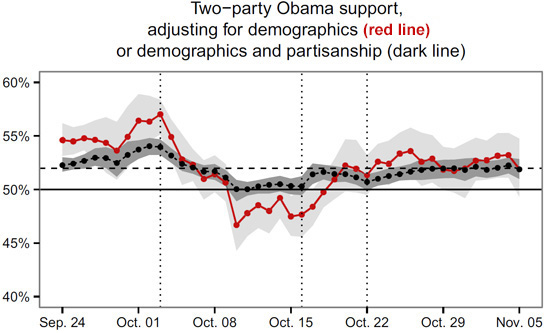
    This chart is a follow-up to my post last night about response rates in polls. It’s from the paper that started the whole thing, published earlier this year by Andrew Gelman and three other researchers. They analyzed the 2012 campaign, and what they found was that polls were far more variable than actual voting intentions. The red line is what the polls looked like in real time. The black line is what they look like when you control for different response rates:

    The first dotted line is the first debate. Remember how Obama did so poorly and plummeted in the polls? It turns out he didn’t, really. Obama fans just stopped responding to polls, producing the illusion of a 10-point collapse. In reality, he only dropped about 4 points. In fact, during the last six weeks of the campaign, Obama’s support was never more than a couple of points away from 52 percent.

    Moral of the story: even poll averages bounce up and down misleadingly. In reality, there’s probably no more than two or three points of change in actual voting intentions during the last month of the campaign. And in the last week? Practically none at all.

  • How to Mislead With Statistics: GMO Crops Edition


    A few days ago the New York Times ran a big front-page story about GMO crops. Roughly speaking, there were two takeaways: GMO crops don’t improve yields and don’t cut down on pesticide use. So why bother?

    That sounded interesting, but I decided not to write about it. The story was pretty shallow in its use of statistics. It assumed that you can compare different countries without controlling for anything (different soils, climates, crops, etc.). And it seemed to suggest that American farmers must be idiots, because they keep buying GMO seeds even though they’re worthless. Put together, this was a little too much for my spidey sense, and it would have taken a long time to educate myself enough to really figure out what was going on. So I passed.

    Yesterday, however, Nathanael Johnson of Grist took a close look at the Times piece and concluded that it was pretty misleading. You can read Johnson’s piece if you want all the gory details, but it contained a pretty interesting example of how to mislead with statistics, which I figured I should pass along. The Times story says that in the US, despite the wide use of GMO seeds, use of insecticides has fallen but the use of herbicides has gone up. In France, by contrast, where they don’t use GMO seeds, “use of insecticides and fungicides has fallen by a far greater percentage — 65 percent — and herbicide use has decreased as well, by 36 percent.” Using data from Andrew Kniss, here’s what this looks like in chart form:
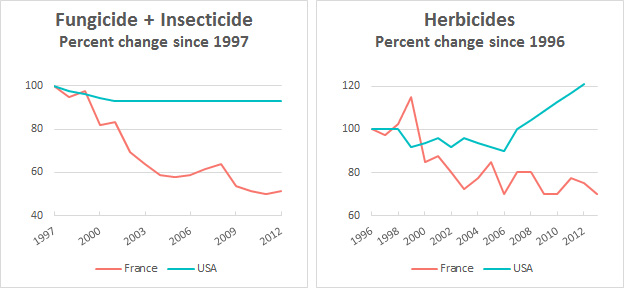
    It does indeed look like France is doing pretty well. But what if you look at the raw numbers, rather than percentages? Here’s a chart from Kniss:
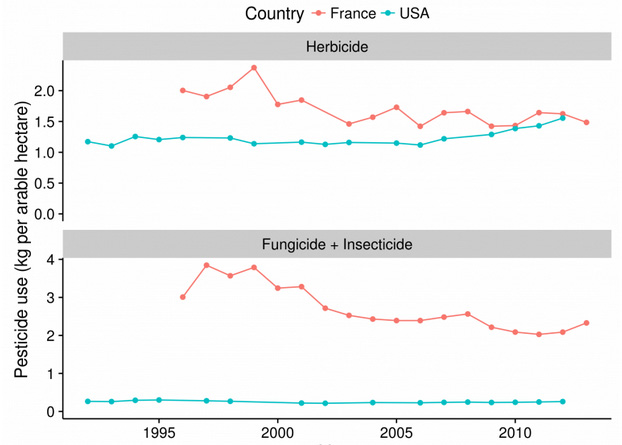
    In the case of herbicides, France started at a high level, and has only recently caught up to the US. In the case of insecticides, France started out way, way higher than the US and is still way higher despite their recent reductions. Looked at this way, it’s clear that France hasn’t actually done that well. What’s more, I had to cherry pick starting and ending years in the top set of charts in order to make France look as good as it does. Plus there’s this, from Kniss:

    It is true that France has been reducing pesticide use, but France still uses more pesticides per arable hectare than we do in the USA. In the case of fungicide & insecticides, a LOT more. But a relatively tiny proportion of these differences are likely due to GMOs; pesticide use depends on climate, pest species, crop species, economics, availability, tillage practices, crop rotations, and countless other factors….Given all of these confounding factors, I wonder why France was singled out by Mr. Hakim as the only comparison to compare pesticide use trends. Pesticide use across Europe varies quite a bit, and trends in most EU countries are increasing, France is the exception in this respect, not the rule. In the early 1990’s, France was using more herbicides compared to almost every other country, so it shouldn’t be too surprising that pesticide use decreased as formation of the EU began to standardize pesticide regulations after 1993.

    So what’s the best comparison to make: percentage change or raw volume? In this case, presenting only the percentage change leaves you with a very misleading impression. Presenting raw volumes, however, makes everything pretty clear. You can see that France started out far higher than the US and that its use of herbicides and insecticides has been decreasing. So why present only percentages?

    POSTSCRIPT: If you click on the chart pack in the Times story, you will actually find charts showing raw volume of pesticide use in the US and France. However, they’re shown in two different charts, using different units, and broken up into different categories. If you were deliberately trying to make a comparison nearly impossible, this is how you’d do it.

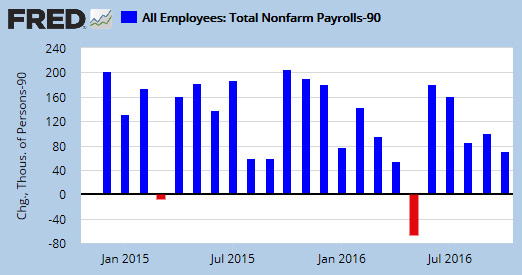
  • Nightly News Takes a Dive on Issues This Year


    Andrew Tyndall notes that the nightly news no longer seems to care about policy debates:

    This year’s absence of issues is an accurate portrayal of the turf on which the election is being played out….If the candidates are not talking about the issues, the news media would be misrepresenting the contest to do so.
    With just two weeks to go, issues coverage this year has been virtually non-existent…. No trade, no healthcare, no climate change, no drugs, no poverty, no guns, no infrastructure, no deficits. To the extent that these issues have been mentioned, it has been on the candidates’ terms, not on the networks’ initiative.

    I disagree with this on two levels. First, Hillary Clinton has talked plenty about issues in the conventional sense that Tyndall means it: speeches that cover specific policy proposals, with detail to back them up. Only Donald Trump has declined to do this.

    More broadly, both candidates have talked about issues. Trump talks all the time about trade, immigration, ISIS, and guns. Clinton talks about childcare, ISIS, health care, guns, and so forth. There are lots of character attacks too, but then, that’s usually the case. But just because issues are talked about in broad strokes doesn’t mean they’re not talked about. They are. The network news broadcasts just don’t want to risk losing their audiences by forcing them to pay attention to such boring stuff.

  • Alcohol and Crime: The Story Isn’t Quite So Simple


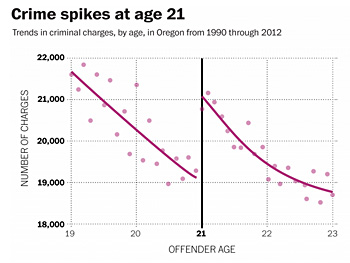
    The chart below comes from Wonkblog. It’s from a study of crime in Oregon, and shows that at age 21—the legal drinking age in Oregon—crime spikes considerably:

    One striking chart shows how alcohol can turn people into criminals
    As soon as people turned 21, their likelihood of criminality spiked considerably….The number of charges filed against 21-year-olds was similar to the number for 19-year-olds. In other words, from a criminal-justice standpoint, turning 21 is akin to turning back the clock to your late teens.

    The mechanism by which this works is fairly obvious — access to alcohol increases dramatically at age 21. That brings more intoxication, and with it more aggressive, belligerent and criminally stupid behavior.

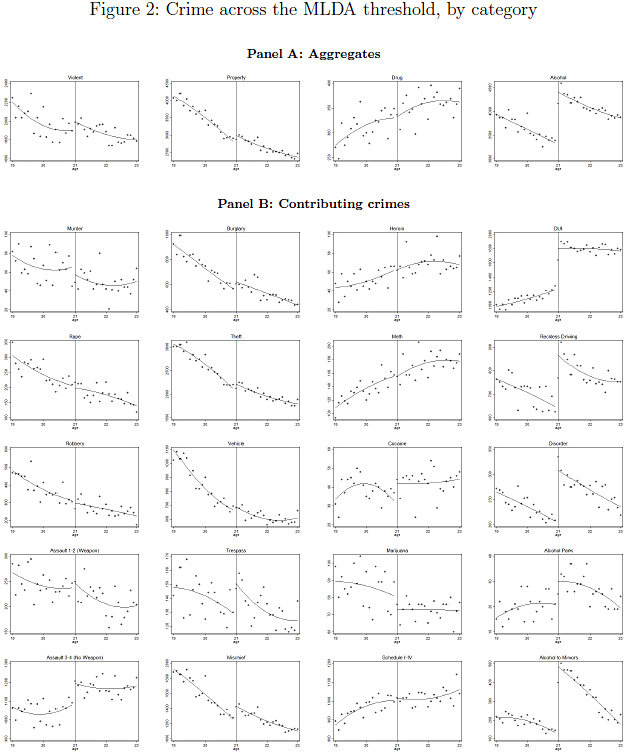
    Sometimes, though, one striking chart isn’t enough. Sometimes you really need to see a whole bunch of them. I apologize for the size and readability of this, but I think it’s best if I show you everything, instead of just picking and choosing. Here’s the complete set of charts from the Oregon study:

    Virtually the entire effect is driven not by “more aggressive, belligerent and criminally stupid behavior” in general—violent crime shows no effect at all—but specifically by alcohol-related offenses: DUI/reckless driving, providing alcohol to minors, public disorder, and so forth. The authors also suggest there might be some small effect on assault, trespass, marijuana, and cocaine. But if you take a look at those charts without pre-assuming a change at age 21, you see a very vague scatterplot that doesn’t really suggest anything special at that age.

    Bottom line: Legal access to alcohol certainly increases alcohol use, and therefore increases the rate of drunk driving, alcohol-induced public disorder, and providing alcohol to minors. You hardly need a study to tell you that. But on all other kinds of crime? It seems to have barely any effect at all.

  • Hillary Clinton Is an Open Book


    With a mere 6 days left in Campaign 2016, Ezra Klein points out that Hillary Clinton is perhaps the most transparent presidential candidate in history:

    We have Hillary Clinton’s full tax returns going back to the year 1977…public schedules…her campaign’s donors and her foundation’s donors…tens of thousands of emails from her time at the State Department…thousands of her campaign chair’s emails…investigative reports, congressional testimony, and documentary evidence from the inquiries into Whitewater, Benghazi, and Travelgate….so many independent biographies that I couldn’t come up with an accurate count.

    ….The story with Trump is quite different. We have the three pages from his 1995 tax return…books Trump has written about himself…financial disclosures to the Federal Election Commission, in which he claims, in all capital letters, to have “10 BILLION DOLLARS,” but no one believes that document…Digging beyond that image is difficult because Trump has forced his former associates, and even his former romantic partners, to sign nondisclosure agreements.

    Despite all this, Clinton has a reputation for opacity while Trump has a reputation for being open about everything. The reason is deceptively simple: it’s what both candidates want. Clinton very clearly does her best to reveal as little as possible. Trump, by contrast, will talk about anything, loudly and volubly. It’s true that when he talks, he lies constantly and says next to nothing when he’s not lying, but the impression he gives is of somebody with nothing to hide.

    Clinton’s reputation is not unfair. Most of her openness has been forced on her, after all. Trump’s reputation, by contrast, is ridiculous. He hides everything and lies about what he can’t. And since he runs a private company and has never served in government, he can get away with it. He’s not subject to FOIA requests or WikiLeaks dumps or random judges deciding that all his emails should be made public.

    This isn’t going to change, and at this point it no longer matters whether it’s fair. It just is. But it’s what produces such bizarre levels of CDS1 among conservatives. They’ve forced so much openness on Clinton in an effort to destroy her, and it drives them crazy that it’s done nothing except paint a portrait of a pretty normal politician. Over 25 years, they’ve managed to uncover only three “scandals” that are even marginally troubling,2 and every dry well does nothing but convince them that Clinton is even more devious than they thought. By this time, we’ve tracked practically every hour of every day of Clinton’s life for the past decade, and there’s almost literally no unexamined time left. But it doesn’t matter. The next one will get her for sure!

    The truth is different, of course. Hillary Clinton dislikes the press and has learned to be very careful in her public utterances. She has done a few dumb things in her life, and pushed the envelope further than she should a couple of times. If you dislike her, that’s fine. But basically she’s a fairly ordinary politico—ironically, an unusually honest one. When she makes a deal, her word is good. When she talks about policy, she’s careful not to overpromise. On the honesty front, she is Mother Teresa compared to Donald Trump.

    1Clinton Derangement Syndrome, in case you’ve forgotten.

    2The cattle futures thing remains intriguingly dodgy. Travelgate didn’t involve anything illegal, but definitely shows Clinton in a bad light. And Emailgate may not have produced any evidence of wrongdoing, but it did uncover a case of poor judgment.