• The Financialization of the World Is Kind of Mysterious


    In the course of a general critique of the US economy over the past few decades, Brad DeLong says this:

    The US today spends 8% of GDP on finance. That is twice as much as 40 years ago. Once again, the U.S. gets nothing for it—gets, in fact less than nothing, because the lion’s share of responsibility for the 10% growth shortfall of the past decade rests on the shoulders of the hypertrophied dysfunctional finance system. It is not as though anybody claims that the plutocrats of high finance and of our corporations are doing a materially better job at running their organizations and allocating capital by enough to justify their now even-more outsized compensation packages. It is not as though we can see the impact of paying more to financiers in the tracks of faster economic growth. Rather the reverse.

    I know I’m probably revealing more ignorance here than I should, but how did this happen? Finance isn’t a monopoly. In fact, it’s one of the most globalized, fluid, and competitive industries on the planet. Why haven’t its profits long since been reduced to zero, or close to it? I can understand occasional blips as markets change—CDOs and SIVs get hot for a while, so experts in CDOs and SIVs make a killing—but the overall industry? How has it managed to hold onto such outlandish rents for such a sustained period?

    Real answers, please, not buzzwords or conspiracy theories. What’s the deal here?

  • Everybody Is Wrong

    Atrios is unhappy with how the left is treated:

    I’m struck by how everything The Left does is wrong. Not just in terms of policy, but tactics. Running a third party candidate is wrong (I actually agree with this generally!), running in a major party primary is wrong, protesting is wrong, protesting the wrong way is wrong, not protesting is wrong, having a journal of important Lefty ideas is wrong, not catering to the feefees of Real Americans is wrong, proposing legislation is wrong, objecting to racism and sexism is wrong. There’s a longer list, I’m sure, but self-styled “moderates” chastise Lefties no matter what they do.

    I dunno. I’m pretty sure we all feel this way. I’m a more moderate liberal than Atrios, but as near as I can tell I’m also wrong about pretty much everything. Hillary is a liar, Glass-Steagall did too cause the economic collapse, nobody votes for a squish, it’s all just privilege, Bernie is going to lead a revolution and his numbers add up just fine, I’m a shill for big corporations, Obama is a total sellout, etc.

    On the conservative side, where I can take a more Olympian view of things, it’s pretty obvious the same thing is true. The tea partiers hate the RINOs, the RINOs hate Trump, and the Trumpettes hate everyone. One side are sellouts, the other side is just a bunch of purity mongers.

    That’s life. In politics, you’re always wrong according to everyone who’s not you—and the more extreme you get, the wronger you are. That’s the price of being in the arena, or even just being a spectator cheering against the Romans.

  • Hillary Clinton, Enemy of the Status Quo


    The headline news from today’s Washington Post poll is the astonishing unpopularity of Donald Trump. His net favorable rating is -37 percent: 30 percent like him and 67 percent don’t. The other candidates have net negative ratings too, but nothing close to this.

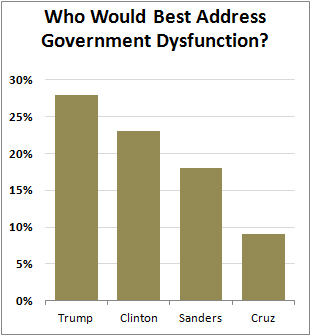
    On another subject, 69 percent of respondents claim to believe that the “current political system” is dysfunctional. I don’t know whether to take that seriously, or just as a generalized gripe about politics. What’s interesting, though, is who would do the most to address this. Trump is the top choice, unsurprisingly, but Hillary Clinton is close behind—which is a bit surprising. It certainly suggests, along with other evidence in this and other polls, that support for Hillary isn’t just strong, but roughly as enthusiastic as it is for anyone else.

    On the Republican side, enthusiasm for Trump sure seems to be waning. That hasn’t translated into votes for Cruz or Kasich—not yet, anyway. But it might.

  • Is This the Most Astonishing Obamacare Result Ever?


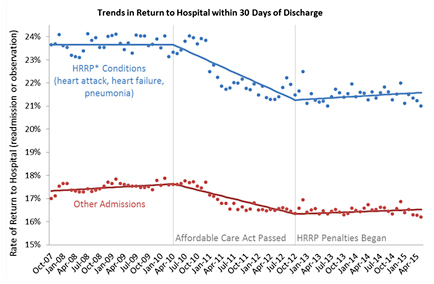
    Phil Price points us today to an intriguing chart from the Department of Health and Human Services. It shows readmission rates within 30 days of a hospital stay for Medicare patients—including both “official” readmissions and short-term “observations”—and it’s pretty stunning. When Obamacare passed, readmission rates started to fall dramatically almost instantly. They fell most sharply for a subset of conditions specifically targeted by Obamacare, and by a smaller amount for other conditions. If this is accurate, it means that hospitals could have done something about readmission rates all along, but they just hadn’t bothered. Only after Obamacare provided an incentive to get their readmission rates down did they do anything about it.

    So how should we think about this? I’ll confess to some skepticism because the chart is almost too perfect. For four years the readmission rate is dead stable. Then, in a single month between December 2010 and January 2011 it suddenly drops by a full percentage point, and continues dropping for two years. This decline started about eight months after the passage of Obamacare, and it’s hard to believe that hospitals could react that quickly.

    Then, the very instant that penalties begin for high readmission rates, everything stabilizes again. Apparently America’s hospitals unanimously decided that once they’d hit a certain level, that was good enough and they wouldn’t bother trying to improve even more.

    Maybe. But even for those of us who believe in incentives, this is the damnedest response to a new incentive I’ve ever seen. I guess my advice is to treat this with cautious optimism. It looks like a great result, but as with most Obamacare outcomes, it’s too early to tell for sure how things are going to work out. When we have five or ten years of experience, we’ll start to be able to draw some concrete conclusions. Until then, we can say how things seem to be going so far, but not much more.

  • Yet More Obama Tyranny Turns Out to Be Pretty Non-Tyrannical


    Stanley Kurtz is yet again in a lather about a HUD program called Affirmatively Furthering Fair Housing, the centerpiece of President Obama’s plan to fight housing discrimination:

    Federal Tyranny Gags GOP in Hillary’s Backyard

    The Obama administration’s AFFH policy has morphed from “mere” massive regulatory overreach into a bald attempt to quash the freedom of speech of its political opponents. The new federal effort to muzzle Westchester County Executive Robert Astorino’s attacks on the Obama administration’s housing policy is very arguably designed to silence public opposition to AFFH, and to remove a potential political time-bomb from Hillary Clinton’s presidential campaign.

    Hillary Clinton’s hometown of Chappaqua, in Westchester County, New York is ground zero in the national controversy over AFFH….And now it just so happens that the “Federal Monitor” appointed to oversee the settlement of a court case compelling Westchester to “affirmatively further fair housing” has asked a court to muzzle Astorino.

    But here’s a funny thing: Westchester’s problems were caused by a private lawsuit filed in 2006, which it lost in February 2009. It hardly seems likely that Obama had much to do with that. And it seems doubly unlikely that AFFH, which was announced a mere nine months ago, could possibly be “ground zero” for a fight that’s been ongoing for over a decade.

    Still, I suppose those are nits. Regardless of when it all started, it’s certainly outrageous for the feds to try to gag an opponent of their policies. This is the kind of thing that—

    What’s that? Maybe I should take a look at the federal monitor’s actual court filing? How tiresome. But we’re professionals around here. Let’s see now…ah, here it is on page 55: “Recommended Remedies.” This is what the monitor wants:

    • a Court declaration reemphasizing the essential terms of the Settlement and issuing findings making clear that none of the terms have been changed and the County’s statements analyzed in Section II of this report are false;
    • distribution by the County, voluntarily or by order, of the declaration and findings described above to the leadership of all of the eligible communities;
    • posting the declaration and findings described above prominently on the County website and the removal of press releases inconsistent with the declaration and findings;
    • unsealing the videotapes of the depositions of, at the least, the County Executive, the Commissioner of Planning, and the Director of Communications, inasmuch as each made or reviewed unsupported public statements that were inconsistent with both the terms of the Settlement and their own sworn testimony; and
    • hiring, within 30 days of the issuance of this report, a public communications consultant that will craft a message and implement a strategy sufficiently robust to provide information broadly to the public that describes the benefits of integration, as required by Paragraph 33(c)….

    Basically, Westchester is under court order to do certain things. They haven’t done them. In fact, county leaders have been loudly and habitually lying about both the consent decree and HUD’s affordable housing requirements for years. So now the monitor wants (a) the actual terms of the settlement to be widely distributed, (b) depositions to be unsealed so everyone can see what county leaders have been saying under oath, and (c) a third-party consultant to craft the court-ordered PR plan, since the county plainly has no intention of obeying the consent decree on its own.

    But nobody is being muzzled. As near as I can tell, Astorino can continue saying anything he wants. However, the county, in its official capacity as an arm of the government, is required to carry out the consent decree. In the face of repeated intransigence, the federal monitor is asking the court to force it to do just that.

    I like reading The Corner. It’s a good place to get a lot of different conservative opinions on the headlines of the day. But there are a few bylines I routinely skip because the authors are basically unhinged. Kurtz is one of them. Among other things, he was part of the crowd that went bananas about Bill Ayers during the 2008 campaign, and he’s been flogging Obama’s “war on the suburbs” for years. Today’s post is just the latest installment.

    Anyway: No muzzling. No gagging. No tyranny. Just a county that refuses to obey a court order and a federal monitor who wants a judge to push harder on them. It’s hard to think of anything more routine.

  • Donald Trump Is Galactically, Deliberately Ignorant


    The depth of Donald Trump’s ignorance is inexplicable. Seriously. How is it that after nine months of campaigning he still knows less about most subjects than your average guy in a bar working on his fourth beer?
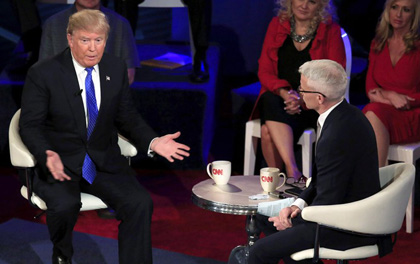
    At the CNN town hall last night, an audience member asked Trump, “In your opinion, what are the top three functions of the United States government?” That’s not a bad question. I think that pretty much every presidential candidate will say that national security is No. 1, but there are plenty of good choices for the next two. Protecting the environment. Keeping taxes low. The social safety net. Protecting religious liberty. Climate change. Gun rights. Creating jobs. Etc.

    But watching last night, it was obvious that Trump had no idea what to say. So after mentioning national security, he paused a bit and then decided on health care and education. This produced incredulity from Anderson Cooper:

    COOPER: Aren’t you against the federal government’s involvement in education? Don’t you want it to devolve to states?

    TRUMP: I want it to go to states, yes. Absolutely. I want—right now…

    COOPER: So that’s not part of what the federal government’s…

    TRUMP: The federal government, but the concept of the country is the concept that we have to have education within the country, and we have to get rid of Common Core, and it should be brought to the state level.

    COOPER: And federal health care run by the federal government?

    TRUMP: Health care—we need health care for our people. We need a good—Obamacare is a disaster. It’s proven to be…

    COOPER: But is that something the federal government should be doing?

    TRUMP: The government can lead it, but it should be privately done. It should be privately done. So that health care—in my opinion, we should probably have—we have to have private health care. We don’t have competition in health care.

    In his panic to pick two subjects—any two subjects—Trump managed to light on precisely the two that every conservative in the country thinks the federal government shouldn’t have a role in. So then Trump fumbles around and starts talking about “the concept of the country” that we have to have education. Brilliant! And Common Core has to be “brought to the state level,” because apparently Trump has no idea that Common Core has been a state program from the very start.

    Then we get to health care. “We need health care for our people,” but it should be privately supplied even if the government leads it. This, of course, is precisely what Obamacare is: a program that coordinates and regulates health care provided by private suppliers. But apparently Trump doesn’t know that either.

    I know that mocking Trump for his policy ignorance is sort of boring. I mean, what else is new? But is it possible that he’s actually getting dumber over time? Out of every possibility available to him, he managed to pick possibly the worst two for any conservative.

    It’s obvious that Trump not only resists the idea of being briefed about anything, but actively tries to avoid learning anything about the government. Just by accident you’d learn more than this just by running for president. What’s the deal here?

  • Crime in St. Louis: It’s Lead, Baby, Lead


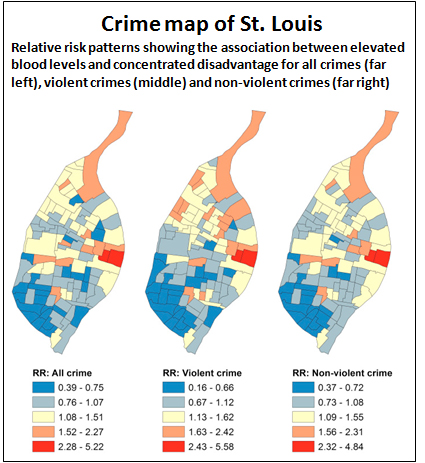
    A team of researchers has released a new study investigating the association between childhood lead exposure and later crime rates in St. Louis. Unlike most previous studies, it uses census tracts in order to get the most detailed possible look at subpopulations within the city. Their conclusion: “We uncovered a relatively strong effect of lead on behavior, especially violent behavior.” This was true even after controlling for other variables that affect crime rates:
    It is important to recognize that for the current analyses, the effect of lead remained a robust predictor of crime using methods capable of accounting for spatial correlations, and above and beyond the possible confounding influence of concentrated disadvantage.

    ….Because sociologists (as well as other macro-level scholars) have continued to highlight the primacy of concentrated disadvantage (as well as other macro-level variables) in predicting societal adversities (including crime), other relevant predictors such as lead often receive short shrift in the literature as well as less consideration when the topic shifts to policy initiatives. This is less than ideal because lead has emerged consistently, both in the current sample as well as others, and at the macro- and individual-level, as an apparent potent predictor of adverse behavior. Continuing to myopically focus on traditional forms of “social” adversity such as poverty runs the risk of downplaying more important behavioral predictors.

    The authors are appropriately cautious about interpreting their findings. This is yet another ecological study, which compares populations across time, and that means it’s hard to assess causality. That said, there are now a lot of ecological studies at different levels (census tract, city, state, nation) showing the same result, as well as a smaller number of prospective and medical studies showing the same thing. There are still some unanswered questions about the lead-crime hypothesis—mostly because we lack the data to clearly demonstrate an age cohort effect—but the evidence sure seems to be piling up. There are lots of causes of crime, and lots of ways of reducing crime. But the biggest bang for the buck might be the simplest: get rid of the damn lead. If we start today, we’ll be glad we did it 20 years from now.

  • Blue Cross Blue Shield Report Suggests That Obamacare Is Doing Its Job


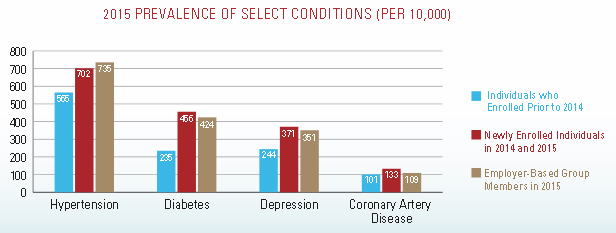
    Blue Cross Blue Shield has a new report out that examines Obamacare enrollees in 2014 and 2015:

    Health insurers gained a sicker, more expensive patient population after the Affordable Care Act expanded coverage in 2014, according to an early look at medical claims from the Blue Cross Blue Shield Association, which represents the most common brand of insurance. Newer customers had higher rates of diabetes, depression and high blood pressure, among other conditions, the association said in a report released Wednesday.

    Technically, there’s nothing incorrect in that paragraph. But take a look at the actual data from the report:

    It’s true that Obamacare enrollees tended to be sicker than pre-Obamacare individual enrollees. But that’s not because Obamacare enrollees are especially sick. In fact, they’re nearly identical to people enrolled through employer plans, which take all comers and therefore come pretty close to representing the average patient in America.

    But if the Obamacare enrollees are about average, what does this say about the pre-Obamacare enrollees? That’s pretty obvious: they were considerably healthier than average. Why? Because insurance companies routinely refused to offer individual coverage to anyone who showed even a glimmer of poor health. Obamacare put an end to that, and that’s good news.

    Oddly, the BCBS report concludes that Obamacare enrollees used more medical services and ran up higher bills compared to those in employer plans. That’s a little hard to make sense of, since Obamacare enrollees are no sicker than average and generally have higher deductibles and copays than people in employer plans, which should motivate them to use fewer medical services. One possibility is that this is related to heart disease, the one area where Obamacare enrollees really do seem to be sicker than average. Another possibility is that this is a one-time thing: lots of people had been putting off medical care, and when Obamacare kicked in they spent the next year or two making up for it.

    Overall, I’d say the bottom line from this report is two things. First, Obamacare enrollees look fairly average compared to everyone else. Second, it’s still early days. It’s hard to draw conclusions based just on the startup period. We’ll know a lot more after five or ten years have passed.

  • Correction of the Day


    From the Washington Post:

    CORRECTION: An earlier version of this article incorrectly said that Clinton used two different email addresses, sometimes interchangeably, as secretary of state. She used only hdr22@clintonemail.com as secretary of state.  Also, an earlier version of this article reported that 147 FBI agents had been detailed to the investigation, according to a lawmaker briefed by FBI Director James B. Comey. Two U.S. law enforcement officials have since told The Washington Post that figure is too high. The FBI will not provide an exact figure, but the officials say the number of FBI personnel involved is fewer than 50.

    Oh well. Close enough for government work, I guess. One of these days, journalists will learn not to rely on Republican sources when they write about the Clintons. One of these days.