
• GOP Primary Contest Continues to Resemble Third-Grade Playground


    Liz Mair was anti-Trump before being anti-Trump was cool. After being let go from the Scott Walker campaign last March, she spent months during the summer and fall trying to get conservatives to take the threat of Trump seriously. In December she started up a super PAC dedicated to defeating him. But Mair also has a sense of humor—something that’s gotten her in trouble before. Her super PAC was called Make America Awesome.

    Anyway, Mair decided to run a Facebook ad in Utah that featured Trump’s wife, Melania, from a nude photoshoot she did many years ago.


    Naturally Trump shot back:

    And then Cruz returned fire:

    Ladies and gentlemen, this is your Republican presidential primary. Slut shaming, schoolyard threats, and puerile taunts all carried out in full public view on Twitter. Are you feeling sorry for the demise of the smoke-filled room yet?
     

  • Why Don’t Millennials Vote?


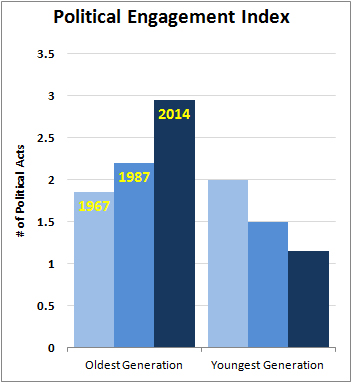
    Let’s scold the millennials today, shall we? Russell Dalton put together some data on political engagement among various age groups over the past few decades, and sure enough, he concludes that young ‘uns just aren’t as engaged as they used to be. Conversely, old folks are much more engaged.

    Millennials in 2016 are significantly less likely to vote or try to influence others vote than were the ’80s generation in the 1987 survey, or the first wave of postwar baby boomers in 1967. But millennials display about the same level of political interest as the youngest generation did in 1987….At the same time, a widening age gap in participation occurs at both ends of the life cycle….Older Americans in the two later surveys are significantly more active than seniors were in 1967.
    The chart on the right shows this pretty dramatically. In 1967 there was very little difference between the youngest and oldest voters. By 1987 a gap had opened up, and by 2014 that gap had become a chasm. Millennials are still interested in politics, and they still work with others on political issues. They just don’t vote. Dalton tries to put the rosiest possible spin on this:

    The widening participation gap between the less involved youth and the very involved elders in 2014 might not mean that millennials — or “kids these days” — don’t care. Rather, it could be that the long slope of differences by life stage is getting steeper, with less involvement in youth and more involvement in later life. And even this widening participation gap is largely based on millennials reluctance to vote, while remaining engaged in other ways.

    ….Lower youth turnout is not a sign of a broad malaise. Millennials are about as interested in politics as youth in prior generations, and about as politically active outside elections….If we look at the full range of political activity, millennials are good democratic citizens — at least as much as their elders were in their youth.

    I dunno. I think Dalton protests too much. The political engagement gap is genuinely huge, regardless of whether millennials say they’re interested in politics. And no argle bargle about the “long slope of difference by life stage” explains this. Voting isn’t all that big a chore, and if millennials don’t do it, it means either that their political engagement really is low or that they simply don’t believe that voting makes any difference. But which is it?

  • There’s Still Slack in the Labor Market—But Not a Lot


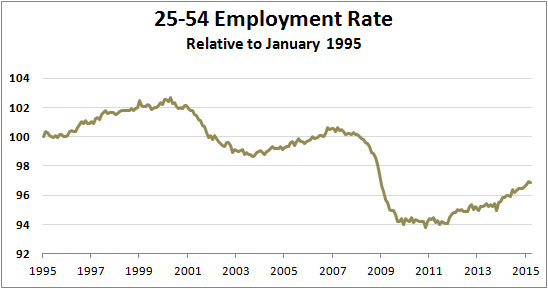
    Brad DeLong looks at a chart showing the employment rate of prime-age workers (ages 25-54) compared to January 2000 and says:

    Without nominal wage growth of 4%/year or significantly rising inflation, no way I am going to believe that the U.S. economy is in any sense at “full employment” with an essentially zero output gap right now.

    It’s not that I disagree, but I think that choosing January 2000 stacks the deck. That’s the absolute peak of the dotcom boom, and there’s no reason to think we’re going to replicate that anytime soon. A better comparison would be the mid-90s, when the economy was strong and growing but not at the peak of a bubble. Here’s what that looks like:

    We’re still not at full employment. But we’re getting there: the unemployment rate is low; the expanded unemployment rate is getting close to low; and wages are increasing a bit. Additional inflationary pressure would be yet another sign of a tight labor market, but we haven’t seen that yet.

    We still have work to do to get to full employment—and it’s possible we’ll never get back to 1990s levels. That depends a lot on precisely who’s dropped out of the workforce and why. But we’re getting close.

  • Ted Cruz Calls For Massive Police Presence in Muslim Neighborhoods


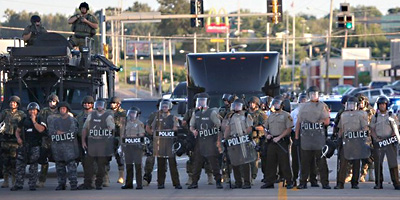
    One of the odd Republican obsessions of the moment is their outrage over liberal refusal to “call radical Islam by its name.” In the wake of today’s Brussels bombing, Ted Cruz naturally says this kind of namby-pamby political correctness is at an end. But that’s not all:
    We need to immediately halt the flow of refugees from countries with a significant al Qaida or ISIS presence. We need to empower law enforcement to patrol and secure Muslim neighborhoods before they become radicalized. We need to secure the southern border to prevent terrorist infiltration.

    “Patrol and secure.” That has an ominous sound to it, especially the “secure” part. Apparently Cruz is trying to out-Trump Trump before Trump even has a chance to say something stupid. This is some campaign these guys are running.

  • No, America Is Not a Poor Country


    When Donald Trump says America is a loser, apparently he’s dead serious. Judging by some of his answers during his interview with the Washington Post editorial board yesterday, he genuinely thinks we’ve all but slipped into third-world status these days. Here he is on American support for NATO:

    NATO was set up at a different time. NATO was set up when we were a richer country. We’re not a rich country. We’re borrowing, we’re borrowing all of this money.

    On South Korea:

    That’s a wealthy country. They make the ships, they make the televisions, they make the air conditioning. They make tremendous amounts of products….I think that we are not in the position that we used to be. I think we were a very powerful, very wealthy country. And we’re a poor country now. We’re a debtor nation.
    And on Saudi Arabia:

    If you look at Germany, if you look at Saudi Arabia, if you look at Japan, if you look at South Korea — I mean we spend billions of dollars on Saudi Arabia, and they have nothing but money. And I say, why?…We pay billions— hundreds of billions of dollars to supporting other countries that are in theory wealthier than we are….I mean we spend billions of dollars on Saudi Arabia, and they have nothing but money. And I say, why?

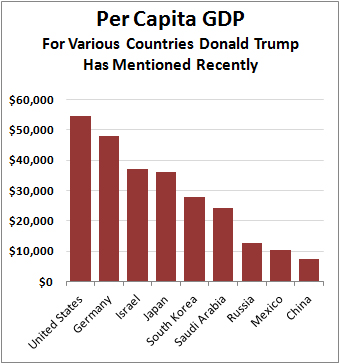
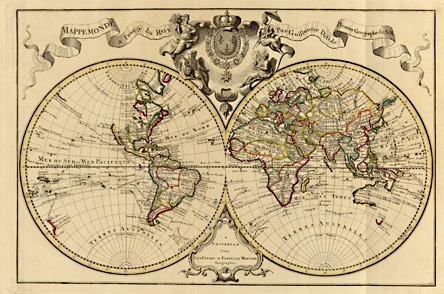
    “We’re a poor country now.” I wonder how many people believe that just because Donald Trump keeps saying it? In case anyone cares, the actual truth is in the chart on the right. There’s not a single country in the world bigger than 10 million people that’s as rich as the US.

  • Donald Trump Has No Clue Where Iraq’s Oil Is


    I know this is just spitting into the wind, but you really have to read Donald Trump’s interview with the Washington Post editorial board to believe it. Here’s one little excerpt about Iraq, American troops, and oil:

    DIEHL: And could I ask you about ISIS, speaking of making commitments, because you talked recently about possibly sending 20 or 30,000 troops and—

    TRUMP: No I didn’t, oh no no no, okay, I know what you’re saying….I didn’t say send 20,000. I said, well the generals are saying you’d need because they, what would it take to wipe out ISIS, I said pretty much exactly this, I said the generals, the military is saying you would need 20- to 30,000 troops, but I didn’t say that I would send them.

    DIEHL: If they said that, would you go along with that and send the troops?

    TRUMP: I find it hard to go along with—I mention that as an example because it’s so much….We should have never been in Iraq. It…was one of the worst decisions ever made in the history of our country. We then got out badly, then after we got out, I said, “Keep the oil. If we don’t keep it Iran’s going to get it.” And it turns out Iran and ISIS basically—

    HIATT: How do you keep it without troops, how do you defend the oil?
    TRUMP: You would… You would, well for that— for that, I would circle it. I would defend those areas.

    HIATT: With U.S. troops?

    TRUMP: Yeah, I would defend the areas with the oil.

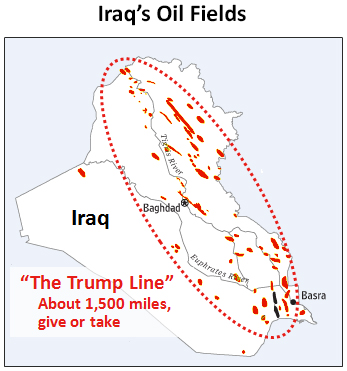
    Trump seems to be under the impression that Iraq’s oil is in a region about the size of Central Park that he could just surround and protect. The map on the right—which has been printed in magazines and newspapers thousands of times over the past decade—shows where the oil really is: everywhere. Trump would need a Maginot Line about 1,500 miles long to “circle it.”

    But he doesn’t want to send over 20,000 troops. In fact, he suggests that’s obviously preposterous. 20,000 troops!

    I’m no military man, but I’m pretty sure a front 1,500 miles long would require a little more than 20,000 troops. Maybe Trump is planning to build a wall instead.

    BY THE WAY: This isn’t even the best part of the interview. I just chose it sort of at random. You can dive in pretty much anywhere and get stuff just as good. Trump’s extended riff on his hands is a good place to start.

  • Oh Wait—Donald Trump Decides He Has a Foreign Policy Team After All


    After finally telling us that he didn’t need a foreign policy team because he was his own team, Donald Trump made yet another U-turn today and announced his foreign policy team. It’s enough to make you dizzy. I’ll let Robert Costa introduce them:

    Keith Kellogg…executive vice president at CACI International, a Virginia-based intelligence and information technology consulting firm…. Joseph Schmitz…Blackwater Worldwide…. George Papadopoulos… international energy center at the London Center of International Law Practice…. Walid Phares…National Defense University and Daniel Morgan Academy in Washington…. Carter Page…managing partner of Global Energy Capital [and] longtime energy industry executive.
    This is quite a team. Kellogg was COO of the Coalition Provisional Authority in 2003-04 under Paul Bremer, and we all know how that turned out. Schmitz is the son of noted Southern California crackpot John Schmitz—which I suppose I can’t hold against him—and served as inspector general of the Defense Department under George Bush. He resigned in 2005 following charges that he “slowed or blocked investigations of senior Bush administration officials, spent taxpayer money on pet projects and accepted gifts that may have violated ethics guidelines.”

    Papadopoulos is on his second presidential campaign this year, having previously found a home with Ben Carson. Phares is well known to all Fox News viewers for his regular appearances there—and for his background during the 80s as a “high ranking political official in a sectarian religious militia responsible for massacres during Lebanon’s brutal, 15-year civil war.”

    Page I don’t know much about. Apparently he’s the head of an investment fund “focused on energy investments worldwide,” and that’s good enough for Trump.

    So….this is a helluva C-list crew Trump has assembled. A guy who worked for Paul Bremer; the son of John Schmitz; a former Ben Carson advisor; a Fox News talking head; and a Wall Street fund manager.

    As for Trump’s actual foreign policy, apparently it’s the same as always: he’s super militaristic, but he doesn’t want to actually use the American military for much of anything. He’d like other countries to start taking care of Ukraine and NATO and the South China Sea—or, if they insist on America doing it, he’d like them to pay us for it. Apparently Trump’s ambition is to sit at the head of a vast American tribute empire.

  • It’s Old People Who Have More Debt, Not the Young


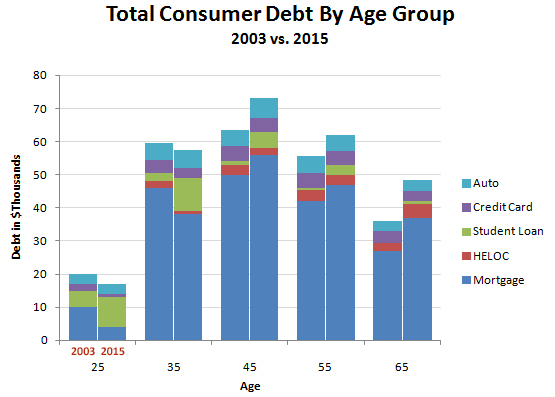
    Ylan Mui points today to a February note from the New York Fed called “The Graying of American Debt.” Here’s the basic picture:

    The student debt story is about what you’d expect: young consumers have more of it, but their total debt load is lower than it was in 2003 because they have lower mortgage debt. Basically, they’re trading student debt for mortgage debt.

    But older age groups make up for it with higher debt than they had in 2003. This is especially true at age 65, where total debt is up by about a third over the past decade. So what does it all mean?

    The close relationship between credit score and age…reflects an average credit history that is considerably stronger among older borrowers….Further, older borrowers’ income streams are comparatively stable, and they have greater experience with credit. Survey of Consumer Finances data show that net worth levels for households with heads who are age 65 and older in 2013 are quite similar to their 2004-07 levels. This holds despite the evidence, seen in the second chart in this post, that consumers are holding substantially more per capita debt at age 65 and beyond. If history is any guide, then, we expect older borrowers to make more reliable payments. Indeed, our data show no clear trend toward higher delinquency at older ages as average balances at older ages have increased.

    Hence the aging of the American borrower bodes well for the stability of outstanding consumer loans. At the same time, the likely combination of muted credit access and lower demand for credit that we observe among our younger borrowers may well have consequences for growth. The graying of American debt that we observe between 2003 and 2015, then, might be interpreted as a shift toward greater balance sheet stability, and away from credit-fueled consumption growth.

    More stability, less growth. Just what old people want. But is it good for the country?

  • Three Cheers For a Contested Convention


    I guess a contested Republican convention has now made a full circle1 from “Spare me” to “I always said that”:

    In multiple television interviews Sunday, Reince Priebus, chairman of the RNC, raised the prospect of a protracted convention fight with multiple rounds of voting needed to determine the winner. “We’re preparing for that possibility,” Mr. Priebus said on ABC. That marks a shift from earlier this month, when Mr. Priebus told a gathering of conservatives that a contested convention was “highly, highly unlikely.”

    Sounds like fun. Seriously. Just think of all the free publicity this gives the Republican Party.

    1Half circle?

