• Europe Slowly Sinks Further Into the Abyss of Timidity


    Europe’s grand experiment in negative interest rates is about to get a teensy bit grander, but not everyone is happy about it:

    Analysts and portfolio managers said they remain skeptical about the efficacy of negative interest rates in stimulating growth and inflation. “The key difference this time is that the market is much less receptive to the idea of the ECB generating inflation than they were a year ago,” said Jack Kelly, head of global government-bond funds at Standard Life Investments.

    ….Markets anticipate that the bank will lower the interest rate it pays on overnight commercial bank deposits by 0.1 percentage point in March, to minus 0.4%, investors say.

    It has long been taken as axiomatic that a motivated central bank can generate inflation whenever it wants. But is this true? In theory, it still is: if a central bank creates a vast enough pool of new money, eventually inflation has to follow. But in the real world, there are political limits to just how vast such an expansion can be, as well as plain old limits on the amount of nerve that central bankers have. So now the question is whether it’s still true in practice that a central bank can generate inflation at will. It sure looks like the answer might be no. And if that’s the case, there are also limits on the amount of monetary stimulus that a central bank can provide.

    And if that’s true, then the only way out of Europe’s hole is with fiscal stimulus: lots of countries running big deficits for a good long time. But that doesn’t seem to be in the cards either. And so we’re stuck.

  • Schoolhouse Rock Gets an Update in the Democratic Debate


    Hillary Clinton tonight, defending her vote for the TARP bank bailout in 2008:

    Were there things in it that I didn’t like? Would I have done it differently? Absolutely. But was the auto bailout money in it — the $350 billion that was needed to begin the restructuring of the auto industry? Yes, it was….You have to make hard choices when you’re in positions of responsibility. The two senators from Michigan stood on the floor and said, “we have to get this money released.” I went with them, and I went with Barack Obama. You did not. If everybody had voted the way he did, I believe the auto industry would have collapsed, taking four million jobs with it.

    Bernie Sanders tonight, defending his vote for the crime bill in 1994:

    You know, as I think Secretary Clinton knows, as we all know, there are bills in congress that have bad stuff, there are bills in congress that have good stuff. Good stuff and bad stuff in the same bill….Violence against women act has protected millions of women in this country, it was in that bill. The ban on assault weapons, that’s what I have fought for my whole life. It was in that bill….So, to answer your question, what you read was a congressman who was torn, who said there are good things in that bill, there are bad things overall. I voted for it.

    This is not the way Schoolhouse Rock explained the legislative process, but it’s certainly accurate. And when it’s convenient, both candidates are happy to use it to justify themselves.

    The good news is that this is a welcome bit of adult conversation. In real life, legislators rarely get the opportunity to vote on major bills that are all good or all bad. The sausage comes out of the grinder, and then you have to decide if the good outweighs the bad—or vice versa. That’s just the way the world works. Politicians shouldn’t have to be embarrassed to admit it.

  • Hillary Clinton Wins the Lead Geek Vote


    If you’re a lead poisoning obsessive (*cough*) Hillary Clinton won your vote tonight during the Democratic debate in Flint moderated by Anderson Cooper:

    COOPER: Let me just point out for accuracy’s sake, there are 10 million lead service pipes delivering water to people all across this country tonight. Secretary Clinton?

    ….CLINTON: I want us to have an absolute commitment to getting rid of lead wherever it is because it’s not only in water systems, it’s also in soil, and it’s in lead paint that is found mostly in older homes. That’s why 500,000 children today have lead — lead in their bodies….That has, unfortunately, been in many ways, moved to a lower priority. I will elevate it, and I will do everything I can. Water, soil, and paint.

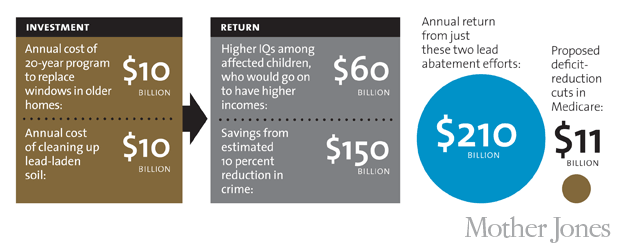
    Naturally I’m pleased that the problems in Flint have turned a national spotlight on the problem of lead poisoning. I’m a little less pleased that the spotlight is so relentlessly on water. Generally speaking, lead water pipes are not really a huge source of lead poisoning in America these days. The main sources are (a) residual lead in soil and (b) lead paint in older homes—especially around window sills, where the friction of opening and closing the windows exposes old layers of paint and spews lead dust into houses. I’d love to see us spend a big chunk of money on lead remediation, which would almost certainly pay off in the long term, but the money should go mostly into soil and paint remediation.

  • Stanley Kubrick Urban Legend Bleg

    What’s the point of having a blog if you can’t help out a friend once in a while? So let’s see if anyone can answer this little trivia question about 2001: A Space Odyssey:

    I’m trying to verify a story about a piece of direction that Stanley Kubrick gave Keir Dullea (who played Dave Bowman) for the scene where Bowman is getting his dinner on board Discovery. As Bowman pulls the little trays of food from the ship’s automated kitchen, it’s obvious that the containers are hot and that he’s trying not to burn his fingers.

    The story is that Kubrick’s instructions stemmed from his being unhappy for some reason with General Mills, whose logo is prominently displayed on the automated kitchen. Kubrick was getting back at General Mills by showing that something was not quite right with their technology.

    Has anybody heard this story? If so, where? I have been searching the web, watching YouTube videos of the actors discussing the film, viewing the special features on the Blu-ray discs, paging through my books, and can’t find any reference to it.

    Has anyone else heard this story?

  • USB-C: A Great Idea, But It Won’t Put a Dent in Price Gouging


    David Pogue sings the praises of the latest standard in computer cables:

    The new cable, called USB Type-C (or USB-C), is the same on both ends, so you never have to fiddle with it. The connector is also identical on both sides—there’s no upside down.

    USB-C can replace four different jacks on your gadget: data, video, power and, soon, audio….Yet the connector is tiny enough for phones and tablets and sturdy enough for laptops and PCs. Every device from every brand can use the same cable.

    ….That USB-C even exists at all is something of a miracle, considering what a big business accessories have become. Apple, for example, makes a staggering amount of money selling cables….Apple’s not alone. A typical charger for a Windows laptop costs $60 to $80….The question is: Why? Why would these archrivals work together to create a charger that works interchangeably across devices and brands, wiping out the proprietary-charger industry in one fell swoop?

    I think I can answer this. I currently use a Surface Pro 4 tablet, and its biggest drawback is lousy battery life (about five hours of moderate use). So I was thinking of getting a second charger to leave downstairs so that it could charge midday when I’m not using it. But as Pogue says, there was sticker shock. The charger costs $80, which is so ridiculous that I rebelled. It’s not as if I can’t afford it, and I’ve long since been trained to accept inflated prices for chargers. But $80 is so high that it felt as if Microsoft was literally giving me the finger.
    Would USB-C change this? Nope. Because the issue here isn’t the proprietary cable, it’s the proprietary charger. You see, the Surface doesn’t use a normal 5-volt charger, it uses a 15-volt charger. Good luck finding one of those! If you try charging it with a normal third-party charger, it will just sit there sullenly doing nothing.

    Micro-USB is already pretty standard for cell phones and such, so USB-C doesn’t change things much there. And I suppose some (most?) tablets work with a normal 5-volt charger. But I know that Dell tablets don’t. Surface tablets don’t. And the truth is that the higher voltage is handy, since it allows large batteries to charge faster.

    USB-C will probably help a bit in the endless war against manufacturers constantly changing cable types. But when it comes to making money, it’s the proprietary charger that’s key, not the cable.

  • High Income Inequality Makes Recessions a Little Worse


    A new paper investigates the association between income inequality and recessions over the past 40 years:

    It would appear that a less equal income distribution leads to deeper and more costly recessions. Overall, the length of the duration of contraction when going into a recession is longer and its amplitude deeper for countries with a less equal distribution of income.

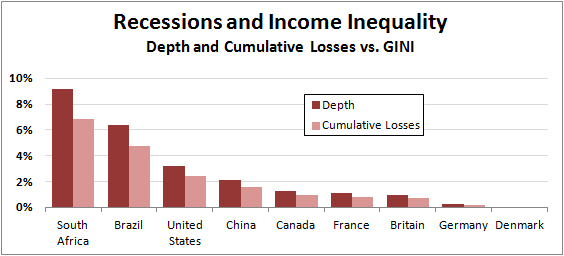
    But by how much? The authors use the World Bank’s GINI score and conclude that a one point increase in GINI leads to a 0.26 percent increase in the depth of a recession and a 0.2 percent increase in cumulative losses over the course of a recession. In other words, the effect is noticeable but not huge.

    To make this a little more concrete, here’s a chart that shows how the authors would expect recessions in various countries to compare to a recession in Denmark, which has a very low GINI score. For the United States, other things equal, we should expect that our recessions would be about 3 percent deeper and produce 2 percent more losses than a recession in Denmark.

  • The Water in Flint Looks Pretty Drinkable These Days


    The New York Times reports on the water in Flint:

    Five months after state authorities announced that it was unsafe to drink unfiltered water because of high lead levels caused by government errors over the past two years, federal officials said here last week that the water still was not safe, and, as testing goes on, offered no promise for when it would be.

    I understand the need for caution, as well as the obvious distrust that Flint residents have for official pronouncements that everything is now hunky-dory. But I wonder if this has paralyzed us in a way that’s now causing more harm than good? There have been more than 13,000 residential tests of Flint’s water since the beginning of the year, and it sure looks to me like the water is now pretty safe.

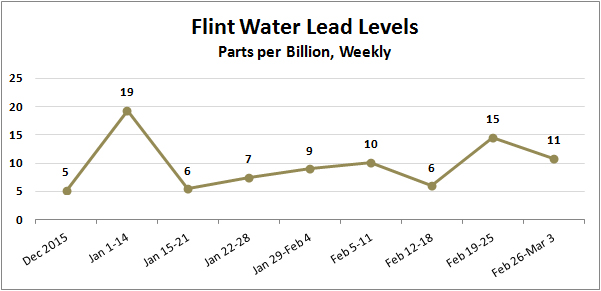
    The chart below shows weekly lead readings compared to the end of 2015 and early 2016. The only thing I’ve done is remove readings over 2,000 ppb, since those outliers can affect the averages in misleading ways. Since the middle of January, there hasn’t been a single week in which the average was over 15 ppb, which is the usual level of concern. The average over the entire period since mid-January is 10.52 ppb. Needless to say, it would be nice to get the average level below 5 ppb, but even for households with kids the water in Flint looks pretty drinkable these days.

  • Tax Plan Showdown: Now We Have Bernie Sanders Too


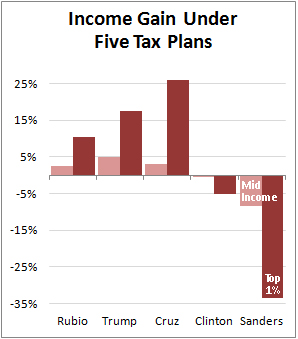
    And now we are five. The Tax Policy Center has analyzed Bernie Sanders’ tax plan, and we now have data for everyone still running except John Kasich, who hasn’t produced any tax proposals yet. The full reports are here: Donald TrumpMarco Rubio, Ted Cruz, Hillary Clinton, and Sanders. Click the links for details. Or just look at the charts below for the nickel summary.

    As before, the Republican plans are all the same: a tiny tax cut for the middle class as a sop to distract them from the enormous payday they give to the rich, and a massive hole in the deficit.

    On the Democratic side, Hillary Clinton’s plan is fairly modest. It leaves the middle class alone and taxes the rich a little more. Once her domestic proposals are paid for, it’s probably deficit neutral. Bernie Sanders is far more extreme. He’s basically the mirror image of the Republicans: he’d tax the middle class moderately more and soak the hell out of the rich. This would raise a tremendous amount of money, which he’d use to pay for his health care plan and his other domestic proposals. It’s impossible to say for sure how this would affect the deficit, but the evidence suggests that it would blow a pretty big hole since he plans to spend quite a bit more money than he’d raise.

    So that’s that. Quite a choice we have this year.

  • Hillary Clinton’s Email Scandal Continues to Dribble Away


    Here’s the latest on classified information being sent via email at the State Department:

    The State Department has removed from its unclassified electronic archives a dozen sensitive emails sent to the personal accounts of former secretary of state Colin L. Powell and the staff of his successor, Condoleezza Rice, according to a memo released Friday by the agency’s watchdog….None of the messages was marked as classified or secret at the time it was sent, but [the department’s inspector general, Steve Linick] wrote the emails may have contained “potentially sensitive material” because of the subject matter.

    Powell has said he has reviewed the messages and disagrees with a State Department decision to retroactively classify them. “I do not see what makes them classified,” he said.

    Hillary Clinton probably sent a lot more emails than Powell, so she ended up with more emails retroactively being classified. Plus the CIA is apparently obsessed with pretending that the US drone program is a deep, dark secret. As usual with Clinton “scandals,” this one is dribbling away to nothing in the light of day, and would undoubtedly dribble a lot faster if any of us could actually see the emails. It’s an election season, so none of this will convince Republicans that there’s nothing of any consequence here, but there’s nothing of any consequence here. It’s just another boneheaded excrescence of the Benghazi pet rock.

  • Explaining Donald Trump’s Dick


    Why did Donald Trump inexplicably defend the size of his penis in Thursday’s debate? Because he’s unnaturally sensitive about it? Because, as Jeet Heer suggests, it’s part of a venerable history of monarchs and presidents? Because Hillary Clinton would be the first penis-free president, so it’s a good way of contrasting himself?

    Yes to all of the above, I suppose. Plus the fact that Trump is a self-centered boor. But this is all background noise. The real reason, which Trump understands instinctively, is simpler.

    Trump’s supporters love him not so much for his policies but for his promise of toughness. Without that, he’s nothing. And to his supporters, toughness is deeply tied up with virility and manliness. This includes all the affairs, the succession of young wives, the supermodels, and the fact that he brags endlessly about it. Most of his supporters don’t precisely approve of all this stuff, but they nonetheless admire it when it comes from someone so successful. If that’s what it takes to save the country, then that’s what it takes.

    So Trump made it clear that his manliness is quite intact, thank you very much. This is, if you’ll pardon the pun, all part of the package. It’s true that Marco Rubio fired the first shot a few days earlier, but that never came up in the debate. Trump brought it up out of the blue. He wanted to bring it up.

    Everyone in the press mocks him for this nationally televised display of crudeness, but Trump brought it up because he wanted to assure his supporters he was a tough guy. And I’ll bet it worked.