• Was Trade the Secret Sauce in Bernie Sanders’ Michigan Win?

    From the Washington Post on Bernie Sanders’ win in Michigan last night:

    Senator’s win fueled by his opposition to ‘disastrous’ trade deals

    Sanders’s come-from-behind victory was fueled by a relentless focus on his opposition to “disastrous” trade deals that have battered the manufacturing sector in Michigan. He will carry the same message to Ohio, North Carolina, Illinois and Missouri next week.

    ….Sanders campaigned hard in Michigan, holding large rallies across the state over the past week and hammering Clinton for what he called her record of failure on trade and job protection — an appealing message in a state that has lost manufacturing jobs. “While others waffle, Bernie is fighting hundreds of thousands in new job losses,” said the narrator of a Sanders television ad in heavy rotation in the state.

    Maybe. But here are a few exit poll results from Michigan:

    • Sanders won union households 49-47 percent.
    • Clinton won voters who think the economy is the most important issue by 51-48 percent.
    • Among voters who think trade with other countries takes away US jobs, Sanders won 58-41 percent.
    • Among voters worried about the economy, Clinton won 50-48 percent.

    There’s clearly some evidence for the trade theory, since Sanders won a convincing victory among voters who think trade takes away US jobs. But more generally, voters concerned about the economy broke pretty evenly.

    The bigger story, perhaps, is that Sanders won a whopping 83 percent of voters under 30. That’s a fifth of the electorate. He also won a respectable 31 percent of the black vote. In both cases, this is better than he usually does.

    Maybe trade really was the key margin of victory for Sanders in Michigan. But the evidence is a little thin, and it seems as though age and race breakdowns can explain things pretty well too. I’d be careful about drawing too firm a conclusion from Michigan about trade being an especially potent issue.

  • Americans Aren’t Anxious About the Economy. So What Are They Anxious About?


    I am going to try everyone’s patience this morning. But I’m going to do it with a big pile of charts, so it won’t take all that long to get through it. You’ll have to decide for yourself if it was worth it once you get to my little surprise at the end.

    The question, once again, is how worried Americans are about the economy. I’m going to come at this a few different ways, all via the magic of charts. Most of them cover the past four years, with a few going back farther to provide historical perspective. Let’s take a look.

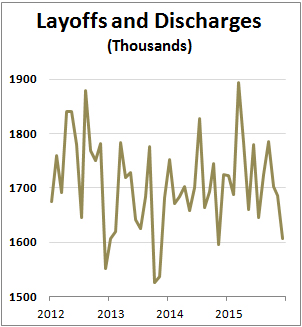
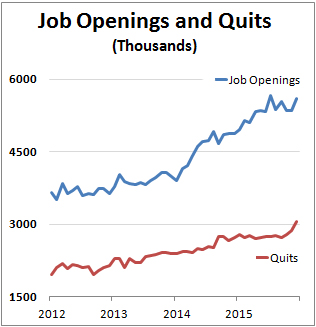
    The most obvious source of economic anxiety is the possibility of losing your job. But that doesn’t seem to be a big problem: the data on layoffs and discharges is noisy, but basically flat. Terminations are running at a pretty normal rate. Still, maybe lots of people are worried about not being able to find a new job if they do happen to get fired. But as you can see, job openings have increased at a very steady clip, and that’s matched by more workers quitting their jobs because they have greater confidence that they can find something new. Job stability just doesn’t seem to be a big issue right now.
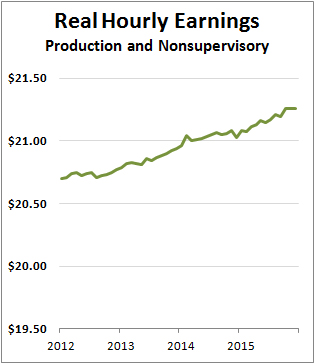
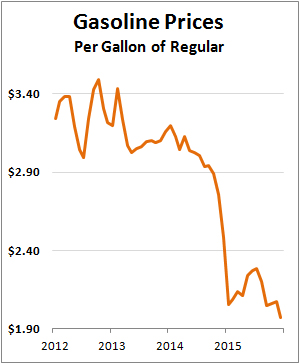
    Let’s look at a couple of other things. We already know that unemployment and inflation are both low, so that’s not the problem. Maybe wages are falling? Nope. Wages haven’t gone up very much over the past four years, but they have gone up. The price of gasoline is often blamed for voter frustration, but gasoline prices have dropped like a rock over the past couple of years. No one is getting upset over that.
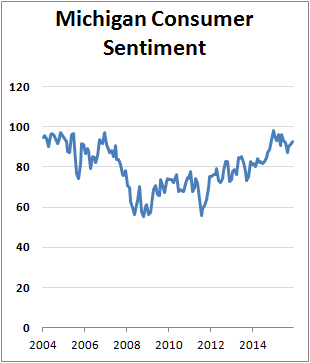
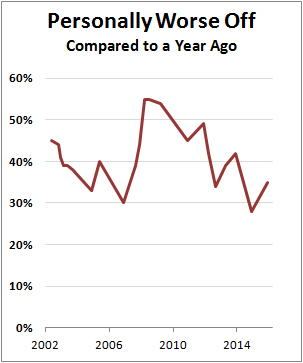
    Let’s switch gears. Objective data is all well and good, but we’re not dealing with Vulcans here. How do people feel? According to the Michigan Consumer Sentiment survey, they feel pretty chipper. Their index shows that consumer sentiment is back in the same range it was in during the early aughts. And Gallup agrees. They’ve been polling people about their personal finances for a long time, and one of their questions is whether you’re better or worse off than a year ago. Right now, only about one-third of workers say they’re worse off, which is better than it was during the aughts.
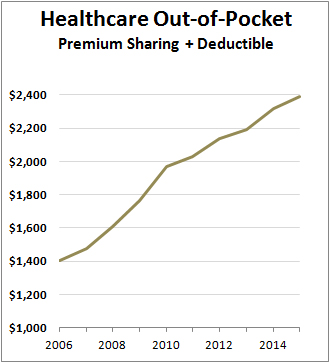
    Needless to say, not everything is coming up roses. There are always specific groups and specific areas that produce more heartburn than average. For example:
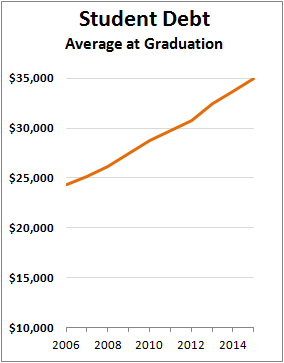
    That said, the vast bulk of the evidence indicates that (a) the economy is in pretty good shape in objective terms, and (b) most voters feel pretty good about the economy. As a result, when Gallup asks about personal satisfaction they get pretty cheerful responses. But when they ask about satisfaction with the country, it all goes to hell:
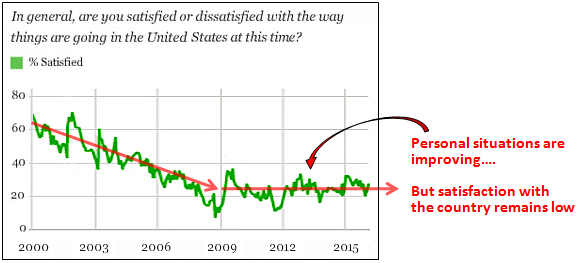
    Satisfaction with the direction of the country took a huge nosedive during George Bush’s presidency, and has stayed at historic lows for all of Obama’s. In the past, low satisfaction was caused by recessions, and it rebounded when the recession was over. This time, it was caused by something else, and it failed to rebound when the economy recovered.

    So what’s behind this? One possibility is angst over illegal immigration, but that doesn’t add up. Net illegal immigration has been negative over the past seven years, producing a decrease in undocumented workers in the US from 12 million to 11 million. What’s more, Gallup polls show more support for legal immigration since 9/11 and less support for deporting undocumented immigrants.

    Maybe Iraq is to blame. Maybe the mood of the country became sullen when we couldn’t win a clean victory there, and we’ve remained in a funk ever since. Or maybe the more general lack of victory over terrorism has kept everyone on edge. There’s a little bit of evidence for that in the past year, but only a little—and none at all before that.

    Or there’s my pet explanation: the economy might be doing OK, but Democrats are afraid to say so because it would make them seem satisfied with a good-but-not-great recovery that hasn’t increased middle-class wages much. So instead they denounce increasing income inequality and focus on the need to get the benefits of growth flowing to the working classes. That may or may not be admirable, but politically it’s a loser. If you have the conservative noise machine and both parties agreeing that the nation’s economy sucks, then people are going to believe the nation’s economy sucks—even if most of them are personally pretty satisfied.

    So then: where’s all the seething anger that Donald Trump is supposedly harnessing? We hear about this endlessly on an anecdotal basis, even though the evidence suggests that Americans aren’t really all that angry at the moment. And we’re not talking about just one demographic group here. Trump draws support from men and women; from young and old; from rich and poor; and from all education levels.

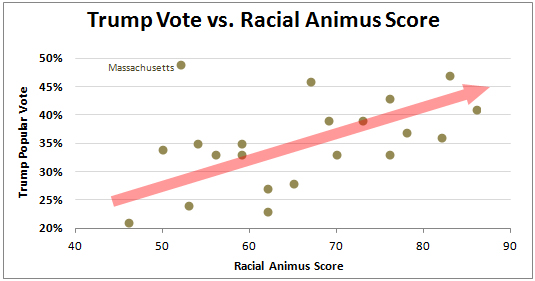
    Well: the white parts of those groups, anyway. Today I happened to run across a paper that measured each state by its level of racial animus. That got me curious: how would the scores compare with each state’s popular vote for Donald Trump? Answer: pretty well! Massachusetts is sort of an odd outlier, but the rest of the states form a pretty decent regression. I guess now we know what all those Trump voters are pissed off about.

  • Medicare Wants to Try a New Way of Paying for Expensive Drugs


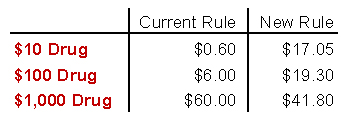
    For drugs administered in clinics and hospitals, Medicare reimburses doctors a flat 6 percent of the price of the drug. This has never really made much sense, since it doesn’t cost any more to attach a $1,000 vial to an IV line than a $100 vial. So now the Obama administration is proposing a five-year test of a new system that pays a flat fee plus a smaller percentage of the cost of the drug. Here’s what it looks like:

    The current rule is an update of an older rule that was even stupider than reimbursing based on price. But it’s still pretty stupid. If two drugs are about the same, and you can make $6 from one and $60 from the other, then you might as well prescribe the more expensive one. That’s exactly the wrong incentive. Not everyone sees it this way, of course:

    The test program is also likely to meet stiff opposition from the pharmaceutical industry and some providers—especially cancer centers where many high-price specialty drugs are used—because of the drop in reimbursement….Providers may also feel they are being pressured by the federal government into selecting cheaper drugs they don’t feel are as effective.

    This makes no sense. No one is being pressured into selecting cheaper drugs. You just won’t get paid an artificial bonus for avoiding them in favor of more lucrative options that don’t work any better. If that’s your idea of “pressure,” I’d recommend you go into a less demanding field.

    The new system, I assume, is designed to recognize that administering a drug is mostly—but not entirely—a flat cost operation. The reason the cost isn’t completely flat is that clinics and hospitals have to pay for the drugs up front and keep them in stock. There’s a carrying cost involved in that, which means that expensive drugs really do cost a little more to administer than cheaper ones.

    But not that much more. The new system seems well worth a try.

  • Here’s Yet Another Penny-Ante Shill From Donald Trump

    The list of Donald Trump’s penny-ante shills seems endless. Trump steaks, Trump mortgages, Trump university, Trump vodka, Trump travel, etc. All of them were going to be the biggest thing ever, and all of them were basically either failures or scams. But it turns out there’s another Trump failure that no one seems to have heard about until now. Here’s Ian Tuttle with the details:

    In November 2009, Trump, boasting a Midas-gold tie, took the stage in front of several thousand fans at Miami’s Hyatt Regency to debut his latest venture: The Trump Network™, a multi-level marketing operation focused on nutritional supplements.

    A pyramid scheme based on nutritional supplements? That has Donald Trump written all over it! Please continue:

    In early 2009, Trump purchased Ideal Health, Inc., founded in 1997 outside Boston by Lou DeCaprio and brothers Todd and Scott Stanwood, who became Trump Network executives….The centerpiece of the program [was] the PrivaTest….Customers would purchase the PrivaTest kit, collect a urine sample, and ship the sample to a lab, which would analyze it and develop a “Custom Essentials” kit of nutritional supplements “calibrated . . . to reflect your unique nutrient needs.”

    ….The PrivaTest and a month’s supply of Custom Essentials cost $139.95, an additional month’s supply cost $69.95, and to keep one’s “unsurpassed individual nutritional support” up to date, the Trump Network recommended repeating the PrivaTest every nine months — at a price of $99.95, plus shipping and handling.

    ….Network marketing has had its successes: Avon and Mary Kay, for example….Trump and his devotees maintain that, because there was an actual product involved, the Trump Network was no scam, and in early 2011, Trump told New York Magazine that he expected the Trump Network to become larger than Amway, then an $8.4 billion operation. Unsurprisingly, that never happened. “The Trump Network had gotten in trouble financially,” Bonnie Futrell, a former Network marketer, told Stat News. “They weren’t being able to pay [the lab]. They weren’t paying vendors. They weren’t paying us.” In early 2012, just over two years after it started, the Trump Network was sold to network-marketing company Bioceutica.

    I assume no one is surprised to hear this, so there’s not much point in dreaming up snarky comments about it. It’s pure Trump.

    But here’s what I don’t get: how is it that we’re hearing about this for the first time? It only happened seven years ago. It was announced with all the usual Trump fanfare. But it seems to have escaped everyone’s notice. How many more of these things are out there just waiting to be discovered?

  • LA Sheriff Having a Hard Time Firing Liars


    Jim McDonnell, LA County’s new sheriff, thinks that deputies who lie on official reports should be terminated for cause. For example, there’s Daniel Genao, who wrote that there was a gun in a suspect’s waistband when it was actually behind a nearby planter. You’d think it would be hard to argue against firing folks like this. But you’d be wrong:
    To fully implement his strict regime, McDonnell must contend with the Civil Service Commission, a five-member body appointed by the L.A. County Board of Supervisors that adjudicates discipline cases of county employees. In the last year, the commission has reinstated Genao as well as a deputy who lied about whether he had tried to take a photo under a woman’s skirt and another deputy found to have falsely asserted that he had not witnessed a colleague beat up a jail inmate.

    ….Sean Van Leeuwen, vice president of the Assn. for Los Angeles Deputy Sheriffs, a union representing deputies, criticized McDonnell’s “one size fits all” approach to honesty. “Was this a bad act or was this a bad heart?” Van Leeuwen said. “Did you do something wrong because you made a mistake, or was this really a bad act?”

    ….The hearing officer concluded that dismissal was excessive because Genao admitted to the false statement and was a popular, well-respected deputy. Other deputies have ended up on the Brady list1 yet remained on the job, and Genao could work a non-patrol assignment, the hearing officer noted.

    How is it that we can happily apply zero-tolerance rules to five-year-olds who bring butter knives to school, but not to full-grown sheriff’s deputies who lie on official reports? And in what universe does it make sense to say that other deputies have lied and kept their jobs, so why shouldn’t Genao? If we want to understand why so many people of color don’t trust cops, this is a pretty good place to start.

    1From the article: “In the landmark Brady vs. Maryland case, the U.S. Supreme Court ruled that prosecutors must turn over exculpatory evidence to the defense. Local prosecutors keep a so-called Brady list of officers with credibility issues, which defense attorneys can use to undermine the officers’ testimony, potentially derailing criminal cases.”

  • Israel’s Donald Trump Cancels Meeting With President Obama


    The New York Times reports that Benjamin Netanyahu has canceled a trip to Washington:

    The Israeli newspaper Haaretz reported on Monday that he would not attend the conference because he had not been offered a meeting with Mr. Obama. The White House later dispatched a spokesman for the National Security Council to insist that it was Mr. Netanyahu who had turned down a chance to meet with the president.

    ….“We were looking forward to hosting the bilateral meeting, and we were surprised to first learn via media reports that the prime minister, rather than accept our invitation, opted to cancel his visit,” the spokesman, Ned Price, said on Monday. Mr. Price said that the Israeli government had requested a meeting on March 17 or 18, and that White House officials had offered one on the 18th.

    Maybe we’ve had this wrong all the time. Donald Trump isn’t the American version of Silvio Berlusconi. He’s the American version of Bibi Netanyahu.

  • Black Voters Are Going to Be Pissed When They Hear About This

    Well, crap. Dinesh D’Souza has somehow uncovered the secret history of the Democratic Party: Not only were we once the party of slavery, but racism among prominent Democrats continued “well into the 20th century.” Can you imagine? But we’ve been working feverishly for decades to keep our shameful past swept under the rug, so virtually nobody knows this anymore.

    Well, some of us knew it. It so happens that I’m part of the inner circle, so I knew it. But the rest of you sheeple didn’t, and that’s the way we intended to keep it. Unfortunately, someone ratted us out. I guess we should have kept D’Souza locked up longer on that bogus campaign finance violation. The foreign oligarchs who have been funding our propaganda efforts are not going to be pleased.

  • Hey Donald, Will You Self-Fund In the General Election Too?


    Megan McArdle says Donald Trump will never run as a third-party candidate for president because he’s not rich enough. It costs upwards of a billion dollars to run for president these days, and Trump doesn’t have that kind of scratch. So what’s he going to do? Raise it from billionaires after spending the entire primary claiming that anyone who raises money from billionaires is corrupt and crooked?

    Well, this is Donald Trump we’re talking about, so sure. He might very well do that. Or he might run a cheap campaign designed not to win, but to take revenge on whoever stole the nomination from him.

    Still, point taken. The whole self-funding schtick won’t work in a general election. But here’s the curious thing: it won’t work if he runs as the Republican nominee, either. He’s going to have to raise money from rich people. So why haven’t any of the other candidates asked about this? Whenever he goes into his self-funding spiel, why doesn’t one of them ask if he’ll promise to self-fund in the general election? If nothing else, it would be interesting to watch Trump try to slither his way out of it.

  • Everyone Uses P-Values, But No One Knows What They Are


    A blue-ribbon committee of the American Statistical Association spent a year arguing about what a p-value is, and finally coughed up the following explanation aimed at laymen:

    Informally, a p-value is the probability under a specified statistical model that a statistical summary of the data (for example, the sample mean difference between two compared groups) would be equal to or more extreme than its observed value.

    Raise your hand if you understood a word of that. Anyone?

    Among experts, the long-running argument about p-values is abstruse and knotty. But even when you ignore the deep philosophical issues, it turns out that coming up with a close-enough explanation for average Joes and Janes is tough too. Over at 538, Christie Aschwanden hints at the problem: statisticians aren’t so much interested in explaining what a p-value is as they are in busting myths and explaining what it isn’t:

    A common misconception among nonstatisticians is that p-values can tell you the probability that a result occurred by chance. This interpretation is dead wrong, but you see it again and again and again and again. The p-value only tells you something about the probability of seeing your results given a particular hypothetical explanation — it cannot tell you the probability that the results are true or whether they’re due to random chance. The ASA statement’s Principle No. 2: “P-values do not measure the probability that the studied hypothesis is true, or the probability that the data were produced by random chance alone.”

    Personally, I’ve never been too happy with this approach, but I’ll leave that aside. I’m probably just wrong. But how about this nickel explanation?

    If you’re testing a hypothesis with only a limited set of data (for example, proposing that someone is the leader of a presidential race by relying on a survey of only 1,000 people) a p-value is, informally, the probability that the small dataset validated your hypothesis merely by chance.

    I suppose that’s wrong too in some kind of barely comprehensible way. It always is. But close! And, perhaps, reasonably comprehensible?