
• Republican Voters Like What Donald Trump Is Selling


    Why is Donald Trump not paying a price for his increasingly unhinged rhetoric? Two recent polls tell the story.

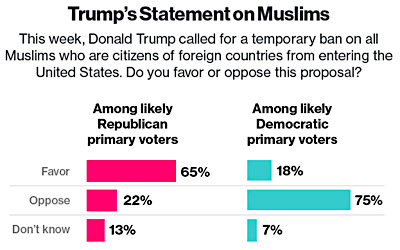
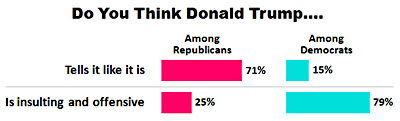
    At the top is a Bloomberg poll that asks if you agree with Trump’s call for a ban on Muslims entering the country. Less than a quarter of Republicans oppose it. At the bottom is an MSNBC poll that asks what kind of person Trump is. Only a quarter of Republicans think he’s insulting and offensive. These aren’t polls of tea partiers. They aren’t polls just of conservative states. These are polls of all Republicans in the nation. By a very wide margin, ordinary Republican voters think the stuff Trump is saying sounds great. Only about a quarter don’t like what they’re hearing.

    I don’t really know what to say about this. On 9/11, nineteen Muslim terrorists killed 3,000 Americans and destroyed two skyscrapers. There was an enormous thirst for revenge, and eventually George Bush used this to send us to war in Iraq. But even at the height of the fear, there was never any call to ban Muslim immigration.

    This year, 14 people are killed by a couple of deranged Muslims with no real ties to international terrorism, and two-thirds of Republicans are in favor of banning all Muslims from the country. So what’s happened over the past decade? Multiple things, I suppose. This is an election year, and 2001 wasn’t. In addition to the San Bernardino shooting, there have been several overseas attacks and a huge tide of refugees coming from Syria. Republican voters have been driven crazy by Barack Obama, who they’ve been told repeatedly is all but a Muslim mole. Finally, in 2001 a Republican president spoke pretty firmly against anti-Muslim bigotry. No one on the Republican side is doing that now.

    And of course, there’s Donald Trump. Is he cause or effect? A bit of both, I think. In any case, it’s increasingly clear why Trump isn’t paying a price for what he says: It’s because most Republicans like it.

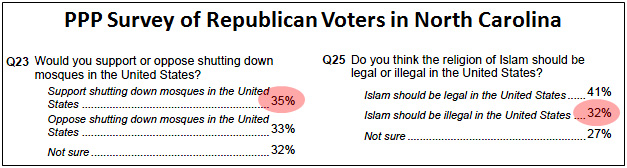
    UPDATE: I’m not trying to drive you all into despair for the country. Honest, I’m not. But here’s another one:
  • The Era of Dog Whistles Is Now Over


    Steve Benen makes a useful point today about Donald Trump’s brass-balled religious bigotry:

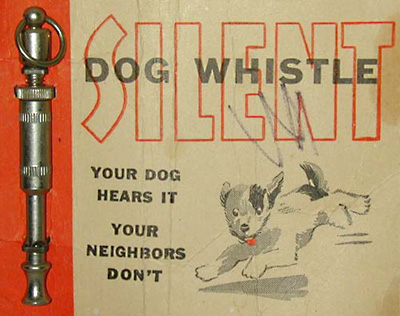
    Jeb Bush told MSNBC’s Chuck Todd yesterday that the Trump campaign is relying on “dog-whistle proposals to prey on people’s fears.” That’s half-right — Trump is clearly preying on people’s fears, but these aren’t “dog-whistle proposals”; they’re the exact opposite. The whole point of dog-whistle politics is subtlety and coded language. Trump’s racism, however, is explicit and overt. “So what? They’re Muslim” is less of a dog whistle and more of a bullhorn.
    Even Jesse Helms felt it necessary to talk about the “bloc vote”—wink wink, nudge nudge. In other contexts, candidates will use phrases familiar to evangelicals, or terms of art specific to deep knowledge of the Israeli-Palestinian conflict, or academese with a very specific meaning only to those in the know. Trump isn’t bothering with any of that. He thinks Muslims are all potential terrorists and he’s saying it just as loudly and as clearly as he can.

    And guess what? It turns out that maybe you don’t need dog whistles after all. Republicans don’t need them because their base turns out to be pretty tolerant of outright bigotry. Democrats don’t need them because Republicans will just make up dog whistles of their own if they miss the meaning of the real ones (Agenda 21, hockey stick, etc.).

    We should all hail our new era of two-fisted politics. Finally, we can just say all the stuff we’ve been holding back for so long. Doesn’t that sound great?

  • Deep Cleaning: A Play in Two Acts


    We could all use a little entertainment today, couldn’t we? Here’s mine. A few days ago I went to Angie’s List and bought a deal for four hours of housecleaning (i.e., two people for two hours, four people for one hour, etc.). Here’s how it went down:

    8:45 am, four cleaners arrive

    Cleaner: Do you have any special requests?
    Me: Nope. Just clean the house.

    9:45 am, with about two-thirds of the house cleaned:

    Cleaner: Our four hours is up! Do you want us to stay and clean the rest of the house?
    Me: Um, what?
    Cleaner: We charge by the hour, and you bought four hours.
    Me: You couldn’t clean the whole house in four hours?
    Cleaner: We clean a lot better than other people. This is a deep cleaning.
    Me: A what?
    Cleaner: When I came this morning, I asked if you wanted anything special.
    Me: And I said I didn’t.
    Cleaner: That means you wanted a deep cleaning.
    Me: That’s what that meant?
    Cleaner: Yep.
    Me: Couldn’t you have just asked if I wanted a regular cleaning or a deep cleaning? Wouldn’t that have been a better way of making sure everything was clear?
    Cleaner: The deal you bought was for a deep cleaning. If you call us back for regular service, we’ll do a normal cleaning.
    Me: Oh.
    Cleaner: So do you want to buy more time?

    I passed on the additional time. But I admit I’m curious to get some feedback. It’s true that the listing for this service said it was a deep cleaning. Apparently I read the headline, which only said “housecleaning,” and didn’t read much further. I guess I should be more careful about reading all the fine print in the future.

    And yet, surely this was an easy thing to clear up at the start. Did I want a regular cleaning of the whole house, or a deep cleaning of whatever could be done in four hours? I feel pretty annoyed by all this. Should I? Or am I the one at fault for not reading carefully enough?

    UPDATE: Interestingly, opinion is split. A majority seems to be on the “you got ripped off” side, but a substantial minority says the service advertised a deep cleaning, and that’s what I got. I should have asked more questions if I wanted to make sure the whole house got cleaned.

  • Less Than 1 Percent of Pre-K Kids are Suspended Each Year


    In the spirit of the old-school blogosphere, I give you Shorter Bob Somerby™:

    There are 1 million kids in public preschools in the United States. In 2012, about 8,000 of them were suspended. Is that really a lot?

    Good question! That’s less than 1 percent, which doesn’t immediately strike me as “astounding”—Melinda Anderson’s description in the Atlantic a couple of days ago. It means that out of every five pre-K classrooms, about one child is suspended per year.

    The racial disparities in preschool suspensions are disturbing, and it’s possible that the overall suspension rate has increased a lot lately, which would also be disturbing if true. But we have no data prior to 2012, so we don’t know.

    It’s also possible that suspension is just flatly inappropriate for 3-year olds, in which case even 1 percent is too high a number. But Anderson doesn’t really make that case either.

    So do we have a real problem here? Beats me.

  • Hillary Clinton Had the Worst Year in Washington?


    Chris Cillizza says Hillary Clinton had the “worst year in Washington.” Jonathan Bernstein says that’s wrong. In fact, she probably had the best year in Washington:

    One year ago, Clinton was the leading candidate for the Democratic nomination, perhaps in the best position any non-incumbent has been in modern times. Yet two potentially strong contenders, Senator Elizabeth Warren and Vice President Joe Biden, were lurking around the edges of the contest….A year later, Warren and Biden are no longer threats. While Senator Bernie Sanders put together an impressive campaign, he’s about as weak a major opponent as Clinton could have imagined drawing.
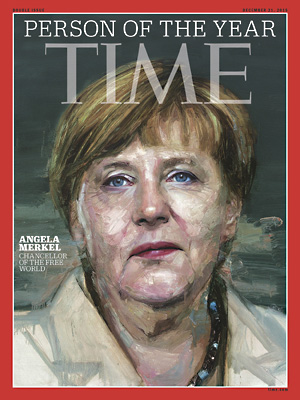
    ….Meanwhile, Clinton has amassed more support from party actors than any previous non-incumbent in the modern era. A potential threat from a House select committee that appears to exist just to do opposition research on her has turned into a bad joke. The summer scandals seem to have died down; they could return, but it’s not clear if voters will care. And her performance in the marathon session in front of that select committee quieted the whispers that her age might be an impediment in her campaign.

    Cillizza’s case is based almost entirely on Clinton’s email problems during the summer. That’s it. But Bernstein is right: Clinton had a trying summer, but not a bad year. She eventually overcame the email issue and ended the year in a position about as strong as you could imagine. She’s a virtual lock for the Democratic nomination, and the meltdown of the Republican primary race has made her an even stronger contender to win the presidency. What more could someone in Washington ask for? If this counts as someone’s worst year, I could use a few more bad years myself.

    So who did have the worst year in Washington? Cillizza correctly pegs Jeb Bush as one of the nominees. John Boehner and Kevin McCarthy are on the list. Scott Walker certainly bombed in spectacular fashion. Benjamin Netanyahu is an honorary Washingtonian, and he didn’t do himself any favors this year. Anyone else?

  • Time Magazine Has Run Out of Admirable People to Honor


    With Silvio Berlusconi out of the picture, Angela Merkel is arguably the worst leader among the major democracies. But Time magazine apparently disagrees:
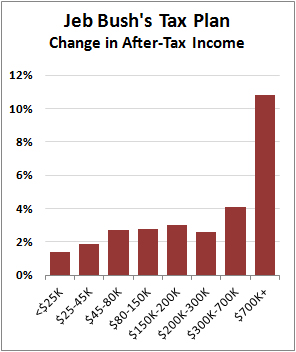
    Time magazine has named German chancellor Angela Merkel its Person of the Year, citing her resolve in leading Europe through this summer’s Greek debt crisis, and her encouragement of other countries to open their borders to migrants and refugees….By the beginning of 2015, Time said, “Merkel had already emerged as the indispensable player in managing Europe’s serial debt crises; she also led the West’s response to Vladimir Putin’s creeping theft of Ukraine”.

    Yeesh. Merkel’s role in “managing Europe’s serial debt crises” has been astonishingly destructive, and if what she did about Ukraine counts as “leading,” Time and I have very different ideas of what that word means. Her government nearly succeeded in scuttling any agreement about Greece, and even her refugee policy, which is morally praiseworthy, probably wasn’t very sensible.

    Then again, apparently it was a lean year:

    Other finalists included the founder of Uber, the $62.5bn ride-sharing app that has been met with both resistance and enthusiasm; Abu Bakr al-Baghdadi, the leader of the Isis terror cell; Iranian president Hassan Rouhani and Republican presidential frontrunner Donald Trump.

    Against competition like that, I guess I’d vote for Merkel too.

  • Jeb Bush’s Tax Plan Will…Um…Oh, Who Cares, Really?


    In 2012 the Tax Policy Center scored most of the Republican tax plans, but this year they’ve sat on the sidelines. I suppose this is partly because the plans generally don’t have enough detail to be seriously evaluated, and partly because they got tired of wasting time on tax plans that are meant more as affinity statements than as actual financial documents. I mean, what’s the point of a bunch of guys with PhDs playing the role of pro wrestling referee in a tired game of “can you top this?”
    For some reason, though, they’ve gone ahead and evaluated Jeb Bush’s tax plan. Their results are the usual ones from the party of fiscal prudence: Bush’s plan would increase the national debt from 78 percent of GDP to 106 percent within ten years; it would increase the federal deficit by about a trillion dollars; and it would benefit the rich far more than the poor. In other words, it’s the same as every other Republican tax plan. A few of the details change a bit from candidate to candidate, as do the specific numbers, but that’s about all

    So does this matter? I go back and forth on this. Dylan Matthews says it does because the other campaigns haven’t provided enough detail for TPC to complete an analysis of their plans:

    In the worst case, in which TPC never gets the details it needs for Rubio and Trump’s plans (or Ted Cruz’s very different plan), the Bush analysis becomes hugely valuable. It gives us a glimpse of what Rubio and Trump’s TPC scores would look like. It indicates that the plans are likely to be very, very expensive, with benefits concentrated at the top.

    I don’t buy this. Everyone who’s not a paid shill for the Republican Party already knows it. The only difference is that reporters now have a well-respected analysis they can use to badger the Bush campaign, but they don’t have one for the others. So Bush will get more heat and the others will benefit from being smart enough not to cooperate with TPC.

    Beyond that, does anyone care about these plans anymore? They’ve gotten so ridiculous that it’s hard to believe that even the candidates still take them seriously, let alone anyone else. They’re basically just a highly ritualized way of indicating that candidates subscribe to the approved catechism. The message is “I hate taxes, especially on the wealthy,” and the details are unimportant. As long as your tax cut is sufficiently large, you’re in.

    TPC says they’d like to evaluate other tax plans, but I’d suggest they not bother. It’s a kabuki show long past its prime, and they must have better things to spend their time on.

  • Cable TV Has a Disturbing Love Affair With Donald Trump


    Back in June, there was a legitimate question about whether Donald Trump deserved significant news coverage. Today there isn’t. He’s been leading the polls for the Republican presidential nomination for months, and that makes him news no matter what crazy stuff he says.

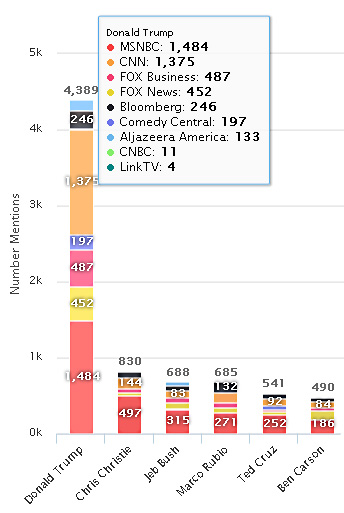
    There is, however, still a legitimate question about whether TV news networks are actively aiding Trump by giving him more attention than he deserves. Jim Tankersley points us to the 2016 Campaign Television Tracker for data on this point, and their database tells us that Trump has gotten 47 percent of all TV mentions among Republican candidates since he announced in June. Marco Rubio has gotten 6 percent. It’s fair that Trump gets more than Rubio, but rather plainly he shouldn’t be getting that much more.

    So who’s responsible for this? The chart on the right shows mentions over the past week. Fox News mentioned Trump 452 times, but the biggest guns by far were CNN and MSNBC, who apparently have serious Trump obsessions. CNN mentioned him 1,375 times and MSNBC mentioned him 1,484 times. Why? Mostly because they just cover politics more extensively. CNN’s mentions of all candidates over the past week were roughly 2x Fox’s, and MSNBC clocked in at nearly 4x.

    As for Trumpmania, CNN is by far the biggest offender. Both Fox and MSNBC have given Trump about half of all Republican mentions over the past week. CNN has given him 70 percent. They’ve all but quit covering the other candidates entirely. Needless to say, this has gone beyond mere reporting and is now edging toward outright advocacy. This kind of coverage is obviously a huge benefit for Trump.

    Does anyone do this kind of analysis for major print media? I’d be fascinated to know if Trump love is mostly a TV phenomenon, or if it’s a more general media phenomenon.

