• No, Obamacare Isn’t Forcing People to Work Less


    Here is Sarah Ferris writing in The Hill today:

    ObamaCare will force a reduction in American work hours — the equivalent of 2 million jobs over the next decade, Congress’s nonpartisan scorekeeper said Monday.

    That’s an unfortunate choice of words, especially since three paragraphs later Ferris herself says it’s not true: “The CBO is not predicting that employers will fire millions of workers or reduce hours because of the law, but that the law changes incentives over the years for the workers themselves both in part-time and full-time positions.”

    Obamacare isn’t forcing anyone to do anything. According to the CBO it has three general effects:

    • It includes some tax increases, which modestly reduce incentives to earn more income.
    • It allows more people to buy health insurance even if they aren’t employed, which modestly reduces incentives to work.
    • Its benefits decline as income goes up, which reduces incentives to work (in some cases) or to work more (in other cases).

    CBO’s specific estimates of reduced work incentives may be wrong—they strike me as a bit high— but their general conclusion is both correct and well-known. Tax increases do reduce incentives to work. Decoupling insurance from employment does reduce the number of people who work solely because they need the insurance. And means-tested benefits do create the equivalent of high marginal tax rates as income increases, which reduces the incentive to work more.

    There’s nothing new here. Obamacare does change work incentives in certain ways, though the effect is small: about 1-2 percent of the workforce by 2025. But it doesn’t force anything. There are no “broken promises” or “catastrophic failures” to rant about. Just some small marginal effects that shouldn’t surprise anyone who’s been paying attention.

  • So How’s Tech Bubble Number 2 Panning Out?


    At the LA Times today, Erin Griffith comments on the latest tech bubble:

    Each day there’s a new report casting gloom on Silicon Valley’s herd of magical billion-dollar “unicorn” start-ups: missed targets at Zenefits, share markdowns at Snapchat, a cash crunch at Jet, an executive exodus at Rent the Runway. Dropbox faces doubts about its revenue potential. Theranos is losing business deals. And don’t forget WeWork’s highly risky real estate deals, and unrealized revenue projections at Lyft. Flipboard failed to find a buyer. Square priced its IPO underwater. Zirtual and Homejoy — not unicorns, but highly valued and highly funded all the same — abruptly shut down.

    Each new report is shocking because we receive little information on the health of these private companies — we know only what they choose to share. Usually those are impressive-sounding figures like “400% revenue growth” (from what base? $1?) or a robust “revenue run rate,” a decidedly non-GAAP measurement. Worse are the totally meaningless, hard-to-contextualize stats: Start-up X has reached 5 billion “impressions” per month! (But what about profits? Does this revolutionary business model actually work? No comment.)

    Needless to say, those of us who were alive 20 years ago are familiar with this. Even the terminology hasn’t changed much. Back then it was run-rates and impressions and record revenues and “decidedly non-GAAP measurements” too. You’d think we might have learned something from that. I mean, say what you will about our 17th century ancestors, but at least they didn’t have a second tulip bubble in 1657.

    That’s not fair, of course. This is more like the railroad mania of the 19th century: genuinely useful technology that got out of hand and produced plenty of fraud and speculation to go along with a transportation revolution that changed the world. Still, you’d think we would have learned something from that, too.

    Of course, you’d think we would have learned something from the invasion of Iraq, but apparently not. You’d think we would have learned something from the financial meltdown, but apparently not. We humans just don’t learn much, do we?

  • Republicans All Seem to Like Obama’s Strategy to Defeat ISIS


    Do any of the Republican candidates have a plan for defeating ISIS?  As near as I can tell, most of them have offered up variations on this:

    • Bomb ISIS, just like Obama, but better.
    • Use Iraqi ground troops, just like Obama, but better.
    • Put together a coalition of local allies, just like Obama, but better.

    Am I missing anything? Aside from being more bellicose (the sand will glow, we’ll bomb the shit out of them, etc.), all of the candidates are saying that Obama’s strategy is basically sound, but they’d tweak it a bit here and there. They’d stop worrying about civilian deaths so they could drop more bombs. They’d somehow train Iraqi forces better than the Army is doing right now. And they’d put together a real coalition, though it’s never really clear what they mean by that or how they’d accomplish it.

    Anything else?

  • Devin Nunes Explains Why He’s Less Conservative Than He Used to Be


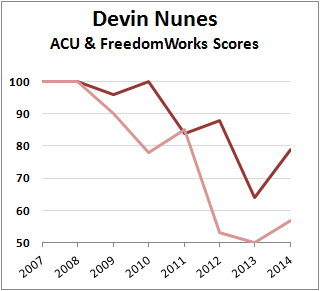
    Devin Nunes represents the conservative 22nd district of California. It’s an inland district near Fresno that’s about 60 percent Republican and voted decisively for both John McCain and Mitt Romney. As you can see from the chart on the right, Nunes used to be a pretty reliable conservative, earning high scorecard ratings from both ACU and FreedomWorks. But over the past few years, as the tea party has taken charge of the GOP, he’s drifted away from the true conservative cause. Why? Ryan Lizza tells us part of the story:

    Nunes, who is the chairman of the House Committee on Intelligence, told me that the biggest change he’s seen since he arrived in Congress, in 2002, is the rise of online media outlets and for-profit groups that spread what he views as bad, sometimes false information, which House members then feel obliged to address.

    ….“I used to spend ninety per cent of my constituent response time on people who call, e-mail, or send a letter, such as, ‘I really like this bill, H.R. 123,’ and they really believe in it because they heard about it through one of the groups that they belong to, but their view was based on actual legislation,” Nunes said.

    “Ten per cent were about ‘Chemtrails from airplanes are poisoning me’ to every other conspiracy theory that’s out there. And that has essentially flipped on its head.” The overwhelming majority of his constituent mail is now about the far-out ideas, and only a small portion is “based on something that is mostly true.” He added, “It’s dramatically changed politics and politicians, and what they’re doing.”

    This is the electorate that Donald Trump appeals to—and it’s why he’s dangerous regardless of whether he wins the Republican nomination. He says that thousands of Muslims in Jersey City celebrated on 9/11, and this gets repeated endlessly by right-wing media and conservative fundraising groups who are always on the lookout for something new to scare people with. Then these people start deluging their representatives with demands that they do something about all the Muslim celebrations on 9/11. Rinse and repeat weekly.

    Nunes is no lefty. But he’d like to actually pass conservative legislation instead of wasting his time fending off nutballs. That makes life pretty tough for a Republican these days. They may be in the majority, but until they do something about their out-to-lunch faction they’re not going to get much done.

  • Let’s Give Mark Zuckerberg a Break, OK?


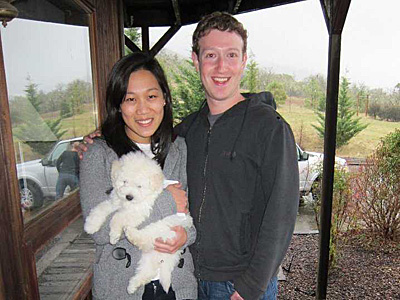
    Mark Zuckerberg’s announcement that he will use 99 percent of his wealth for charitable purposes has generated a surprising amount of acrimony. I don’t really get why. Anyone who looks into it for more than a few seconds understands that the financial structure he set up doesn’t benefit him personally, so there’s no point griping about that. Nor does it make a lot of sense to make Zuckerberg into a poster boy for income inequality. There are lots of better examples. Josh Barro identifies the only real concern about Zuckerberg’s plan:

    The bigger issue is the promise: to use nearly all his wealth “to further the mission of advancing human potential and promoting equality.”….[This] is, to a large degree, subjective. Most political donors believe their favored candidates benefit not just themselves but the public, and essentially all start-up founders in Silicon Valley believes their companies will serve to advance human potential. Even donations that fit within the legal framework of charity can be duds: Mr. Zuckerberg’s $100 million gift to the Newark Public Schools seems to have done little to benefit Newark students.

    Well, yeah. There’s no way to force Zuckerberg or anyone else to give their money away. There’s no way to force them to give it away on projects you approve of. There’s no way to guarantee that all their donations will work out well. That’s life, and Zuckerberg is no better or worse than any other billionaire on these scores. Still, the mere fact of announcing that he plans to give away 99 percent of his wealth is praiseworthy, isn’t it? He’s putting himself under pressure to follow through and setting an example for others at the same time. What’s not to like?

    As for the fact that he wants to oversee what the money is spent on instead of, say, giving it all to the Red Cross—well, I’d do the same thing. Wouldn’t you?

  • Americans Seem to Have Given Up on Retirement Plans


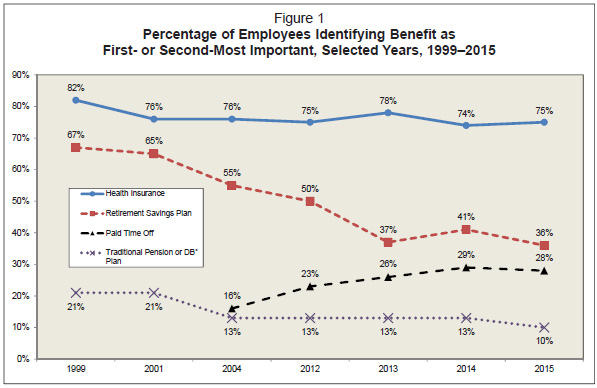
    This chart gets filed under things that leave me scratching my head. It’s from a survey published in the latest EBRI newsletter, and it shows how much people value certain kinds of job benefits. Health coverage is #1, unsurprisingly. But the perceived importance of retirement benefits has plummeted over the past couple of decades. This applies to both traditional pensions and 401(k) plans. Retirement benefits are still considered “very important” or “extremely important” by three-quarters of those surveyed, but fewer than half rank retirement benefits as one of the two most important benefits. That compares to nearly 90 percent who did so in 1999.

    I’m really not sure what to make of this. Is it because Americans have given up on retirement plans they think are too cheap to make much difference? Do lots of Americans not plan to retire, for either good or bad reasons? Do they think Social Security will be sufficient? None of these explanations makes much sense. But what does?

  • Obama Didn’t Say Anything New Tonight. That’s Just Fine.


    I decided to watch President Obama’s Oval Office address on Fox News so that I could understand just how bad he sucked tonight. And sure enough, he sucked! His speech was a complete failure, ladies and gentlemen. There was nothing new. He showed no emotion. He refused to say “radical Islam.” He did nothing to assuage the fears of the American people. It took him four days to say anything about the San Bernardino shootings. And what was with the lectern, anyway?

    Conservatives sure get bothered by some weird things. I mean, what’s the deal with their endless obsession about “radical Islam,” anyway? Hillary Clinton keeps getting asked why she doesn’t like the phrase, but shouldn’t the real question be why conservatives are so intent on everyone using it? How come no one ever asks them about this? Over at The Corner, Ian Tuttle insists the problem is that “The liberal mind…cannot take seriously the claim of religion as an animating force in human lives,” which is a singularly strange assertion to make. Then he ends up with this: “Until we identify the religious conviction at the heart of Islamic terrorism, we’ll continue to wage an ultimately futile war.” That doesn’t make much sense to me. I think everyone understands perfectly well the religious motivations that make up a big part of the stew of beliefs that inspire Islamic terrorists. Literally everyone. But why obsess about it in public? George Bush didn’t, and for good reason: he wanted all the non-terrorist Muslims in the world to be on our side. Why is this so hard to understand?

    Then there’s the whole business about why Obama waited four whole days to give a speech about the San Bernardino shootings. Is four days really that intolerable a period these days? In the same vein, it’s common to rail about the fact that Obama has been fighting ISIS for 16 months and still hasn’t destroyed them. I can’t tell if this is just a handy talking point or a genuine concern. If it’s genuine, what did everyone expect? George Bush spent eight years fighting the Taliban and still had to hand over the war to his successor. I don’t think the war against ISIS will take that long, but it was never going to take less than a few years. Hell, it’s going to take a few years just to get Iraqi troops into decent shape—something conservatives should appreciate since each and every one of them insists that Iraq will have to provide most of the ground troops to take out ISIS.

    Next up are the constant complaints that Obama doesn’t engage in a suitable display of emotion. I’ll admit this is a matter of taste. I find Obama’s manner refreshing. Others may find it too low key. That’s fine. But it’s become a major talking point rather than just a matter of personal preference. I swear, I think Obama could announce that he’d ordered a nuclear attack on Tehran and conservatives wouldn’t be happy unless he did a fist pump at the end.
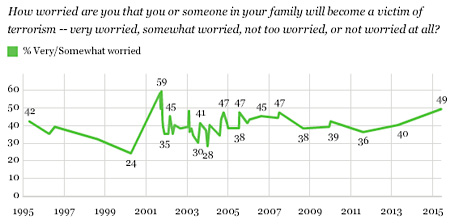
    As for the fears of the American people, I’m a little curious about that. Conservatives seem to think that most of us are in a state of panic over the San Bernardino attack. Are we? There’s no question that attacks like this are unsettling, and I’m perfectly well aware that my own lack of fear is atypical. There’s some polling evidence that Americans think a terrorist attack is more likely in the wake of Paris, which is perfectly reasonable. But are more people personally fearful of being killed by terrorists? Gallup hasn’t shown much change in this over the years, even after 9/11, so I guess I’m skeptical that the latest attacks will produce more than a short blip. But I could be wrong.

    Anyway, my conservative friends will be unsurprised that I think Obama’s approach to terrorism and ISIS is basically fine. Sure, maybe we could loosen up a bit on the rules of engagement. Maybe we should be more aggressive about the oil infrastructure. You can argue about these things. But it’s basically small beer, and most of the Republican candidates don’t really have anything more to suggest. They all seem to think that pounding the table and saying “radical Islam” a lot will have a big effect. I doubt that. Unless they’re willing to send in a whole lot of US ground troops, they really aren’t proposing to do a whole lot more than Obama is already doing.


  • Friday Cat Blogging – 4 December 2015


    Last week, when Marian was preparing Thanksgiving goodies, she decided to go ahead and re-organize some stuff in the cupboards at the same time. Hilbert thought this was a fine idea and hopped up to help. His recommendation: just toss out the spices and recipes and leave a nice, cat-sized area for him. This way he can keep a close eye on all kitchen-related activities without constantly being shooed away. Smart cat.

  • Ted Cruz Explains the Great Recession


    Jim Pethokoukis draws my attention to Ted  Cruz’s theory of why the Great Recession was so great. Here is Joseph Lawler describing Cruz’s questioning of Fed chairman Janet Yellen yesterday:

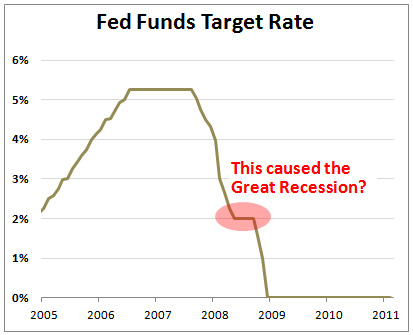
    Cruz began a round of questioning by stating that, in the summer of 2008, “the Federal Reserve told markets that it was shifting to a tighter monetary policy. This, in turn, set off a scramble for cash, which caused the dollar to soar, asset prices to collapse and [the consumer price index] to fall below zero, which set the stage for the financial crisis.”

    ….Yellen, although used to obscure or hostile questions from members of Congress, seemed taken off-guard. “I think the Fed responded pretty promptly in easing monetary policy to the pressures that were emerging,” she responded, saying that she wouldn’t blame the financial crisis on the Fed failing to lower rates during the meeting. She also noted that the Fed had lowered its target rate to zero by December.

    I think you can argue that the Fed should have responded sooner and more forcefully to the events of 2008, but the problem with Cruz’s theory is that it just doesn’t make sense. Take a look at the chart on the right, which shows the Fed Funds target rate during the period in question. In April 2008, the Fed lowered its target rate to 2 percent. Then it waited until October to lower it again.

    So the idea here is that if the Fed had acted, say, three months earlier, that would have saved the world. This ascribes super powers to Fed open market policy that I don’t think even Scott Sumner would buy. Monetary policy should certainly have been looser in 2008, but holding US rates steady for a few months too long just isn’t enough to turn an ordinary recession into the biggest global financial meltdown in nearly a century.

    Cruz would like to blame the Fed, but they bear only a modest responsibility. Better culprits include underregulation of shadow banking; a housing bubble fueled partly by fraud and partly by Wall Street irresponsibility; excess systemic leverage; and Republican unwillingness to fight the recession with fiscal policy. Unfortunately, none of those fit Cruz’s agenda. So the Fed it is.