• Liberals and Climate Change: Not Yet a Happy Marriage

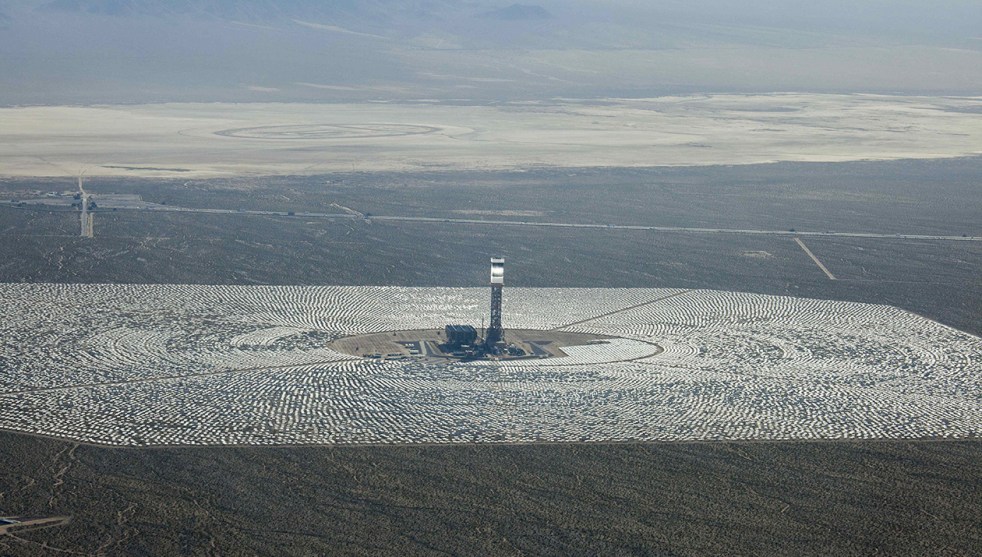
    Brightsource Energy's Ivanpah Solar Project, a solar thermal electric generating facility in the Mojave Desert in San Bernardino County.Jim West/ZUMA

    San Bernardino County is really big and really sunny. It’s a great place for solar energy farms. But not everyone is thrilled about that:

    The county’s Board of Supervisors is slated to vote Thursday on a policy that would prohibit large renewable energy projects on much of the unincorporated private land governed by the county….Renewable energy has been a source of tension in California’s deserts for years, with nearly all large solar and wind projects facing opposition from unhappy local landowners, environmental groups or both.

    Hmmm. Environmental groups. Then there’s this:

    After signing onto the Green New Deal as an original sponsor, one House Democrat…said he faced harsh criticism from building trade representatives who worried the plan would put their members out of work….Unions, a key constituency, have been less than enthused by — and in some cases, downright hostile to — the ambitious proposal to tackle climate change. Terry O’Sullivan, the general president of the Laborers’ International Union of North America, or LIUNA, denounced the Green New Deal the day it was introduced.

    Hmmm. Unions. Here’s a “fact check” on Sen. Sherrod Brown’s website:

    In 2011, in order to protect Ohio manufacturers and consumers, Sherrod sided with the coal industry over President Obama on regulations for new and upgraded coal power plants and factories…. Sherrod voted against the Cap and Trade bill…. Sherrod teamed up with the business community, including the National Association of Manufacturers, to protect Ohio manufacturers in the climate change debate.

    Hmmm. Sherrod Brown, the liberal’s liberal! But how about our neighbor to the north? The Trans Mountain pipeline is designed to carry oil from tar sands field in Alberta to a port in British Columbia:

    Patricia Mohr, an economist and commodity market specialist, puts the case for Trans Mountain this way: “Oil pays the bills in Canada, oil pays the rent”….Trans Mountain has its defenders, not least Prime Minister Justin Trudeau, who says Canadians don’t have to choose between a clean environment and resource development.

    Hmmm. Justin Trudeau. Such a progressive guy, but he still wants to export all the oil Canada can get its hands on. And remember when the Kennedy family opposed wind power off of Cape Cod, where they happen to live? In that case, every environmentalist who didn’t live near Cape Cod supported the project. It finally died a couple of years ago.

    You will note that I have not yet uttered the word “Republican.” There is no question that Republican denial of climate change is odious and obscene. If Republicans were all to disappear tomorrow, it would certainly become a whole lot easier to address climate change.

    But it would be no slam dunk. Progressive or not, nearly everyone with an axe to grind ends up opposing climate change policies that happen to injure them personally. Until that changes, Republicans are the least of our problems.
  • Blue Slips Are Finally Dead

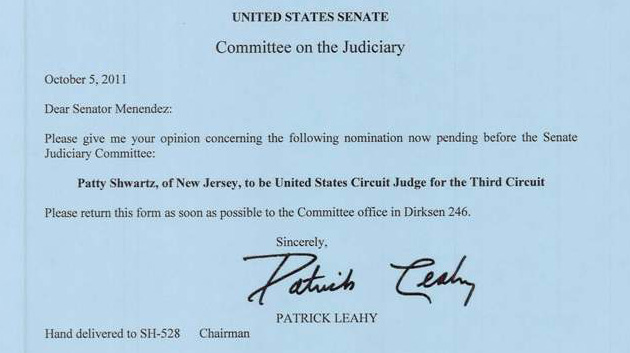
    A blue slip from 2011, back when Democrats controlled the Senate.

    The blue-slip process for judicial appointees has finally broken down completely:

    Seattle attorney Eric Miller was confirmed as a judge on the country’s most liberal appeals court this week without the consent of either home-state senator, a break from tradition that Democrats say Republicans will come to regret….Before this week, a nominee had never been confirmed without the support of at least one home-state senator, the Congressional Research Service told The Washington Post.

    The blue-slip process has weakened steadily over the past 20 years, and Republicans have edged closer and closer to killing it completely ever since Donald Trump was elected president. Various one-off scandals and compromises have just barely prevented this from happening, but now it finally has. And now that it’s happened once, it’s almost certain to happen routinely in the future. Mitch McConnell has made it pretty clear that his only priority these days is confirming conservatives for judgeships, and he’s determined to stuff as many through the confirmation process as he can while Trump is still president. This is an opportunity he never expected, and with legislation of any importance off the table thanks to the Democratic landslide last year, it’s now his legacy. A lack of blue slips from liberals senators was never going to slow him down.

    Is there any upside to this? With blue slips now all but dead, the only thing really standing in the way of the Senate becoming a normal legislative body is the filibuster and unanimous consent. Those will be next to go, perhaps as soon as 2021. It will have been a long, crooked road that led to this point, but in the end it will be a good thing. Every state in the union and every country in the world seems to get by fine with normal legislative bodies, so why not the US Senate?

  • Southern California Housing Market Is Down Yet Again

    The Southern California housing market, often a bellwether for the rest of the nation, is officially in bad shape:

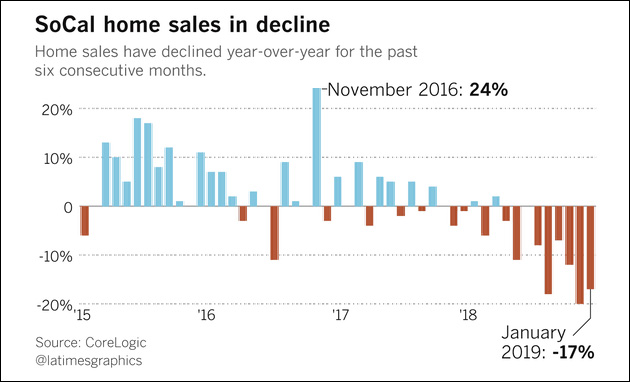
    The sluggish Southern California housing market took another hit in January, with sales plunging 17% from a year earlier, according to a report released Wednesday….The median [price] is now $32,000 below its all-time high reached in June and sales, clocking in at 12,665 last month, haven’t been this low in January since 2008.

    ….As homes have sat unsold, the number of listings has swelled, spurring more sellers to trim the asking price to close a deal. In Los Angeles County, nearly 28% more homes were on the market in January than a year earlier, according to Zillow. Nearly 16.5% of those listings had at least one price cut last month, up from 10% a year earlier.

    There’s an awful lot of red in this chart from the LA Times:

    None of this means we’re looking at a housing bust à la 2007. But it’s not a great sign of continued economic growth either. Y’all be careful out there.

  • Chart of the Day: GDP Growth in Q4

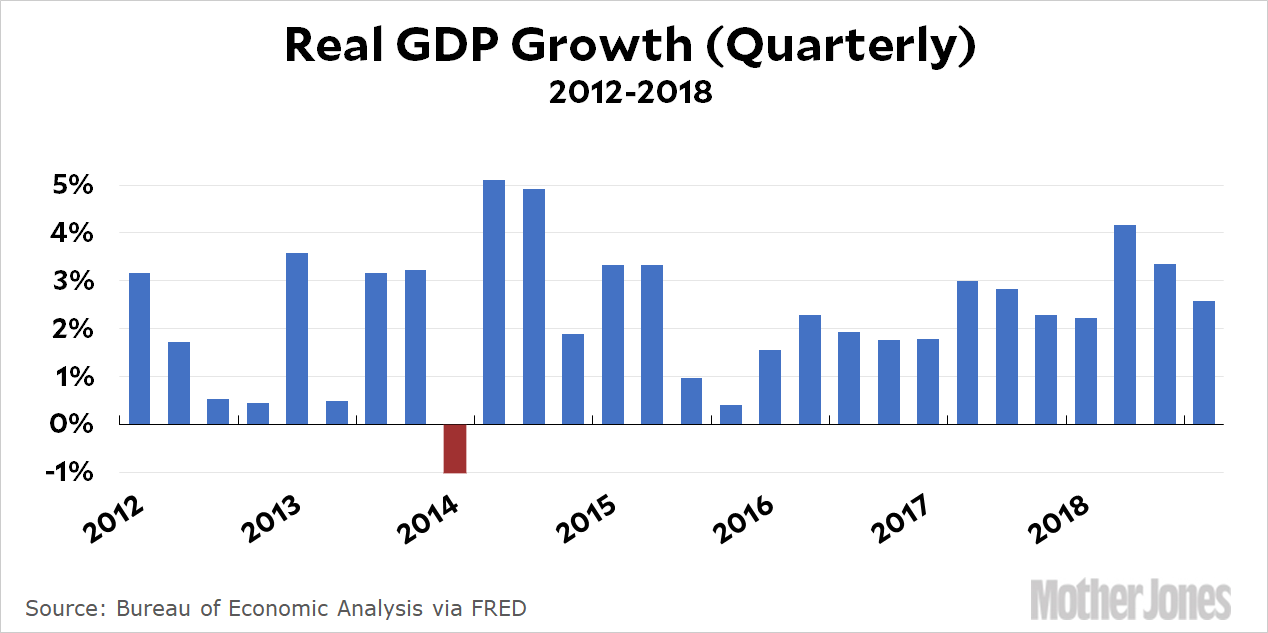
    Real GDP increased 2.6 percent in the fourth quarter:

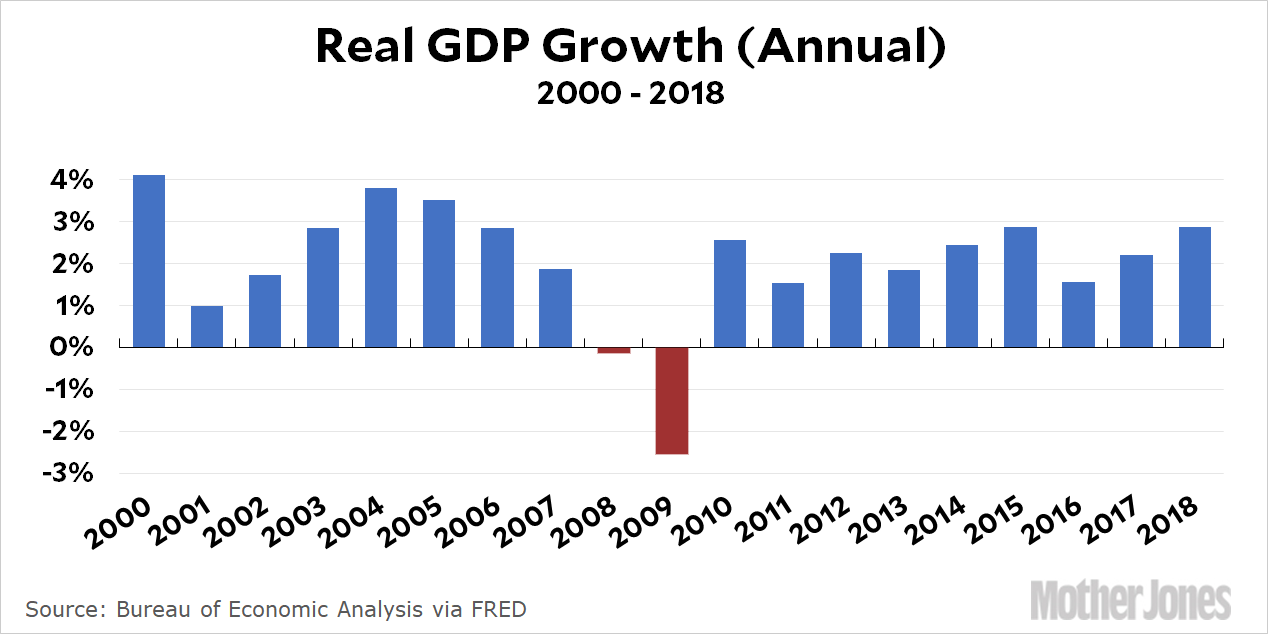
    For the year, GDP increased 2.9 percent:

    So close! But GDP didn’t quite grow 3 percent as President Trump has been insisting it would. Maybe next year.

    Still, not a bad year overall, and not too bad a final quarter. It looks like the Republican tax cut gave the economy a quick boost for a couple of quarters but then petered out. Maybe next time they’ll be more careful to time its benefits for election season.

  • No Agreement in Hanoi

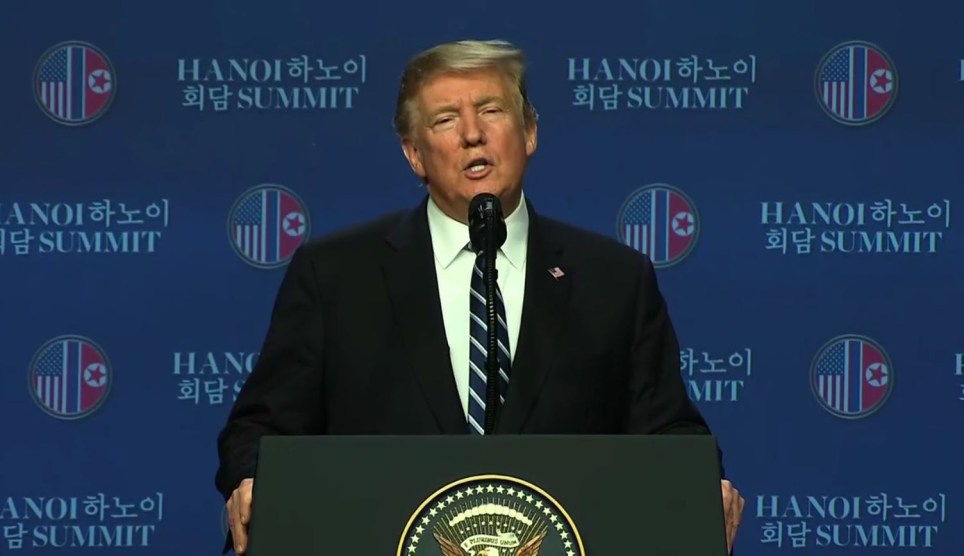
    The Hanoi summit is over early and President Trump says no agreement was reached. “There is a gap,” he said, and the gap is that Kim Jong-un wanted all sanctions on North Korea lifted but was not willing to eliminate his nuclear arsenal in return. Trump was very vague about this, saying that Kim was willing to “denuclearize large portions of the areas we wanted”—whatever that means—but this was not enough to justify ending the sanctions. I wouldn’t take this to mean very much. On the contrary, my guess is that Kim wouldn’t agree to reduce his existing nuclear arsenal at all.

    “We could have signed an agreement but I didn’t think it would be appropriate,” Trump said—though that sounds like a typical Trump lie. Kim left the summit quickly without doing even a joint press appearance with Trump, and that doesn’t suggest a super amicable walkaway no matter what Trump and Mike Pompeo say.

    This abrupt ending to the summit doesn’t speak well for Pompeo’s negotiating team either. Whatever happened in that final negotiating session, it’s obvious that neither side was prepared for it. Normally, if talks break down you have at least a few small objectives in the bag that both sides can agree to in a public ceremony. The fact that this didn’t happen means that either the prep for this meeting produced literally nothing or else that Kim was so unhappy about the sanctions that he stalked out when it became obvious they would continue.

    And that’s it. Trump ended the press conference in typical style, blaming his failure on previous presidents who “did nothing, absolutely nothing.” Charming to the end.

  • New Study Confirms That Tariffs Are Bad

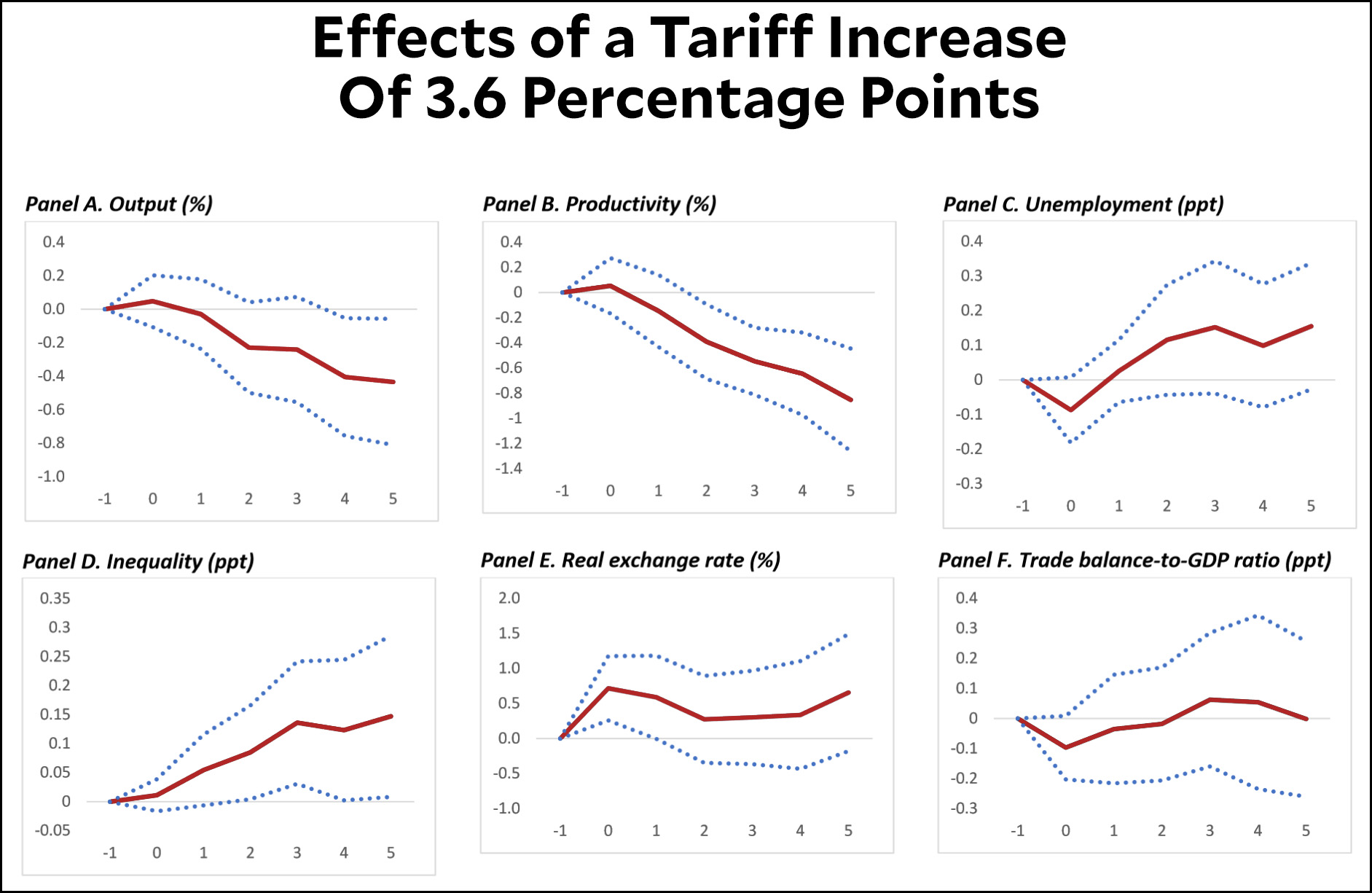
    It’s been awhile since I renewed my neoliberal shill membership, so let’s do that today. Over at NBER, a quartet of authors examine evidence from the past half century about the effect of raising and lowering tariffs. Why? They claim it’s because no one has done this before. Lots of economists believe tariffs are bad, but no one’s looked at the empirical evidence to verify this in the real world. “Filling this gap is the chief objective of this paper,” they say.

    That sounds great. So what did they find?

    In other words, increasing tariffs results in lower GDP and lower productivity, higher unemployment, and no change in the trade deficit. This is exactly the opposite of what Donald Trump wants.

    Now, my guess is that his tariffs will have a fairly small effect. For one thing, his tariff increases as a percentage of total trade are barely noticeable, and as a percentage of US GDP they’re microscopic. Still, to the extent they have any effect at all, it’s almost certain to be negative by virtually every measure.

    POSTSCRIPT: The authors break down the data in various ways, including separate calculations for developing and advanced economies. The charts above show the overall results, but they’re nearly identical to the results for advanced economies on their own. That makes them suitable as estimates for the effect of tariffs on the US.

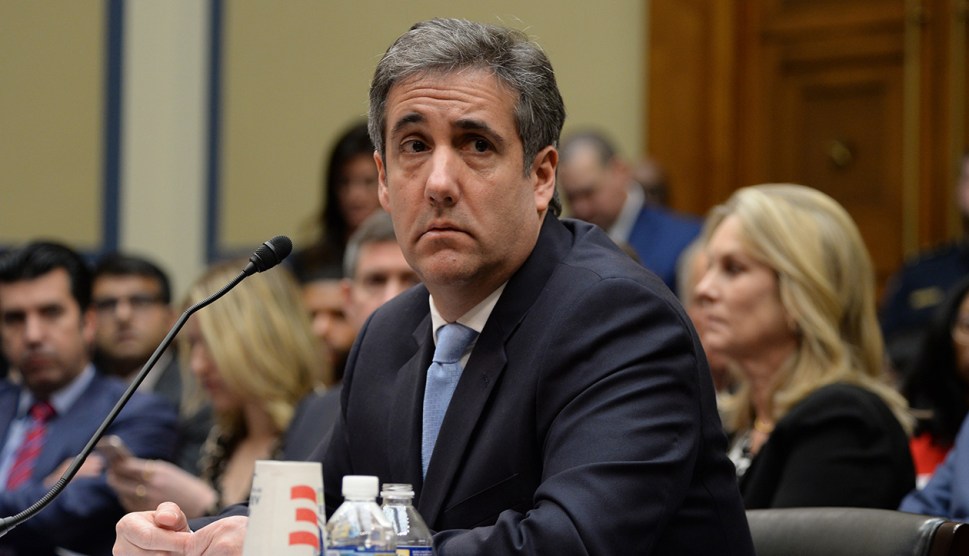
  • Michael Cohen’s Testimony Today Was Explosive, But Probably Not Explosive Enough

    Christy Bowe/ZUMA

     I assume you’ve all been getting your Michael Cohen fixes elsewhere. I myself only watched his testimony off and on, and taken as a whole it confirmed for me that it’s going to be hard to nail Donald Trump on anything. As explosive as Cohen’s testimony was, it’s clear that Trump treated even trusted associates with the caution and animal cunning of a mob boss who’s aware that even the most private conversation might be bugged. He never told anyone to lie to Congress. (He may have told them to lie to the public, but that’s not illegal.) He never got his own hands dirty. He never said anything that could be directly incriminating. For example:

    Cohen alleges that in July of 2016, Trump held a phone call with longtime adviser Roger Stone, in which Stone informed him that a WikiLeaks dump of Hillary Clinton emails was coming, to which Trump said something like: “Wouldn’t that be great.”

    Was Trump aware of this before it happened? Did he play any role in getting WikiLeaks to dump the emails? Maybe, but who knows?

    I could end up being wrong about this—I hope I’m wrong about this—but I continue to suspect that Mueller will end up with lots of indictments of Trump associates but nothing clear enough to get to Trump himself.

  • Lunchtime Photo

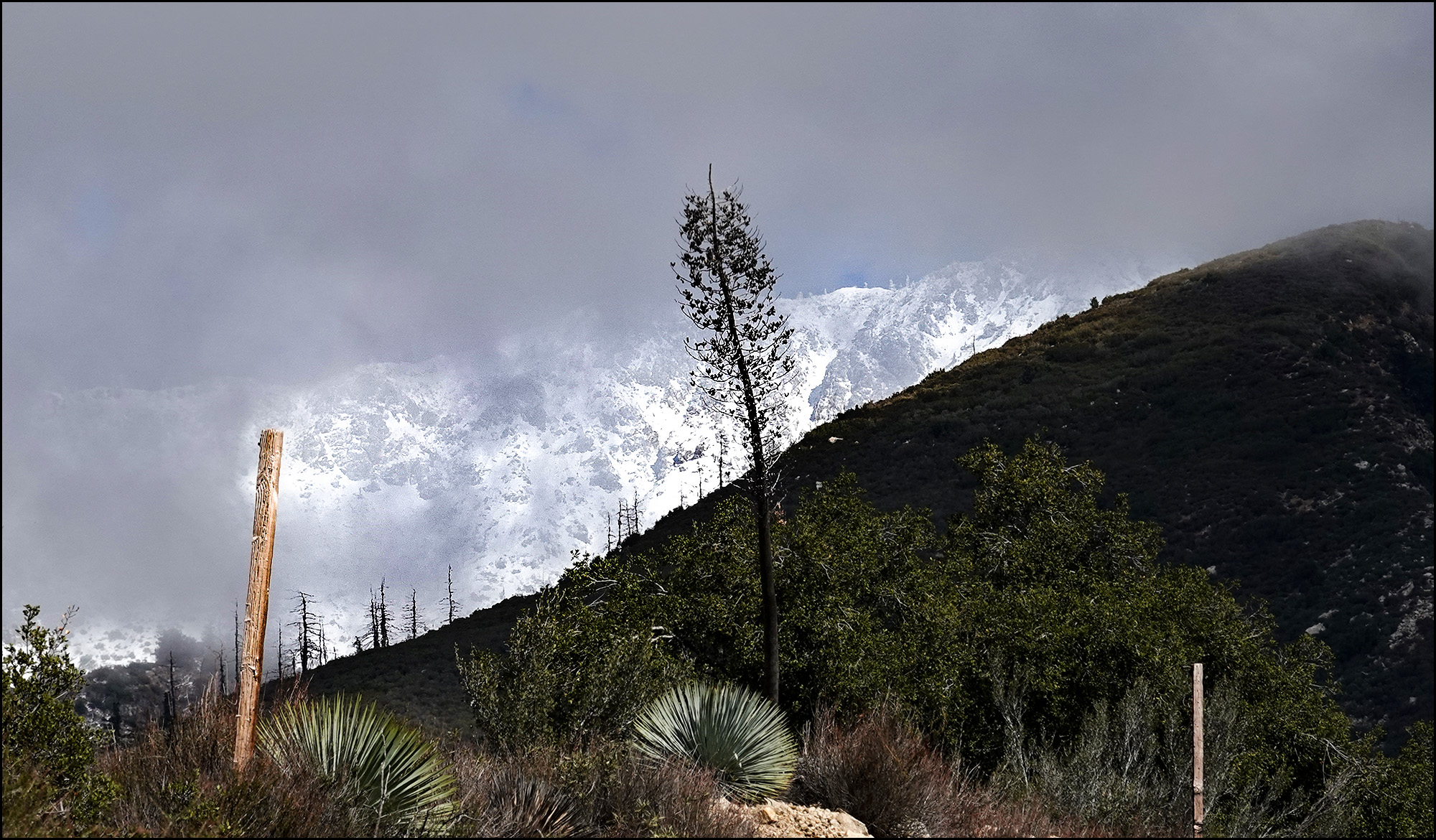
    This picture was taken a couple of weeks ago on Highway 39 in the Angeles National Forest. I really liked the contrast of the sunny chaparral yucca plants in the foreground and the looming, snowy mountains in the background. It’s pure California.

    February 16, 2019 — Near Falling Springs, California
  • Claim Denials Are Huge on Obamacare

    Via Andrew Sprung, here is a Kaiser analysis of data from Obamacare claims:

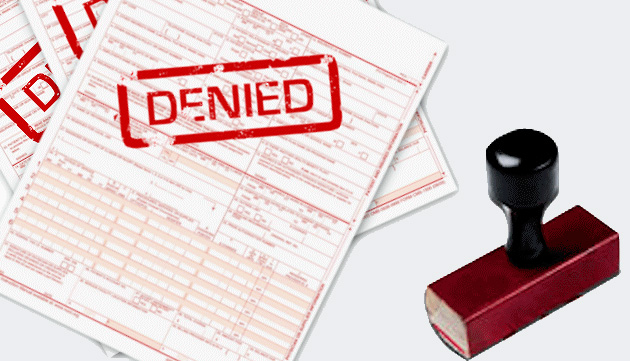
    We find that, across issuers with complete data, 19% of in-network claims were denied by issuers in 2017, with denial rates for specific issuers varying significantly around this average, from less than 1% to more than 40%.

    This is solely for providers on the federal exchange, but it matches data for California, which has its own exchange. Apparently there’s no data for employer insurance to compare this to, but a best guess suggests that the denial rate on Obamacare claims is at least twice that of private employer insurance.

    This is fodder for critics of Obamacare on both the right and the left. It’s certainly one way in which health coverage via Obamacare is worse than private insurance, and it’s especially noteworthy given that so many Obamacare providers use narrow networks. After all, the whole point of narrow networks is that customers are forced to see only pre-screened doctors that the insurance company trusts not to overtreat.

    At the same time, Medicare almost certainly has a much lower incidence of claim denial, which is yet another mark in favor of universal health care. It is really amazing the number of problems that could be solved by simply giving up the long twilight struggle that’s produced America’s insane patchwork of health care providers and insurers. Employers pay more than they have to, patients pay more than they have to, millions go without coverage at all, and those of us who do have coverage have to put up with terrible service. What an unholy mess.

  • Once Again, a New Book Debunks Some History I Never Knew In the First Place

    I am once again befuddled by history:

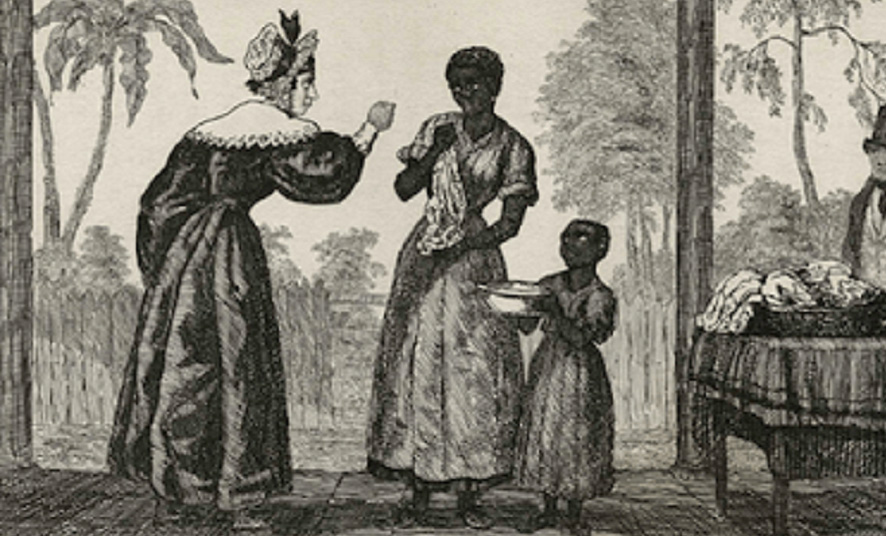
    The full role of white women in slavery has long been one of the “slave trade’s best-kept secrets.” “They Were Her Property,” a taut and cogent corrective, by Stephanie E. Jones-Rogers, who teaches at the University of California, Berkeley, examines how historians have misunderstood and misrepresented white women as reluctant actors. The scholarship of the 1970s and ’80s, in particular, did much to minimize their involvement, depicting them as masters in name only and even, grotesquely, as natural allies to enslaved people — both suffered beneath the boot of Southern patriarchy, the argument goes.

    Jones-Rogers puts the matter plainly. White slave-owning women were ubiquitous. Not only did they profit from, and passionately defend, slavery, but the institution “was their freedom.” White women were more likely to inherit enslaved people than land. Their wealth brought them suitors and gave them bargaining power in their marriages. If their husbands proved unsatisfactory slave owners in their eyes, the women might petition for the right to manage their “property” themselves, which they did, with imaginative sadism.

    Am I befuddled by history? Or by historiography? Or do I need a different word altogether?

    Until five minutes ago, before I read this book review, it never would have occurred to me that white women were anything less than full partners with men in the white supremacy of the antebellum South. I have never read anything that even remotely suggests such a thing. And yet, apparently this has been a widely held belief—and not just by the masses, but by practicing historians as well.

    If it were just that I was ignorant of this era in history, that would be one thing. But that’s not it. I’m no expert, but I’ve read the usual amount about America before the Civil War and about slavery in particular. And the conclusion I’ve always drawn—without ever really thinking hard about it—is that white women were every bit as racist, cruel, and domineering as white men. I’ve never read the opposite. So where did it come from? Was it taught in college classes just after I graduated from college? In popular books? In movies? Solely in journal articles for professionals? Or what? Can someone un-befuddle me?