Rep. Tom Cole of Oklahoma is the ranking member of the House Rules Committee. That means he’s a senior guy, not some miscellaneous, bomb-throwing backbencher. Yesterday he complained that Democrats were moving too fast on their joint resolution to overturn President Trump’s border emergency. “We’ve had no time to review the bill and no committee has held a hearing or marked it up,” he said.
Via Martin Longman, who caught this remark, here’s the full text of the resolution:
Pursuant to section 202 of the National Emergencies Act (50 U.S.C. 1622), the national emergency declared by the finding of the President on February 15, 2019, in Proclamation 9844 (84 Fed. Reg. 4949) is hereby terminated.
This is full-on Trumpism from Cole: just say it and people will believe you. So charming.
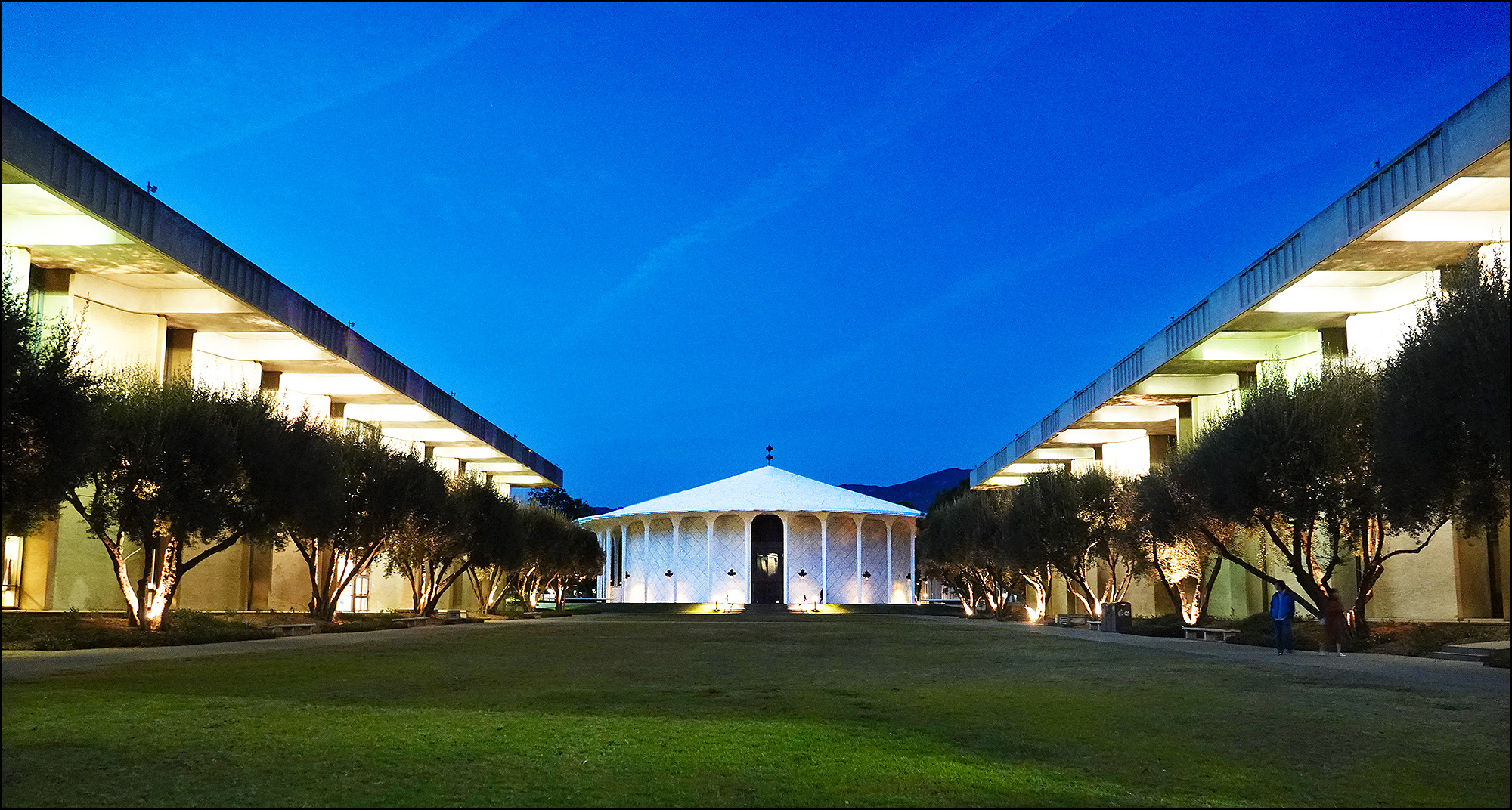
This is Beckman Auditorium at Caltech. On the left is the Beckman Behavioral Biology building and on the right is the Baxter Humanities building. The grass field in the middle was called, rather ponderously, the Court of Man back when I was there, but I’m not sure that name has stuck.
There’s nothing especially outstanding about this picture aside from the fact that it was taken well after sunset on a monopod at a shutter speed of 1/6th of a second—and it’s still sharp and saturated anyway. I’ve been shooting exclusively digital for more than 20 years now, but even so I still find myself periodically amazed at what a digital camera plus a bit of Photoshopping can accomplish.
At Stanford, Hecker, Carlin and researcher Elliot Serbin have been charting the degree of risk on the Korean Peninsula since 1992, using a range of indicators ranging from diplomacy to various aspects of North Korea’s nuclear and missile program. On their color-coded chart, bright green is the safest classification, bright red the riskiest.
When Barack Obama took office, the boxes were a mixture of pinks and light reds. By the time he left office, eight out of 11 boxes were bright red, with North Korea testing missiles and bombs.
By 2017 — with Trump’s bombastically calling Kim “Little Rocket Man” — nine boxes were bright red. “The risk of war was high,” Hecker said.
Since then, though, the diplomacy box has shifted to green. With North Korea suspending nuclear and missile tests, other boxes have returned to a more reassuring mid-red or pink.
I suspect that lots of people privately hold this view but won’t admit it. It’s the reason that so much of the analysis before the Trump-Kim summit in Singapore was fairly tepid: a lot of people were afraid to flat out say that Trump’s approach was dumb until the summit was well over and had produced nothing. After all, it was so crazy it might have worked, right? Kim is certainly susceptible to flattery, and who knows more about ego stroking than Donald Trump?
The second-round summit in Vietnam is getting less attention in general than the first, but apparently there are now a few more people who are willing to defend Trump’s methods out loud. And who knows? Maybe they’re onto something. But there’s a huge caveat: as near as I can tell, nobody believes that North Korea will give up its nukes no matter what Trump offers.
In other words, Trump’s approach might work, but only if “work” means accepting North Korea as a nuclear state and then moving forward from there. This is a deal that my cats probably could have negotiated, and I hardly understand why it required a long bromance between Trump and Kim to get there. It’s a nothingburger. Wake me up if Trump negotiates something that’s actually difficult.
After writing a post last week about personal sacrifice and climate change, I received a deluge of lectures explaining that personal action to address climate change was pointless. It would be a drop in the ocean. Only collective action at a government level could possibly make a noticeable dent in carbon emissions.
This is the sort of reasoning one expects from libertarian undergrads, not progressive pundits. [Long paragraph about why personal sacrifice is pointless.] To his credit, Drum eventually transitions to a more cogent argument, suggesting that neither he nor his readers would “vote for anyone who we thought might force us to live like this” (i.e., without air conditioning or air travel).
That’s it. I’m tired of everyone reading that post and deliberately ignoring what it actually said. Levitz quotes a few sentences of mine and then says I “eventually” transition to a more cogent argument. But that cogent argument is the very next sentence. It is the entire point of the post. Here it is:
With current technology, this is what it would take from all of us to make a serious dent in climate change. And you’re not doing it. Neither am I. Nor, if we’re being honest, would we vote for anyone who we thought might force us to live like this. And that’s despite the fact that people like us are the most likely to support serious carbon reduction. As we all know, there are plenty of others who won’t even go so far as to support modestly higher CAFE standards or decommissioning of coal plants.
….This should be a lesson to all of us: if we ourselves, who believe passionately that climate change is an existential threat, aren’t willing to make serious sacrifices to stop it, we should step back and ask why. Is it solely because it would be unfair for some of us to sacrifice like this when others aren’t? That’s certainly a handy excuse. Would we then be willing to support laws that forced everyone to live like this? I very much doubt it.
It’s obvious—or should be—that I understand the difference between individual and shared sacrifice. I also understand why individual sacrifice seems unfair. I address that explicitly by asking if we liberals would even be willing to support shared sacrifice on the scale required to address climate change. I don’t think most of us would be.
If you think I’m wrong about that, fine. Make your case. But don’t ignore the argument just because it’s easier to pretend I made a different one.
POSTSCRIPT: And since several days have gone by since that first post, you should probably skip it and instead address my more recent posts about climate change policy here and here. You can disagree with those too! But if you do, be sure to explain why no country in the entire world, after at least 20 years in which the danger of climate change has been plain to policymakers everywhere, has agreed to even the slightest genuine shared sacrifice. And then, taking into account the entire historical record of the human race, please explain why that’s going to change.
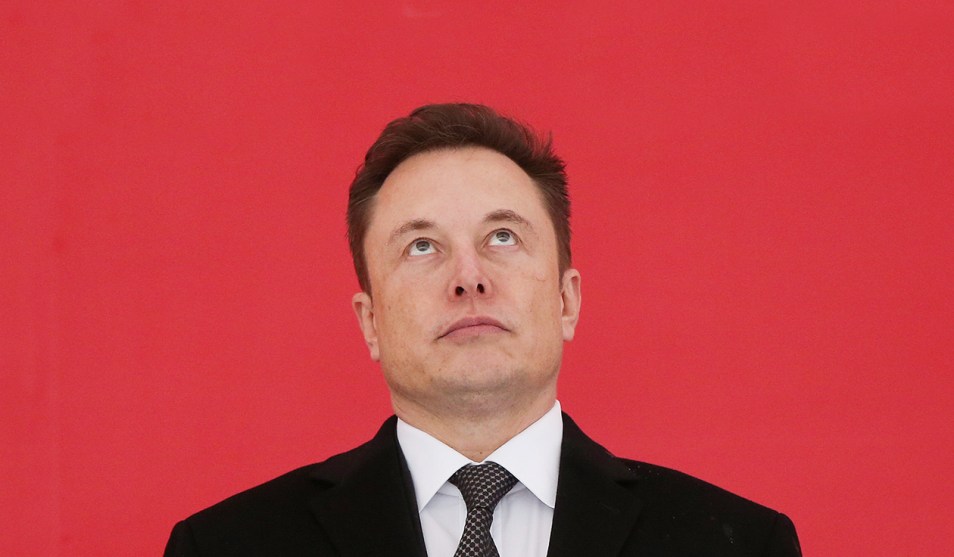
Tesla Inc. Chief Executive Elon Musk violated an agreement that settled fraud charges with the Securities and Exchange Commission by tweeting material information about his electric car company without prior review, and should be held in contempt, the federal regulatory agency said Monday in a court filing. The potential repercussions are big: It’s possible that Musk could be unseated as CEO and banned from serving as an officer of a publicly traded company.
….Last September, Musk, Tesla and the SEC struck a deal to settle fraud charges over a series of Aug. 7 tweets….Under the deal, Musk agreed to have the company monitor his public comments about Tesla before putting them out on Twitter or elsewhere. He also agreed to personally pay a $20-million fine, give up his chairman’s seat at Tesla and bring two new independent directors onto the electric-car maker’s board.
The only way Musk’s behavior makes sense is if he’s tired of Tesla and wants to be gloriously kicked out instead of quitting on his own. If the SEC kicks him out, after all, he could gripe and bitch about it for the rest of life while maintaining no responsibility for the decline of the company. I dunno. Maybe that seems like an attractive option at this point. It’s hard to account for doing something so obviously stupid any other way.
I spent all morning in the infusion center today—mostly napping—and then all afternoon at home—again, mostly napping. This cold has really knocked me out, mainly because the chest congestion has compromised my already compromised breathing. I feel kind of like I did as a kid when I had an asthma attack. Hopefully today’s cat-like sleeping pattern means I’m finally on the mend.
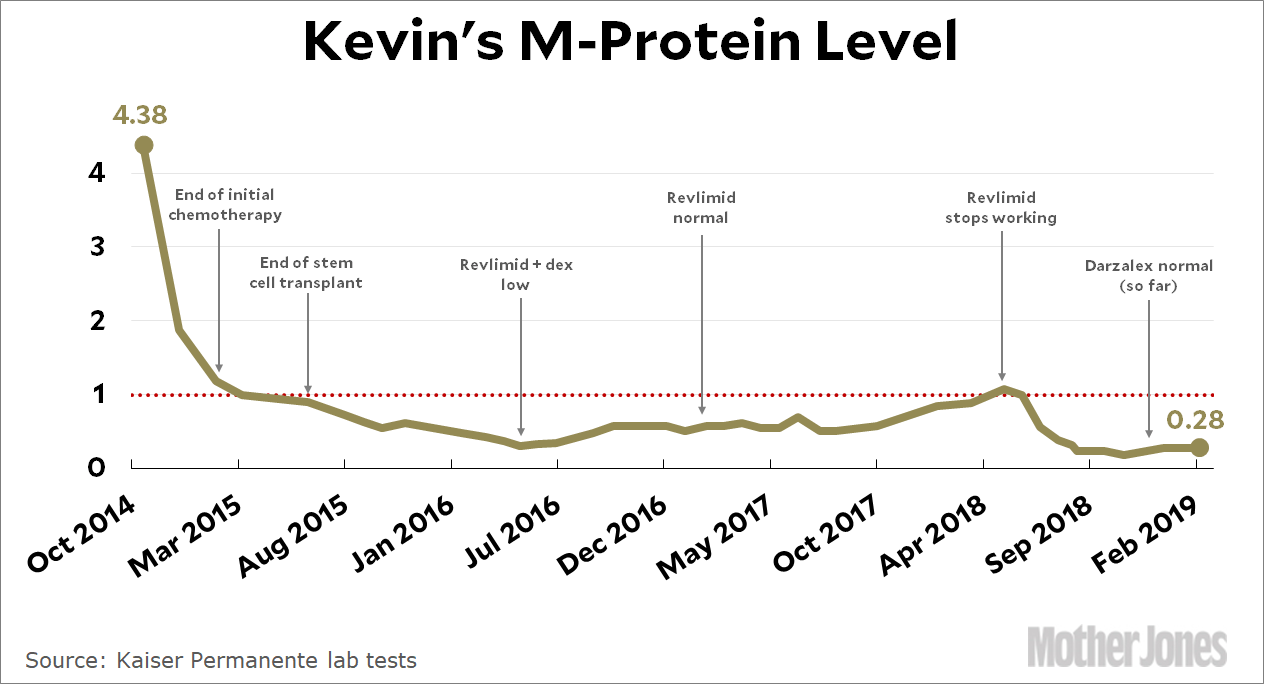
Anyway, when I woke up my latest test results were waiting for me. My M-protein level, which bounced up a bit two months ago, appears to have steadied out at around 0.28 even without the Evil Dex. This is half the level I was at for the past few years, so that’s pretty good news. Here’s hoping it stays there.
Today is a double feature. The top photo is a picture of a Northern Harrier juvenile Cooper’s Hawk that I took about a year ago. He was just sitting there a few yards away from me while I waited for the train, and I got plenty of lovely, sharp shots.
Then, on Saturday, I saw another one a red-tailed hawk perched on a stop sign in a deserted parking lot. I got out to take a picture, but he flew away just as I lifted the camera to my eye. Luckily, he flew away sort of lazily and I managed to get an OK shot of him in flight.
NOTE: All bird IDs corrected per comments.
January 20, 2018 — Irvine, CaliforniaFebruary 23, 2019 — Irvine, California
An interesting contrast between liberals and conservatives is playing out right now. Conservatives, as you probably recall, faced a problem 40 years ago: their concern over budget deficits always made them the bad guy. Democrats could spend with abandon, but Republicans had to be skinflints—and voters don’t like skinflints.
Then, 40 years ago, Jude Wanniski published The Way the World Works and conservatives rushed to embrace his new gospel of supply-side economics. Tax cuts would supercharge the economy so powerfully that they could banish deficits even if spending went up. It was a free lunch so seductive that it remains conservative dogma to this day.
Today the roles are reversed: liberals have big spending ideas and are tired of having to face deficit constraints that nobody else cares about. This time, the fiscal white knight galloping to the rescue is called Modern Monetary Theory, which says that taxes aren’t really necessary to fund the government. Basically, all government spending is funded by printing money.
There are more details, of course, and so far no liberal version of Jude Wanniski has written a bestselling book about it. Nevertheless, MMT has started to gain a following in the AOC wing of the Democratic Party. It’s become an all-purpose way of supporting things like Medicare for All without having to fuss over taxes or worry about deficits.
So what do liberal economists and pundits have to say about it? So far, they’re not buying it. “I am not a fan of MMT,” says Paul Krugman. It is not just wrong, says Max Sawicky, but “will impress most people as either crankish or arcane.” Matt Brueunig calls it “word games.” Josh Barro says MMT is just circular reasoning: “Whether you take a Keynesian view or an MMT view, if the government spends more, it’s likely going to need to tax more, sooner or later.” Josh Marshall calls it “hokum.”
So far, then, MMT has not seduced most lefty economists into becoming defenders of crank theories the way supply-side economics did on the right. Hooray for us! But it’s still early days, even though MMT itself has been around for a while. What will happen if a Democratic candidate for president decides to become the Reagan of the left, with MMT acting as the gateway to liberal dreams? What will we all be saying then? Especially if the alternative is Donald Trump?
Let’s noodle some more about climate change today. On Thursday I regaled you with my abridged Green New Deal. It’s still fine, but I think it can be abridged even more. Bear with me here.
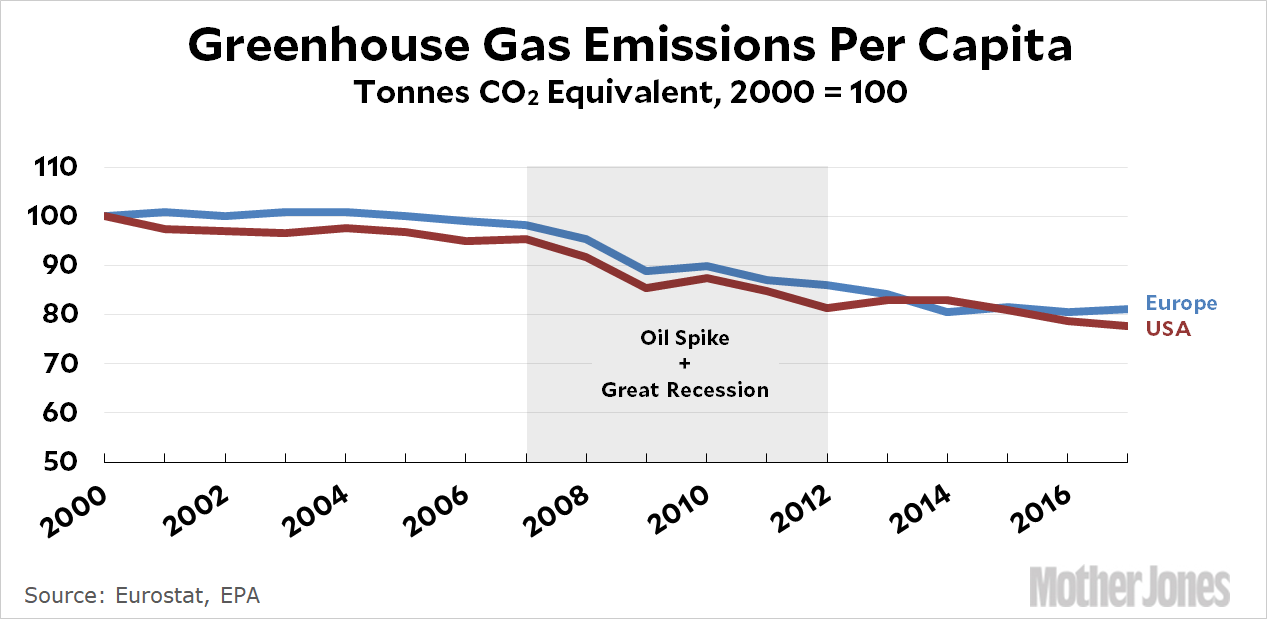
First off, I want to acknowledge that for all the infighting in liberal circles, the real problem is that full-scale climate denialism has taken over the Republican Party. This is what’s keeping us from making serious inroads into carbon emissions. In Europe, by contrast, there is no equivalent to the Republican Party. Nobody denies that climate change is real, and there’s no monolithic political opposition to doing something about it. As a result, over the past two decades Europe has been far more successful at reducing carbon emissions than the United States:
Wait. What’s going on here? In fact, the United States has reduced per-capita carbon emissions slightly more than Europe, and neither one has managed much reduction at all except when they’re forced to.¹ Nearly all of the reduction since 2000 came during the five-year period when oil prices spiked and the Great Recession killed off economic activity.
In other words, it doesn’t seem as if either the Republican Party or America’s dysfunctional politics is really the problem. So what is? It must be something common to both Europe and the US, and the obvious answer is that we all live in democracies. Roughly speaking, our governments do what the public wants, and the public doesn’t have much interest in reducing carbon emissions. Oh, we say we do, and we’ll support minor things like ETS or CAFE that have a barely noticeable effect on us. We’ll support solar power—if it produces electricity nearly as cheaply as coal. We’ll all buy electric cars—but only when the price comes down and the batteries get better. We’ll check out the energy star rating the next time we buy a new refrigerator. And that’s about it.
As for the rest of the world, I won’t even show you the chart. It’s too depressing. Outside of Europe and the US, carbon emissions are just going steadily up, up, up. Even the Great Recession barely made a dent. For the world as a whole, carbon emissions have increased more than 20 percent in the past two decades as poor countries try to catch up to the living standards of the West.
The GND resolution is not a policy or a series of policies. It is a set of goals, aspirations, and principles. It purposefully puts the vision up front and leaves the policymaking for later.
Precisely. It’s just a bunch of goals: “net zero” greenhouse emissions and 100 percent renewable power via a “10-year mobilization”; a 40-60 percent reduction in global carbon emissions by 2030; “millions” of new green jobs; etc. These are familiar goals. We all know them and we all support them—but only as long as nobody is rude enough to talk about what it would take to actually meet these goals. The GND certainly doesn’t. That’s because the folks who wrote it know perfectly well what would happen if it did: it would die instantly.
None of what I’m saying should be even slightly controversial. Outside of war, I can’t think of an example in all of human history where a large polity—let alone the entire world—willingly made significant sacrifices in service of a fuzzy, uncertain hazard that’s decades away. We are overclocked hairless apes who are simply not designed to think that way. Why would anyone deny this?
This, then, circles back to what I was saying a couple of days ago: A climate plan that requires significant sacrifice might work on planet Vulcan, but not on planet Earth. Assuming otherwise is nonserious. We need a plan that will work with only homo sapiens to carry it out, and that means a plan that takes into account human selfishness and shortsightedness. It means a plan that will appeal to China and India and Brazil and the rest of the world. It means a plan that will somehow reduce atmospheric carbon a lot even while most of us sit around fat, dumb, and happy.
The only such plan I can think of is one that increases global R&D spending on climate mitigation by, oh, 10x or so. Maybe 20x if it’s feasible. This money would be spent on developing new sources of clean energy and energy storage; reducing the price of current sources of clean energy; figuring out ways to remove carbon from the atmosphere; and pretty much anything else that seems remotely useful. The fruits of this research would be turned over to the private sector for free, and they would then compete to sell it all over the globe. This would harness human selfishness instead of fighting it. It’s not guaranteed to work, but unlike the GND and similar manifestos, at least it’s not guaranteed to fail.
POSTSCRIPT: Just to make something absolutely clear, I’m not in any way opposed to taking additional steps to address climate change. In fact, I’m all in favor of trying to scare the hell out of people about just how bad climate change is likely to be. I think the goals of the GND are great. I’m all in favor of ETS and CAFE and the Paris Accords. They don’t accomplish a lot, but they accomplish something, and every little bit helps. I just wouldn’t count on the public ever supporting strong enough versions of this stuff to prevent a catastrophic future.
¹This chart shows relative declines, but Europe’s emissions were far lower than the US at the start and are still far lower today in absolute terms. However, almost none of this has to do with policies aimed at climate change, which are fairly recent. Europe’s per-capita emissions have been lower all along because (a) the modern EU contains a lot of fairly poor countries which have low GDPs and therefore low carbon emissions, (b) even rich European countries generally have lower GDPs than the US, and (c) automobile usage is lower thanks to big taxes on gasoline. Those taxes, and the European devotion to small cars, were a result of postwar policies designed to reduce gasoline use decades before anyone had ever uttered the words climate change.
This is Hilbert up on the patio cover doing his best beached whale imitation. Only the tail gives him away. And the feet. And the fur. And the ears. But other than that, it’s almost perfect.
Can you pitch in a few bucks to help fund Mother Jones' investigative journalism? We're a nonprofit (so it's tax-deductible), and reader support makes up about two-thirds of our budget.
We noticed you have an ad blocker on. Can you pitch in a few bucks to help fund Mother Jones' investigative journalism?
We’re halfway there, but time’s running out.
With only days left in 2025, we've made real progress toward our $400,000 goal—the funding we need to keep our nonprofit newsroom running at full
strength. But to close the remaining $200,000 gap before December 31, it will take a huge surge in reader support. Whether you've given before or this is your first time, your contribution right now will matter. Will you help us get there?
We’re halfway there, but time’s running out.
With only days left in 2025, we've made real progress toward our $400,000 goal—the funding we need to keep our nonprofit newsroom running at full
strength. But to close the remaining $200,000 gap before December 31, it will take a huge surge in reader support. Whether you've given before or this is your first time, your contribution right now will matter. Will you help us get there?