• Here’s a Name to Remember: All County Building Supply & Maintenance

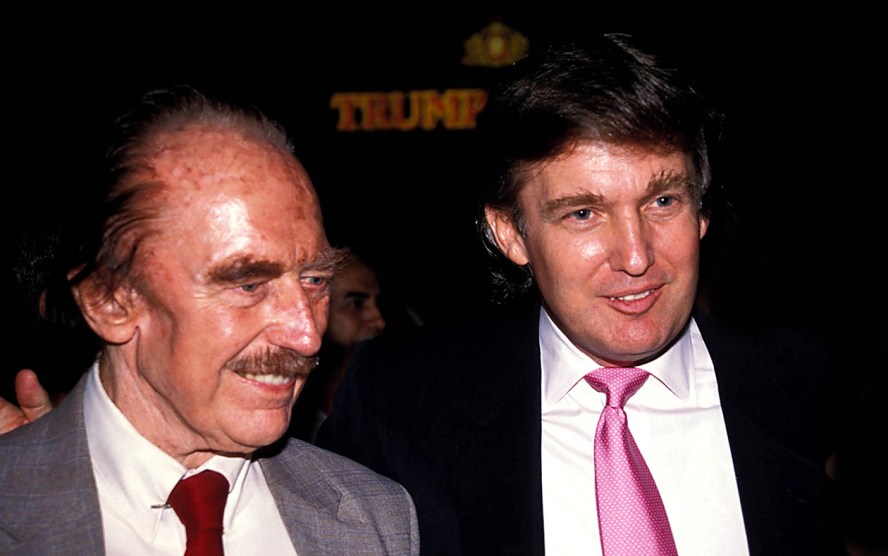
    Fred and Donald Trump in 1989.Globe Photos/ZUMAPRESS

    I’ve written a couple of times about the blockbuster New York Times story that documented the routine tax fraud which helped build the Trump empire from its earliest days—and which Donald Trump eventually inherited. But maybe you’d like an example to make this more concrete. So here’s a name for you from the depths of Trump lore: All County Building Supply & Maintenance.

    The year is 1992 and Donald is deep into bankruptcy proceedings, living on a small allowance doled out to him monthly by his banks. Naturally his father was there to help bail him out. He started by incorporating a new company, All County Building Supply & Maintenance, and putting a favorite nephew in charge. Its purpose was to act as a central purchasing agent for all of the Trump properties.

    That doesn’t sound so bad, does it? Efficient, even. Needless to say, there’s much more:

    All County’s main purpose, The Times found, was to enable Fred Trump to make large cash gifts to his children and disguise them as legitimate business transactions, thus evading the 55 percent tax.

    The way it worked was remarkably simple. Each year Fred Trump spent millions of dollars maintaining and improving his properties. Some of the vendors who supplied his building superintendents and maintenance crews had been cashing Fred Trump’s checks for decades. Starting in August 1992, though, a different name began to appear on their checks — All County Building Supply & Maintenance.

    ….[All County] billed Fred Trump’s empire for those same services and supplies, with one difference: All County’s invoices were padded, marked up by 20 percent, or 50 percent, or even more, records show. The Trump siblings split the markup.

    For example, if a new boiler cost $300, All County would pay the vendor the invoiced price but bill the Trump Organization $400. The extra $100 would be split up among the Trump kids—and needless to say, no gift taxes were paid on that money.

    So far, this sounds illegal as hell, but nothing more. Trump being Trump, though, he found a way to expand this grift so he wasn’t just cheating the government, but plundering his working-class tenants as well. Fred’s nephew, John Walter, did the dirty work:

    As an owner of rent-stabilized buildings in New York, Fred Trump needed state approval to raise rents beyond the annual increases set by a government board. One way to justify a rent increase was to make a major capital improvement….Fred Trump, according to Mr. Walter, saw All County as a way to have his cake and eat it, too. If he used his “expert negotiating ability” to buy a $350 refrigerator for $200, he could raise the rent based only on that $200, not on the $350 sticker price “a normal person” would pay, Mr. Walter explained….As Robert Trump acknowledged in his deposition, “The higher the markup would be, the higher the rent that might be charged.”

    State records show that after All County’s creation, the Trumps got approval to raise rents on thousands of apartments by claiming more than $30 million in major capital improvements. Tenants repeatedly protested the increases, almost always to no avail, the records show.

    In a nutshell, then:

    • All County purchased appliances and fixtures for Trump properties at low negotiated prices.
    • It inflated the prices it charged to the Trump Organization.
    • It then doled out the difference to the Trump kids without paying any taxes on it.
    • And the Trump Organization used the inflated prices as a way of raising rents more than it was allowed to.

    I doubt there’s any proof that Donald Trump had any knowledge of this. But it’s inconceivable that he didn’t. By 1992 he was running the Trump Organization almost completely even if he didn’t own it. He knew exactly what was going on, and his bankruptcy gave him a huge motivation to set up schemes like this:

    “All of this smells like a crime,” said Adam S. Kaufmann, a former chief of investigations for the Manhattan district attorney’s office….Mr. Kaufmann said the Trumps’ use of All County would have warranted investigation for defrauding tenants, tax fraud and filing false documents.

    Ladies and gentlemen, this is your president of the United States. Makes you proud, doesn’t it?

    POSTSCRIPT: Are you curious about how the Times found out about this scam? It was only because his sister referenced All County on a disclosure form when she became a federal judge. That was it. If not for that, nobody would ever have known about any of this.

  • Brett Kavanaugh Is on His Way to the Supreme Court

    I’ve been deliberately avoiding Brett Kavanaugh lately because I just can’t stand to write about him. The whole sordid, disgusting affair sends me into a depressive spiral whenever I think about it. I feel so badly for Christine Blasey Ford. I can’t even imagine how she’s taking this.

    That said, the sham FBI investigation is over and both Susan Collins and Jeff Flake have announced that they’re satisfied with it, which probably means they’ll vote to confirm Kavanaugh. That’s enough. Mitch McConnell has scheduled the votes, and by this time on Saturday Kavanaugh will be a member of the Supreme Court. Let’s all have a beer.

  • Cultural Studies Hoax Mostly Being Brushed Off as Tiresome BS

    Yonhap News/Newscom via ZUMA

    Yesterday I wrote about an extensive hoax perpetrated on various disciplines that are part of the field of cultural studies. Three hoaxsters with no previous expertise brushed up on their pomo and then wrote a series of deliberately dumb papers that they submitted to serious, peer-reviewed journals in the areas of gender studies, masculinities studies, queer studies, sexuality studies, psychoanalysis, critical race theory, critical whiteness theory, fat studies, sociology, and educational philosophy. Seven of their papers were accepted, and the number probably would have been higher if they hadn’t been uncovered and forced to end their experiment early.

    So what’s been the reaction? Crickets, basically:

    Mounk’s list is similar to one I put together last night, and he does a good job of addressing it. So go read Mounk for more on all that. For myself, I just want to make one point about this affair. It’s by far the most important point:

    If an amateur with no background can spend three months brushing up on your field, and then immediately start cranking out papers that get accepted at serious, peer-reviewed journals, there is something badly wrong with your field.

    That’s it. That’s what the hoaxsters uncovered. All fields have at least a few weak journals. All fields can boast of plenty of lousy journal articles. All fields are embarrassed by occasional frauds. All fields suffer from ideological biases or conflicts of interest that interfere with good scholarship.

    But I can’t think of any serious field in which an amateur who’s done a few month’s reading could even produce a plausible parody, let alone a paper that would be taken seriously by dozens of editors and peer reviewers. If that’s all it takes, a PhD is a meaningless five-year waste of time.

    This is the problem the academy needs to address, and they need to address it for exactly the reason the hoaxsters gave: these fields are mostly important ones. They deserve rigorous, high-quality scholarship. They can’t be treated as dumping grounds for impassioned mediocrities and then ignored.

    If they are, and everyone tacitly agrees to sweep away the whole episode because the hoaxsters didn’t get IRB approval or something, it just gives the game away: these fields exist only to placate troublemakers, and nobody in the serious parts of the university cares about them.

    Alternatively, we do care about them, and it’s time for the various disciplines of cultural studies to end their adolescence and adopt the same standards of scholarship as their older, more established peers. That’s my vote.

  • Lunchtime Photo

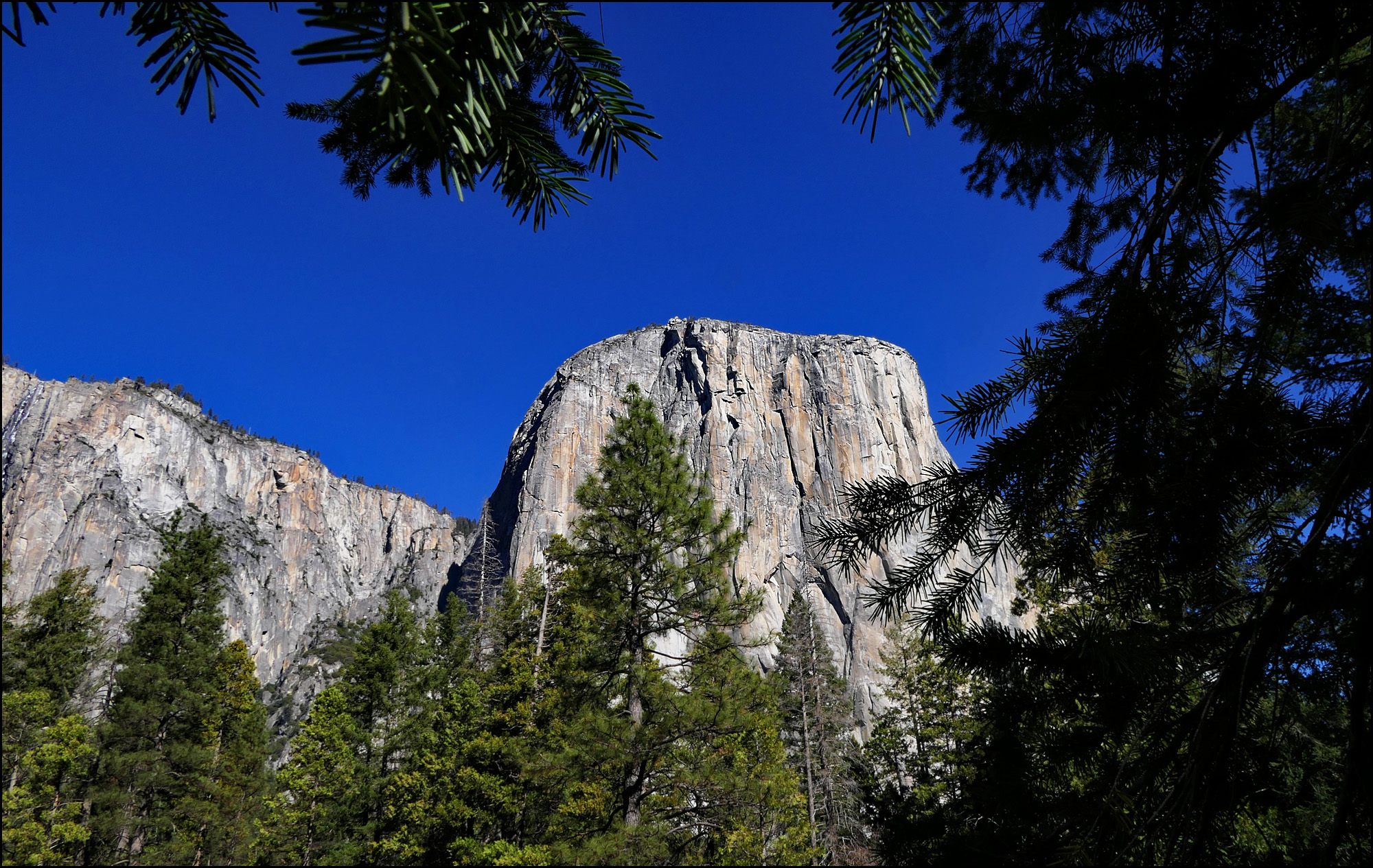
    Free Solo, a documentary about Alex Honnold’s free solo climb of El Capitan, is getting great reviews. You should probably go see it! To get you in the spirit, here’s a picture of El Capitan taken during our trip to Yosemite earlier this year. Honnold’s climb started at the Valley floor and ended at the block of shadow slightly to the left of center in this picture (the “Freerider” route).

    This is close to the end of the road: I’ve only got a couple of Yosemite pictures still left in the queue. But one of them is really good, so you still have something to look forward to.

    February 15, 2018 — Yosemite National Park, California
  • Chinese Military at Center of Massive US Server Hack

    Yin Gang/Xinhua via ZUMA

    Bloomberg reports today that the world’s largest maker of motherboards for computer servers was hacked several years ago by the Chinese military. But this was no ordinary software hack. This was a hack straight at the source: chips installed on the board that opened up the boot process to malicious penetration:

    The chips on Elemental servers were designed to be as inconspicuous as possible….Gray or off-white in color, they looked more like signal conditioning couplers, another common motherboard component, than microchips, and so they were unlikely to be detectable without specialized equipment. Depending on the board model, the chips varied slightly in size, suggesting that the attackers had supplied different factories with different batches.

    Officials familiar with the investigation say the primary role of implants such as these is to open doors that other attackers can go through. “Hardware attacks are about access,” as one former senior official puts it. In simplified terms, the implants on Supermicro hardware manipulated the core operating instructions that tell the server what to do as data move across a motherboard, two people familiar with the chips’ operation say. This happened at a crucial moment, as small bits of the operating system were being stored in the board’s temporary memory en route to the server’s central processor, the CPU. The implant was placed on the board in a way that allowed it to effectively edit this information queue, injecting its own code or altering the order of the instructions the CPU was meant to follow. Deviously small changes could create disastrous effects.

    So how did the Chinese manage to get away with this?

    As the agents monitored interactions among Chinese officials, motherboard manufacturers, and middlemen, they glimpsed how the seeding process worked. In some cases, plant managers were approached by people who claimed to represent Supermicro or who held positions suggesting a connection to the government. The middlemen would request changes to the motherboards’ original designs, initially offering bribes in conjunction with their unusual requests. If that didn’t work, they threatened factory managers with inspections that could shut down their plants. Once arrangements were in place, the middlemen would organize delivery of the chips to the factories.

    The investigators concluded that this intricate scheme was the work of a People’s Liberation Army unit specializing in hardware attacks, according to two people briefed on its activities. The existence of this group has never been revealed before, but one official says, “We’ve been tracking these guys for longer than we’d like to admit.” The unit is believed to focus on high-priority targets, including advanced commercial technology and the computers of rival militaries. In past attacks, it targeted the designs for high-performance computer chips and computing systems of large U.S. internet providers.

    Interestingly, US intelligence agencies apparently got little cooperation from the victims of these operations. Companies like Apple and Amazon don’t want even a hint of being hacked to become public, so they clam up and then quietly ditch all the suspect equipment when it’s convenient.

    This is your latest installment of Spy vs. Spy. But not the last, I’m sure.

  • Steel Is Booming, But Workers Are Fuming

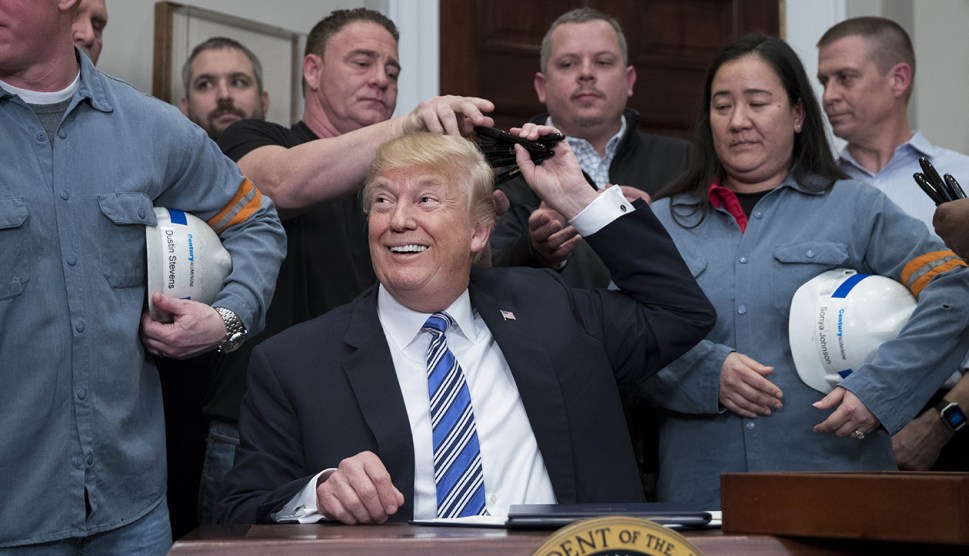
    Donald Trump signs new steel tariffs in March surrounded by grateful steelworkers. Nobody in a suit is anywhere near. But when it comes time to dole out the windfall profits, Trump is having lunch on Wall Street and there are no visits to steel mills on his agenda. Funny how that works.Michael Reynolds/Pool/CNP via ZUMA

    The Washington Post reports that Donald Trump’s steel tariffs have caused the domestic steel industry to boom:

    The steel industry was already in a period of renewal when Trump slapped 25 percent tariffs on steel imports….The tariffs sent the price of steel surging more than 33 percent. “We have a strong U.S. exposure; clearly we are a net beneficiary of the trade actions,” Aditya Mittal, chief financial officer of ArcelorMittal, said in August, according to Bloomberg News.

    Trump has repeatedly cited the gains as one of the biggest upsides of his trade policy. After he visited the Granite City plant, video circulated of a steelworker being brought to tears by news of the plant’s expansion. “Trump has supercharged [the sector] with broad-based tariffs,” said Phil Gibbs, a steel industry analyst at KeyBanc Capital Markets.

    That’s great! I guess us naysayers were all full of—

    When President Trump imposed tariffs on steel imports in June, Richard Lattanzi thought of dozens of his fellow steelworkers who have for years put off badly needed repairs of their cars and homes. “There was a lot of excitement here; there were a lot of us saying, ‘It’s about time someone is looking out for us,’ ” said Lattanzi, the mayor of this town of 7,000 and a safety inspector at the U.S. Steel plant in nearby West Mifflin.

    ….Four months later, Lattanzi is less optimistic. Production at U.S. Steel’s facilities have ramped up, and the company announced this summer that, thanks in part to the tariffs, its profits will surge. But in interviews in recent weeks, Lattanzi and other steelworkers said they’re no longer confident they’ll take part in the tariff bounty.

    ….In its latest offer, U.S. Steel said it would give workers an immediate raise of 4 percent, followed by 3 percent annual raises later on. By the usual standards, that would be a good deal. But at the same time, the company said it is wrestling with soaring health-care costs in the long run….and that it needs to start asking workers to absorb some of those — namely by paying $145 per month for health care.

    ….But to the union, it was an upsetting plan. It would reduce the overall wage increase to just about 1.7 percent over nine years.

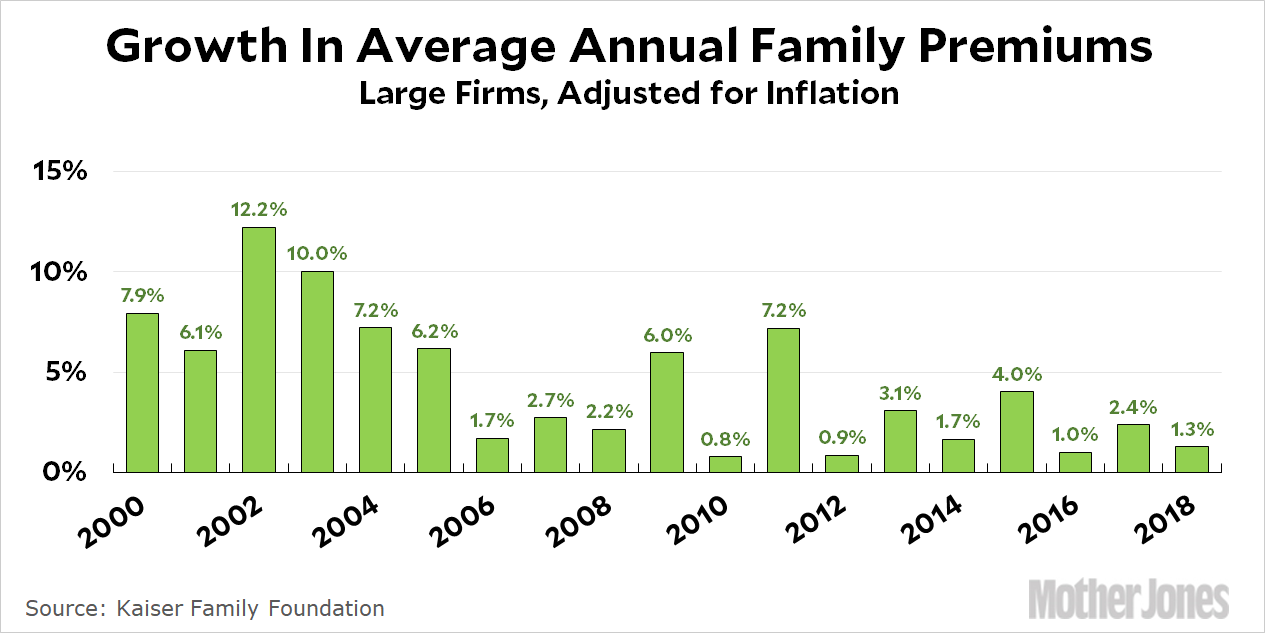
    ArcelorMittal’s last contract with US Steel workers was ratified in 2016. According to the Kaiser Family Foundation, family health premiums have increased about $60 per month for large firms since then. For some reason, though, ArcelorMittal wants workers to start paying $145 per month. That’s about a thousand dollars per year more than their actual increase in costs. At the same time, they’re offering a raise of 4 percent, which comes to about 1.5 percent when you adjust for inflation. At a guess, that comes to about a thousand dollars per year. In other words, no net increase at all. But there’s more!

    ArcelorMittal is also demanded sweeping concessions, including wage givebacks and cuts to vacation pay, as well as the elimination of profit-sharing bonuses for newer workers. Out-of-pocket health care costs will increase by up to $9,300 over the three years of the contract.

    Well, who knows? Maybe that’s just union propaganda. But even if you account for that, it sure sounds as if steelworkers will at best come out even under the new contract proposal, but will probably come out worse. And that’s in the wake of a three-year period of no wage hikes.

    In other words, somebody is getting rich thanks to the domestic steel boom caused by Trump’s tariffs. But as usual under Trump’s Republican policies, it sure doesn’t seem to be the workers themselves.

  • Donald Trump Shrugs Off Decades of Tax Fraud

    Globe Photos/ZUMAPRESS

    Yesterday the New York Times reported that the Trump family, including Donald Trump, had engaged for years in both outright tax fraud and an endless string of tax scammery that might or might not edge over into fraud. They also reported that far from being a self-made billionaire, Trump had received nearly half a billion dollars from his father over the years. Today, Trump responded:

    That’s it. Donald Trump, who brags constantly about graduating from Wharton, pretended that adjusting for inflation was some kind of rare wizardry and then blew off the whole thing. He didn’t even bother denying any of the charges in the article, all of which were based on brand new documentary evidence. Neither did his press secretary:

    Asked to identify what in the article was incorrect, she said, “I won’t go through every line of a very boring 14,000-word story.” Instead, she said the article demonstrated that Mr. Trump’s father believed in him. “One thing the article did get right is it showed that the president’s father actually had a great deal of confidence in him,” she said. “In fact, the president brought his father into a lot of deals and made a lot of money together.”

    Why does Trump think he can get away with this? It’s easy: this is precisely the kind of story that the press will forget almost instantly. It’s an exclusive to the New York Times, which spent over a year on it, and there’s very little prospect of following it up. There won’t be new documents dropped every few days. There aren’t people to interview to advance the story. There aren’t politicians with axes to grind who will start up investigations and keep generating news. As long as Trump himself ignores it, there’s very little the Times can do to keep this story in the public eye day after day.

    In a world where Trump generates news at will almost daily, it’s doomed unless something miraculous happens to keep it going. Unfortunately, Democrats are too busy with other stuff and Republicans couldn’t care less if Trump is a crook. But who knows? Maybe the Times has a follow-up or two that they plan to drop in a few days.

  • Lunchtime Photo

    Today’s photo is more of a curiosity than anything else. I was out walking a few days ago and passed by a spot that often has some hummingbird activity. I wasn’t really planning to take any hummingbird picture, but I went ahead and changed the camera settings anyway in case one showed up. And one did. I aimed the camera and reeled off a couple of dozen shots in burst mode.

    But when I got home I saw that none of them were any good. The autofocus wasn’t set right, so the bird was fuzzy in every shot. But then I looked again and was sort of intrigued by one of them. The background was pure white, and the foreground flower was in sharp focus. With a bit of photoshopping I amped up the color of the flower a bit and turned the hummingbird into more of a silhouette.

    And then I stared at it. Is there really anything interesting about this shot after all? Or is it just a routine addition to the discard pile? I’m not sure, though I’m leaning toward the latter.

    September 26, 2018 — Irvine, California