Mitch McConnell says he’s thrilled that Democrats tried so hard to keep a serial liar and teenage sexual marauder off the Supreme Court:
“It’s been a great political gift for us. The tactics have energized our base,” he said, adding: “I want to thank the mob, because they’ve done the one thing we were having trouble doing, which was energizing our base.”
Oh, fuck you. I don’t have any data to measure base energy, but I will offer McConnell one anecdotal warning before he gets too pleased with himself: Marian is mad as hell about this, and she barely even pays attention to politics. McConnell better hope that’s not the case with too many millions of other women who also don’t usually pay attention to politics.
Will this latest financial data make any difference in support for Donald Trump?
Who knows. Here is the tally of Republican senators who (to the best of my knowledge) have said anything about it:
This was, of course, the same day on which Donald Trump, at a rally in Mississippi, mocked Christine Blasey Ford, for her testimony against Brett Kavanaugh.
It’s worth noting that the tally of Republican senators will stay at zero unless reporters first ask them for comment, and who knows if any of them will bother with that? In any case, even if they do, the answer to Fallows’ question is easy: No. Most common response if asked about Trump’s dubious dealings: “The American people knew all about his business background and they elected him anyway. There’s nothing new here.”
One of these pictures of the Los Angeles skyline is worth $3 million. One of them is worth $0. Both were taken within the past 20 years. Can you figure out which is which?
Tom Williams/Congressional Quarterly/Newscom via ZUMA
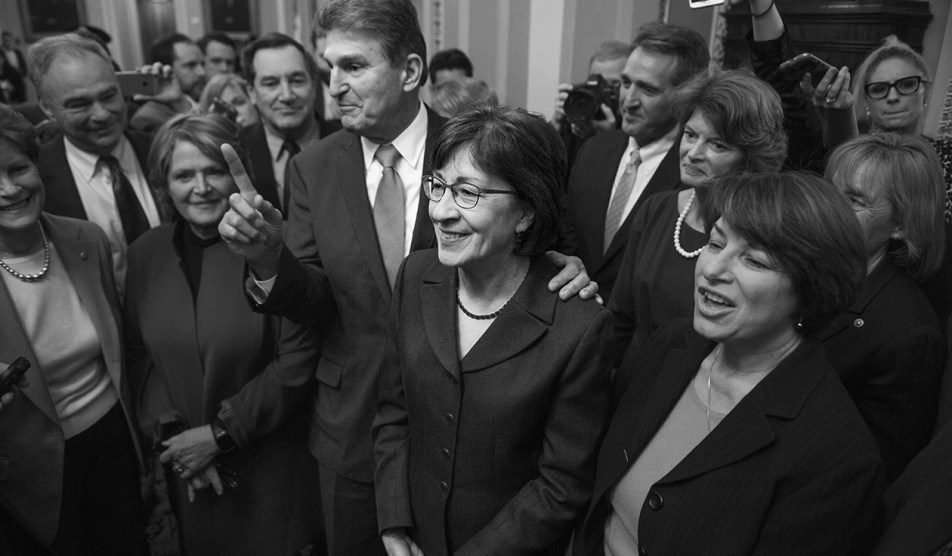
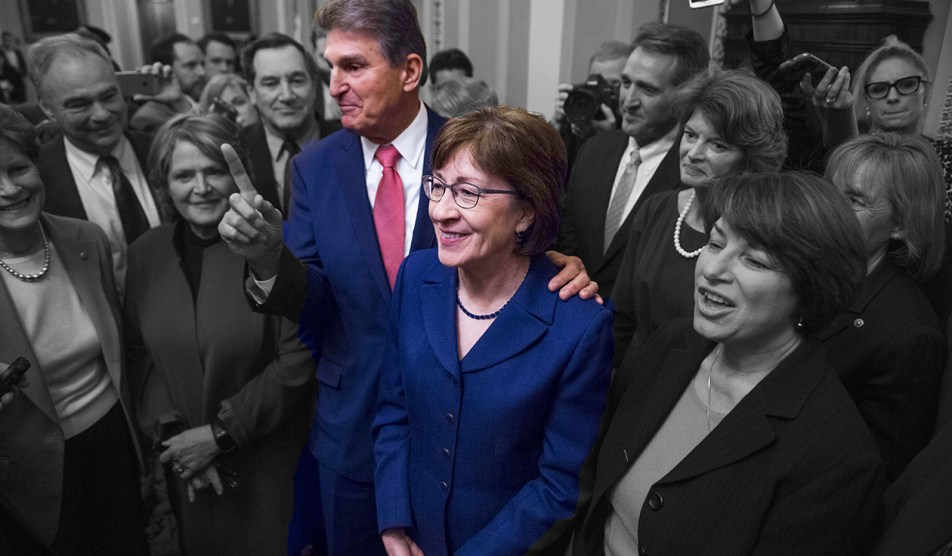
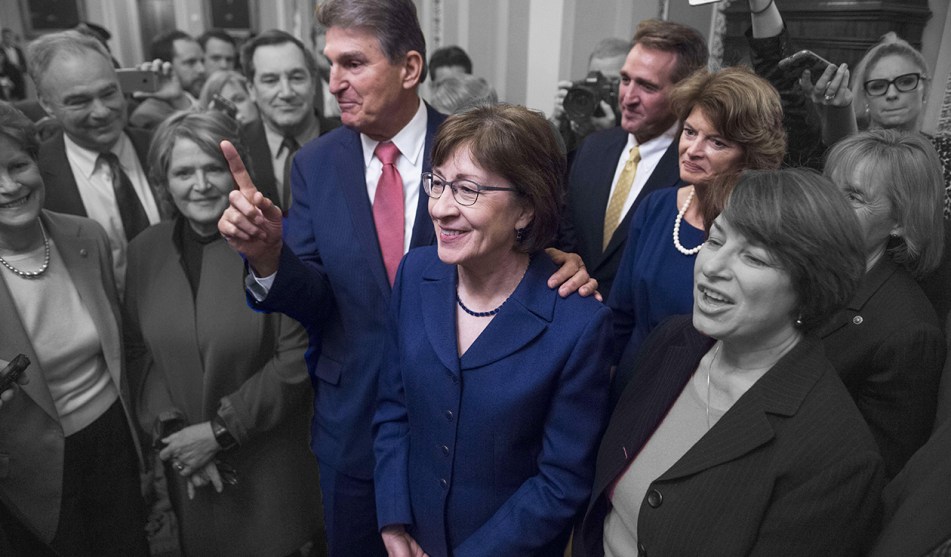
Susan Collins and Joe Manchin have both announced that they will vote to confirm Brett Kavanaugh. Assuming that Lisa Murkowski remains a no, Kavenaugh will win confirmation tomorrow by a vote of 51-49. It’s all done except for calling out the fat lady to sing a dirge for the final defeat of decency and integrity.
It's down to Joe Manchin and Susan Collins. Everyone else has announced how they'll vote.Tom Williams/Congressional Quarterly/Newscom via ZUMA
At this point, it appears that Jeff Flake will vote yes on Brett Kavanaugh’s nomination to the Supreme Court, while Lisa Murkowski will vote no. That puts us at 49-49.
Both Susan Collins and Joe Manchin have provided no solid clues about how they’ll vote. But apparently it’s all up to them. If they split, it’s 50-50 and Kavanaugh wins (thanks to VP Mike Pence’s tiebreaking vote). If they both vote no, Kavanaugh goes down.
This is Hopper up on the patio cover watching some birds in the next tree over. They were chirping. They were asking for it. As usual, though, they escaped unharmed. They always do.
I don’t know where this post came from anymore. It started when I was reading a Matt Bruenig piece about how social pressures are as important as market forces in bringing up minimum wages. I think someone on Twitter told me I should take a look at it. As he often does, Bruenig extolled the Nordic countries, and then….
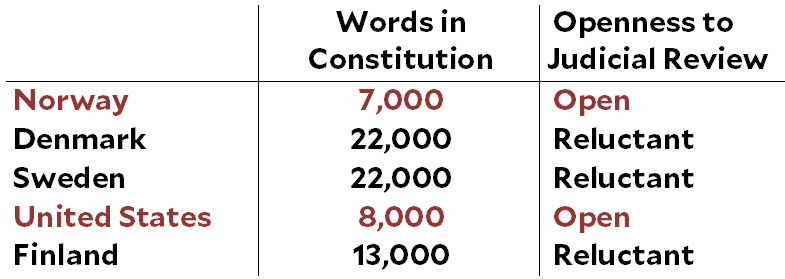
I don’t know. Somehow I got rerouted to a piece about judicial review in Nordic countries. It turns out Norway does a lot of judicial review, while Sweden, Denmark, and Finland are reluctant to overturn parliamentary laws on constitutional grounds. But why?
My guess is that has to do with the age and length of the constitution. The US constitution is old and short, and therefore contains lots of ambiguity. Ditto for Norway, which was modeled on the US Constitution. After considerable effort,¹ I also found the word lengths of the other constitutions, and here they are:²
Sure enough, Denmark, Sweden, and Finland all have long, modern constitutions, which probably spell out the meaning of the words pretty explicitly and cover a whole lot of ground. There’s just not as much need for judicial review as there is in the US or Norway.
Anyway, I don’t know if anyone cares about this. But I did the damn counting, so I’m going to post it. Enjoy.
¹This is not a joke. Most of them were in PDF form, which doesn’t include a tool to count words. So I downloaded each one and uploaded it to a site that said it would count the words for me. It worked a treat for Norway, but then choked on the longer ones. So I tried to convert the PDFs to Word. No joy. Finally I cut and pasted the PDF text into Word, but it turned out there was a limit to how big a chunk of text you can copy out of a PDF. So I had to do it in 20-page chunks. Even the official National Archives of the US Constitution appears to be divided into the Constitution, the Bill of Rights, and the rest of the amendments, so I had to copy all three separately. FFS.
²These word lengths are all from the English translations. I don’t know how much difference that makes, but I figured it was best for comparative purposes to use the same language for all of them.
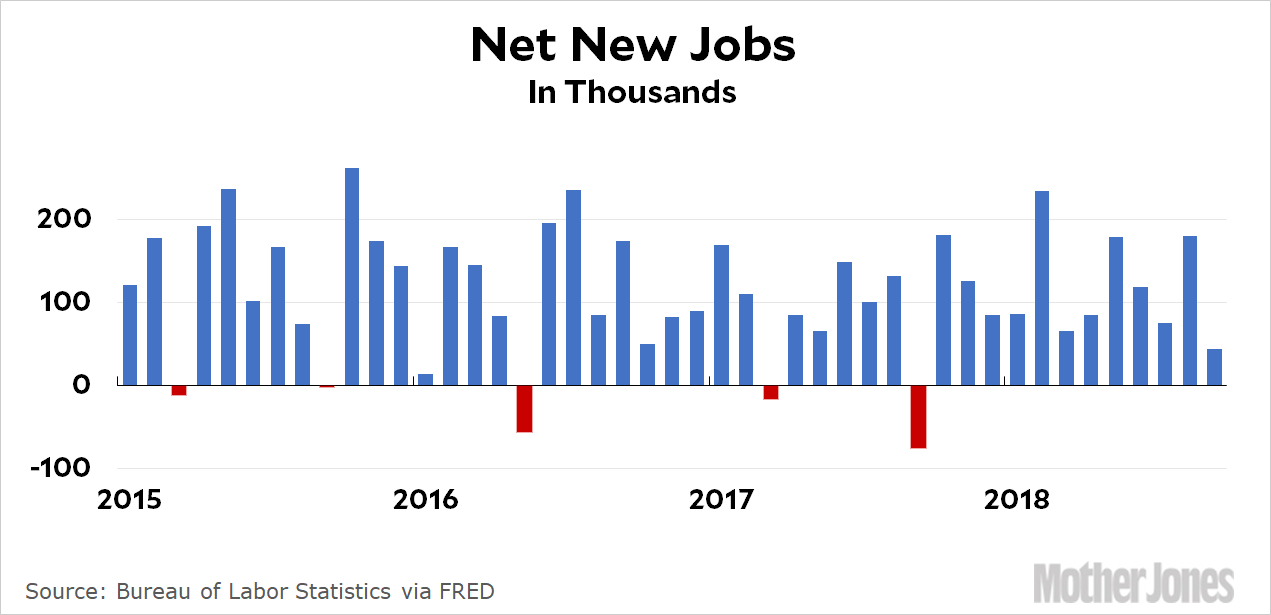
The American economy gained 134,000 jobs last month. We need 90,000 new jobs just to keep up with population growth, which means that net job growth clocked in at a miserable 44,000 jobs. The unemployment rate dropped to 3.7 percent, which was a little odd. The number of new jobs really was low, but the number of unemployed dropped by a respectable 270,000. But where did their jobs come from?
The civilian labor force increased by 150,000 but 420,000 people found new jobs.
New jobs increased by 134,000 and the unemployed found 270,000 jobs. This adds up to 404,000 newly employed
These numbers add up pretty closely, but what jobs did the unemployed find? Old ones? Unreported ones? Part time occasional jobs? I’m not clear about that. However, the employment-population ratio ticked up from 60.3 percent to 60.4 percent, so there were definitely more people working in the market labor force than before.
Wages of production and nonsupervisory workers were up at an annualized rate of 3.3 percent. The annualized rate of inflation right now is 2.7 percent, which means that blue-collar workers increased their real wages by 0.6 percent, which is so-so. Taking everything together, this wasn’t the worst jobs report ever, but it was still a pretty mediocre one, and well under expectations.
POSTSCRIPT: President Trump is very fond of tweeting out the early job estimates from ADP, which bases its estimate on a survey of about 20 percent of all private US employees.
Blowout numbers on New Jobs and, separately, Services. Market up!
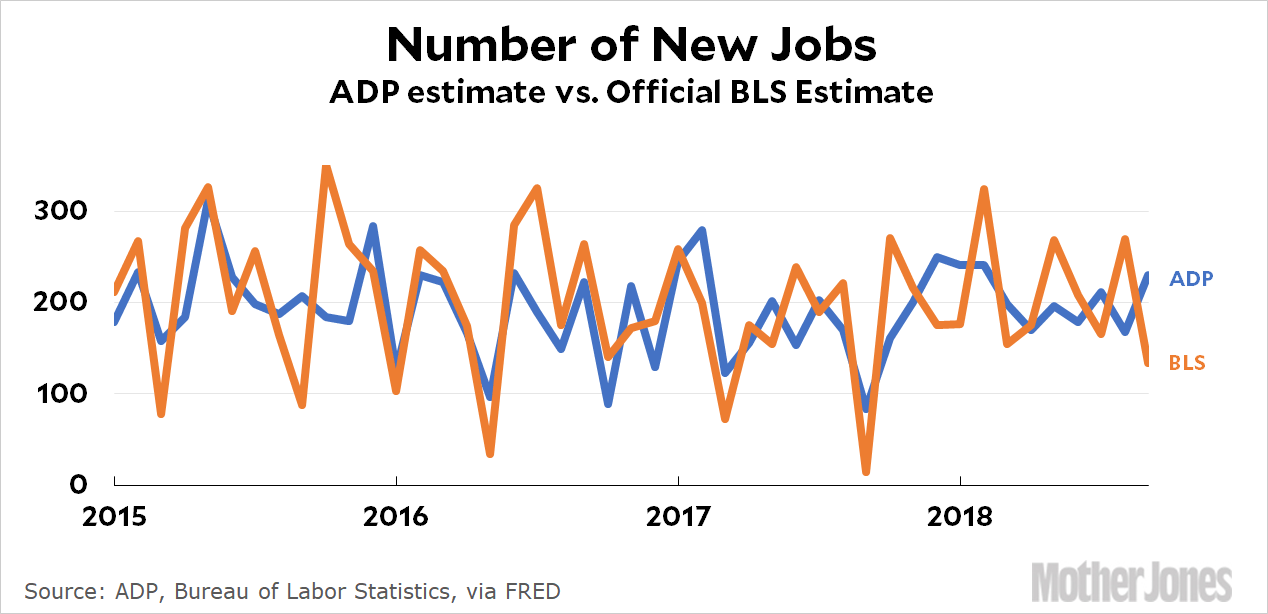
This got me curious: how closely do the ADP estimates track the BLS estimates: Here’s the chart:
There’s a ton of noise here, and the September numbers diverged considerably. ADP predicted 230,000 new jobs while the BLS estimated only 134,000 new jobs. This kind of noise is invevitable when you survey with two very different instruments, and it’s impossible to say which is more accurate. Over the long term they agree pretty closely, and ADP claims that their goal is to match the final revision of the BLS numbers, not the first print. If that’s really the case, then in a couple of months the BLS will revise its September number up to around 230,000. Wait and see.
In any case, Wall Street traders generally take the ADP numbers as gold, and if the BLS numbers come in lower then the economy has come in “below expectations.”
These are the potential swing votes on Brett Kavanaugh's nomination:
Joe Manchin, D-W.Va., Susan Collins, R-Maine, Jeff Flake, R-Ariz., and Lisa Murkowski, R-Alaska.Tom Williams/Congressional Quarterly/Newscom via ZUMA
Brett Kavanaugh won a procedural vote this morning to cut off debate on his nomination and move toward a final vote on Saturday. The vote was 51-49 along party lines with two exceptions:
Joe Manchin (D–WV) voted yes
Lisa Murkowski (R–Alaska) voted no
Sen. Susan Collins (R–Maine) voted yes on the procedural vote but didn’t commit to how she’d vote on the final confirmation vote.
If Murkowski votes no, the vote would be 50-50 and Vice President Mike Pence would break the tie. If Collins or Manchin also vote no, the vote would be 49-51 and the Kavanaugh nonimation would fail
This makes Collins and Manchin the people to watch, along with Jeff Flake, I suppose, who just might change his final vote on Kavanaugh to no. He provided no indication of whether he was thinking of doing this.
So that’s that. That’s the state of play. If you care about this, it’s time to make a phone call, especially if you live in the same state any of these senators. As always, be polite. Yelling and screaming at Senate staff doesn’t do any good.
Burn up the phone lines. At a minimum, make calls to these Senators and implore a NO VOTE on Kavanaugh.
Susan Collins (202) 224-2523
Lisa Murkowski (202) 224-6665
Jeff Flake (202) 224-4521
Joe Manchin 202-224-3954 pic.twitter.com/vXmDDk6QJP
The Yangshan Deep Water Port, in east Shanghai, is the largest cargo port in the world.SIPA Asia via ZUMA
The Wall Street Journal reports today that Donald Trump isn’t really interested in removing trade barriers. Quite the contrary:
The underlying principle, as Mr. Trump himself said in unveiling the North American accord this week, is that trade partners should consider it “a privilege for them to do business with us.” Access to the U.S. market will become increasingly contingent on countries adopting American rules and standards, from intellectual property protections to higher wages.
Now, this is nothing new even though Trump probably doesn’t know it. US presidents have pushed other countries for years to adopt American rules on IP, financial access, and other services that benefit American corporations. It’s just standard trade treaty negotiation, and all of this stuff was part of the TPP that Trump tossed out when he became president.
But then the Journal mentions one other thing. Trump apparently included several clauses in the new USMCA that don’t really have much effect on either Canada or Mexico, but are included as a sort of template for future agreements he hopes to negotiate:
The U.S.-Mexico-Canada deal could complicate Britain’s emerging strategy for crafting its own independent commercial diplomacy once it breaks from the EU. Britain hopes to achieve separate free-trade pacts with both the U.S. and China.
But the Trump administration seeks to add clauses in future deals that allow the U.S. to withdraw if a trade partner forges a separate deal with a “nonmarket economy”—a clear reference to China. That could force Britain to choose between Washington and Beijing.
So…if you negotiate a trade deal with China, you can’t also negotiate one with the US? Is that as crazy as it sounds? Can some experts weigh in? And even if it’s not totally crazy, how dangerous is it? If they were genuinely forced to choose, how many countries would choose the US over China? I’m not so sure. As near as I can tell, Trump’s idea of brilliant negotiating is to threaten 25 percent tariffs on everything if you don’t cut a deal with him, but that’s nowhere near as clever as he seems to think. And if that leverage is mostly a mirage, there are lots of countries that would probably prefer a trade agreement with China to one with Trump’s America. In fact, threatening to do a deal with China might provide them with leverage over Trump.
Anyway, the whole thing sounds pretty laughable. It also sounds very Trumpish. But I repeat myself.
And we respect that! But maybe you’re of a mind to support our work directly instead? We have until December 31 to raise the last $400,000 we need to keep our nonprofit newsroom running at full strength into 2026. Will you make a gift today?
We noticed you have an ad blocker on. Can you pitch in a few bucks to help fund Mother Jones' investigative journalism?
We’re halfway there, but time’s running out.
With only days left in 2025, we've made real progress toward our $400,000 goal—the funding we need to keep our nonprofit newsroom running at full
strength. But to close the remaining $200,000 gap before December 31, it will take a huge surge in reader support. Whether you've given before or this is your first time, your contribution right now will matter. Will you help us get there?
We’re halfway there, but time’s running out.
With only days left in 2025, we've made real progress toward our $400,000 goal—the funding we need to keep our nonprofit newsroom running at full
strength. But to close the remaining $200,000 gap before December 31, it will take a huge surge in reader support. Whether you've given before or this is your first time, your contribution right now will matter. Will you help us get there?