• The Mystery of the Tight Labor Market

    The Wall Street Journal reports on the strength of the job market:

    Americans are less likely to be laid off than at any point in at least 50 years….The steep fall in layoffs is mainly a result of a vastly improved labor market. It means Americans have more job security than they may realize less than a decade after dismissals spiked in the 2007-2009 recession….After nearly seven years of consistent job growth, firms are reluctant to let employees go in a tight labor market in which available workers with a recent employment history are quickly snapped up.

    The Journal is right about all this. Here’s a summary of the Labor Department’s JOLTS data since the end of the recession:
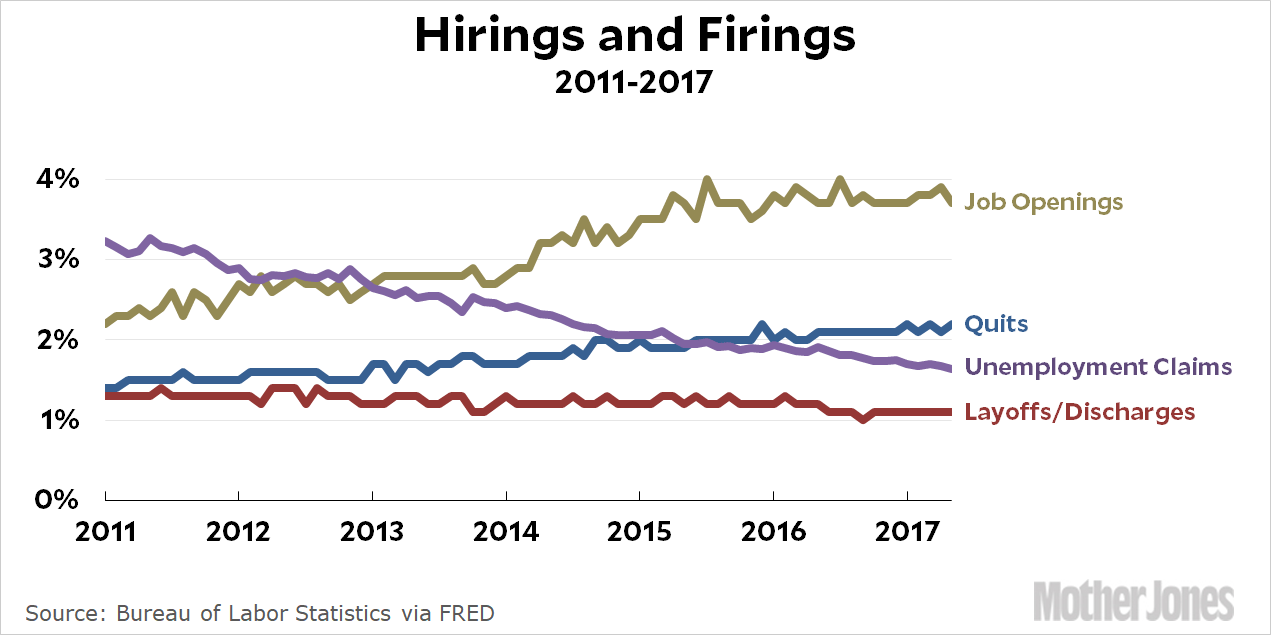
    Layoffs are going down. That’s good. Initial unemployment claims are going down. That’s good. Voluntary quits are going up. That’s good, because it signals that people are confident about finding a new job (or have already been recruited away into one). And job openings are up. That’s good, because it means there are more opportunities for job seekers.

    And yet, we still have this chart that I posted on Friday:
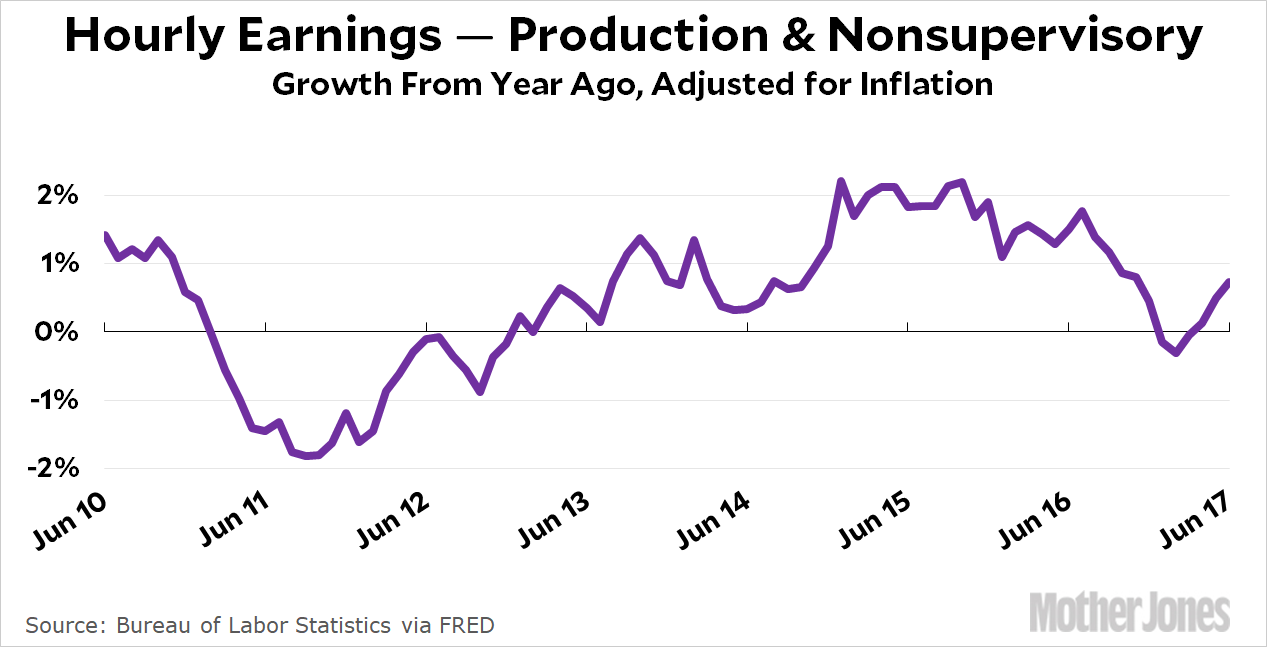
    There are lots of job openings; managers report trouble finding workers; and voluntary quits are up. Despite all this, though, wages have barely moved. The most obvious way to fill job openings and keep people from quitting is to raise wages, but that hasn’t happened.

    There really is something of a mystery here. Nearly all the data points to a tight labor market with the exception of the single most important bit of data: wages. Rising wages are the clearest sign of a tight labor market, but we’re not seeing them. Not at the working and middle-class level, anyway. What’s going on?

  • Hiring Workers for Manufacturing Jobs Isn’t All That Hard

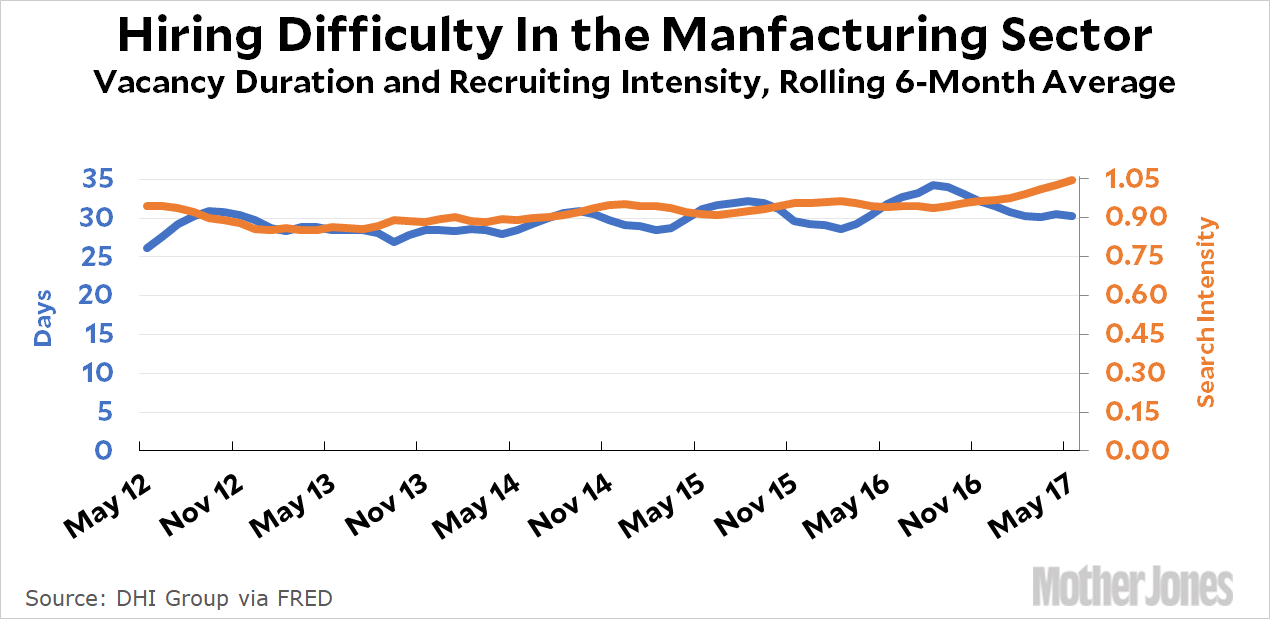
    FRED has some new data. Isn’t that exciting? They now have several new series from DHI Group that measure how difficult it is for firms to hire people. I was curious about the manufacturing sector, so here’s the data:

    As you can see, both average duration of job vacancies and average search intensity to fill jobs was pretty flat through the middle of last year. Average vacancy duration went up a bit in mid-2016 and companies responded by recruiting a little harder. Very quickly, vacancy duration returned to 30 days, roughly the average of the past five years.

    What this tells us is that it has gotten a little harder to find people in the manufacturing sector over the past couple of years, and companies have had to work a little harder to fill their positions. But only a little.

    However, if you look at this over a longer timeframe, what you see is that over the past five years, vacancy duration has been consistently higher than it was during the aughts, but recruiting intensity has been consistently lower. What this suggests is that for the past five years manufacturing companies have been deliberately leaving vacancies open longer than they used to. If lack of qualified workers was really a problem, they would have recruited harder. But until very recently, they didn’t.

  • GOP Would Rather Pass No Tax Reform At All Than Endanger Tax Cuts For the Rich

    This is from a couple of days ago:

    Hmmm. What’s to object to here?

    • Regular order allows tax reform to be permanent, and Republicans have been pulling their hair out to make sure their tax plan is permanent. So it can’t be that.
    • Republicans hate budget deficits, so surely it’s not that.
    • No one wants to increase the taxes of the middle class, so it can’t be that either.

    That only leaves one possibility: they object to the Democratic demand that a tax plan not cut the taxes of the rich. That’s the one thing they can’t abide, even if it means passing a plan via reconciliation with only Republican votes. Of course, this endangers everything, since it means they can’t afford to lose more than three votes in the Senate. It also guarantees that their tax cuts will be temporary.

    But that’s where we’re at. Republicans would rather run the risk of passing no tax reform at all than of agreeing to tax reform that doesn’t benefit the wealthy. Is anyone surprised?

  • Friday Kitten Blogging – 4 August 2017

    Hilbert and Hopper are taking the week off. Maybe a few weeks off. You never know!

    This is Mika, Professor M’s new Siberian kitten. Mika is not named after the better half of Morning Joe. Prof M’s other cat is named Mocha, and Mrs. M liked the idea of naming the new cat after the Hebrew prayer “Mi Chamocha,” which you can listen to here. So now they have Mika and Mocha.

    Also, Mika is male, because everyone likes transgressing gender stereotypes, right? Anyway, isn’t he cute? He’s been happily exploring his new house, and Mocha seems fine with the whole thing. She’s already started playing with her miniature new friend, but when the playing stops, it’s time for a nap. And what better place for that than Prof M’s desk?

  • Trump Approval Holding Steady In the One Place That Matters

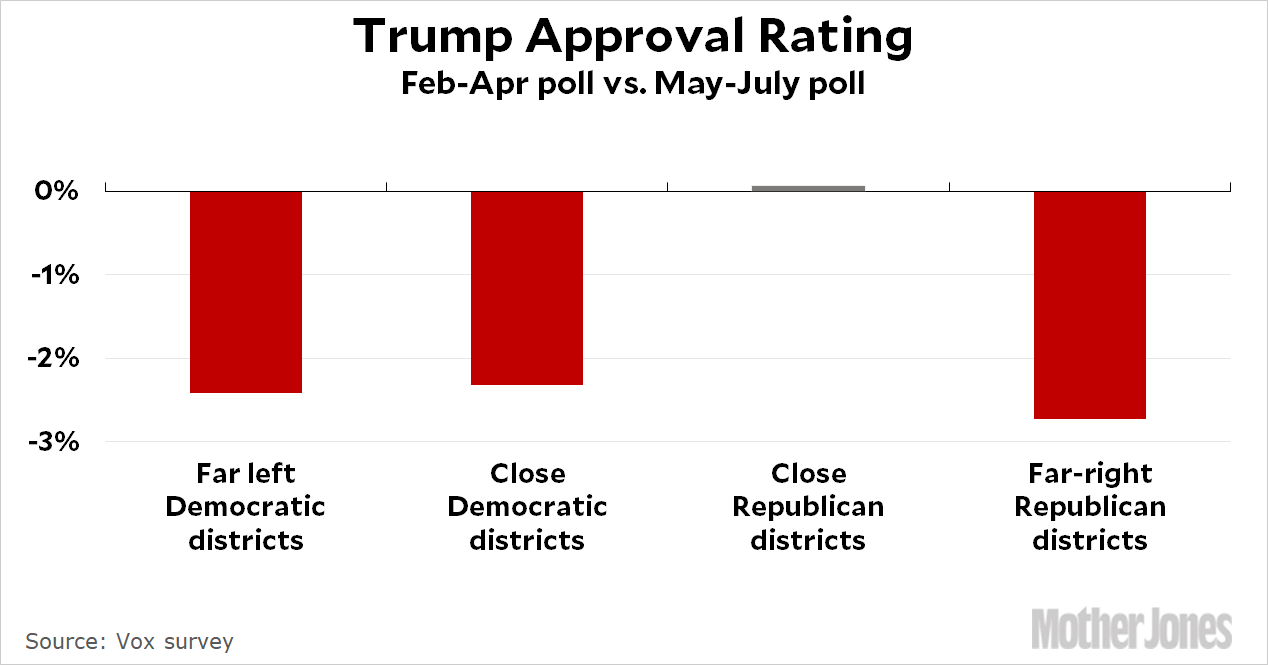
    Vox has a new survey out that bodes poorly for Democrats in next year’s midterm elections. It turns out that Donald Trump’s approval rating is down almost everywhere over the past few months—but that “almost” is a killer. The one place where Trump’s approval has held steady is the one place where Democrats actually need it to go down:

    Nobody cares much about safe left and right districts, where nothing is likely to change. Meanwhile, Trump’s declining approval in districts that Democrats hold by a small margin is positive for Dems, but only slightly. Given the dynamics of midterm elections, where the out-of-power party usually does well, they were always likely to hold most of these districts.

    What Democrats really want is to pick up some close districts currently held by Republicans. But that’s the one place where Trump is stubbornly holding on. If Democrats are hoping Trump will have some negative coattails that will help them next year, they aren’t seeing it yet.

    Of course, we still have more than a year to go. There’s no telling what Trump could do over the next 15 months.

  • Here’s What the Labor Market Really Looks Like

    There’s not a whole lot going on today, so here’s another chart about the economy for you. It shows the percentage of prime working-age adults who have jobs:

    Over the previous two economic cycles (1990-2000 and 2000-2008), this number averaged 79.8 percent. Today it’s 78.7 percent. So we still have some ground to make up just to reach the average of past cycles. At the top of the cycle, we ought to be around 81 percent or so.

    One of the problems with this statistic is that it can fluctuate depending on how many young workers go to college and how many older workers are retiring. As the baby boomers retire, for example, we should expect the overall ratio to drop steadily. This is why it’s best to look only at 25-54 year-olds. These are the folks who are out of school and aren’t retired, so they provide a pretty good look at how the labor market is doing.

    When you put this together with sluggish wage growth for middle-income workers, it shows that we still have some slack in the labor market even though the headline unemployment rate is a very healthy 4.3 percent. At the rate things are improving, we ought to have another three years of expansion left before the economy tops out. But will we?

  • Workers in the Middle Have Stagnated During the Entire Recovery

    Every month, when I post the latest jobs numbers, I also mention the wages of production and nonsupervisory workers. I do this because I think it’s a good rough measure of how well economic growth is helping the working and middle classes, not just the upper middle class of lawyers and programmers. But I don’t normally put this in any larger context, so here’s the wage growth of production and nonsupervisory workers during the past seven years of the recovery, adjusted for inflation:

    P&NS workers took a big hit in 2011, made up for it with good wage growth in 2015, and have seen very modest growth since then. Over the past seven years this adds up to cumulative real wage growth of 3.9 percent. That’s about 0.6 percent per year.

    This is better than going down, of course, but not much better. We’ve had a long, steady recovery since the Great Recession, but workers in the middle mostly continue to stagnate.

  • Chart of the Day: Net New Jobs in July

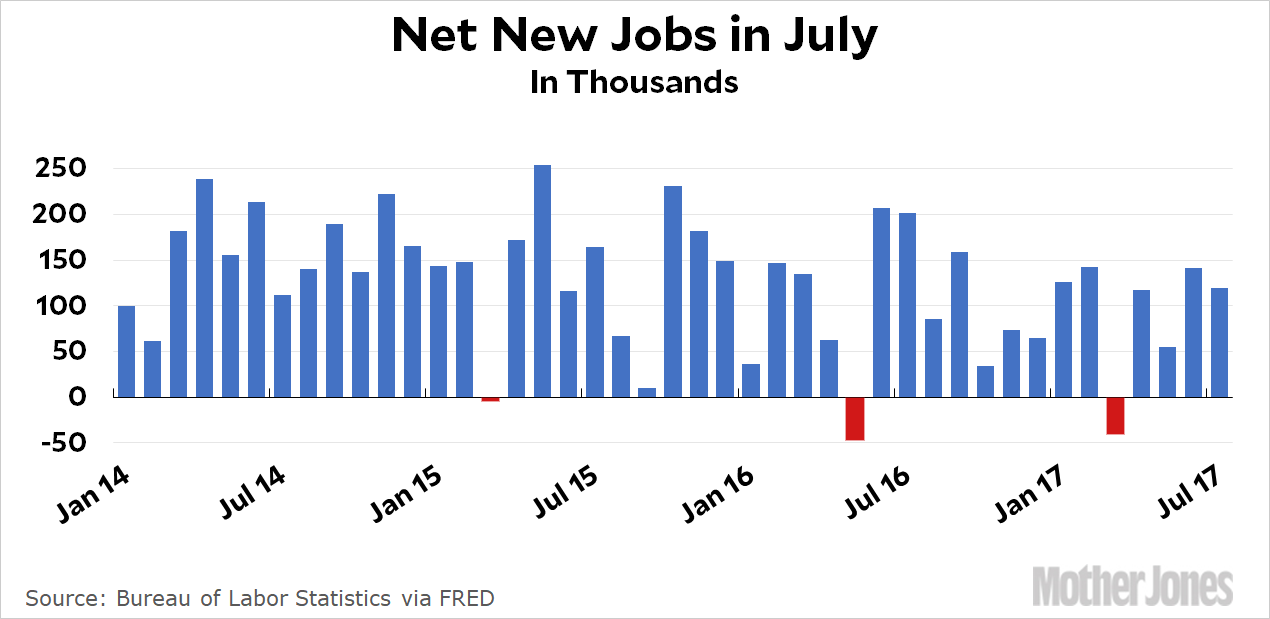
    The American economy added 209,000 new jobs last month, 90,000 of which were needed to keep up with population growth. This means that net job growth clocked in at 119,000 jobs. That’s an OK number, about the same as last month and equal to the average of the past three years. The headline unemployment rate ticked down slightly to 4.3 percent, all of it due to an increase in the number of employed people. A net of about 150,000 people re-entered the labor force, and the labor participartion rate ticked up slightly.

    Hourly earnings of production and nonsupervisory employees went up at an annual rate of 3.4 percent. Inflation is currently running at 1.6 percent, so that’s pretty good. If we could only keep this up for a year or two, we might have a real recovery. All in all, this was a modestly positive report with no real downsides.

  • There Is No Longer Any Way to Halt North Korea’s Nuclear Program

    I don’t ordinarily do this, but I want to clear up what I said yesterday about North Korea and nukes. This time, I’ll say it in the plainest language possible.

    Fifteen years ago, it’s possible that diplomacy could have stopped North Korea from developing nuclear weapons. That’s certainly what I thought. It’s also possible that heavy sanctions could have done it. It’s even possible that military action could have done it, though that would have been very risky for reasons that everyone knows about—though here’s a map in case you don’t:

    None of this is true anymore. North Korea already has nuclear weapons. They have a productive source of fissile material. They’re very close to developing a reliable ICBM, and probably close to developing a nuclear warhead small enough for their ICBMs. That’s what the DIA thinks, anyway. And North Korea has made it crystal clear that developing a nuclear deterrent capability against the United States is their #1 national priority.

    Liberals like to think that maybe more diplomacy will stop North Korea’s nuclear program. It won’t. Conservatives like to think that tougher sanctions, or possibly military force, will stop their nuclear program. They won’t. Donald Trump likes to pretend that China can stop their nuclear program. They either can’t or won’t. Like it or not, this is where we are.

    There are only two options left. Either we accept a nuclear-armed North Korea or we launch a nuclear strike to take out their capabilities. Since a nuclear strike is insane for too many reasons to list—including the fact that it might not even work—this means we really have no options at all. We can, if we want, maintain a hostile attitude toward North Korea as a signal to others about the price of developing nukes, but we basically have to accept the reality that North Korea is a nuclear state.

    This is what I think could use some plainer language from national security types. Let’s knock off the fantasy op-eds full of vague talk about China and sanctions and diplomacy. Instead, tell people the bald truth. It would give the hawks some pause, and might even reduce the pressure that could lead someone like Donald Trump to do something stupid. This is, unfortunately, something we all have to think about these days.