Get your news from a source that’s not owned and controlled by oligarchs. Sign up for the free Mother Jones Daily.

The world has become addicted to debt.  Wall Street loves it because you can play far more interesting games with debt than you can with equities.  Consumers love it because it makes up for stagnant wages.  Investors love it because it gooses their returns.
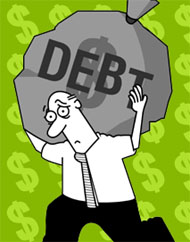
As a result, there’s way too much of it.  So how do we cut it down to size?  Felix Salmon suggests that although massive regulatory interventions are probably doomed to failure, we could, at a minimum, stop subsidizing debt by getting rid of its tax advantages:

At the moment, companies pay tax not on earnings before interest but earnings after interest — that gives them an incentive to lever up as much as possible. Last year, Steve Waldman had a great post entitled “Eliminate the business interest tax deduction“; it’s well worth (re)reading in light of what has happened since.

In general the multi-trillion-dollar edifice of debt financing is predicated on all manner of artificial tax advantages which are given both to borrowers and to fixed-income investors; tax-free municipal bonds and mortgage-interest tax relief are just two of the most egregious examples here.

Forcibly converting mortgages into some kind of shared-equity arrangement where banks get direct exposure to the house price is fraught with difficulty; abolishing mortgage-interest tax relief, however, is easy. And it raises much-needed money for the government as well.

I wouldn’t exactly agree that eliminating the mortgage interest tax deduction is easy, but point taken.  It’s at least within the realm of imagination.

In the past, debt has received preferential tax treatment because it was thought to be good for the economy: it lowered hurdle rates for businesses and encouraged capital-intensive expansions; it gave a boost to the housing industry and encouraged home ownership; and it increased purchasing power and encouraged consumer spending. But that was back in the dark ages, when debt was relatively more expensive than it is now.  The financial world has changed a lot in the past 50 years, and debt is now far cheaper, far more easily available, far more efficiently hedged, and far more broadly (and deeply) traded than it was in the immediate postwar era.  Its tax advantage might have been justifiable in the past, but it isn’t anymore.  We should get rid of it.

(We won’t, of course, any more than we’ll get rid of agricultural payments or road-building subsidies.  If you scratch most free market capitalists you’ll find a socialist just below the surface.  But we can still dream.)
From the desk of Mother Jones CEO, Monika Bauerlein...

Newsrooms can be funded in many ways. One of the most controversial (and volatile) ways is by a for-profit corporation or a billionaire owner. We see it across the headlines on a weekly basis: the claw backs in public media, the gutting of The Washington Post, the bending over backwards to appeal to Trump and his allies.

But not here.

When Mother Jones first started publishing 50 years ago, our founders made a critical decision: to be a reader-supported nonprofit. They knew that no corporate owner would be interested in a muckraking newsroom; they also knew that no muckraking newsroom would be interested in following the agenda of a corporate owner.

And so, we’ve been reader-funded for half a century. We rely on contributions from our readers—readers like you—whether it’s $50, or $15 a month, or whatever fits your budget. People give what they can, and every donation makes a difference for our newsroom, which has grown tremendously—in size and reach and renown—since its inception in 1976.

You may be wondering: What does it take to publish an investigation? And what does my donation actually fund? The answers are one and the same: It takes people, resources, and time. And that’s what your donation funds directly.

Every donation Mother Jones receives from readers fortifies our newsroom, whether we’re covering underreported scandals out of Washington, DC, or the most important news of the day. And right now, each donation will be doubled because of our $50,000 match. So when you make a donation—$5, $50, any amount—it’ll go twice as far.

Your support keeps us going. If you’re able, donate today.

Thanks for reading.

—Monika

From the desk of Mother Jones CEO, Monika Bauerlein...

Newsrooms can be funded in many ways. One of the most controversial (and volatile) ways is by a for-profit corporation or a billionaire owner. We see it across the headlines on a weekly basis: the claw backs in public media, the gutting of The Washington Post, the bending over backwards to appeal to Trump and his allies.

But not here.

When Mother Jones first started publishing 50 years ago, our founders made a critical decision: to be a reader-supported nonprofit. They knew that no corporate owner would be interested in a muckraking newsroom; they also knew that no muckraking newsroom would be interested in following the agenda of a corporate owner.

And so, we’ve been reader-funded for half a century. We rely on contributions from our readers—readers like you—whether it’s $50, or $15 a month, or whatever fits your budget. People give what they can, and every donation makes a difference for our newsroom, which has grown tremendously—in size and reach and renown—since its inception in 1976.

You may be wondering: What does it take to publish an investigation? And what does my donation actually fund? The answers are one and the same: It takes people, resources, and time. And that’s what your donation funds directly.

Every donation Mother Jones receives from readers fortifies our newsroom, whether we’re covering underreported scandals out of Washington, DC, or the most important news of the day. And right now, each donation will be doubled because of our $50,000 match. So when you make a donation—$5, $50, any amount—it’ll go twice as far.

Your support keeps us going. If you’re able, donate today.

Thanks for reading.

—Monika

We Recommend

Latest

Sign up for our free newsletter

Subscribe to the Mother Jones Daily to have our top stories delivered directly to your inbox.

Get our award-winning magazine

Save big on a full year of investigations, ideas, and insights.

Subscribe

INDEPENDENT. BECAUSE OF YOU.

Mother Jones has no billionaires calling the shots—just readers like you making fearless reporting possible

Donate