
• The Hack Gap Rears Its Ugly Head Yet Again

    The hack gap is a liberal problem of long standing. Put simply, we liberals don’t have enough hacks. Conservatives outscore us considerably in the number of bloggers/pundits/columnists/talking heads who are willing to cheerfully say whatever it takes to advance the party line, no matter how ridiculous it is.

    My conservative readers may scoff at this notion, but rarely has the hack gap been on such febrile display as it has since last Wednesday’s presidential debate. Ask yourself this: can you even imagine Sean Hannity or Rush Limbaugh tearing their hair out over a weak debate performance by Mitt Romney the way that liberals have been over President Obama’s? I can’t.

    Here’s how things would have gone if liberals had their fair share of hacks. Obviously Obama wasn’t at his best on Wednesday. But when the debate was over that wouldn’t have mattered. Conservatives would have started crowing about how well Romney did. Liberals would have acknowledged that Obama should have confronted Romney’s deceptions more forcefully, but otherwise would have insisted that Obama was more collected and presidential sounding than the hyperactive Romney and clearly mopped the floor with him on a substantive basis. News reporters would then have simply reported the debate normally: Romney said X, Obama said Y, and both sides thought their guy did great. By the next day it would barely be a continuing topic of conversation, and by Friday the new jobs numbers would have buried it completely.
    Instead, liberals went batshit crazy. I didn’t watch any commentary immediately after the debate because I wanted to write down my own reactions first, and my initial sense was that Obama did a little bit worse than Romney. But after I hit the Publish button and turned on the TV, I learned differently. As near as I could tell, the entire MSNBC crew was ready to commit ritual suicide right there on live TV, Howard Beale style. Ditto for all their guests, including grizzled pols like Ed Rendell who should have known better. It wasn’t just that Obama did poorly, he had delivered the worst debate performance since Clarence Darrow left William Jennings Bryan a smoking husk at the end of Inherit the Wind. And it wasn’t even just that. It was a personal affront, a betrayal of everything they thought was great about Obama. And, needless to say, it put Obama’s entire second term in jeopardy and made Romney the instant front runner.

    For a moment, ignore the fact that these talkers had a stronger reaction than I did. That’s why God made lots of different kinds of people: so that we could all have different opinions about stuff. What’s amazing is that, as near as I can tell, hardly any liberal pundits held back. Aside from paid campaign workers, no more than a handful decided to pretend that Obama had done well because, hey, that’s how the game is played, folks. Those refs aren’t going to work themselves, after all. Instead it was a nearly universal feeding frenzy.

    You don’t normally see the temperamental difference between liberals and conservatives so dramatically on display. Most conservatives simply wouldn’t have been willing to slag their guy so badly. Liberals, by contrast, almost seemed to enjoy wallowing in recriminations. It was practically an Olympic tournament to see who could act the most agonized. As a friend just emailed me a few minutes ago, “I can’t tell you how many liberals I’ve had to talk off the ledge today.”

    In the end, I doubt this will make a big difference. The polls were always going to tighten up a bit after the huge post-convention, post-47% runup for Obama, so I don’t attribute as much of his recent poll decline to the debates as most people do. Obama has plenty of time to come back, and the fundamentals — his incumbency, the economy, and Romney’s stiffness as a candidate — still suggest a modest Obama win in November. But if I’m wrong, and this does make a big difference, it will be 100% attributable to the hack gap. Without that, Obama’s debate performance would barely have registered. This was a completely avoidable debacle.
  • Mitt Romney’s Foreign Policy in 3 Sentences

    There’s so little interesting news today that I finally caved in. I read Mitt Romney’s big foreign policy speech. Below, I’ve picked out all of the pieces that appear to represent actual policy goals:

    1. I will put the leaders of Iran on notice that the United States and our friends and allies will prevent them from acquiring nuclear weapons capability.
    2. I will make further reforms to our foreign assistance to create incentives for good governance, free enterprise, and greater trade, in the Middle East and beyond.
    3. I will champion free trade and restore it as a critical element of our strategy, both in the Middle East and across the world.
    4. I will vigorously pursue the terrorists who attacked our consulate in Benghazi and killed Americans.
    5. In Afghanistan, I will pursue a real and successful transition to Afghan security forces by the end of 2014.
    6. In Egypt, I will use our influence—including clear conditions on our aid—to urge the new government to represent all Egyptians, to build democratic institutions, and to maintain its peace treaty with Israel.
    7. I will recommit America to the goal of a democratic, prosperous Palestinian state living side by side in peace and security with the Jewish state of Israel.
    8. I will reaffirm our historic ties to Israel and our abiding commitment to its security—the world must never see any daylight between our two nations.
    9. I will roll back President Obama’s deep and arbitrary cuts to our national defense that would devastate our military.
    10. In Syria, I will work with our partners to identify and organize those members of the opposition who share our values and ensure they obtain the arms they need to defeat Assad’s tanks, helicopters, and fighter jets.

    As near as I can tell:

    • Items 1-6 are, with minor differences in emphasis, essentially the same as various bits of Obama’s existing foreign policy.
    • Item 7 can be safely ignored. In the video of his Boca Raton fundraiser, Romney made it pretty clear that he thinks a Palestinian state is a lost cause.
    • Items 8-10 specify genuine differences with Obama.

    Aside from a return to George Bush levels of bluster, then, Romney plans to outsource our policy toward Israel to Benjamin Netanyahu. He’ll take a defense budget that’s already fantastically higher than any other country in the world and add a couple trillion dollars to it. And he’ll supply arms to the rebels in Syria. 

    Will he close Guantanamo? End drone strikes? Issue an executive order banning the assassination of U.S. citizens overseas? Speak up against torture? Reform the military tribunal process? Nope. He appears to think everything is hunky dory on those fronts.

    Bottom line: Romney will buy more ships, never disagree with Benjamin Netanyahu, and arm the Syrian rebels. If you’re impressed by that, I’d guess that Romney’s your man. I’d also guess that you’re easily impressed.

    UPDATE: Fred Kaplan is even less impressed than I was: “Mitt Romney has delivered a lot of dishonest speeches in recent months, but Monday’s address on foreign policy may be the most mendacious yet.” More detail — much more — here.

  • If You Want to Fix the Economy, You Need to Know What’s Broken

    In the Washington Post a few days ago, Danielle Douglas reported that deposits in savings accounts have skyrocketed recently:

    The total amount in those accounts climbed nearly 5 percent to $6.9 trillion in the spring, the highest level recorded since the Federal Reserve launched its regular reports on the flow of money in the economy in 1945. At the same time, other data show that Americans are fleeing the stock market and avoiding the purchase of new homes.

    Dean Baker is not happy:

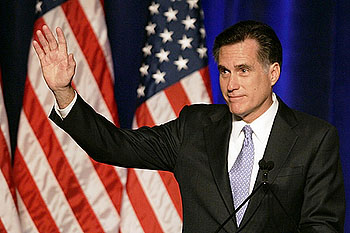
    The problem with the article is that people actually are not saving excessively…. This is not a debatable point where we will have Keynesians giving one line and conservative economists giving another. This is data that is available to anyone who takes a moment to look at the Commerce Department’s website.
    ….Unfortunately, the Post is not alone in this confusion. There are many accounts in the business press about consumers holding back as a result of concern about the state of the economy. The same is frequently claimed about investment….But if we look at the data from the Commerce Department, investment in equipment and software is almost back to its pre-recession level….Given the huge amounts of excess capacity in many sectors, this is actually an impressive level of investment. This is certainly not consistent with the story of firms who are hoarding cash and scared to go out on a limb.

    ….If we look at the data on the volume of existing home sales, the recent annual rate of 4.8 million is more than 20% above the 3.9 million average of 1993-1995, the last years before bubble-generated exuberance began to drive sales. The same story applies to house prices. Inflation-adjusted house prices are even with or above their long-term trend, according to the Case-Shiller national index.

    ….These basic, irrefutable facts are absolutely central to our understanding of the economy — yet most public debate starts from premises that are completely wrong on these and other issues.

    I’d add to this that the percentage of Americans with investments in the stock market has been declining for a decade. This might have something to do with the economy, but more likely has to do with demographic trends. The usual advice given to ordinary people is to reduce their holdings of volatile securities as they age, and as the Baby Boomers have aged they’ve done exactly that. We should probably expect this trend to continue for some time.

    In any case, Dean is right: there’s plenty to argue about on the economic front, but basic economic data isn’t part of it. This stuff is pretty easily available, after all. The personal savings rate is currently hovering around 4%, roughly the same as it’s been for the past 15 years. Businesses are investing, and home prices are back at their historical trend level. “This matters hugely,” says Dean, “because there is no possibility of changing policy if people don’t have a clue as to the nature of the economy’s current problems and how policy could be changed to make things better. In this sense, the confusion hugely benefits the elites. After all, they are fat and happy.”

    Indeed. It’s too bad his piece was published across the Atlantic in the Guardian, instead of in the Washington Post, where it belonged.

  • Apparently Mitt Romney Needs to Lie to Americans About His Foreign Policy

    Dan Drezner recommends Danielle Pletka’s foreign policy advice to Mitt Romney in the New York Times this weekend. So let’s take a look, shall we? Having “met him on a few occasions,” Pletka believes there really is more substance to Romney than his usual campaign nonsense about never apologizing for America. Here’s what he needs to do:

    Mr. Romney needs to persuade people that he’s not simply a George W. Bush retread, eager to go to war in Syria and Iran and answer all the mail with an F-16. He needs to understand that even though Mr. Obama’s so-called pivot to Asia is more rhetorical flourish than actual policy, it responds to a crying need.
    ….Mr. Romney must make clear that he has a strategic view of American power that is different from the Obama administration’s narrow and tactical approach. He must tell Americans that he won’t overlook terrorist threats, as the Obama administration did in Benghazi; that he won’t fight to oust a dictator in Libya and ignore the pleas of another revolution in Syria; that he won’t simply denounce Iran’s nuclear program while tacitly legitimizing the country’s theocratic regime and ignoring its opponents; and that he won’t hand out billions of dollars in aid and debt forgiveness to Egypt’s new leaders when the principles of religious and political freedom are being trampled in the streets of Cairo.

    Stop me if I’m wrong, but as near as I can tell Pletka says in one breath that Romney needs to make it clear that he’s not just a mindless hawk who’s eager to go to war with Syria and Iran, and in the next breath says that he needs to make it clear that he is eager to go to war with Syria and Iran. As Dan would say, am I missing something here?

    More generally, I’m really, really tired of the whole “advice to Mitt Romney” column genre. They’re all basically identical: telling him he needs to do things that he has very plainly, very consciously decided he can’t do if he wants to win the election. He can’t beat the tar out of Obama in every stump speech because his focus groups show that independents don’t like it. He can’t provide details of his tax plan because all those deductions he wants to get rid of are popular with independents. He can’t get more specific on foreign policy because his base demands hawkishness but independents really don’t want to hear that. He can’t speak honestly to the American people about entitlement reform because independents don’t want to hear that their Medicare benefits are going to be cut. Etc.

    Bottom line: all that stuff that columnists think would resonate like the ringing of the Liberty Bell? It won’t, and Romney knows it. He knows perfectly well that the actual details of conservative policy aren’t very popular at the moment, so he’s fudging things. It’s his only chance to win. Conservative columnists ought to be smart enough to know that.

  • Groupthink and the Great Debate

    Dave Weigel chats up some Democrats in New Mexico:

    ALBUQUERQUE — After spending a weekend talking to voters in a close state that’s no longer really “swinging,” the first presidential debate has come to remind me of Star Wars Episode I: The Phantom Menace. Democrats walked out of the theater/turned off the TV saying “huh, well, I wanted it to be better.” After a few days of talking to friends, it changes from a disappointment into the worst piece of crap in human history.
    Roger that. As near as I can tell, here’s how things went. People who were polled during the debate thought it was about even. People polled after the debate thought Romney won. People polled a little later, after the media feeding frenzy, thought Romney crushed Obama in an epic rout. Robert Wright chalks it up to weirdly high expectations for Obama, who’s never been more than a fair debater in the first place:

    Rather than a tie being inflated into a Romney win, a clear Romney win — one that shouldn’t have shocked anyone — was inflated into Hiroshima-level devastation. And so devastation is what happened — though, as with Hiroshima, much of the damage seems to have been done not by the blast itself, but by the after effects.

    I promise not to keep droning on about this, but I remain puzzled. Even after rewatching parts of the debate and listening to several days of apocalyptic doomsaying from liberals and conservatives alike, my take remains about the same as it did on Wednesday: Romney chalked up a modest victory. That’s about it.

  • Why We Need Mandatory Snitch Policies


    Lowry Heussler asks:

    Have you ever heard the term “disruptive physician”?

    Why no, I haven’t. Please go on:

    The term “disruptive” means doing things that would get you fired on the spot if you were a less exalted person than an M.D….When analysts began looking closely at negative patient outcomes, we were all astonished to learn that disruptive physicians were firmly linked to morbidity and mortality. Put in simplest terms, if Dr. Frankenstein has a habit of verbally abusing the ICU nurse who calls him in the middle of the night about a patient who is not doing well, sooner or later that nurse’s subconscious causes her to start taking a more rosy view of the patient’s symptoms. Dr. Frankenstein arrives fresh and rested in the morning, but the patient lost too much ground over the night, and oops! there you have it, a negative patient outcome, also called “death.”

    So here’s how the problem was addressed. Malpractice insurance underwriters and accrediting bodies require hospitals to have disruptive physician policies that clearly define the prohibited behavior, and to train all staff – right down to the parking-lot attendants – every year about what the policy says. What makes it work is the mandatory-snitch rule. If said parking lot attendant happens to witness a physician in violation of the policy, the incident must be reported or the attendant’s job is on the line.

    It sounds ridiculous: threaten to fire the victims of an abusive bastard if they are too intimidated to stand up for themselves? But on closer inspection it functions exactly as a good policy should….

    Heussler suggests that hundreds of people might be unfairly behind bars in Massachusetts because of faked drug tests that would have been prevented with a mandatory snitch rule. If, like me, you’ve never heard of this before, the whole thing is worth a read.

  • 2012 Election Pool Is Now Open!

    There’s exactly one month left until the November election, and that means it’s time for predictions. As usual in a presidential cycle, there are three categories this year:

    • Winner and total electoral votes for president.
    • Composition of the House. Current composition is 190 D, 240 R (5 vacancies).
    • Composition of the Senate. Current composition is 53 D/I, 47 R.

    This year, instead of giving my own projections, I decided to provide an official line as forecast by Sam Wang, this blog’s semi-official election forecaster (and winner of the 2008 election pool). Here it is:

    The links take you to Sam’s posts, which include error bars and other details. Can you do better than Sam? His presidential forecast sure seems optimistic to me. I’m thinking Obama wins something in the neighborhood of 300-310 electoral votes. In any case, put your guess in comments. The winner gets a one-year subscription to Mother Jones and the adulation of your peers.

  • The BLS Employment Figures May Have Been Unfairly Hurting Obama, Not Helping Him

    So I open up my LA Times this morning, and the front page of the business section greets me with this headline:

    Steep drop in jobless rate has some Obama foes crying foul

    And I thought: This is amazing. One tweet from Jack Welch sets off a wingnut firestorm that actually makes the front page of the Times. The power of these guys to set the news agenda is pretty spectacular.

    But there may be an unappreciated irony at work here. Although the Bureau of Labor Statistics (BLS) didn’t cook the unemployment books, there’s no question that the headline number, which is derived from a telephone survey of households, can be fairly noisy from month to month. There was a big spike upward in September’s employment figure, and that could be real or it could be a statistical outlier.

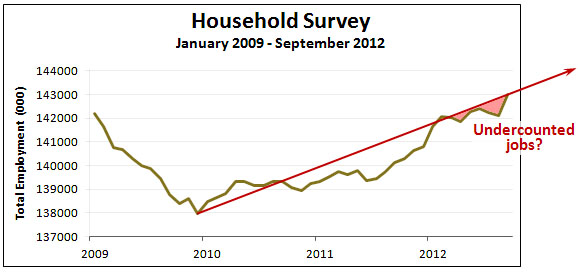
    Or there might be a third option: In a little-noticed part of yesterday’s report, BLS announced that it had systematically undercounted jobs by 386,000 from April 2011 through March 2012. So maybe it’s continued to undercount jobs since then, as Karl Smith suggests here. If so, then not only is the September number accurate, it’s making up for an undercount over the past six months. That’s the shaded portion under the red line in the chart below, which is a simple trend line that runs through the revised March 2012 figure and extends it through September. It suggests that the September employment number is right where you’d expect it to be if the economy were continuing a steady but modest recovery — which seems like a reasonable bet.

    So here’s the irony: If BLS really has been undercounting, it means that the jobs picture has looked overly gloomy during the first half of the year, which is exactly when it hurt President Obama the worst. What this means is that the wingnuts might be more than merely wrong. They might have things 180 degrees backward. It’s quite possible that far from being unfairly favorable toward Obama, the BLS numbers have been unfairly hurting him. September’s spike corrected that, but probably too late to do him very much good.

  • Where it Counts, There’s No Enthusiasm Gap


    Enthusiasm gap? What enthusiasm gap?

    President Obama’s campaign and Democratic allies raised a record $181 million in September, his campaign manager said today….The Obama campaign manager said the average donation was $53, with 98% of the contributions at $250 or less.

    In the end, I wonder if the Republican focus on Super PACs will end up hurting them? Team Blue might be raising a bit less money overall than Team Red, but the Obama campaign is raising more than the Romney campaign. If you’re Karl Rove, I suppose you might argue that Super PACs have more freedom to launch nasty (but effective) attack ads than the campaigns themselves, so it’s a good thing that a big chunk of conservative money is going to Crossroads GPS and their ilk. If you’re Jim Messina, you’ll probably argue that, in the end, it’s better to have most of your money under central control, where you can use it precisely the way you need to.

    I have no idea which is the better argument. Either way, though, Obama certainly doesn’t seem to be having any big problem raising money from the folks who supported him in 2008. I continue to think that Mitt Romney lost a real chance to eat into that support when he decided last spring that he had to continue placating the tea partiers instead of immediately moving to the center.
