

• Another Conservative Conspiracy Theory Bites the Dust

    <a href="http://www.shutterstock.com">Micha Klootwijk </a>/Shutterstock

    This week the modern conservative id took center stage when Mitt Romney was caught on video telling a bunch of wealthy donors what they wanted to hear: that the poor are a bunch of lazy parasites who refuse to take personal responsibility for themselves. Coincidentally, the same week another bit of the conservative id reached the end of its road. I’m talking about their obsession with Fast and Furious, the gun-walking operation in Arizona that Republicans have been in a lather about for the past two years.

    There’s not much question that Fast and Furious was a cockup. ATF agents wanted to track guns that were being sold to Mexican drug cartels, but poor planning, idiotic infighting, and a tangle of laws that got in the way of arresting obvious gunrunners produced little but chaos. Thousands of guns ended up in Mexican hands, one of which was eventually used to kill ATF agent Brian Terry. Katherine Eban wrote the best take on the whole sorry affair three months ago in a long piece for Fortune called “The truth about the Fast and Furious scandal.”

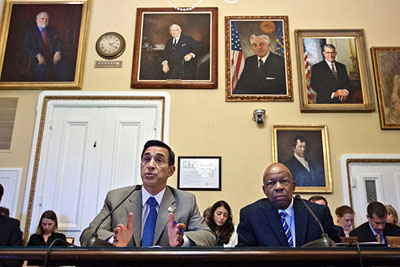
    But this was never enough for Republicans. Rep. Darrell Issa, the Republican attack dog who was the point man for congressional hearings into the affair, insisted that Barack Obama was using Fast and Furious to “somehow take away or limit people’s Second Amendment rights.” This was pretty much the party line in the fever swamps of the right: It wasn’t just a local mess, it was a carefully planned operation from Eric Holder on down to set the stage for a massive new effort to take away people’s guns. As Ann Coulter explained things, Fast and Furious put guns in the hands of Mexican drug cartels “to strengthen liberals’ argument for gun control…Innocent people dying was the objective of Fast and Furious, not collateral damage.”

    On Wednesday that all came crashing down when Michael Horowitz, the Department of Justice inspector general, finally released his lengthy report on the operation. Horowitz is no Democratic hack. As Time’s Massimo Calabresi reminds us, “Horowitz managed to impress the House GOP in briefings over the past week, and the report itself was met with support from all quarters…Issa himself called Horowitz and his report ‘courageous.'” But there’s more:
    What none on the right are admitting is that Horowitz’s report systematically reveals how irresponsible and speculative the accusations from their side have been. The report criticizes Holder’s Criminal Division chief Lanny Breuer for failing to inform Holder or his deputy that “gun walking” had taken place in the Bush administration in another case in Arizona called “Wide Receiver.” But the report shows that Breuer knew nothing about gun walking in Fast and Furious, and that therefore the scandal existed three levels below Holder (let alone the White House)…As for the source of the false statements to Congress, Horowitz finds they were the result of inaccurate reassurances given to Breuer’s deputy Jason Weinstein, by the U.S. attorney in Arizona, Dennis Burke. 

    …Horowitz destroys the conspiracy theories on both sides of the aisle over 471-pages, but it’s the right wing screamers who come out looking worst. Horowitz shows definitively that the Arizona ATF agents and prosecutors in the U.S. Attorney’s office there were responsible for the operation, not the White House or the Justice Department in Washington and that the primary source of the inaccurate testimony given to Congress was the U.S. Attorney for Arizona, Dennis Burke.

    For over a year, it’s been an article of faith on the right that Fast and Furious was a carefully constructed scheme directed by the White House to trash the Second Amendment and build support for more gun control laws. It wasn’t. Neither the White House nor Eric Holder had any idea what was going on. It was just a local operation that was badly botched. This makes Fast and Furious offically yet another lunatic conservative conspiracy theory that has bitten the dust in the cold light of reality.
  • Mitt Romney: The GOP’s Very Best

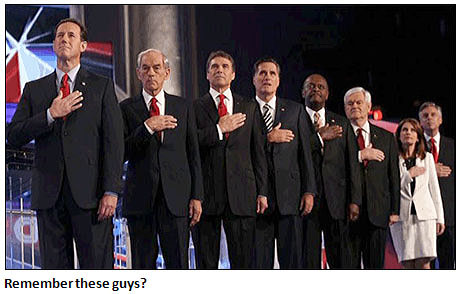
    I would like to take this chance to remind everyone that earlier this year Mitt Romney was pretty unanimously considered the strongest candidate in the Republican field — by a large margin. He was, without much question, the most electable of the primary bunch and the toughest opponent for Barack Obama. He was disciplined, well-funded, and had a moderate background that appealed to independents. He was, in short, the very best the Republicans had to offer in the year 2012.
    This was not a fantasy, either. It was an accurate assessment. Romney was the best they had. The very best.

    Let that sink in for a bit.

  • Be More Cynical!


    Keying off Mitt Romney’s complaint that 47% of Americans pay no federal income tax, David Gregory asked Tim Kaine today whether everyone in Virginia should pay at least something. Kaine, for some unfathomable reason, didn’t respond that he’s not in favor of raising taxes on the middle class, full stop. Instead, he said:

    I would be open to a proposal that would have some minimum tax level for everyone.

    Why would he say that? Dave Weigel, after noting that Kaine is trying hard to portray himself as a pragmatist after his stint as chair of the DNC, takes a stab at explaining what happened:

    So: David Gregory asks the tax question again and again. Kaine’s been programmed to never rule out anything bipartisan. He gives his dumb answer. But I don’t think the dumb answer appreciates how cynical you need to be to win elections in 2012. Look: The House and Senate passed mandatory defense and discretionary spending cuts because Republicans demanded them in exchange for a debt limit hike. A year later, the existence of these cuts are being used against Democrats.

    It doesn’t matter if Republicans are talking up the need to decrease the number of lucky duckies. Be more cynical! Telling a skeptic that the “47%” don’t need to pay income taxes may sound partisan, but it’s one of the party’s winningest stances.

    This is probably sound advice, politically speaking. Stick to the script. Don’t feel like you have to respond to momentary uproars. Don’t worry if you sound like a hack. Just smile and repeat your talking points. It’s maddening for all of us who write about politics, but it seems to be the path to victory.

  • Why I Remain Skeptical That Democrats Will Take Back the House

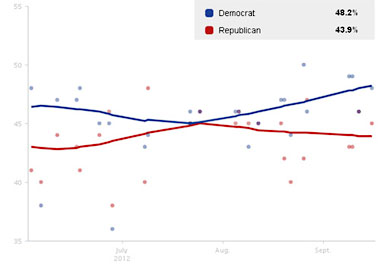
    The chart on the right shows the current state of polling for the generic congressional ballot. By “generic,” we’re talking about polling questions that don’t ask about specific candidates, but just ask which party you plan to vote for. For example: “If the election for the U.S. House of Representatives in November were being held today, would you vote for the Democratic candidate or the Republican candidate in your congressional district?”

    At of today, Democrats lead the generic ballot by a little over four points. My initial reaction when I saw this was a shrug. My longtime understanding is that Democrats almost always do well in these polls, but on election day Republicans typically outperform the generic ballot by four or five points. So this result suggests that Republicans might lose some House seats but retain their majority.

    That’s why I’m skeptical of Sam Wang’s most recent projection that Democrats have a 74% chance of retaking control of the House. In a post that’s gotten a lot of attention today, Sam basically says two things:

    1. The generic ballot predicts the eventual national House vote.
    2. The national House vote predicts the margin of House seats.

    I’m sold on #2: the national vote really does correspond pretty closely to the actual number of seats won. But I’m not sold on #1 unless I see more evidence. It’s possible that my rule of thumb (Republicans outperform the generic ballot by four or five points) is only true for early polling, and by September that systematic edge goes away. Or maybe it goes away once the pollsters start consistently applying their likely voter screens. Or something. But one way or another, I’d like to see some evidence that generic ballots do a good job of predicting the eventual House vote. Until then, I remain skeptical that Democrats are really in the lead.

  • Cell Phones: Maybe It’s Just Me


    Oddly enough, a lot of commenters on my previous cell phone post seem to think I’m bashing young people, or that I don’t understand that portability is the reason people like cell phones, or that there are now lots of other communications options that make voice calls less necessary than in the past. But there was no bashing of the younger generation in that post, portability is pretty obvious, and I myself am a big user of email, Twitter, blogging, and so forth. (Though not texting much. I am that much of an old fogey.) So believe it or not, I already knew all that stuff!

    However, another reader just flatly takes issue with my contention that the audio quality of cell phones is lousy:

    Your comments on wireless voice quality are…inexplicable to me. I got rid of my landline as a redundant expense six or seven years ago and have never once regretted it. My experience with wireless voice quality is very different from yours — even with some fairly significant hearing loss, I find my ability to hear and understand other people is much greater on the cell phone than it ever was on the POTS. And for the last few years, using a stereo bluetooth headset the quality is amazing, you can hear a whisper as the active noise cancellation cuts out the background clutter. I do use GChat for a lot of my more “recreational” calls, but that’s because it’s completely free and the option to just kind of slouch in front of a tabletop microphone and a pair of stereo speakers is irresistible. But I would only use the wireless for important/business calls.

    Part of it might be my carrier — Verizon has always kind of owned Silicon Valley — I became a customer in ’93 when they were still GTE Mobilnet — and the coverage and capacity at least SEEMS unlimited….

    This is more interesting to me. I happen to use Verizon too (on an iPhone these days), though the people I talk to are on a variety of different carriers. But I still don’t much like talking on my cell phone, and even when I’m on a landline I usually find it pretty frustrating to talk to other people who are on cell phones. This is true even under good conditions. Under not-so-good conditions, which is pretty common, it’s even worse. But maybe this is just me. I’ve always had an unusually hard time following conversations when there’s a lot of ambient noise (just turning on the bathroom faucet makes it hard for me to hear the TV), so maybe I’m ultra-sensitive to this. I guess that most of you don’t really have any problem with the overall voice quality on cell phones. Yes? No?

  • Chart of the Day: One-Third of Americans No Longer Have Decent Phone Service

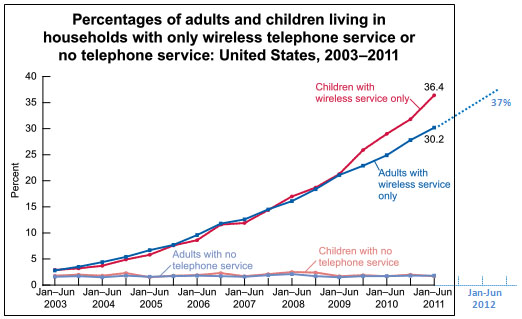
    Via Nate Silver, who’s making a point about political polling, I came across the CDC’s latest estimate of the number of homes that rely solely on wireless phones. There’s no real surprise here, it’s just that I haven’t been paying attention to this for the past several years. So my vague memory is that about 20% of homes have no landline phones, but that number has continued to rise and is now just a bit under 40%. The chart below, with my own extrapolation to September 2012, shows the trend.

    I’ve now owned a cell phone for 14 years, and I have yet to hold a conversation with either party on a cell phone that didn’t suck. The sound quality is bad, the delay is bad, the voice activation that continually cuts off tiny bits of conversation is bad, and the general level of background static is bad. And that’s on basically solid connections. When you’re on a weak connection, you might as well be talking on tin cans. It doesn’t surprise me in the least that young people, who have grown up with this, don’t like to talk on phones much. I hate talking to people on cell phones too.

  • Ben Bernanke’s Great Inflation Coverup

    This is what Ben Bernanke is up against:

    Federal Reserve Bank of Dallas President Richard Fisher said the central bank’s third round of bond purchases will probably fail to create jobs while risking higher inflation. “I do not see an overall argument for letting inflation rise to levels where we might scare the market,” Fisher said yesterday.

    ….“A sustained increase” in inflation expectations “would suggest incipient doubts about our commitment to the Bernanke doctrine of sailing on a course consistent with 2 percent long- term inflation,” Fisher said in a speech in New York.

    Bernanke’s problem is pretty simple here: he almost certainly wants higher inflation, but he can’t say he wants higher inflation. He simply doesn’t have enough support for inflation tolerance among his Fed colleagues.

    Nonetheless, higher inflation would be good. The simplest way to see this is to look at interest rates. Once the Fed has reduced interest rates to zero, it can’t go any further. But what if the economy is so bad that all the standard models suggest you need negative interest rates to get the economy back on track? The only answer is higher inflation. If inflation is running at 2% and interest rates are at zero, the real interest rate is -2%. If you borrow money, you’re effectively being allowed to pay back less than you borrowed, which provides a big incentive to buy a house or expand your business.

    But if even that’s not enough, then how about inflation of 4%? As long as you promise to keep interest rates at zero, the real interest rate is now -4%. The Fed is making it almost irresistable to take out a loan and buy new stuff. And there’s a virtuous circle here: businesses understand that negative borrowing rates stimulate consumption and demand, so not only is it super cheap to expand production, but they have good reason to think it will pay off as demand increases in the future.

    But this all depends on tolerating higher inflation for a while, and inflation is a major hot button in American politics, as guys like Fisher demonstrate. So Bernanke has to pretend that he’s still dedicated to 2% inflation even though he’s probably not. This is unfortunate, since it blunts the power of his policies. If he could come right out and make it clear exactly what he’s doing and how long he plans to keep it up, it could have a big impact. But he can’t, and so his policy loses about half its power. All because inflation is such a boogeyman. This is the price we pay for our mindless fears.

  • Barack Obama’s Radical Socialist Pop Business Bafflegab


    I don’t really blame Republicans for desperately trying to change the subject after the release of the secret Romney fundraising video, but it cracks me up that they’re trying to make hay out of this 1998 statement from Obama:

    I think the trick is figuring out how do we structure government systems that pool resources and hence facilitate some redistribution because I actually believe in redistribution, at least at a certain level to make sure that everybody’s got a shot. How do we pool resources at the same time as we decentralize delivery systems in ways that both foster competition, can work in the marketplace, and can foster innovation at the local level and can be tailored to particular communities.

    It’s not just that this is 14 years old. It’s not just that Obama extols competition, the marketplace, and innovation. It’s the fact that this is basically buzzword central. I mean, this is a guy who’s obviously trying to make it sound like he has some kind of actual governing philosophy, and tossing in every piece of MBA-speak he can think of to hide the fact that he’s saying nothing. If he had immediately followed this up with a reading of “Jabberwocky” I wouldn’t have been surprised.

    And this is supposed to be the evidence that Obama is some kind of radical socialist who hates the free market? Sure. In reality, it’s evidence that he was spending a little too much time back then in the pop business aisle at Barnes & Noble.

  • Breaking: You Should Always Tell Your Employer That You’re an Honest Person


    The Wall Street Journal reports that more and more companies are turning to software to make hiring decisions for them, rather than using human interviewers:

    It isn’t just big companies that are turning to software for hiring help. Richfield Management LLC, a Flint, Mich., waste-disposal firm that employs 200 garbage collectors, was looking for ways to screen out applicants who were likely to get hurt and abuse workers’ compensation.

    About a year and a half ago, Richfield turned to an online test developed by a small firm called Exemplar Research Group. It asks applicants to pick between statements like “When I’m working for a company I take pride in making it as profitable as possible” and “I’m only concerned with how well I can do financially in my job,” then rate how strongly they agree or disagree.

    The goal is to gauge an applicant’s emotional stability, work ethic and attitude toward drug and alcohol. Those who score poorly are considered high disability risks. Richfield said its workers’ comp claims have fallen 68% since it has used the test.

    Honestly, this just seems like an IQ test to me. Do I take pride in making my company as profitable as possible? Yes sir, I sure do! Do I consider myself a clock watcher? No sir, I sure don’t! If you can’t figure out that these are the right answers, you might not be bright enough even to be a garbage collector.

    Of course, these tests might be trickier than I think. Retail outlets ask questions that test for honesty, and according to one retailer who uses software to screen new clerks, “People who are trying to fool the system are going to get tripped up.” Maybe so.

    On a more policy-centric note, if this kind of thing becomes genuinely widespread, I wonder if it will create a new class of the permanently jobless. It’s a law of nature that there will always be a certain number of people who just don’t have good temperaments. Still, even if you’re basically a lousy worker — unreliable, quick-tempered, etc. — you can still find jobs here and there since human interviewers won’t always figure this out. But if screening software becomes hard to beat (especially among those who aren’t too bright), then lousy workers will simply never be able to find jobs. They’ll be turned down every time. So then what happens?

  • Republicans and the 47 Percent: A Case Study

    Mitt Romney’s complaint that lots of people pay no federal income tax has become a familiar conservative lament over the past few years. But how did this become such a staple of tea party conservatism? Here’s a case study that gives us a clue.

    The main target of Republican ire on the zero-tax front isn’t the elderly or the temporarily unemployed. It’s poor people. And one of the reasons that so many poor people pay no income tax is the Earned Income Tax Credit, which can reduce your tax bill to zero or less. To qualify, though, you need a minimum income (i.e., you need to have a job), which makes the EITC an incentive to work—and this is why it’s an anti-poverty program that Republicans used to support. Reihan Salam tries to figure out why they don’t anymore:

    A more parsimonious explanation is that cohort replacement and a lack of a sense of history is doing all of the work: many of today’s Republicans are unacquainted with the case for the EITC and the child tax credit and the exclusion of Social Security benefits, or they fail to connect these initiatives to the narrowing of the tax base. This isn’t a sinister plot.

    Maybe. But let’s do a quick history review first. Back in the ’60s there was a groundswell of support for a negative income tax, a concept that held some appeal as a simple mechanism that could replace the complex alphabet soup of existing New Deal and Great Society anti-poverty programs. But Mr. Great Society himself, Lyndon Johnson, objected to it because it doled out money even if you weren’t working. (FDR probably would have opposed it for the same reason.) Republicans agreed that it undermined incentives to work, and the NIT died.

    However, after several years of political haggling, Sen. Russell Long (D-La.) won passage of the EITC in 1975. Because it was available only to those with earned income, it provided a positive incentive to work and enjoyed bipartisan support. It was made permanent in 1978, again with bipartisan support.

    But then things changed. EITC was expanded in 1986 with support from Ronald Reagan but with far less support from congressional Republicans, most of whom fought the expansion. Another expansion in 1990 enjoyed even less Republican support, and in 1993, when Bill Clinton included a further expansion of EITC in his budget bill, it passed with no Republican votes at all. It was at this point that the EITC became associated exclusively with Democrats, and after the Gingrich revolution of 1994 the EITC became a frequent target of attacks from the GOP. House Republicans pushed for major cuts, and Clinton eventually managed to buy them off only by setting up a special $100 million IRS fraud unit targeted specifically at the working poor.

    Roughly speaking, then, Republican support for the EITC has steadily declined since the mid-’80s, and the majority of the party has been actively opposed to it since the mid-’90s. So I don’t think you can really blame the current antipathy toward EITC on the historical ignorance of modern Republicans. This all started 30 years ago, when Republicans were still keenly aware of both the program’s origins and its conservative policy underpinnings. They just decided they didn’t like the idea of giving money to poor people anymore. Now they’ve gone even further, and Mitt Romney’s echo of his wealthy donors’ disdain for the nontaxpaying poor is merely the next step along a logical path. Here’s the path:

    1975-1985: Support for work-oriented anti-poverty programs like the EITC

    1985-1995: Mixed emotions toward EITC

    1995-2005: Opposed to EITC

    2005-present: Not just opposed to EITC, but actively in favor of making the poor start paying income taxes

    The EITC hasn’t been a bipartisan program for a long time, and its current sorry state within the GOP isn’t just due to youngsters who have forgotten their party’s past. As the EITC’s history demonstrates, for the past several decades the core of the Republican Party has simply become steadily more hostile toward the working poor. They’re no longer fellow citizens who deserve some help as long as they’re willing to work, they’re parasites who are mooching off the sweat of the productive classes. You can decide for yourself if this is sinister or not.
