• #RomneyStrength: The Birth of a Meme


    Here’s how Twitter memes are born. First, one of Mitt Romney’s advisors said this to the Washington Post:

    “There’s a pretty compelling story that if you had a President Romney, you’d be in a different situation,” Richard Williamson, a top Romney foreign policy adviser, said in an interview….“In Egypt and Libya and Yemen, again demonstrations — the respect for America has gone down, there’s not a sense of American resolve and we can’t even protect sovereign American property.”

    A few hours later, Benjy Sarlin of TPM gave the quote this gloss:

    A top foreign policy aide to Mitt Romney suggested Thursday that the deadly attack on the U.S. consulate in Libya that killed Ambassador Christopher Stevens would never have happened if Romney were president. There wouldn’t even be anti-American protests in the Middle East if Romney were in charge, the aide said.

    Josh Marshall then tweeted a promo for Sarlin’s piece:

    Romney Adviser: If Romney were prez no one wld attack r embassies because of Romney strength.

    And thus was born the #RomneyStrength hashtag. A few examples:

    @MlTTR0MNEY: A cop pulled me over once. I let him off with a warning. #Romneystrength

    @UOJim: Mitt Romney once pulled Corey Booker out of a burning building. #RomneyStrength

    @buckaroo1260: He swam the Delaware ahead of Washington to clear the way. #Romneystrength

    @radiobobkansas: Lance Armstrong had all those titles taken away because he was caught using #Romneystrength

    @Clarknt67: Mitt has fired more people than @realDonaldTrump. #RomneyStrength

    @erinscafe: Built his tax shelters with his bare hands. #Romneystrength

    @AzureGhost: Can lose his head when all about him are keeping theirs. #Romneystrength

    @JoshuaGreen: woulda freed Willie in the first five minutes of the movie. #Romneystrength

    So there you have it. Blink and you’d miss it. By Friday it will probably be completely forgotten by all but a few diehard Twitter junkies.

  • Why “Innocence of Muslims” Doesn’t Really Matter Very Much


    An awful lot of press attention has been focused on “Innocence of Muslims,” the anti-Islamic film at the center of this week’s turmoil in the Middle East. In the latest twist in the story, Google, which owns YouTube, has blocked access to the video in both Egypt and Libya.

    But there are a couple of good reasons that we probably shouldn’t get too consumed by the video itself or the backstory behind its creators. Shadi Hamid provides the first reason:

    The anti-Islam film in question was a pretext much more than the cause of yesterday’s violence. It could have been anything. Anti-American anger, even in Libya, the most pro-American country in the Arab world, remains palpable, lingering underneath the surface of apparent gratitude. But, that aside, even if the United States did everything on Arabs’ wish lists, there would remain a small, influential fringe that would find another reason to hate — or at least dislike and distrust — the United States.

    The extremist groups who are behind the kind of violence we saw this week will always be able to find some pretext for their actions, and the exact nature of the pretext is no more important than the exact nature of a lightning strike that starts a forest fire. As long as there’s enough dry tinder around, you’ll get a fire eventually. Likewise, it’s the underlying hatred of the United States that provides the real fuel for anti-American violence in the Middle East, and the reason for that hatred is much more about past and present American policies than it is about some shoddily-produced YouTube video. In that sense, getting hung up on the video just distracts us from the real — and much more difficult — issues at hand.

    Robert Wright provides us with the second reason, which is even more compelling: even as a pretext, the video probably wasn’t the inspiration for the violence anyway.

    Here is what now seems to be the case: the anti-Islam film wasn’t made by an Israeli-American, wasn’t funded by Jews, and probably had nothing to do with the American deaths [in Libya], which seem to have resulted from a long-planned attack by a specific terrorist group, not spontaneous mob violence.

    ….And there may be one more misconception: the idea that the Egyptian protests were originally spontaneous. El Amrani reports that “the initial Egyptian protests were in good part due to a call by a small Salafi group… and timed for the anniversary of the 9/11 attacks.”

    To recap: In Libya, the video probably had nothing at all to do with the attacks. In Egypt, it was probably little more than a convenient way to add some extra energy to a 9/11 protest that had been planned long before. This had the intended effect, of course, and now the video really is at the center of the ongoing protests. But it’s still just a pretext. In and of itself, it’s probably not worth all the ink that’s been spilled on it.

  • Here’s What Big Money Buys You in the 2012 Presidential Campaign

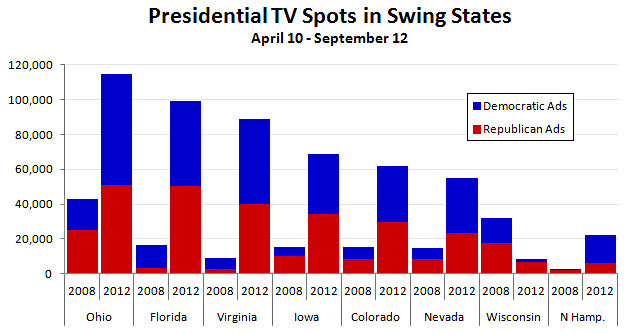
    Via Andrew Sullivan, the chart below compares TV ad buys for the presidential contests of 2008 and 2012. The raw data comes from Kantar Media’s Campaign Media Analysis Group, as reported by Elizabeth Wilner of Advertising Age. The big takeaway is that 2012 spending in battleground states is running at about three times its 2008 level. Based on past patterns, Wilner figures this means that the two campaigns will be airing about 43,000 ads per day for the rest of the election cycle.

    And that’s just presidential ads. It doesn’t count Senate races, congressional races, ballot measures, or state races. This is just Obama vs. Romney.

    The other big takeaway is the difference in strategy between the two campaigns. Up to now, their ad buys have been about even. But that’s going to change as the Romney campaign — aided by oceans of outside money — ramps up its spending:

    The Obama campaign has seen this contest as a seven-month run, while the Romney campaign has seen it as a three-month sprint. Team O. has bet a few hundred million advertising dollars on winning by undercutting Romney’s candidacy before the airwaves become completely saturated and September and October ads start reaping diminishing returns.

    ….The Romney campaign is betting on total saturation this fall to persuade voters that the country can’t afford another four years with Obama in charge of the economy….As we enter this eight-week ad whiteout, whichever campaign has made the right bet will win the presidency.

    Fasten your seat belts. Especially if you live in Ohio.

  • Living With the Muslim Brotherhood


    David Frum says you don’t need to toss around slanders about how the president “sympathizes” with the killers of Americans in order to criticize Barack Obama’s approach to Islamism in the Middle East. Instead, there’s a perfectly legitimate critique to be made:

    Obama’s Foolish Embrace of Egypt’s Muslim Brotherhood

    The Obama administration has staked its foreign policy on the assumption that the best way to deal with radical Islam is by engaging with radical Islam, thus splitting the men of violence from the men willing to try politics.

    By this theory, the problem with radical Islam was its method (terrorism), not its goals (establishing Muslim Brotherhood style governments).

    Some in the Obama orbit hoped that the entry into government would modulate and moderate Islamist goals. Others believed that even if the Islamists did not moderate, it was still preferable to live with them than to do what was necessary to resist them.

    My friend Dean Godson of the British think tank Policy Exchange has a fascinating lecture — it would make a brilliant book — about how this approach derives from the British experience in Northern Ireland. Under Tony Blair, the British government had followed a double Irish policy: a more effective approach to kill or capture IRA terrorists — combined with vigorous negotiations that offered IRA leaders willing to abjure violence the very role in government they had been fighting to seize.

    If you notice a similarity to the Obama policy in Afghanistan, it’s not a coincidence.

    Unfortunately, that’s all Frum has to say. So here’s my question: if you think this is the wrong approach, then just what do you think Obama should have done instead in Egypt? What leverage did he have to keep Hosni Mubarak in power? Or, if you agree that Mubarak was a lost cause and nothing could have stopped the tide of democracy, what leverage did he have to keep the Muslim Brotherhood out of power?

    Nobody thinks that military force was an option. Nobody (I hope) believes we still live in an era when the CIA could quietly engineer a friendly election result. There’s always money, of course: we could have threatened to cut off aid to Egypt if the Brotherhood took power. At a guess, though, that would have helped the Brotherhood, not hurt them — and would have had about the same effect as hanging out a huge neon sign announcing that America believes in democracy only when we approve of the election results. That probably wouldn’t help our cause any in the Middle East.

    Conservatives too often assume that American power can accomplish anything we set our minds to. But it’s not so. Sometimes there just aren’t any good options, and the best path forward is to ride out the storm and refrain from doing anything foolish. It’s not very satisfying at a gut level, but nine times out of ten it’s the best you can do.

    Frum may disagree, but if he does I’d sure like to hear his side of the argument. What exactly is the more tough-minded policy that he thinks would have produced a better result?

  • The Fed Finally Takes Action, But Is It Enough?

    Triff/<a href="http://www.shutterstock.com/cat.mhtml?lang=en&search_source=search_form&version=llv1&anyorall=all&safesearch=1&searchterm=rain+money&search_group=#id=83651230&src=b757ccdf721b4548ea5fad954b47b03d-1-64">Shutterstock</a>

    Today the Fed braved Republican wrath and announced a new program of monetary easing. The previous one was QE2, so this one is QE3. It has two components:

    • An announcement to buy $85 billion in mortgage-backed securities per month through the end of the year, and $40 billion per month after that for as long as it takes to get the economy back on track.
    • A statement that it plans to keep interest rates low through 2015, about six months longer than it’s previously promised.

    The vote was nearly unanimous, with only Richmond Fed president Jeffrey Lacker, as usual, voting against. Here’s the Fed’s justification:

    The Committee is concerned that, without further policy accommodation, economic growth might not be strong enough to generate sustained improvement in labor market conditions. Furthermore, strains in global financial markets continue to pose significant downside risks to the economic outlook. The Committee also anticipates that inflation over the medium term likely would run at or below its 2 percent objective.
    In other words, without action they believe the economy will remain weak and inflation will fall below their goal of 2%. Naturally, Republicans were questioning the propriety of Fed action even before it happened. Here’s a piece in The Hill from this morning:

    “It really is interesting that it is happening right now before an election,” said Rep. Raul Labrador (R-Idaho). “It is going to sow some growth in the economy, and the Obama administration is going to claim credit.”

    ….“They are the ones who always say they want to remain independent. So they should consider, just how independent are they when they come out, only 50 days before the election, with this?” said Rep. Scott Garrett (R-N.J.).

    ….Rep. Rob Woodall (R-Ga.) said he does not personally think the Fed is being political, but predicted the public will question its motivations if major actions are announced. Asked if people are going to ascribe political motivations, he said, “Folks are going to interpret it that way.”

    This is pretty crude stuff: these guys are more or less admitting that monetary policy might boost the economy, and they don’t want that to happen before the election.

    They probably shouldn’t worry, though. Monetary action has, in Milton Friedman’s famous phrase, long and variable lags, and it’s unlikely the Fed’s action will have any substantial immediate effect. The most likely impact will probably be in early 2013, so it has as much chance of helping Mitt Romney as it does Barack Obama.

    What’s more important, though, is whether it will help the economy and get people back to work. That’s a question for professional analysts to weigh in on, but one thing we can look at immediately is the sheer size of the Fed’s action. It amounts to about $700 billion over the next 15 months, a fairly modest amount compared to the previous round of easing, QE2, which expended about $600 billion over seven months. On the plus side, it’s an open-ended commitment, not a set amount, and it was accompanied by a promise to keep interest rates low through 2015. This is an effort to affect behavior via the “expectations channel” — the hypothesis, as Paul Krugman explains it, “that QE works, to the extent it does, largely because markets see it as a form of forward guidance.” In other words, QE works best when investors believe the Fed has promised to continue it for a long time, even after the recovery starts to pick up steam.

    Overall, my guess is that QE3 will have some effect, but not that much. It’s not a huge program, and the Fed’s easing programs are probably getting less effective with each round anyway. But it’s a bit of an insurance policy, especially given the very real possibility of irresponsible congressional action when negotiations over the fiscal cliff rev up later this year.

    And on a wonky note, since the actual size of QE3 is fairly modest, it will be an interesting test of the expectations channel theory. If QE3 has a significant effect on the economy despite its small size, it probably means that expectations setting is pretty important. If it doesn’t, it probably means that expectations are overrated. Granted, this will only be a single data point, and one that will be drowned in lots of noise, but it’s still an intriguing experiment.

    I’ll have more later as the pros weigh in.

  • A Blast From the Past: The Media vs. Al Gore

    Paul Krugman writes in passing that reporters who covered the 2000 election “liked Bush and didn’t like Gore, and as a result they treated Bush with kid gloves while gleefully passing on every smear against his opponent.” Andrew Gelman pushes back:

    Far be it from me to question something that was “obviously true to anyone who lived through it”—as a non-T.V. owner, I think it’s safe to say that I did not actually live through the 2000 election campaign—but . . . really??? Even if it’s true that reporters liked Bush and didn’t like Gore (again, I’d like to see the evidence), one thing we do know is that twice as many journalists are Democrats as Republicans.

    Hoo boy. I’ve told Bob Somerby before that I think he obsesses too much over the 2000 election, but I guess someone needs to if the media’s treatment of Gore in the 2000 campaign still isn’t common knowledge. So for those of you who think Krugman was over the top, here are some reading assignments:

    • Robert Parry, writing in real time, on the press corps’ contempt for Gore (“The national news media have repeatedly portrayed the vice president…as a willful liar who may even live in a world of his own delusions”).
    • Evgenia Peretz, seven years later, describing the treatment of Gore by Kit Seelye, Ceci Connolly, and other campaign reporters (“They just wanted to tear Gore apart,” said a major network correspondent).
    • Jonathan Schwartz summarizing the great debate incident (“The media groaned, howled and laughed almost every time Al Gore said something”).

    And for the longer version of all this, there’s Bob’s own “How He Got There” — not a finished product yet, but up to Chapter Six anyway. Read and be amazed.

  • Would Firing More Teachers Improve School Performance?


    Nicholas Kristof thinks the Chicago teachers union is wrong to fight so hard against more stringent teacher evaluations, but he also offers this important observation:

    In fairness, it’s true that the main reason inner-city schools do poorly isn’t teachers’ unions, but poverty. Southern states without strong teachers’ unions have schools at least as lousy as those in union states. The single most important step we could take has nothing to do with unions and everything to do with providing early-childhood education to at-risk kids.

    Not all school districts are unionized, and the balance of the evidence suggests very little difference in student performance between unionized and nonunionized districts. You’re still welcome to approve or disapprove of teachers unions on other grounds, of course, just as you’re welcome to think that we should use the results of standardized tests as a basis for evaluating teachers and firing the bad ones. (This is Kristof’s view.) It’s a fraught subject with evidence that points in both directions, and personally, I’m more skeptical than Kristof. My own read of the evidence is that the value of standardized tests as a way of evaluating teacher performance has enough problems that we should approach it very slowly and methodically. For now, it should probably be no more than a small portion of any evaluation method.

    But even if you’re more gung-ho on standardized tests than I am, you should know that the evidence doesn’t really back up the claim that union-coddled burnout cases are a big contributor to poor student outcomes. They can fire teachers in Georgia a lot more easily than they can in Illinois, but that hasn’t improved their schools any. The stubborn fact is that Georgia kids don’t score any better on national standardized tests than Illinois kids do. 

  • Obama Smear Was a Team Effort, Says Romney Team


    I sort of hate to keep obsessing over Mitt Romney’s ham-handed smear of President Obama following last night’s embassy attacks, but this New York Times story really does advance the narrative. Up until now, I figured there was a pretty simple explanation for the Romney campaign’s cockup: they were rushing to get something out and just fell back on a known script (Obama as apologizer-in-chief) without really vetting their statement. But no. It turns out the whole thing was carefully orchestrated:

    The resulting statement took shape while Mr. Romney and a reduced staff contingent flew from Reno, Nev., to Jacksonville, Fla., from about 5:30 p.m. to 9:30 p.m. on Tuesday, and the statement went out about an hour after he landed and signed off on it. Aides said it was drafted by committee — a team effort by one group of advisers specializing in policy, the communications team and the strategy shop.

    ….Mr. Romney’s criticism fed into his larger theme of painting Mr. Obama as apologizing for the United States, and his team stuck by it. “While there may be differences of opinion regarding issues of timing,” said one senior strategist, who asked not to be named, “I think everyone stands behind the critique of the administration, which we believe has conducted its foreign policy in a feckless manner.”

    This was no late-night, one-person screwup that Romney then felt he had to stand behind. It was a carefully calculated statement drafted by Romney’s entire team and then signed off on by Romney himself. Even with his whole staff beavering away on this, apparently not a single person pointed out that (a) they didn’t have their facts straight, (b) it might be appropriate to wait a little while before scoring cheap political points, and (c) accusing the president of the United States of “sympathizing” with embassy attackers was beyond the pale.

    Alternatively, someone did point this stuff out and got voted down. I’m not sure which is worse.

    UPDATE: In case you’re wondering, this is the same story that Josh Marshall writes about here. A very different version was up on the Times website earlier, and that’s the version that originally prompted this post. The version that’s up now (and quoted above) was so thoroughly altered from the original that initially I didn’t even realize they were different revisions of the same story. I’m not sure what the explanation for this is.

    I’d reproduce the original Times piece below the fold, but I’m pretty sure that would be a copyright violation. Sorry.

  • Mitt Romney Is a Guy Who Doesn’t Know When to Quit

    I’m glad to see that even plenty of Republicans are apparently nauseated by Mitt Romney’s late-night smear of President Obama in response to yesterday’s attacks in Libya and Egypt. From Ben Smith:

    “They were just trying to score a cheap news cycle hit based on the embassy statement and now it’s just completely blown up,” said a very senior Republican foreign policy hand, who called the statement an “utter disaster” and a “Lehman moment” — a parallel to the moment when John McCain, amid the 2008 financial crisis, failed to come across as a steady leader.

    …”It’s bad,” said a former aide to Senator John McCain’s 2008 presidential campaign. “Just on a factual level that the [embassy] statement was not a response [to the attacks] but preceding, or one could make the case precipitating. And just calling it a ‘disgrace’ doesn’t really cut it. Not ready for prime time.”

    A third Republican, a former Bush State Department official, told BuzzFeed, “It wasn’t presidential of Romney to go political immediately—a tragedy of this magnitude should be something the nation collectively grieves before politics enters the conversation.”

    But I think Andrew Sprung hit on what was really so distasteful about the whole episode: its knee-jerk quality.

    You do not have to be expert in anything to assess the merit of Romney’s reaction—or his fitness for the presidency. You need only be a social mammal of the human species.

    In response to everything Obama [does] or says—or, for that matter, anything his primary opponents did or said—Romney’s reaction is so knee-jerk condemnatory, so extravagantly worded, so predictably self-serving that the instinctive response for most listeners or readers not themselves besotted with hatred for the target has got to be, “this guy is faking it.” His condemnations have the rote extravagance of a Soviet communique.

    What we have here is a meme that was born in the fever swamps of the conservative blogosphere—Obama apologized to attackers!—and which the Romney campaign could barely restrain itself from mimicking even while the entire episode was still unfolding. They didn’t care whether it was true (it wasn’t), they didn’t care if it was appropriate, and they didn’t care what effect on actual events it might have. They just jumped at a chance to pretend that Obama had disgraced the country yet again. In Romneyland, everything Obama does is automatically a disgrace, no matter how you have to mangle his words to get there.

    But this time they’ve seriously misjudged things. This was not the time or place for an insta-reaction that was so plainly political, so obviously twisted, so transparently opportunistic, and so obnoxiously over the top. But they just don’t know any other way of running a campaign. This is who they are.