• Walking Out on Congress


    Gregory Koger comments on the fact that most Democrats didn’t actually vote against the Republican contempt resolution aimed at Eric Holder last Thursday. Instead, they simply walked out:

    The nice thing about this tactic is that it is a suitable response to the situation the Democrats found themselves in. The contempt resolution stank of politics (the inquiry was not into the Fast and Furious operation per se, which began during the Bush Administration, but Holder’s response to the scandal), so Democratic opposition was a natural response. However, the National Rifle Association was “scoring” the vote, so a “nay” vote would downgrade Democrats on the NRA’s year-end evaluation. Nonvoting solves both problems: it expresses not just disapproval, but disrespect for the proposal of the majority party and the legitimacy of the proceedings. At the same time, it gives conflicted members some latitude for how they explain their position. And, depending on how the NRA scores nonvoting on this roll call, it may enable them to avoid a downgrade on their annual NRA score.

    I doubt very much that the NRA will cut anyone some slack on this, especially since the abstainers were all Democrats. Nonetheless, I’m surprised minority parties don’t do this more often. Not frequently, mind you: voting records are important for most of them, and they want to have solid evidence that they were on the right side. But on the occasions when it’s appropriate to register some contempt of your own over legislative kabuki, walking out is a pretty good way to do it if you know beforehand that you’re going to be on the losing end anyway.

  • Obama and Romney Are Both Raising Money from Americans Overseas

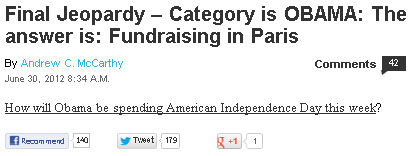
    The post on the right was put up on Saturday morning by Andy McCarthy over at National Review’s group blog, The Corner. It is untrue. As my colleague Tim Murphy reports, Obama will spend the Fourth, his daughter Malia’s birthday, throwing a party on the White House lawn for military families.

    And yet, more than 48 hours later, it’s still up without any correction. At least, no correction that I can see. Surely National Review can at least bring itself to post simple corrections to simple factual errors?

    In any case, if you’re curious about where this comes from, check out Tim’s piece. In a nutshell, both the Obama campaign and the Romney campaign hold fundraisers overseas because lots of Americans live overseas. The Obama campaign is hosting events in Paris and Geneva, while the Romney campaign is hosting events in Hong Kong and London. All kosher, all above board. Nothing to get in a tizzy about.

  • Grandstanding Over Medicaid Begins in Florida, South Carolina


    Following Thursday’s Supreme Court decision, Republican governors in the South are starting to trip all over themselves to see who will be first across the line to turn down the Medicaid expansion that’s part of Obamacare. As it turns out, Florida’s Rick Scott and Louisiana’s Bobby Jindal took the checkered flag. Sarah Kliff assesses the damage:

    The Affordable Care Act would have extended Medicaid to cover everyone who earns less than $14,500, regardless of whether they have children or not. That expansion, to cover higher earners, would have covered 951,622 Floridians, according to a Kaiser Family Foundation report.

    In South Carolina, the expansion was expected to cover 330,932 people. Taken together, that’s 1.2 million people—about 7.5 percent of the 17 million people expected to gain Medicaid coverage—who would no longer have access to the program.

    Needless to say, we should expect a lot more of this. I figure every Republican governor in the South, and at least half of them elsewhere, will do the same thing.

    For now, though, I’m treating this as simply part of campaign season. It’s an easy way of ginning up the base, but it means nothing until 2014 rolls around and the Medicaid provisions of ACA actually kick in. I don’t doubt that some states will continue to hold out, but if Obama wins in November and ACA stays intact, I expect things to cool down over time. Some of the ideologues will stick to their guns, but not all of them. Eventually most will probably take the money.

    Nevertheless, this is a good argument for one of my favorite policy prescriptions: we should federalize Medicaid. There’s never really been any good argument for making it a joint state-federal program, and there are plenty of good arguments for taking this monkey off the backs of state budgets and letting the federal government run the whole thing, just like they do with Medicare. Now, with the Supreme Court imposing new limits on federal authority to manage joint programs, we have yet another argument for federalizing it.

  • Mitch McConnell Demonstrates the “Repeal and Replace” Tap Dance

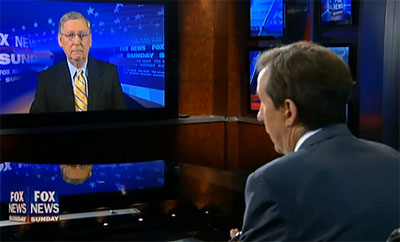
    On Sunday Chris Wallace interviewed Mitch McConnell, the Republican leader in the Senate, and tried manfully to get him to comment on the “replace” part of “repeal and replace.” He didn’t succeed:

    WALLACE: One of the keys to “Obama-care” is that it will extend insurance access to 30 million people who are now uninsured. In your replacement, how would you provide universal coverage?

    MCCONNELL: Well, first, let me say the single the best thing we could do for the American health care system is to get rid of Obamacare….

    WALLACE: But if I may, sir, you’ve talked about repeal and replace. How would you provide universal coverage?

    MCCONNELL: I will get to it in a minute. The first step we need to take is to get rid of what is there….

    WALLACE: But respectfully sir, because we are going to run out of time and I just want to ask, what specifically are you going to do to provide universal coverage to the 30 million people who are uninsured?

    MCCONNELL: That is not the issue….

    WALLACE: You don’t think the 30 million people that were uninsured is an issue?

    MCCONNELL: Let me tell you what we are not going to do….

    I think it’s safe to say that Republicans have exactly zero intention of replacing Obamacare with anything at all except a few miscellaneous gifts to their campaign contributors (state-level regulation for insurance companies, tort reform for the Chamber of Commerce, etc.). The 30 million uninsured will be quickly and completely forgotten, as McConnell’s robotic dedication to GOP talking points showed. How about if we all stop pretending that they were ever serious about this in the first place?

  • Why John Roberts Changed His Mind

    Yesterday’s big story came from Jan Crawford of CBS News, who reports that two separate sources within the Supreme Court confirmed to her what people have been speculating about since Thursday: Chief Justice John Roberts was initially planning to join the court’s conservatives to strike down Obamacare, but then changed his mind. But why?

    Some of the conservatives, such as Justice Clarence Thomas, deliberately avoid news articles on the Court when issues are pending….But Roberts pays attention to media coverage. As Chief Justice, he is keenly aware of his leadership role on the Court, and he also is sensitive to how the Court is perceived by the public.

    There were countless news articles in May warning of damage to the Court — and to Roberts’ reputation — if the Court were to strike down the mandate….It was around this time that it also became clear to the conservative justices that Roberts was, as one put it, “wobbly,” the sources said.

    Hmmm. Maybe. In any case, it sure sounds like Crawford’s sources are a couple of pissed-off conservative justices, doesn’t it? I’d tentatively view this story though that lens, anyway. Then there’s this:

    Some informed observers outside the Court flatly reject the idea that Roberts buckled to liberal pressure, or was stared down by the President. They instead believe that Roberts realized the historical consequences of a ruling striking down the landmark health care law….To strike down the mandate as exceeding the Commerce Clause, the Court would have to craft a new theory, which could have opened it up to criticism that it reached out to declare the President’s health care law unconstitutional. Roberts was willing to draw that line, but in a way that decided future cases, and not the massive health care case.
    This sounds plausible to me — mainly, I admit, because it was precisely what I thought the court should do:

    If they don’t want a rerun of the 1930s, which did a lot of damage to the court’s prestige, but they do want to put firmer limits on Congress’s interstate commerce power, the [justices should] find a limiting principle of their own. But find one that puts Obamacare just barely on the constitutional side of their new principle. This would avoid a firestorm of criticism about the court’s legitimacy — that they’re acting as legislators instead of judges — but it would satisfy their urge to hand down a landmark decision that puts firm limits on further expansion of congressional power. Liberals would be so relieved that Obamacare survived that they’d probably accept the new rules without too much fuss, and conservatives, though disappointed, would be thrilled at the idea that the court had finally set down clear limits on Congress’s interstate commerce power.

    As it happens, that’s pretty much how it went down: Obamacare was upheld, but new limits were placed on Congress’s power. Roberts just wasn’t able to get any of the other conservatives to go along.

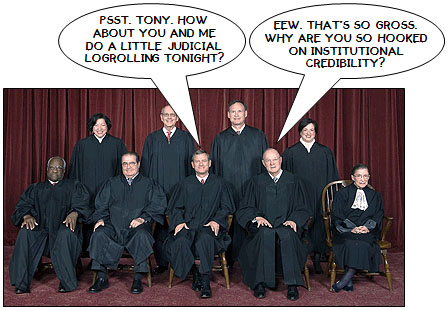
    If I had to guess, the bait for the conservatives was the possibility of getting liberal buy-in for new restrictions on Commerce Clause power. A decision that went 7-2 or 8-1 in favor of some concrete restriction, at the price of letting Obamacare slide in on a technicality, might have seemed appealing. And it’s possible that some of the liberals were willing to go along. But if that was the pitch, apparently none of the conservatives was willing to bite. In fact, the story suggests they’re pretty bitter about the whole thing:

    Roberts [] engaged in his own lobbying effort — trying to persuade at least Justice Kennedy to join his decision so the Court would appear more united in the case. There was a fair amount of give-and-take with Kennedy and other justices, the sources said. One justice, a source said, described it as “arm-twisting.”

    ….The majority decisions were due on June 1, and the dissenters set about writing a response, due on June 15. The sources say they divided up parts of the opinion, with Kennedy and Scalia doing the bulk of the writing….The fact that the joint dissent doesn’t mention Roberts’ majority was not a sign of sloppiness, the sources said, but instead was a signal the conservatives no longer wished to engage in debate with him.

    Will we be hearing more about this? I hope so! Every other agency of government leaks like a sieve, and I don’t know why the Supreme Court should be any different. I want the dirt, and I want it now. Who is going to be the TMZ of Supreme Court gossipmongering?

  • No, Obamacare Isn’t the Biggest Tax Increase in History

    Republicans have eagerly taken to the airwaves to say that the Supreme Court has proven that Democrats are liars. After all, Democrats have long insisted that Obamacare’s penalty for not buying health insurance isn’t a tax, but on Thursday the Supreme Court upheld it on the grounds that it was a tax. J’accuse! Or, as America’s Bard of the Frozen North tweeted, “Obama lies, freedom dies.”

    This is so stupid it hurts. But Josh Marshall says that what comes next is even more brain dead:

    Republicans are now saying it’s the ‘biggest tax increase in history’ — either of America or the universe of whatever. But this is demonstrably false.

    The Congressional Budget Office says the mandate penalty will raise $27 billion between 2012 and 2021. $27 billion over a decade. Anybody who cares to can do the math. But if you want to call it a ‘tax increase’ — which is debatable — it’s clearly one of tiniest ones in history.

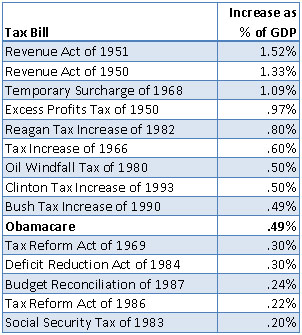
    Let’s be fair: When Republicans talk about ACA’s tax increases, most of them are talking about all the taxes in the bill, not just the penalty. But they’re still off base. There have been 15 tax increases of significant size since 1950, and Jerry Tempalski, a tax analyst in the Treasury Department, has estimated the size of all of them as a percentage of GDP.  Tempalski hasn’t estimated the eventual size of ACA, but PolitiFact took a crack at it using the same methodology, and they figure that ACA amounts to a tax increase of 0.49% of GDP seven years from now. That places it tenth on the list.

    It’s fair for Republicans to complain that ACA includes a bunch of new taxes. It does. Most of them fall on high earners and corporations, not the middle class, but they’re still taxes. However, the “biggest tax increase in history” nonsense is crazy, and no news outlet interested in accuracy should let it pass without challenge.

  • Coming Soon: A Worldwide Drone Shopping Spree

    This is obviously no surprise or anything, but just so you know:

    Despite concerns about U.S.-made drones ending up in enemy hands, American military contractors are lobbying the government to loosen export restrictions and open up foreign markets to the unmanned aircraft that have reshaped modern warfare.

    ….”Export restrictions are hurting this industry in America without making us any safer,” Wesley G. Bush, Northrop’s chief executive, said at a defense conference this year….As the U.S. war effort draws down and the Pentagon budget shrinks, defense companies say they need Congress to ease restrictions so they can tap lucrative foreign markets for their wares.

    More important, they say, the current export restrictions may cause the U.S. to lose potential customers to nations eager to elbow their way into the market. Already, Israel is making drones and selling them to several countries, including Azerbaijan, India and Ecuador. China has more than a dozen drones in development.

    It’s all about the economy, of course. Howard Berman’s liberal 28th congressional district might not be the aerospace hub it used to be, but there’s still plenty of defense business in the Los Angeles area that benefits his constituents. So naturally he’s in favor of increasing the sale of drones overseas. “A very significant part of this economic recovery depends on exports,” he told the LA Times. “We need to take advantage of where our strengths lie.”

    Neither China nor Israel is a party to the Missile Technology Control Regime, which prevents sales of all but the smallest unmanned craft, and they’re selling drones all over the world. Pretty soon, we will be too. We may be pretty happy about our drone superiority at the moment, but it won’t last long. Welcome to the 21st century.

  • The Strategic Value of Being a Punching Bag


    Over at the Washington Monthly, Ryan Cooper is annoyed at the tendency of moderate drug policy reformers to spend time attacking hardcore reformers to their left who want to see full legalization of illicit drugs. In particular, he singles out some of the academics who blog at Reality Based Community:

    These guys have done a lot of great work….But they have a rather foolish tendency to attack the “legalizer” community, efforts which are not only misguided, but self-defeating….The “legalizers,” which are few and powerless, aren’t just a pointless waste of ink and oxygen, they’re actually helping the RBC case by making them seem like the sensible moderates. Kleiman and company should welcome these folks as holding down the flank of the debate, and focus their attacks on Joe Arpiao and the DEA.

    This is a common argument from folks on the extreme left:1 without them, they argue, centrists wouldn’t look like centrists. It’s only the existence of a loud, firebrand flank that makes moderate lefties seem sensible and attractive to the vast mass of non-radical voters. Purely as a strategic necessity, then, moderates should welcome their comrades on the left.

    I don’t really know if this holds water or not. But suppose it does. Doesn’t it imply that centrists have to attack the far lefties? If this is all a bit of play acting, with the far lefties playing the role of scary revolutionary, part of that role is to be attacked. That’s what gives centrists their centrist cred.

    And yet, whenever this happens, the left flank yells about it. There’s nothing wrong with that on its own, but you can’t do it if you’re also making a strategic argument about your value to the center. That is, you can’t (a) claim that you play a strategic role as a punching bag and (b) complain when you get punched. They go together, don’t they?

    1I assume the same thing happens on the right. I’m using the left as an example here because I’m more familiar with it.

  • Friday Cat Blogging – 29 June 2012

    My sister called last night to chatter about the Obamacare decision and to demand extra super good catblogging today. The problem is that this is catblogging we’re talking about, and sometimes the cats cooperate and sometimes they don’t.

    For better or worse, though, this week we have action shots. On the left, Domino is looking rather alarmed, and the reason is that she had just crashed her way through the flowers behind her. When I snapped the shutter she was still shaking the cobwebs out of her face. On the right, Inkblot is taking a sunset hunting stroll through our neighbor’s yard. In a second or two he’ll realize that the brown object he’s staring at isn’t a mouse, it’s a leaf. But life is full of disappointments like that. Both of them are still wondering if the Supreme Court upheld Obamacare’s Freedom From Vet Visits clause yesterday, and I don’t have the heart to tell them that it never made it through the conference report in the first place. They’ll find out soon enough.

  • The Good, the Bad, and the Ugly of our Shiny New Highway Bill


    Brad Plumer runs down the new highway bill for us today, providing both the good news and the bad. The good news is, basically, that we even have a highway bill. The bad news is that the bill’s funding is dumb and mass transit got screwed. Plus this:

    5) Two obscure — but important! — reforms got left out of the final bill. The original Senate transportation bill did two things that may seem minor but were actually quite significant, says Joshua Schank of the Eno Center for Transportation. For one, the bill shifted more money to fixing existing roads rather than building new ones. (Analysts have long argued that it’s more cost-effective to repair the roads we already have, but state and local politicians prefer new projects that come with shiny ribbon-cuttings.) That earlier version also would’ve established a new coordinated policy that linked up freight and ports. But these provisions have been cut from the final bill.

    Hooray for Washington! Lots of money for stuff we don’t really need, not so much for stuff we do. But at least it’s bipartisan. That’s what matters, right?