The Sad Story of Fish Oil and Small Sample Sizes

Get your news from a source that’s not owned and controlled by oligarchs. Sign up for the free Mother Jones Daily.


Keith Humphreys passes along the sad story today of fish oil’s journey from miracle cure to nothingburger. The chart below shows the evolution of research on Omega-3 supplements over the past 17 years, where a small “relative risk” number indicates a beneficial effect and 1.0 indicates no effect at all:
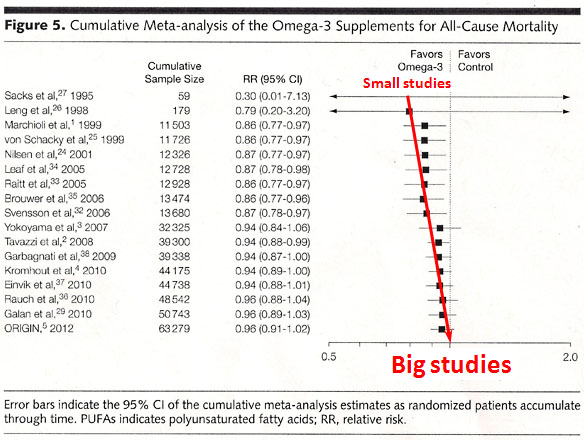
Humphreys explains how this happens:

When there were only a little data available, fish oil looked like manna from heaven. But with new studies and more data, the beneficial effect has shrunk to almost nothing. The current best estimate of relative risk (bottom row of table) is 0.96, barely below 1.0. And the “confidence interval” (the range of numbers in parentheses), which is an indicator of how reliable the current estimate is, actually runs to a value slightly greater than 1.0.

Why does this happen? Small studies do a poor job of reliably estimating the effects of medical interventions. For a small study (such as Sacks’ and Leng’s early work in the top two rows of the table) to get published, it needs to show a big effect — no one is interested in a small study that found nothing. It is likely that many other small studies of fish oil pills were conducted at the same time of Sacks’ and Leng’s, found no benefit and were therefore not published. But by the play of chance, it was only a matter of time before a small study found what looked like a big enough effect to warrant publication in a journal editor’s eyes.

Caveat lector. Don’t believe everything you read, especially if there’s only one study and it has a small sample size. It’s still possible that fish oil has a slight beneficial effect, but it’s unlikely. Spend your money on something else.
What’s independent journalism worth to you?

Our news will always be free to read, watch, and listen to online. But what is its value?

Unbiased reporting on the issues that billionaire-owned newsrooms won’t touch. Fearless research into the dark corners of government and corporations. Ferociously fact-checked news that focuses on the facts, and the facts alone.

It IS free for you and every reader, viewer, and listener to utilize. But it’s not free for our team to make. So, what’s it worth to you? Let us know by making a donation: Make a one-time donation today to support this work. Or make a monthly sustaining donation to help us plan for the future.

Whatever you choose, know that you’re supporting more independent, investigative journalism in a time when we need it most.

What’s independent journalism worth to you?

Our news will always be free to read, watch, and listen to online. But what is its value?

Unbiased reporting on the issues that billionaire-owned newsrooms won’t touch. Fearless research into the dark corners of government and corporations. Ferociously fact-checked news that focuses on the facts, and the facts alone.

It IS free for you and every reader, viewer, and listener to utilize. But it’s not free for our team to make. So, what’s it worth to you? Let us know by making a donation: Make a one-time donation today to support this work. Or make a monthly sustaining donation to help us plan for the future.

Whatever you choose, know that you’re supporting more independent, investigative journalism in a time when we need it most.

We Recommend

Latest

Sign up for our free newsletter

Subscribe to the Mother Jones Daily to have our top stories delivered directly to your inbox.

Get our award-winning magazine

Save big on a full year of investigations, ideas, and insights.

Subscribe

INDEPENDENT. BECAUSE OF YOU.

Mother Jones has no billionaires calling the shots—just readers like you making fearless reporting possible

Donate