• Yesterday Was 400 ppm Day


    Well, we finally did it. We hit a new carbon dioxide milestone yesterday:

    Scientific monitors reported that the gas had reached an average daily level that surpassed 400 parts per million — just an odometer moment in one sense, but also a sobering reminder that decades of efforts to bring human-produced emissions under control are faltering.

    The best available evidence suggests the amount of the gas in the air has not been this high for at least three million years, before humans evolved, and scientists believe the rise portends large changes in the climate and the level of the sea.

    This is from NOAA. The reading from the Scripps instruments for yesterday was 399.73 because they use local time, not Greenwich time. This gives them a slightly different 24-hour window that defines a “day.”

    But not to worry. They’ll hit 400 soon too. And by next year, pretty much every day will be above 400. Congratulations, homo sapiens!

  • Chart of the Day: Student Loan Debt Crowding Out Mortgages


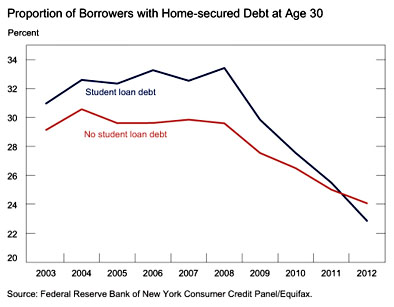
    A new report from the New York Fed describes a disturbing trend: student loan debt has increased so much that it’s crowding out the ability of college graduates to buy homes. As the chart on the right shows, young workers with student loan debt—most of whom are college grads—used to take on mortgage debt at a higher rate than the rest of the population. This made sense, since they generally had higher incomes and better career prospects.

    But that’s been changing over the past few years. In 2012, for the first time, those without student loan debt actually took out mortgages at a higher rate than those with student loan debt. Annie Lowrey writes about this in the New York Times today:

    “It is a new thing, a big social experiment that we’ve accidentally decided to engage in,” said Kevin Carey, the director of the Education Policy Program at the New America Foundation, a research group based in Washington. “Let’s send a whole class of people out into their professional lives with a negative net worth. Not starting at zero, but starting at a minus that is often measured in the tens of thousands of dollars. Those minus signs have psychological impact, I suspect. They might have a dollars-and-cents impact in what you can afford, too.”

    Obviously there are other things going on here too. The housing crash may have had more of an impact on college grads, who decided to stay out of the market until it hit bottom. They also might have internalized the lessons of high debt levels better.

    But spiraling loan debt probably plays a role too. This is one of those issues that continues to bedevil me, since I think there’s a good case to be made that college is something individuals should pay for. It’s going to reward them with lots of extra income, after all, so why should anyone else help subsidize it?

    But as reasonable as that sounds, it’s self-defeating in the end. Yeah, a college education is a boon for the person getting the education. But it’s even more of a boon for society overall to have a big pool of college-educated workers. And it’s a boon to have college-educated workers who don’t spend the first decade of their working lives in a defensive crouch. This is an accidental experiment that’s gone too far. The problem is, I’m not sure what we should do about it. Returning to the era in which state universities provided good quality, low-cost educations would sure be a start, though.

  • Finally, a Real Scandal for Conservatives to Chew On

    <a href="http://www.shutterstock.com/cat.mhtml?lang=en&search_source=search_form&version=llv1&anyorall=all&safesearch=1&searchterm=IRS&search_group=#id=114011557&src=PNUiDNnHI3FAQHKGcvWOAw-1-6">Stephen VanHorn</a>/Shutterstock


    Hey, guess what? Conservatives now have a real scandal to tout! They’ve been complaining for a while that the IRS singled out tea party groups for audits, and it turns out they were right. Today, the IRS fessed up:

    Organizations were singled out because they included the words “tea party” or “patriot” in their applications for tax-exempt status, said Lois Lerner, who heads the IRS division that oversees tax-exempt groups…”That was wrong. That was absolutely incorrect, it was insensitive and it was inappropriate. That’s not how we go about selecting cases for further review,” Lerner said at a conference sponsored by the American Bar Association.

    “The IRS would like to apologize for that,” she added.

    Lerner said the practice was initiated by low-level workers in Cincinnati and was not motivated by political bias. After her talk, she told The AP that no high level IRS officials knew about the practice. She did not say when they found out. About 75 groups were inappropriately targeted. None had their tax-exempt status revoked, Lerner said.

    In this case, conservatives will undoubtedly demand more information about how this happened, who was involved, and when top officials found out about it. And this time, they’ll be right to.

  • ABC News Reveals Drafts of Benghazi Talking Points


    Do I have to write about the latest on Benghazi? I guess so. In for a penny, in for a pound.

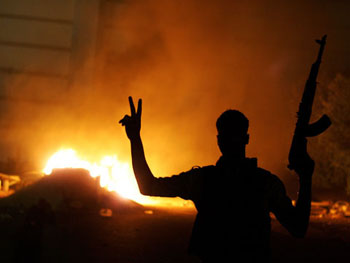
    ABC News now has a complete set of drafts of the infamous “talking points” that were prepared a few days following the Benghazi attacks. The drafts don’t tell us much that we didn’t already know, but here’s a nickel summary:

    • From the very start, the talking points say that the attacks were “spontaneously inspired by the protests at the U.S. Embassy in Cairo” and then “evolved” into the assaults on the two compounds in Benghazi.
    • The first draft included references to “Islamic extremists with ties to al-Qa’ida.” This was eventually sanded down to “extremists” after the State Department pointed out that they had been deliberately withholding this information because “we don’t want to prejudice the investigation.” This is the same thing that David Petraeus told Congress last November.
    • The third draft included an ass-covering paragraph from the CIA making sure everyone knew they had produced “numerous pieces” on possible threats to Benghazi in the previous few months, with the obvious implication that the State Department had ignored them. Unsurprisingly, the State Department’s spokesman, Victoria Nuland, objected to this gratuitous display of bureaucratic point scoring. It was removed in the final draft.

    So….nothing much, really. The third bullet point is the only one that’s even tenuously problematic, and it’s not much more than a disclosure of internal backbiting. In any case, it was ultimately removed at a Deputies Committee meeting on Saturday morning that Nuland didn’t attend.

    I’m really, really trying to find anything scandalous here. I know I’m biased. But on a scale of 1 to 10, this is about a 1.5. It’s a little bit of unseemly bureaucratic squabbling combined with the usual mushiness that you get when an interagency process produces a series of drafts of sensitive information for public consumption. But I’m sure it calls for impeachment hearings to begin anyway.

  • Controlling Medicare Costs is Now Un-American


    Yesterday, John Boehner and Mitch McConnell announced that Republicans would not be naming any members to IPAB, the board empowered by Obamacare with making recommendations for ways to cut the cost of Medicare. Wesley Smith is really, really excited:

    Way to go! The next step is to use Senate confirmation hearings to educate the American people about why the IPAB is un-American and shatters representative democracy. Pound it, pound it, pound it! Then, Republicans and commonsense Democrats in the Senate should refuse to confirm any nominated members to the board, using a filibuster if necessary. After that, defunding and eventual repeal. 

    Really, this is amazing. It’s now un-American for a government agency to be tasked with controlling costs in a government program. Is this because controlling costs is un-American? Because appointed commissions are un-American? Smith doesn’t say. But apparently it’s now conservative dogma that the only patriotic way Medicare costs can be reined in is by voucherizing the program.1 Nothing else is tolerable.

    Of course, as a number of people have pointed out, this move doesn’t prevent IPAB from working. If the Senate doesn’t confirm anyone to the board, it just means that the HHS secretary has to make cost-cutting proposals on her own if Medicare grows faster than allowed. So what’s the point? Pretty obviously, it’s to make sure that if Medicare is cut in any way, Republicans can blame it solely and completely on Democrats.

    Ladies and gentlemen, this is your fiscally responsible Republican Party. Keep all this in mind the next time you hear them yammering on about how critical entitlement reform is and how our spiraling deficits are imperiling the country.

    1This is the gospel according to St. Paul. But it’s worth noting (yet again) that even Paul Ryan has never fessed up about what he’d do if his voucher plan fails to meet his own growth control targets. He’d have to do something, and it’s hard to see how he could avoid something un-American.

  • The Groundbreaking Isaac Newton Invention You’ve Never Heard Of


    I feel the need to write about something that’s as far removed from Benghazi as humanly possible. How about Isaac Newton? As we all know, he invented calculus, the theory of gravity, and Newtonian mechanics, as well as conducting pioneering work in optics. But I’m reading a book called Newton and the Origin of Civilization right now,1 and I’ve learned to my surprise that he invented something else that was similarly groundbreaking. Read on for more.

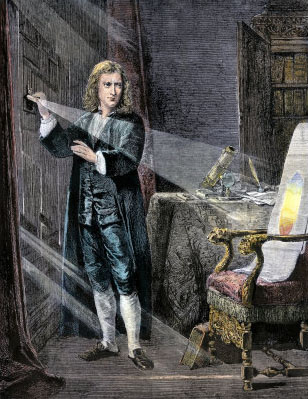
    Observational science was as important in the 17th century as it is today, and Newton has long had a reputation as a master of precise observation. But one way or another, observations of that era all depended on the human eye. Some were unaided, while others depended on instruments, but in the end, their accuracy was still no better than that of the observer, and scientists of the day—very much including Newton—were well aware that human observation was imperfect. The usual way of handling this was to make a series of observations and then pick out the one that seemed most accurate. Newton, however, invented a revolutionary new method in 1671 while he was measuring the differences in the diameters of the rings produced when a spherical lens is pressed against a plate of glass—the phenomenon later termed “Newton’s rings”:
    Newton did something unusual, and even, as Alan Shapiro notes, “almost [we would say entirely] unprecedented in the 17th century”: he averaged all of the differences….None of this reached print….Newton certainly avoided hinting in print that his law of arithmetical progression was adduced by anything other than the most skillful and precise of measurements.

    ….Newton’s “mean”—the average—was the weapon with which he slew the invevitable dragons of sensual errors. It was a most paradoxical weapon for the times, because it amounted to a method by which error seems to be reduced by committing it repeatedly. No such method appears elsewhere at the time, and it would certainly have seemed odd, to say the least, to most practitioners of the period.

    ….We have no contemporary record of the reasoning by which he justified this unusual method….Yet Newton used averages early on; he used them frequently and, it seems, consistently….Why did Molyneux and Flamsteed, a decade or two later, do so as well?….Is there some evidence as to what underpinned the average, decades before statistical notions became widespread?

    Apparently the answer to that last question is no. The authors produce a bit of evidence that Newton thought of the average as akin to measuring a center of gravity, but that’s about it. It appears that Newton never explained himself, but just quietly went ahead with his use of  averages several decades before anyone else. It was the secret behind his famously accurate observations.

    So how about that? Newton invented the now-standard method for reducing noise in measurements, and did it apparently by pure intuition, long before anyone (including Newton) suspected there was a rigorous mathematical basis for doing so. Also—and this is par for the course—he kept it a secret. So chalk up another amazing discovery for old Isaac.

    1Actually, reading might be too strong a word. It’s a long, dense monograph about Newton’s obsession with ancient chronology, which joins alchemy, numerology, and Biblical exegesis among his somewhat less successful endeavors. So I’m sort of dipping into the book here and there, not really giving it a thorough read.

  • The Simple Reason Hedge Fund Billionaires Are Mad at Ben Bernanke


    Matt Yglesias informs me today that there is something called the Sohn Investment Conference, which, according to Reuters, “gets big name hedge fund managers to share their ‘best ideas’ with other wealthy investors.” The hedge fundies, it turns out, are really unhappy with Ben Bernanke’s monetary policy, and Matt provides a fairly philosophical explanation for why this is. I suppose he might be right, but I’m going to take a wild guess that the real reason is much simpler, summarized here by Reuters:

    The Fed’s easy money policy has helped boost riskier assets such as equities, with the S&P 500 up 14 percent this year. Both the S&P and Dow Jones Industrials have set a string of all-time highs.

    In contrast, the average hedge fund is up only 4.4 percent.

    So there you have it. In Ben Bernanke’s America, hedge funds aren’t doing so well. And guess what? Billionaire hedge fund managers aren’t very happy about that. It’s not complicated at all.

    By the way, I love the scare quotes the Reuters reporters put around “best ideas.” I’m guessing they’re a little skeptical that these billionaires are truly sharing anything remotely approaching their best ideas. I would be too.

  • Quote of the Day #2: Paul Ryan Says Obama Never Calls to Chat


    From Rep. Paul Ryan, about a “secret beer” he had last month with White House Chief of Staff Denis McDonough:

    It was the first time I have had a candid conversation or a substantial conversation with a member of the Obama administration since they came into power.

    This time I’ll make exactly the opposite point that I made in the previous post. If this is true,1 it really is a little unsettling. Sure, we all know how Ryan feels, and I doubt that this meeting had even the slightest effect on anything. Still, these guys ought to get together and chat at least a little bit. It’s just part of the job.

    1I’m being cautious because “candid” and “substantial” seem to be doing a lot of heavy lifting here. Is this really the first real conversation Ryan has had with the White House? Or merely the first conversation of a particular kind that he’s had? Hard to say.

  • Quote of the Day: Eric Cantor Says Obama Just Doesn’t Understand Him


    From Eric Cantor, criticizing the fact that President Obama hasn’t done much to develop personal relationships with House leaders:

    The president could benefit himself and the country a lot by developing those relationships and understanding where conservatives are, instead of just thinking that he knows where we are.

    Um….and just what would Obama learn if he did this? I mean, don’t get me wrong. Schmoozing is part of the job, and Obama should probably do more of it, whether he likes it or not. But is Cantor seriously suggesting that his positions, and the positions of the tea-party wing of the party that he leads, are even slightly nebulous? That Obama might learn about some surprising new areas of compromise if he talked to Cantor more? Seriously?

    For more on this, I commend to your attention Ryan Lizza’s account of Cantor’s role in the 2011 debt ceiling fight. Based on Cantor’s own testimony to Lizza, it wasn’t really Obama’s request for more revenue that killed the deal. Regardless of the size of the revenue increase, Cantor just flatly didn’t want to reach an agreement. He didn’t want to give Obama a political win, and figured that a failed deal would hurt Obama enough that Republicans could win the presidency and then write their own bill. Behind the scenes, he persuaded Boehner to go along, and the deal was dead.

    Maybe Cantor is a changed man, and he wants the chance to prove it to Obama. But what are the odds?

  • A (Very) Brief Benghazi Timeline Recap


    I don’t want to spend too much time diving down the Benghazi rabbit hole again—seriously, I think I’d rather have my big toe cut off—but I do think it’s worthwhile to very briefly recap the three basic phases of Benghazi and what questions we have about them:

    The months leading up to the attacks. Should the State Department have approved more security for both the Tripoli embassy and the Benghazi compound? Were they incompetent not to?

    Quite possibly. Certainly, the State Department’s own investigation was scathing on this score (“Systemic failures and leadership and management deficiencies at senior levels…resulted in a Special Mission security posture that was inadequate for Benghazi and grossly inadequate to deal with the attack that took place”). But there was nothing new about this in yesterday’s hearing, and certainly no evidence of cover-up or scandal. At worst, it was misjudgment that reflects badly on State’s security operations. At the same time, it’s worth keeping in mind that hindsight is always 20-20. There were also plenty of legitimate resource constraints, budget shortfalls, and deliberate policy choices that contributed to this.

    The night of the attacks. Was the military response to the Benghazi attacks incompetent and chaotic? That’s possible, but like everyone else, I’ve read through the timelines and the evidence is thin. Republican investigators have continually dug up examples of things they think the military should have done (scrambled F-16s, dispatched FAST teams, etc.) and in every case the military has explained why they made the decisions they did. Gregory Hicks repeated many of these charges yesterday, and he’s obviously angry about what happened that night. But the fact that he’s angry doesn’t make him right. So far, anyway, the military’s explanations have always struck me as pretty reasonable. They certainly sound as though they understand the military realities better than Hicks and the other Monday morning quarterbacks do.

    It’s also worth noting that there was simply no conceivable motive for the military not to respond forcefully to the Benghazi attacks. Maybe there was confusion and maybe there were bad decisions, but nothing more.

    The months after the September 11 attacks. Did the Obama administration try to cover up what really happened in Benghazi? This is the deepest rabbit hole of all, and the conspiracy theories have flown faster and thicker than I can keep track of. But after eight months of throwing mud against the walls, nothing has stuck yet. For several days after September 11, the intelligence community said that the attacks were preceded by protests, and that turned out to be wrong. But it was just wrong, not a cover-up. The intelligence community also believed—and still does—that the attacks were essentially opportunistic, not the results of weeks or months of planning. And Susan Rice, in her Sunday interviews, infamously mentioned the role of the “Innocence of Muslims” video that had sparked the Cairo protests earlier that day, and it’s fair to say that she probably put too much emphasis on that. But only a little. There was, and maybe still is, evidence that the video played a supporting role.

    And of course there are the notorious talking points, which have been subject to a deconstruction effort that would make Jacques Derrida proud. Did the interagency process sand them down a bit too much before the intelligence community released a public version? Perhaps. Were they wrong not to mention the role of Ansar al-Sharia? Perhaps. Should they have been more forthright about calling the attackers “terrorists” rather than just “extremists”? Perhaps.

    But again: At most, this is evidence of misjudgment, not cover-up or scandal. And frankly, there’s not much evidence even of serious misjudgment. Nor any motive for it. The Republican theory has always been that Obama didn’t want to admit terrorist involvement because this would reflect badly on him, but this has never made any sense, either politically or practically. There’s just no there there.

    Finally, we did hear one new thing yesterday: Gregory Hicks’ claim that he was demoted after he spoke with congressional investigators and questioned the State Department’s handling of the crisis. If that happened, it was wrong and Hicks is right to be angry about it. But I’d remain cautious about this. Hicks is pretty obviously bitter, but even with only his side of the story available to us, we have very little solid evidence of mistreatment. Was he asked not to speak to Rep. Jason Chaffetz (R-Utah) without a lawyer present? Probably, but that’s pretty normal. Did he do it anyway? Apparently so, and it’s not clear why. Did he get an irritated phone call about it from Hillary Clinton’s top aide? He says he did, but that wouldn’t be surprising, and we have only Hicks’ characterization of the conversation so far. Was he demoted to a desk job in retaliation? Maybe, or it could be a routine, temporary assignment while his superiors wait for something to open up for him.

    We don’t have the State Department’s side of this because, of course, it’s a personnel matter and they aren’t allowed to talk about it. So I suppose we’ll have to wait on the inevitable leaks. But I’d be very cautious about swallowing Hicks’ story whole. It simply didn’t strike me as wholly credible. But we’ll see.