Here’s what happened at 1:09 pm today when the Associated Press’s Twitter feed was hacked and reported: “Breaking: Two Explosions in the White House and Barack Obama is Injured.” Matt Yglesias sees a moneymaking opportunity.
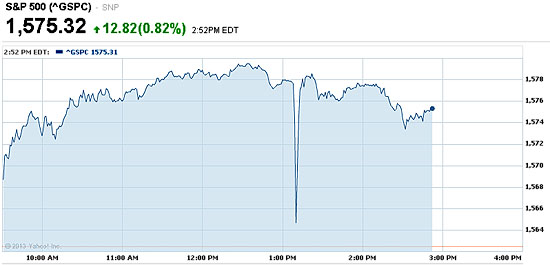

Here’s what happened at 1:09 pm today when the Associated Press’s Twitter feed was hacked and reported: “Breaking: Two Explosions in the White House and Barack Obama is Injured.” Matt Yglesias sees a moneymaking opportunity.
Sen. Lindsey Graham thinks the Boston bombing suspect should be held as an enemy combatant. Dave Weigel isn’t convinced:
The 2001 authorization of force made official a war between the United States and terrorist organizations/state sponsors who could be tied to the 9/11 attacks. Yaser Esam Hamdi was an American citizen caught on the battlefield of Afghanistan, by the Northern Alliance. How do you stretch that case far enough to cover Tsarnaev?
Well, here’s Graham last night on Greta Van Susteren’s show making the case:
GRAHAM: I don’t want to hold him for more than 30 days, but within 30 days he can petition a judge and say, hey, I’m not an enemy combatant….To hold him as an enemy combatant they’d have to prove by a preponderance of the evidence that you’re tied to al-Qaeda, the Taliban, or affiliated groups. Chechnyan
Islamic groups are affiliated with al-Qaeda under our laws.
VAN SUSTEREN: So is it enough that he visited Chechnya for six months for you to conclude that there’s a threshold met that he’s part of a group?
GRAHAM: I think so. If I were president of the United States who makes this decision, I would say, this is clearly a mass terrorist attack. [Runs down evidence against the older Tsarnaev brother] ….All that would allow me as president to say that I want to find out more in the national security legal system, not the criminal justice legal system.
In a statement a few days ago, Graham and a few other senators made the same point he made last night: “any future trial” would be held in a civilian court, but Tsarnaev should be questioned by intelligence analysts in the meantime: “The questioning of an enemy combatant for national security purposes has no limit on time or scope. In a case like this it could take weeks to prepare the questions that are needed to be asked and months before intelligence gathering is completed.”
The emphasis here is a little different than it was on Van Susteren’s show, where she repeatedly mentioned the 30-day limit on questioning. So would Tsarnaev be held for 30 days or would he be held indefinitely? Technically the former, but Graham sure seems to think that indefinitely is a lot more likely, and he’s OK with that.
It’s all moot now, since President Obama has made the decision to keep Tsarnaev in the criminal justice system. As for Graham, he might not want to try Tsarnaev in front of a military commission, but I get the pretty strong impression that he’d be just fine with tossing Tsarnaev in a brig somewhere and keeping him there forever without any trial at all. Adam Serwer has more here.
From White House senior adviser Dan Pfeiffer, explaining why only certain sequestration cuts seem to get the attention of Republican members of Congress:
What do [White House] tours and flight delays have in common? They affect members directly.
Well, that’s true enough. But I imagine that’s not really why they’ve highlighted these things. They’ve highlighted them because they affect middle-class constituents and therefore have a lot of political traction. Most of the other domestic sequestration cuts affect the poor and the working class, and Republicans just don’t care very much about them. The poor and the working class don’t vote much for Republicans, after all.
The most amusing part of all this, I think, are the endless laments that if Obama really wanted to, he could find something else to cut. Republicans can get away with saying this because the federal budget is pretty big, so it seems reasonable that there just has to be someplace to make cuts that wouldn’t cause any pain. Waste and fraud, right? Cut the fat, not the bone. And yet, every time someone actually dives into the numbers, it turns out there really isn’t much choice after all. All that money really is being spent on stuff that matters. “Consulting” sure sounds like something the FAA ought to be able to cut, but only until you find out that the consulting in question is for outsourced telecommunication and weather radar assistance. Can’t cut that!
By all accounts, Marco Rubio seems to be entirely sincere in his desire to pass a comprehensive immigration bill. I had some doubts about that initially, wondering if his support was mostly for show. I thought it was pretty plausible that he’d go along for a while to cement his reputation as a reasonable guy, but then find some convenient excuse to abandon the proceedings, accusing Democrats of refusing to get serious about border security or guest workers or something.
That might still happen. So far, though, Rubio sure looks like a guy committed to getting a bill passed. Unfortunately for him, as National Review’s Robert Costa reports, the base isn’t buying it. Last week 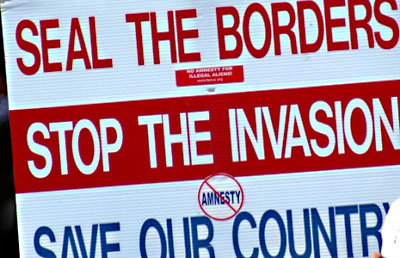 Rubio made the rounds of an anti-immigration convention to chat up conservative radio talkers:
For an hour, the freshman Republican went from table to table, speaking passionately about the bill’s merits. As I shadowed Rubio, it was striking to see how much he is personally admired by the colorful conservative pundits who broadcast on local AM stations, and by the bigger syndicated names like Limbaugh. They still believe, without a doubt, that he’s a top contender for the Republican presidential nomination in 2016, and they love that he’s already a national force.
But when it comes to immigration, they aren’t buying it.
The whole scene plays out uncomfortably. Rubio is the young salesman everyone invites inside for a cup of coffee, but sends off with only a smile and a handshake.
This is going to be a very tough sell. A big part of the problem is going to be headlines like this from Politico yesterday: “Immigration reform could be bonanza for Democrats.” Their analysis is crude, and conflicts with more sophisticated studies like this one, but let’s face it: working politicians are more likely to be swayed by a simple, crude look at the numbers than by some academic with a regression model. What’s more, denying Obama a political victory is every bit as seductive to the right as it’s ever been. If immigration reform passes, it’s going to pass by the skin of its teeth. Background checks were just a drop in the ocean compared to this.
It’s hard to resist a little hypocrisy-mongering occasionally, especially when it’s a high-profile subject. Republicans, as you may or may not know, have been fuming for years that Democrats refused to pass a budget via “regular order,” instead making deals in back rooms that allowed them to avoid public scrutiny of their priorities. This year Republicans finally insisted on regular order, and Democrats have taken them up on it. But as Ezra Klein explains, a funny thing happened next:
House Republicans, it seemed, weren’t that eager to move to regular order after all. There’s been no evident interest in the next move, which is appointing conferees to begin reconciling the two budgets….In fact, Republicans see a disadvantage in a formal public process. “If you appoint conferees and after 20 legislative days there’s no agreement, the minority has the right to offer motions to instruct, which become politically motivated bombs that show up on the House floor,” Boehner told reporters.
Senate Democrats don’t find this a very convincing excuse: They note that they had to vote on dozens of Republican amendments — many of which were designed to embarrass them.
House Republicans instead want a private agreement — a “framework” — that would direct the conference committee as they attempt to reconcile the budgets….And Senate Democrats aren’t having it. After years of Republicans complaining about secret deals and hammering Senate Democrats for betraying regular order, they’re calling the GOP’s bluff. That’s why Reid intends to move towards conference this morning. Either Republicans will agree, and regular order will proceed — which will likely mean no deal, and which will then give House Democrats a chance to throw their bombs — or Senate Republicans will filibuster, and that will be the end of the regular order talking point.
Isn’t Washington grand? I can’t say that I personally care much about regular order for the budget, but tea party types and radio blowhards have been griping about this forever. So now they’ve got it. And guess what? It turns out they don’t like it so much after all.
I’ve written once or twice before about Amazon’s scorched-earth policy against being forced to collect state sales taxes, and also about its eventual cave-in to California legislators who demanded that they collect sales taxes whether they wanted to or not. At the time, Amazon’s excuse for fighting over this was its supposed belief in fair play: they took the position that Congress should pass a federal law that sets a single nationwide standard, either exempting everyone from internet sales taxes or requiring everyone to pay. I was unimpressed:
It would actually be nice to have a federal law on this issue. But I sure don’t see how we can get one. States would go ballistic if a federal law upheld the general exemption of internet retailers from collecting sales taxes, and there doesn’t seem to be any path through the Senate for such a bill. On the other hand, the anti-tax jihadists would burst a vein if Congress passed a law that effectively increased taxes by putting e-tailers on a
level playing field with brick-and-mortar stores, and the House is controlled by the anti-tax brigade. So there’s deadlock.
But maybe it’s not so impossible after all. In the 1992 Supreme Court decision that prohibited states from forcing companies to collect state sales taxes unless they had a physical presence there, the Court specifically said that its prohibition was based solely on Commerce Clause issues. Thus, “Congress is now free to decide whether, when, and to what extent the States may burden interstate mail-order concerns with a duty to collect use taxes.” For the next two decades, Congress declined to take up this offer, but during that time internet sales grew exponentially and states grew ever more jittery about the amount of tax revenue they were losing. What’s more, Amazon grew big enough that they were having a harder time avoiding state sales taxes, as their 2011 California cave-in demonstrated. Suddenly, instead of opposing a federal law, Amazon supported one. If they had to collect sales taxes, they were better off if everyone else had to collect them as well.
A bill to authorize this has been quietly wending its way through the Senate for the past year or so, and Brad Plumer informs me today that it might be up for a vote as soon as this afternoon. Needless to say, Grover Norquist is opposed, and this has made it hard to get Republican votes. On the other hand, the bill is cosponsored by Sen. Mike Enzi, the fourth most conservative senator in the country and a guy with a 90 percent rating from Norquist’s own lobbying group, Americans for Tax Reform. That’s brought quite a few Republicans into the fold.
Long story short, it turns out that the Senate is indeed poised to pass something useful. How about that? Not quite this afternoon, though: cloture was invoked this afternoon and passed, which means passage of the bill is assured too, but not until it comes up for debate later in the week. Next stop: the House of Representatives, where we’ll find out if Norquist’s grip is tighter than it is in the Senate.
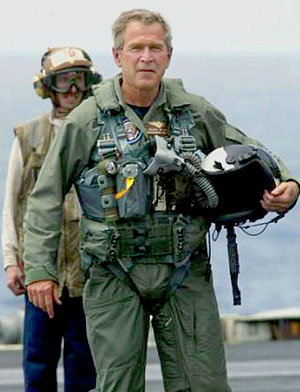 From Dan Drezner, listing reasons why George Bush’s legacy may improve over time:
First, he’s been a great ex-president. For such a polarizing political figure, it’s remarkable how successfully Bush has receded into private life.
Can’t argue with that! There’s not much question that doing nothing puts Bush in his best light.
(Reason #2: The Republican Party has gone so crazy that Bush looks almost good by comparison. I’d buy that one too if Bush himself weren’t substantially responsible for this shift.)
(Reason #3: Bush responded halfway decently to the 2008 financial collapse. I guess so, though as near as I can tell, Bush himself played almost no role in this. He was clueless about what to do and just let his economic team run the show.)
Drezner admits that this is all pretty thin beer. His final conclusion:
At best, George W. Bush was a well-meaning man who gave the occasional nice speech and was thoroughly overmatched by events. At worst, he was the most disastrous foreign policy president of the post-1945 era.
Am I missing anything?
Nope. He’s still the Frat Boy President and always will be.
Once upon a time you could smoke everywhere. Hell, high schools had smoking lounges. Everybody smoked. I actually remain a bit puzzled about why people start smoking these days. I’m not being judgmental, I’m just genuinely curious. When being a smoker involves always having to find a moment to duck out of wherever you are to light up outside, it just doesn’t seem that fun anymore.
If I were less lazy I’d peruse the internet for supporting evidence, but I’m pretty sure the answer is: people start smoking as teenagers, and teenagers have always had to duck out of wherever they are to light up. So nothing much has changed on that front. And by the time they’re old enough that smoking has become a pain in the ass, it’s too late. They’re already addicted.
Thus the vast amount of cigarette marketing aimed at young people, combined with similarly vast denials from the cigarette industry that they’re doing any such thing.
UPDATE: I started to feel guilty about being so lazy and decided I should go ahead and dig up some Actual Facts™. That turned out to be surprisingly hard (i.e., it took more than the 60 seconds I figured it would). However, a pamphlet from the CDC here says, “Nearly 9 out of 10 smokers start smoking by age 18, and 99% start by age 26.” I’m not sure what their source is, but I guess the CDC wouldn’t lie to us, would it?
 Andrew Sullivan argues that the Boston bombings orchestrated by Tamerlan Tsarnaev were clearly an act of Islamic jihad:
One reason the Miranda rights issue is not that salient is that the evidence that this dude bombed innocents, played a role in shooting a cop, shutting down a city, and terrorizing people for a week is overwhelming and on tape. And yes, of course, this decision to commit horrific crimes may be due in part to “some combination of mental illness, societal alienation, or other form of internal instability and rage that is apolitical in nature.” But to dismiss the overwhelming evidence that this was also religiously motivated — a trail that now includes a rant against his own imam for honoring Martin Luther King Jr. because he was not a Muslim — is to be blind to an almost text-book case of Jihadist radicalization, most likely in the US.
….We see the sexual puritanism of the neurotically fundamentalist. We have his YouTube page and the comments he made in the photography portfolio. To state today that we really still have no idea what motivated him and that rushing toward the word Jihadist is some form of Islamophobia seems completely bizarre to me.
Please. Just stop this. What we know about Tamerlan Tsarnaev is that he was (a) Muslim and (b) enraged about something. Was he enraged, a la Sayyid Qutb, about the sexual libertinism of American culture? Was he enraged about perceived American support for Russia against Chechen rebels? Was he enraged about American wars in Iraq and Afghanistan? Was he acting on orders from a foreign terrorist group?
We don’t know yet. Yes, there’s plainly evidence of his growing Islamic extremism over the past three years. But if there’s anything we’ve learned over the last week, it’s that jumping to conclusions on this stuff is foolish. Our natural curiosity isn’t a good enough reason to rush to judgment about Tsarnaev’s motivations. Just wait. There’s no harm in it. We’ll find out soon enough.
Maureen Dowd was widely pilloried over the weekend for writing this:
How is it that the president won the argument on gun safety with the public and lost the vote in the Senate? It’s because he doesn’t know how to work the system….The White House should have created a war room full of charts with the names of pols they had to capture, like they had in “The American President.” Soaring speeches have their place, but this was about blocking and tackling.
Instead of the pit-bull legislative aides in Aaron Sorkin’s movie, Obama has Miguel Rodriguez, an arm-twister so genteel that The Washington Post’s Philip Rucker wrote recently that no one in Congress even knows who he is.
The president was oblivious to red-state Democrats facing tough elections. Bring the Alaskan Democrat Mark Begich to the White House residence, hand him a drink, and say, “How can we make this a bill you can vote for and defend?”
My objectivity about Dowd’s advice is questionable, since I’ve been gobsmacked for years that the New York Times continues to publish her tedious rambles. I’m only surprised that her internal censor wasn’t quite sharp enough to understand that this particular critique—Obama should 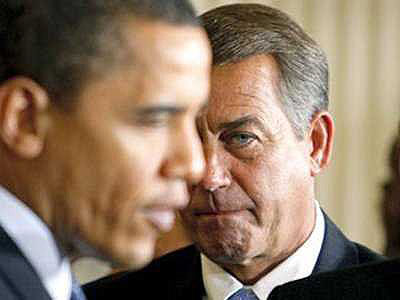 do things like they do in the movies!—was laughable even by her standards.
Still and all, maybe this is a good oppportunity to talk—yet again—about presidential power in domestic affairs. Presidents obviously aren’t powerless: they have agenda setting power, they have agency rulemaking power, and they’re always at the table since nothing becomes law without their signature. This provides them with a certain amount of leverage. But not much. The truth is that presidents have never had all that much personal power in domestic affairs. Modern presidents have largely succeeded when they had big majorities in Congress (FDR, LBJ, Reagan, Obama’s first two years) and failed when they didn’t. That’s by far the biggest factor in presidential success, not some mystical ability to sweet talk legislators.
But there’s more to this. Dowd’s real problem is that she hasn’t kept up with either academic research or simple common sense over the past half century. She’s still stuck in the gauzy past when presidents really did have at least a bit of arm-twisting power. LBJ’s real source of success may have been an overwhelming Democratic majority in Congress, but it’s also true that he really did have at least a few resources at hand to persuade and threaten recalcitrant lawmakers. The problem is that even those few resources are now largely gone. The world is simply a different place.
Party discipline, for example, is wildly different than it used to be. The party apparatus itself, which the president heads, has far less power than it used to have to compel support for a president’s agenda. At the same time, parties are far more ideologically unified than in the past, which means that picking off a few members of the opposition party is much more difficult than it used to be.
And that’s not all. Earmarks and pork barrel budgeting in general are largely gone. You can partly blame Obama for this state of affairs, since he was in favor of getting rid of earmarks, but this is something that affects all lawmaking, not just guns. The budget barons of the Senate simply don’t have the power any longer to make life miserable for backbenchers who don’t toe the president’s line.
In fact, party leaders don’t have very much power at all over backbenchers anymore. The days are long gone when newly elected members spent years quietly working their way up the seniority ladder and providing reliable votes for the party along the way. These days, they vote the way they need to vote, and there’s very little anyone can do about it. Even threats to withhold fundraising are mostly empty. Party leaders need them more than they need party leaders, and everyone knows it.
Finally, there’s the most obvious change of all: the decision by Republicans to stonewall every single Obama initiative from day one. By now, I assume that even conservative apologists have given up pretending that this isn’t true. The evidence is overwhelming, and it’s applied to practically every single thing Obama has done in the domestic sphere. The only question, ever, is whether Obama will get two or three Republican votes vs. three or four. If the latter, he has a chance to win. But those two or three extra votes don’t depend on leverage. In fact, Obama’s leverage is negative. The last thing any Republican can afford these days is to be viewed as caving in to Obama. That’s a kiss of death with the party’s base.
Obama may very well be a lousy negotiator. But honestly, that’s just not a big factor here. He simply doesn’t have much leverage of any concrete kind, and when it comes to soft leverage, his power is quite probably negative. That’s life in modern Washington. Dowd needs to grow up and figure that out.
But I will congratulate her on one thing. As near as I can tell, she actually cares about gun control. Yesterday was the first time in years that I’ve read a column of hers where she actually seemed to care about anything substantive. Mostly she seems to be on autopilot, creating some juvenile wordplay first and then adopting whatever position makes the column easiest to write. So as bad as Sunday’s column was, I’d have to grade it an improvement over her usual gig.

Award-winning photojournalism.
Stunning video. Fearless conversations.


